

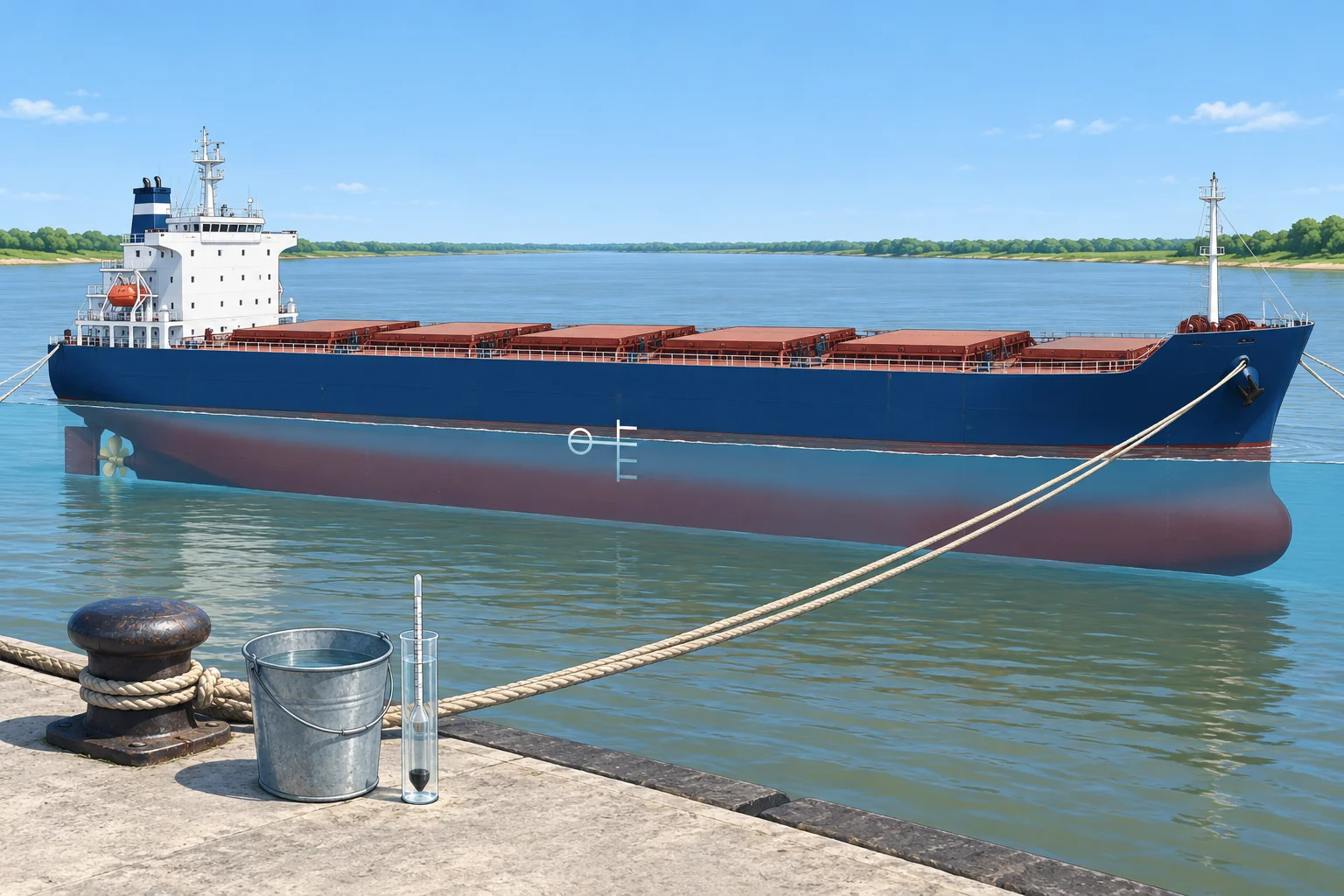
Fresh water allowance and dock water allowance
1The lesson in plain words
A ship floats deeper in fresher water. FWA and DWA tell you by how much, so you can load in a river port and still float at your mark at sea.
Why she sinks
Displacement is the same in any water, but fresher water is lighter, so she must displace more volume. Going from sea water (1.025 t/m³) into fresh water (1.000 t/m³) at her summer draught, she sinks by the fresh water allowance (FWA). Going back out, she rises by the same amount.
The formula
At summer displacement Δ, fresh water needs extra volume Δ × (1/1.000 − 1/1.025) = Δ × 0.025/1.025 m³. Since Aw = 100 × TPC/1.025 m², extra volume ÷ Aw = Δ/(4000 × TPC) m. Multiply by 1000: FWA (mm) = Δ/(4 × TPC). Use Δ in tonnes and sea-water TPC in t/cm at summer draught. The Convention gives Δ/(40 × TPC) cm.
Dock water
Docks and rivers are often brackish, between 1.000 and 1.025. The dock water allowance (DWA) is the share of FWA for that density: DWA = FWA × (1.025 − ρ) ÷ 0.025. Measure ρ with a hydrometer, a floating density gauge, in water sampled alongside.
Using it
In dock water you may load until the load line mark for the zone is submerged by the DWA. At unchanged displacement in sea water of 1.025 t/m³, she rises by that amount and floats at the mark. The Load Lines unit covers the marks, the allowance for fuel used on the way down a river, and the checks before sailing.
Limits
The formula assumes nearly vertical sides at the waterline and a small change, which holds near the summer draught. Your ship's FWA is stated on her International Load Line Certificate; use that value.
2Step by step
Worked example: FWA and DWA
- 1
Data: summer displacement 16,500 t, TPC 25.3 t/cm in sea water. Summer mark applies.
Summer values, as the formula requires.
- 2
FWA = 16,500 ÷ (4 × 25.3) = 163 mm.
Sinkage from sea water into fresh water.
- 3
Dock water 1.012 t/m³: DWA = 163 × (1.025 − 1.012) ÷ 0.025 = 85 mm.
0.013 ÷ 0.025 = 0.52 of the FWA.
- 4
She may load until the summer mark is 85 mm under water in the dock.
At unchanged weight in sea water of 1.025 t/m³, she rises about 85 mm to the mark.
- 5
In fresh water of 1.000 the full FWA, 163 mm, applies.
DWA equals FWA when ρ = 1.000.
3Key data
- FWA
- Δ ÷ (4 × TPC) mm, summer values in sea water
- DWA
- FWA × (1.025 − ρ) ÷ 0.025
- Sea / fresh water
- 1.025 / 1.000 t/m³
- Ship's own FWA
- Stated on the International Load Line Certificate
4Key points
- 1
Same Δ, lighter water, more volume: she floats deeper.
- 2
FWA (mm) = Δ ÷ (4 × TPC), with summer values in sea water.
- 3
DWA = FWA × (1.025 − ρ) ÷ 0.025 for brackish water.
- 4
Load to the mark plus the DWA; she rises to the mark at sea.
5Frequent mistakes
Wrong: In fresh water the ship floats higher because she weighs less.
Right: Her weight is unchanged. Fresh water is lighter, so she floats deeper.
Wrong: Use the full FWA in any dock water.
Right: Use the DWA for the measured density. The full FWA applies only in fresh water of 1.000.
6Practice case & exam keys
Your ship has an FWA of 163 mm. In a river berth the hydrometer reads 1.018 t/m³ and the summer mark applies. The mate proposes submerging the summer mark by the full 163 mm. Do you agree?
Show the answer
No. Full FWA applies at density 1.000. Here DWA = 163 × (1.025 − 1.018) ÷ 0.025 = 45.64 mm, about 46 mm. Use the measured density again near completion.
Exam keys
- FWA (mm) = Δ ÷ (4 × TPC); the Convention gives Δ ÷ (40 × TPC) in cm.
- DWA = FWA × (1.025 − ρ dock) ÷ 0.025.
- In dock water, load to the mark plus the DWA.
Finish this unit
When you've read it, answer three questions. Get all three right to finish the unit; opening the page alone doesn't count.
My notes for this unit
No notes