

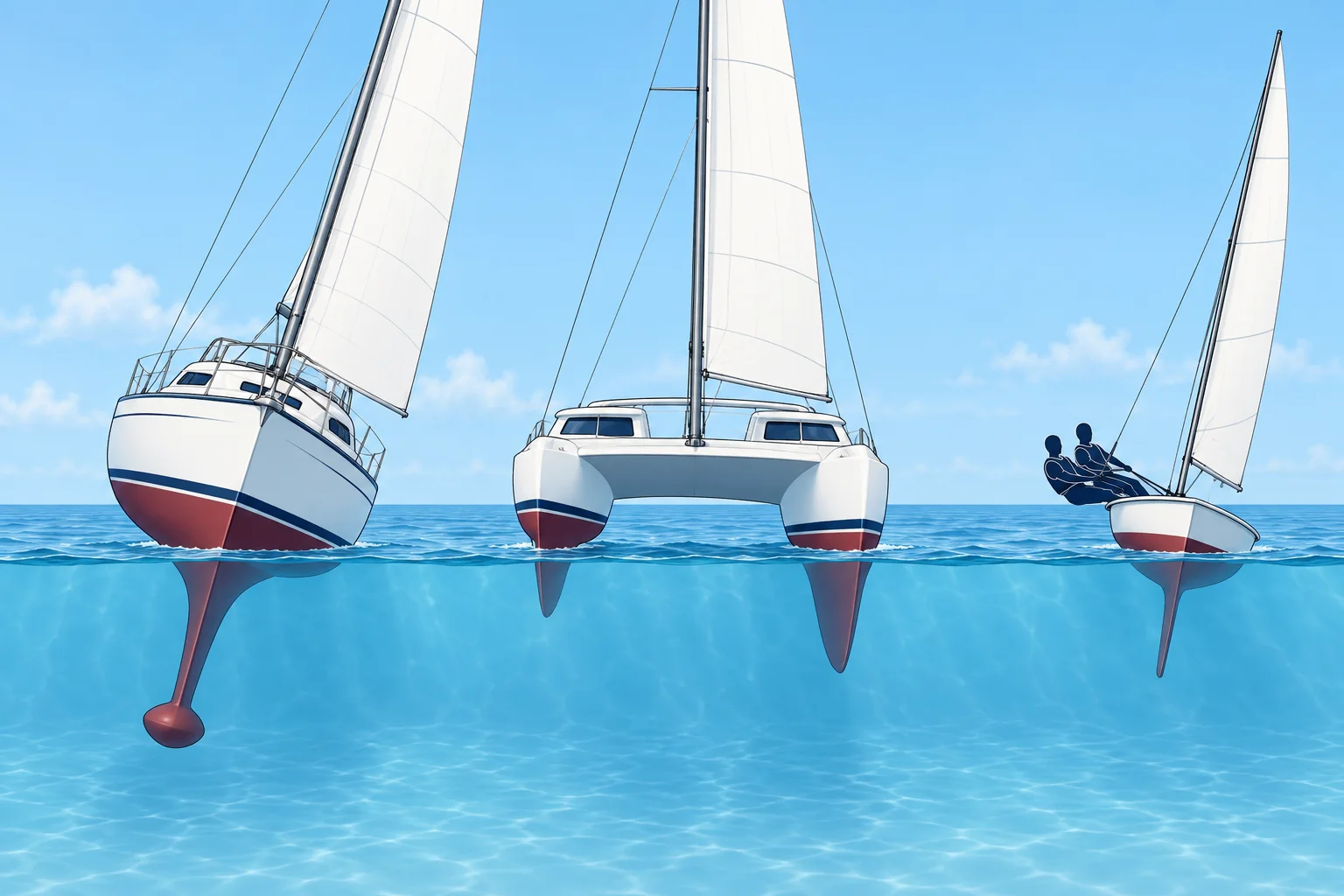
Monohulls, multihulls, dinghies and planing boats
1The lesson in plain words
Ballasted keelboats, catamarans and light dinghies stay upright in very different ways. Know which kind you are on.
Ballasted monohull
A keelboat is a monohull: a boat with one hull. It carries ballast, weight placed low for stability, in its keel. Low ballast helps preserve a righting lever at large heel, within the boat’s range of positive stability. Most recover from a knockdown, when the mast is in the water. A big breaking wave can still roll her over.
Multihull
Catamarans have two hulls; trimarans have three. Their wide hull spacing provides stability. Cruising multihulls may give little warning through heel. They can remain stable upside down after capsize and normally cannot self-right. Reef early: reduce the sail area using the builder’s wind-speed guidance.
Dinghies and planing boats
A sailing dinghy has little ballast. Hull shape and crew weight help keep it upright. Sitting out means leaning your weight over the side. Most sailing dinghies are designed to be righted after capsize. Planing boats have hulls that lift partly out of the water at speed. Small planing motorboats rely mainly on hull shape and width. Rigid inflatable boats (RIBs) also have buoyant tubes. Crew and load position matter in both.
Heel tells you different things
On a keelboat 20° of heel is normal sailing. On a cruising catamaran, a hull lifting clear of the water is a serious warning. In a dinghy, heel is controlled by the crew’s weight moment to moment. Learn what is normal for your boat.
2Key data
- Keelboat
- Ballast low in the keel: usually self-rights from a knockdown
- Catamaran
- Hull spacing gives stability; can remain stable inverted
- Sailing dinghy
- Crew weight and hull shape; most are designed to be righted
3Key points
- 1
Keelboats rely on low ballast; most recover from a knockdown.
- 2
Cruising multihulls rely on hull spacing and can remain stable inverted.
- 3
Sailing dinghies rely on shape and crew weight; most are designed to be righted after capsize.
- 4
Reef a multihull early; she gives little warning by heeling.
4Frequent mistakes
Wrong: A catamaran does not heel, so she cannot capsize.
Right: Little heel does not guarantee a safe margin. Cruising multihulls can remain stable inverted. Follow the builder’s wind-speed guidance.
Wrong: A keelboat cannot roll over.
Right: Most recover from a knockdown, but a large breaking wave can roll any boat. Keep G low and avoid breaking seas.
5Practice case & exam keys
You usually sail a 10 m keelboat. A friend asks you to sail her 12 m catamaran in a freshening Force 5. She is barely heeling. Do you carry full sail as long as she stays flat?
Show the answer
No. Heel gives little warning on a cruising catamaran. Cruising multihulls can remain stable inverted after capsize. Follow the builder’s reefing guide, using true or apparent wind as specified.
Exam keys
- Keelboat: weight stability from low ballast; usually self-rights from a knockdown.
- Cruising multihull: form stability from hull spacing; can remain stable inverted.
- Sailing dinghy: shape and crew weight; most are designed to be righted after capsize.
- Cruising multihull: reef using the builder’s wind-speed limits and specified wind reference.
Finish this unit
When you've read it, answer three questions. Get all three right to finish the unit; opening the page alone doesn't count.
My notes for this unit
No notes