

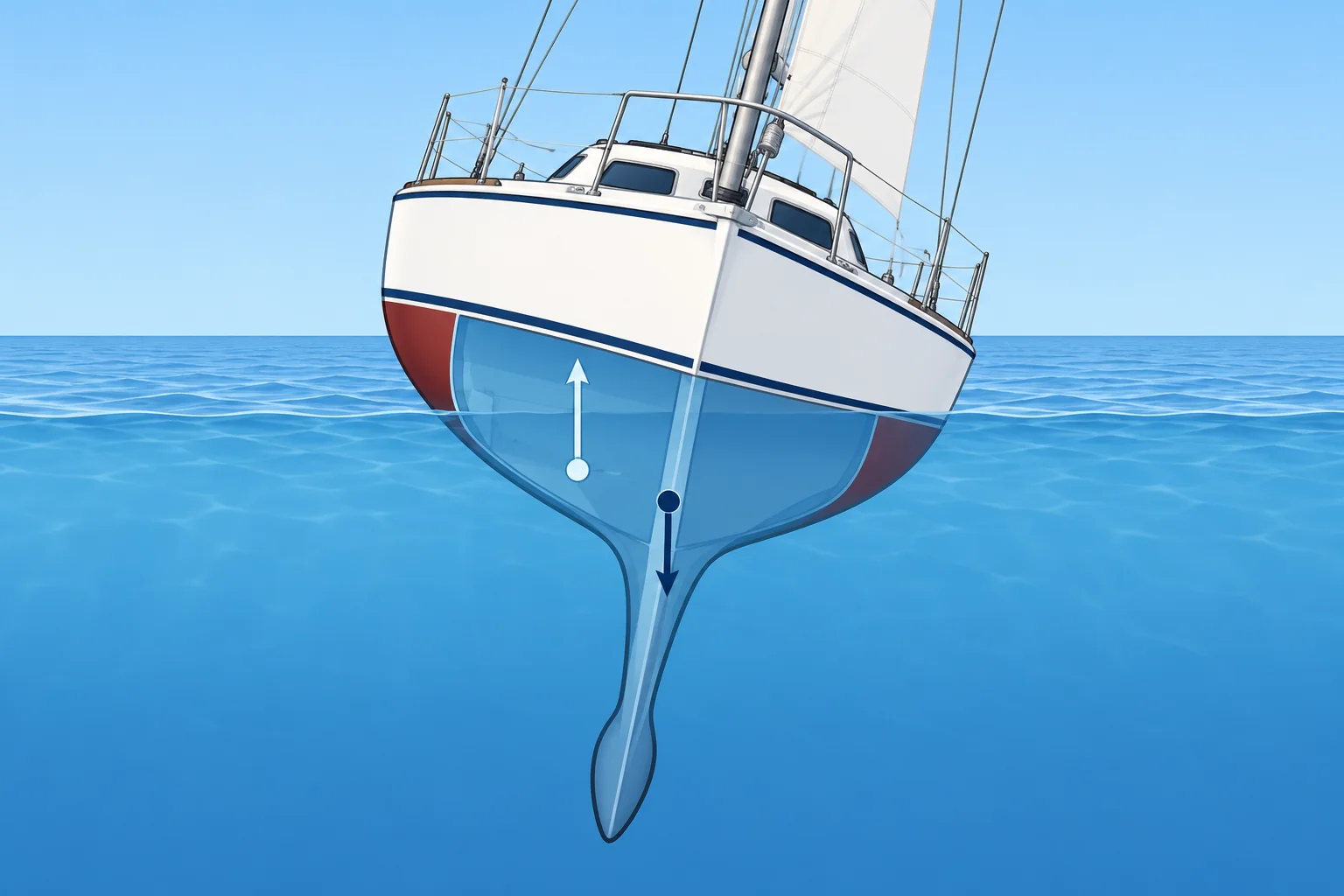
Heeling and the righting lever GZ
1The lesson in plain words
When a stable boat heels slightly, B moves to the low side. Weight and buoyancy create GZ, a lever that pushes her upright.
B moves when she heels
Wind or a wave tips the boat. This is heel. More of the hull goes under on the low side and some comes out on the high side. The underwater shape changes, so B moves towards the low side. If nothing shifts aboard, G stays fixed within the boat.
The righting lever
Now weight pulls down through G and buoyancy pushes up through B, but they are no longer in line. The horizontal distance between the two lines is the righting lever, called GZ. Z is the point on the buoyancy line level with G. The bigger GZ is, the harder the boat pushes back upright.
Righting moment
The turning effect is the righting moment: displacement × GZ. A heavy boat with a small lever can still have a large moment. A light dinghy has a small moment, which is why one person moving changes things so much.
Two sources of stability
A wide hull moves B towards the low side as the boat heels. This is form stability. Beam means hull width. Low ballast lowers G and increases GZ at the same heel angle. This is weight stability. Most boats use both.
When the lever runs out
At large heel, the positions of G and B can bring their vertical force lines closer together. GZ shrinks and may reach zero. Beyond this large-angle zero, the moment tends to overturn the boat. Lowering G generally extends the range of positive stability.
2Key data
- Righting lever
- GZ: horizontal distance between weight and buoyancy lines
- Righting moment
- Displacement × GZ
- Form stability
- Beam moves B out to the low side
- Weight stability
- Low G increases GZ at the same heel
3Key points
- 1
Heeling moves B to the low side; if nothing shifts aboard, G stays fixed within the boat.
- 2
A positive GZ gives a righting moment; a negative GZ gives an overturning moment.
- 3
Righting moment = displacement × GZ.
- 4
Beam gives form stability; low ballast gives weight stability.
- 5
For the same load and heel between 0° and 180°, raising G reduces GZ.
4Frequent mistakes
Wrong: When the boat heels, G moves to the low side.
Right: If nothing shifts aboard, G stays fixed within the boat. Heel moves B because the underwater shape changes.
Wrong: A wide boat can never capsize.
Right: Beam gives strong early stability, but at large angles the lever can shrink fast. Wide, light boats can capsize and may stay upside down.
5Practice case & exam keys
After a gust, your keelboat returns upright. A crewmate says this proves that heavy stores can safely go on the coachroof. Do you agree?
Show the answer
No. Recovery shows that the righting moment overcame the remaining heeling moment in that gust. It does not prove that every loading arrangement is safe. Moving stores higher raises G and reduces GZ at the same heel. Keep heavy stores low.
Exam keys
- Heel moves B to the low side; if nothing shifts aboard, G stays fixed within the boat.
- GZ = righting lever. Righting moment = displacement × GZ.
- Form stability from beam; weight stability from a low G (ballast).
- For the same load at 20° heel, a higher G gives a smaller GZ.
Finish this unit
When you've read it, answer three questions. Get all three right to finish the unit; opening the page alone doesn't count.
My notes for this unit
No notes