

Weight and buoyancy: why a boat floats
1The lesson in plain words
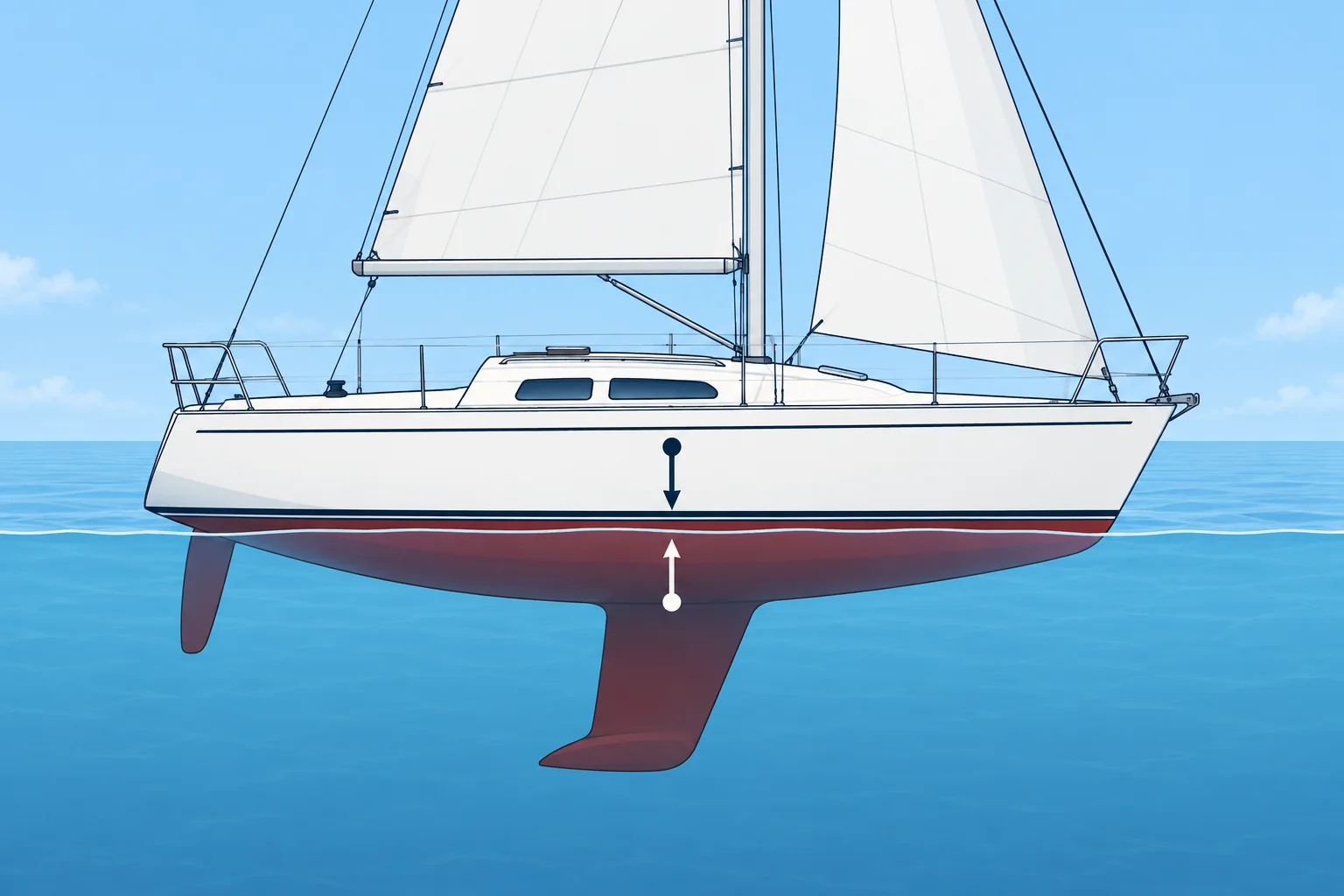
A boat floats because the water it pushes aside weighs as much as the boat. Two points, G and B, tell the whole story.
Weight down
Everything aboard has weight: hull, engine, keel, water, fuel, crew. All that weight acts as if it pulled down through one point, the centre of gravity, called G. When you move, add or remove weight, G moves too. Weight low down keeps G low.
Buoyancy up
The water pushes up on the underwater hull. This push is buoyancy. Archimedes’ principle says the push equals the weight of the water the hull pushes aside. The boat sinks until that water weighs exactly as much as the boat. The boat’s weight is called its displacement.
The centre of buoyancy
Buoyancy acts as if it pushed up through one point, the centre of buoyancy, called B. B is the centre of the underwater shape of the hull. When the shape of the underwater hull changes, B moves.
Upright and at rest
A boat at rest floats with G and B on the same vertical line. Weight pulls down, buoyancy pushes up, and they cancel. If you add weight, the boat sinks a little until buoyancy matches again. That is why a loaded boat sits lower and has less freeboard, the height of the deck edge above the water.
Salt and fresh water
Salt water is denser than fresh water. A boat needs to push aside less salt water to float. So she floats a little deeper when she motors from the sea into a river or lake, roughly 2–3 % more volume under water.
2Key data
- Archimedes
- Buoyancy = weight of water displaced
- Floating
- Displacement (boat’s weight) = buoyancy
- Sea water
- About 1.025 t per m³
- Fresh water
- About 1.000 t per m³: the boat floats slightly deeper
3Key points
- 1
G is where all the weight acts; it moves when weight moves.
- 2
B is the centre of the underwater shape; buoyancy acts up through it.
- 3
Afloat at rest, the boat’s weight equals the weight of water displaced.
- 4
Upright and still, G and B lie on the same vertical line.
- 5
Extra load means a deeper boat and less freeboard.
4Frequent mistakes
Wrong: A heavy boat floats because it is made of light materials.
Right: Steel ships float too. Any boat floats while her hull pushes aside water weighing as much as she does.
Wrong: G and B are fixed points marked by the builder.
Right: G moves whenever weight moves aboard; B moves whenever the underwater shape changes, for example when the boat tilts (heels).
5Practice case & exam keys
After loading friends and stores, your yacht’s waterline stripe is submerged and freeboard is much lower. A friend suggests moving everything onto the coachroof. Is that a good fix?
Show the answer
No. The extra weight requires more displaced water, so the boat floats deeper. Moving stores onto the coachroof, the cabin roof, does not remove weight; it raises G. B is the centre of the new underwater shape. Keep heavy stores low and central, check the load limit, and remove excess load.
Exam keys
- Archimedes: buoyancy equals the weight of water displaced.
- G = centre of gravity (weight acts down). B = centre of buoyancy (buoyancy acts up).
- At rest upright: weight = buoyancy, and G and B are on the same vertical.
- Fresh water is less dense than sea water: the boat floats deeper.
Finish this unit
When you've read it, answer three questions. Get all three right to finish the unit; opening the page alone doesn't count.
My notes for this unit
No notes