

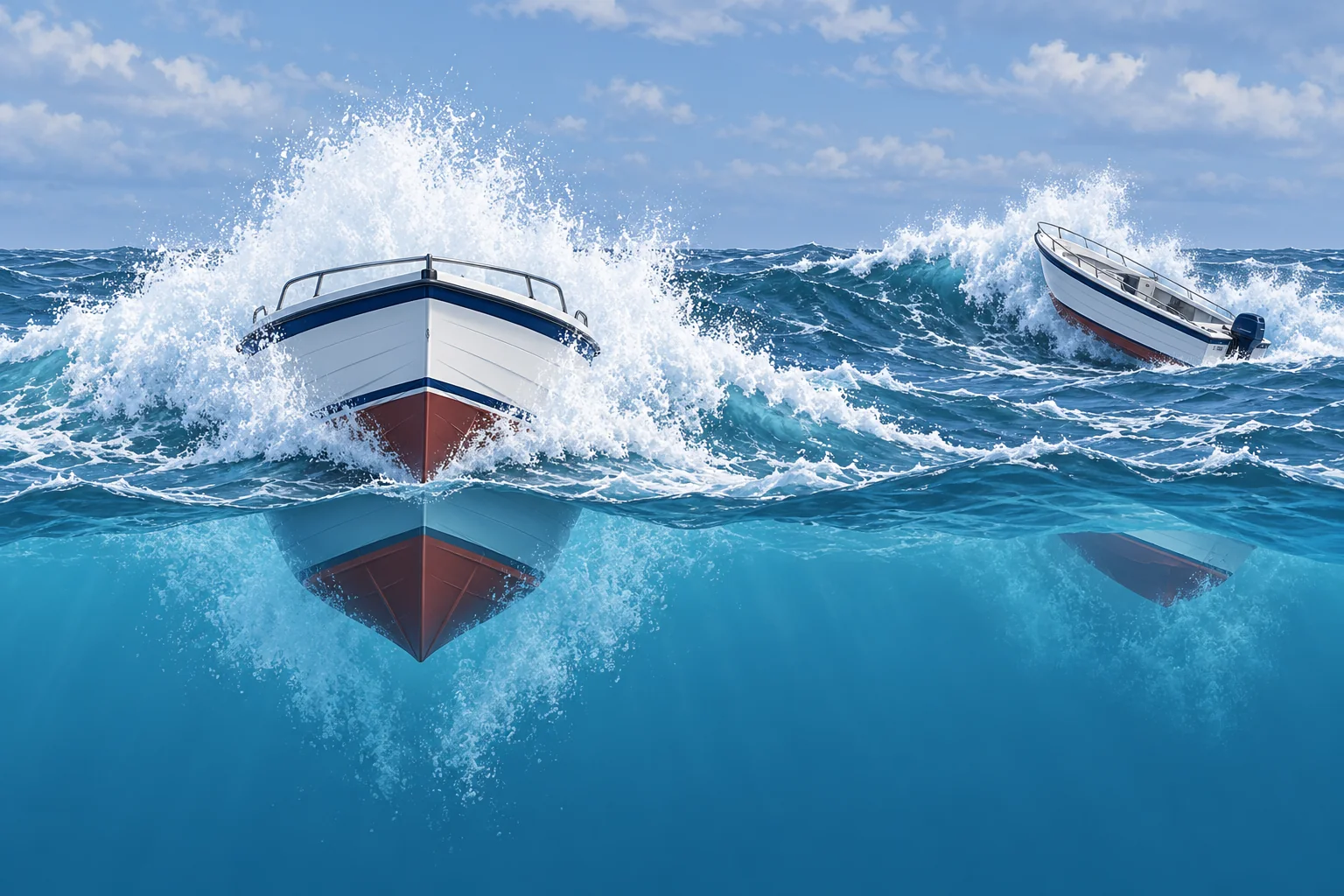
Capsize, swamping and design categories
1The lesson in plain words
The CE design category on the builder’s plate tells you what wind and waves the boat was built for. Take it seriously.
Design categories
The Recreational Craft Directive (2013/53/EU) sets categories A–D. ISO 12217 assesses stability and buoyancy. Significant wave height is the average height of the highest third of waves. Individual waves can be much higher. A: above Force 8 and 4 m, excluding abnormal conditions such as severe storms and rogue waves. B: up to Force 8 and 4 m. C: up to Force 6 and 2 m. D: up to Force 4 and 0.3 m significant height, with occasional waves up to 0.5 m. Other heights here are significant.
What the category means
The category describes assessed design conditions, not a safe target or distance limit. Category C covers up to Force 6 and 2 m significant wave height; individual waves can be much higher. Decide by crew, loading, forecast and sea state.
Small open boats
ISO 12217-3 assesses stability and buoyancy for boats under 6 m. The applicable tests depend on the design and include people moving to one side and, where required, flotation when swamped. Check the builder’s load and flotation information.
How small boats get into trouble
Overloading, sudden crew movement, waves over a low stern and sharp turns in waves can capsize or swamp an open boat. Extra load reduces freeboard, so waves enter more easily. Keep weight low and centred, avoid overload and sudden movements, and wear lifejackets. Avoid breaking waves: they can roll the boat or flood it over a low bow or stern.
2Key data
- Category A
- Above Force 8 and 4 m significant height; excludes abnormal conditions
- Category B
- Wind up to Force 8; significant wave height up to 4 m
- Category C
- Wind up to Force 6; significant wave height up to 2 m
- Category D
- Up to Force 4; significant height 0.3 m, occasional waves 0.5 m
- Standard
- ISO 12217-1 motor, -2 sail (6 m+), -3 boats under 6 m
3Key points
- 1
The design category (A–D) is on the builder’s plate.
- 2
C: up to Force 6 / 2 m significant wave height; D: Force 4 / 0.3 m significant height, occasional waves 0.5 m.
- 3
The category is a design limit for the loaded boat, not a target.
- 4
Overload, sudden crew movement and breaking waves can capsize a small boat.
4Frequent mistakes
Wrong: Category C means the boat may only sail within a certain distance of the coast.
Right: The category is about wind and wave conditions, not distance. Local law may set separate distance limits.
Wrong: If the forecast is within the category, it is safe to go.
Right: The category is a design limit for a fully loaded boat. Crew skill, sea state and how conditions may change still decide.
5Practice case & exam keys
Your 5.5 m open motorboat’s plate says category C, 6 persons. The forecast is Force 5 gusting 6, with 1.5 m significant wave height outside the harbour. Six of you plan a picnic run along the coast.
Show the answer
Six people reach the persons limit; check their combined weight and all counted gear against the separate load limit. Force 5–6 and 1.5 m significant wave height may be unsuitable for an open 5.5 m boat even within category C. Individual waves can be higher. Choose another day or a genuinely sheltered route; fewer people do not make breaking seas safe.
Exam keys
- Significant wave heights: A above F8/4 m, excluding abnormal conditions; B up to F8/4 m; C F6/2 m; D F4/0.3 m, occasional waves 0.5 m.
- Category = design condition for the loaded boat, not a distance limit.
- Boats under 6 m: ISO 12217-3; design-dependent stability and buoyancy checks.
Finish this unit
When you've read it, answer three questions. Get all three right to finish the unit; opening the page alone doesn't count.
My notes for this unit
No notes