
A DSC call is a short digital message
Digital selective calling is the doorbell; voice is the conversation.
A DSC call tells the receiving station who is calling, how urgent it is and where the follow-on communication will be. It is sent on a DSC frequency: channel 70 on VHF, 2187.5 kHz on MF, and 4207.5, 6312, 8414.5, 12577 or 16804.5 kHz on HF.
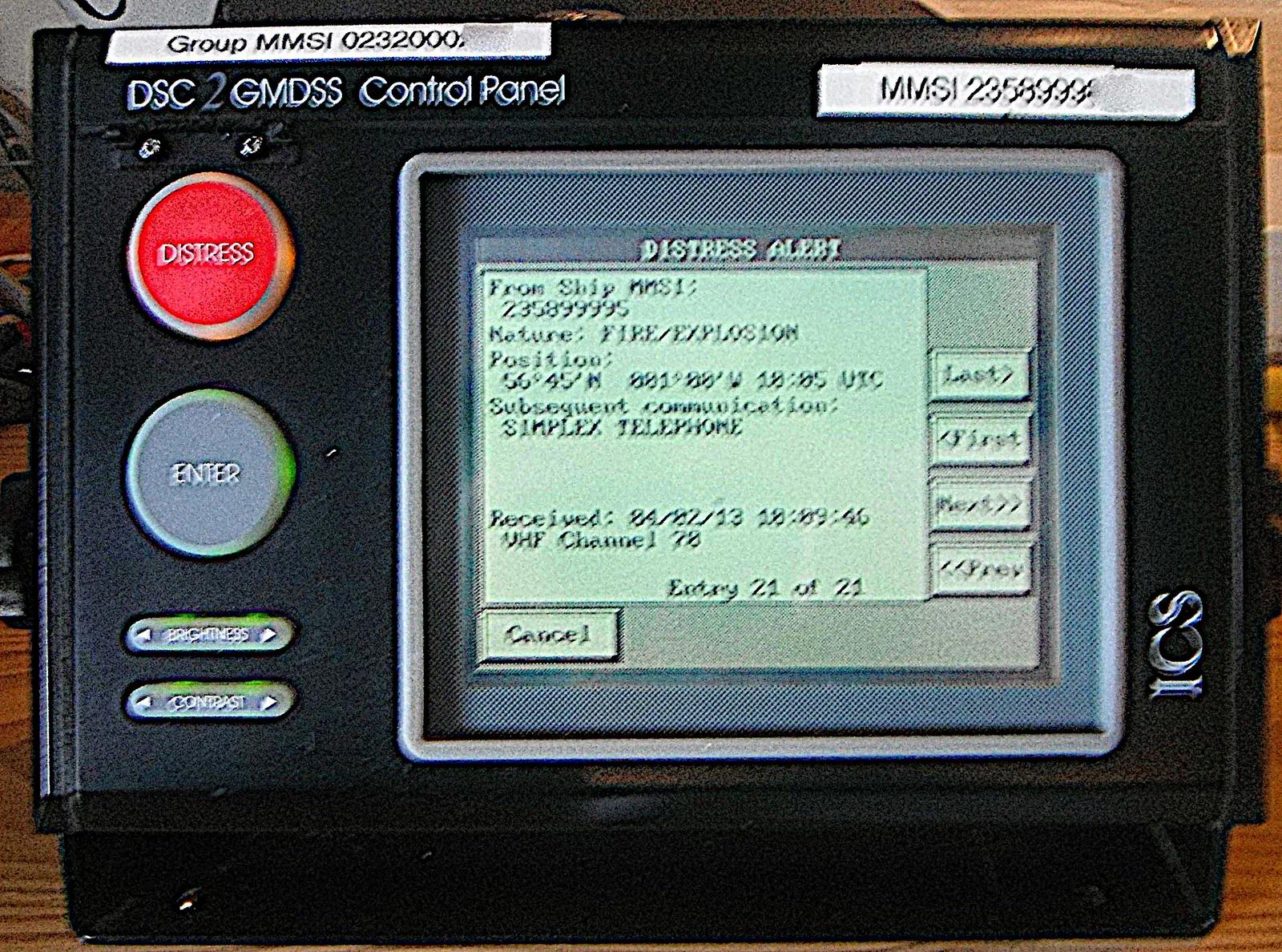
A distress alert carries your MMSI, the nature of distress, your position and the UTC time of that position, and the type of follow-on communication, normally radiotelephony (CEPT GOC B2 2.3). Choose the nature if you have time; if not, an undesignated alert is still an alert.
Other calls carry an address (one station's MMSI, a group, all ships or, on MF/HF, a geographical area), a category (urgency, safety or routine), the follow-on mode and, where needed, the working channel or frequency (B2 2.4).
- Send a distress alert only on the authority of the master or the person responsible for the ship (47 CFR 80.1111(c)).
- Hold the distress button for its full count: the cover and the delay are there to stop false alerts.
- A DSC distress alert repeats automatically until it is acknowledged. After an alert on VHF or MF, go to the matching voice frequency (channel 16 or 2182 kHz) and send your MAYDAY.
Check this lesson
Which categories can a DSC call have besides distress?