
Decide
Four situations at sea. Decide first, then read why.
A deckhand ties the EPIRB lanyard to the rail 'so it cannot be lost'. Is that right?
Key points
- The 406 MHz EPIRBAlerts an RCC by satellite; 121.5 MHz for homing; floats free.
- Register it; update after name, owner or flag change.
- Annual test; shore maintenance at most every 5 years.
- Check battery and hydrostatic release expiry dates.
- Radar SART and AIS-SARTThey show where survivors are; they do not alert the shore.
- Radar SART: 9 GHz, dots on the radar, 96 h + 8 h.
- AIS-SART: own position on 161.975/162.025 MHz, 96 h, starts within 1 min.
- Survival craft radio500 GT and passenger ships: three VHF, one SART each side. 300–500 GT: two VHF, one SART.
- Test survival VHF on a channel other than 16.
- Cancelling a false alertDSC: reset and cancel by voice. EPIRB: switch off and call the RCC.
- Give name, call sign and MMSI.
- Log it; keep watch for the call-back.
Check what you have read
In which band does a satellite EPIRB send its alert?
Worked case: A false alert, cancelled the right way
1015 UTC, alongside in port before departure. During cleaning, the EPIRB is knocked out of its bracket and its light starts flashing. Five minutes later, on the bridge, a cadet testing the VHF presses the DSC distress button for too long, and an alert goes out on channel 70.
Before you read the solution: what would you do?
True or false?
Decide each statement before you see the answer.
DSC: reset and cancel by voice. EPIRB: switch off and call the RCC.
Test the survival VHF on channel 16.
Twelve dots on the radar are twelve survivors.
500 GT and passenger ships: three VHF, one SART each side. 300–500 GT: two VHF, one SART.
Switching off a false EPIRB alert is enough.
They show where survivors are; they do not alert the shore.
The SART alerts the rescue centre.
Alerts an RCC by satellite; 121.5 MHz for homing; floats free.
Tie the EPIRB lanyard to the ship so it cannot be lost.
Exercise: Beacons in the survival craft
The master orders abandon ship. You are the GOC holder. You take the radio equipment for the survival craft.
Step by step
Put the radio actions in order.
- 1Send the DSC distress alert and MAYDAY from the bridge
- 2Switch on the SART or AIS-SART and raise it
- 3Release the EPIRB and take it to the survival craft
- 4Keep the two-way VHF on channel 16
At least how high above the sea should the radar SART antenna be?
On your radar, what does a SART look like at 6 miles?
Now on your own
Now check your knowledge of the AIS-SART and the EPIRB.
How many hours should an AIS-SART operate?
How often must the EPIRB go through shore-based maintenance at most?
The EPIRB was switched on by accident. Who must you tell?
Check: 10 questions
Questions from this subject, explained after each answer.
Free: lesson + 10 questions · Exam Pass: all 26 questions, unlimited practice tests, your mistakes retrained
The full explanation and the lessons for each programme item
Topic 1 of 4
The 406 MHz EPIRB: the alert that floats free
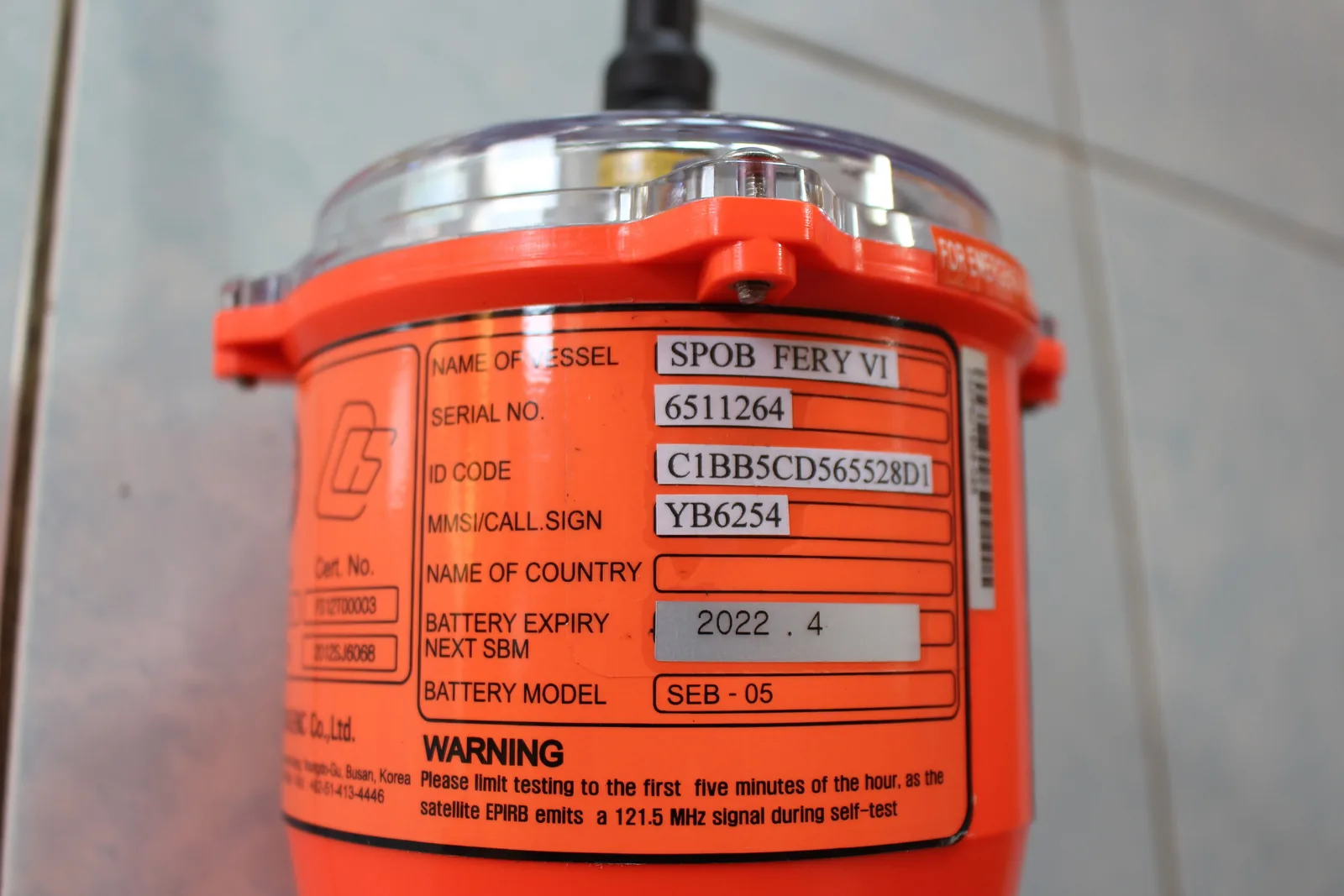
The EPIRB alerts an RCC through satellites, even if nobody on board can. It transmits in the 406.0–406.1 MHz band to a rescue coordination centre via satellite, and gives locating signals on scene (SOLAS IV/2.1.5). A 121.5 MHz signal lets aircraft and lifeboats home in on it (47 CFR 80.1077).
SOLAS asks for an EPIRB that is easy to reach, can be released by hand and carried by one person into a survival craft, floats free and switches itself on if the ship sinks, and can also be switched on by hand (IV/7.1.5).
The alert carries the beacon's coded identity, which leads the RCC to the ship's registration. That only works if the beacon is registered in a database open 24 hours a day and the data are updated after any change of name, owner or flag (MSC.514(105)).
- Do not tie the lanyard to the ship: it would stop the beacon floating free. The lanyard is for survivors to secure it to a raft or a person (MSC.514(105)).
- Do not switch it on if help is already immediately available; after use, retrieve and switch it off if you can (MSC.514(105)).
- Tests: an annual test of all aspects, including emission, coding and registration, and shore-based maintenance at intervals not exceeding five years (IV/15.9). The UK also asks for a monthly self-test without using the satellite system (MCA Master's Guide).
- Check the battery expiry date and the hydrostatic release expiry date (CEPT GOC C3 3.1).
Topic 2 of 4
Radar SART and AIS-SART: found, not just alerted
A SART does not alert the shore; it shows rescuers exactly where the survivors are. A radar SART works in the 9.2–9.5 GHz (X-band, 3 cm) radar band.
When a search radar's pulse hits it, it answers, and the searching radar shows a line of equally spaced dots on the SART's bearing; the dot nearest the centre marks the SART (Resolution A.802(19)). As the searcher closes to within about a mile the dots become arcs, then circles.
A radar SART should last 96 hours on standby plus 8 hours of transmission. Its antenna should be at least 1 metre above the sea. It should answer a ship's radar (antenna 15 m high) at 5 miles or more, and an aircraft radar at 3,000 feet at up to 30 miles (A.802(19)).
An AIS-SART transmits its own position on the AIS channels, 161.975 and 162.025 MHz (IV/2.1.1), at least once a minute, from an internal position source. It should start within 1 minute of activation, last 96 hours and be detectable at 5 miles over water (MSC.246(83)).
- Every ship carries a radar SART or AIS-SART (IV/7.1.3). Passenger ships and cargo ships of 500 GT and upwards carry one on each side and three two-way VHF sets; cargo ships of 300–500 GT carry one SART and two two-way VHF sets (IV/7.2–7.4).
- Raise the SART as high as you can: height gives range.
- Test a SART with its built-in test and check it for damage; the UK asks for this monthly, and a monthly test of each survival craft VHF on a channel other than 16 (MCA Master's Guide).
Topic 3 of 4
Cancelling a false alert
A false alert costs little if you cancel it fast; silence costs a search. A false alert is one sent without anybody being in distress.
Cancelling it properly is part of your job; failing to cancel it, or to answer the RCC, makes it worse (47 CFR 80.334).
VHF DSC: reset the equipment, go to channel 16 and tell all stations: your ship's name, call sign and MMSI, and that you cancel the false distress alert (80.335(a)). MF DSC: the same on 2182 kHz. HF DSC: the same on the voice frequency of every band that carried the alert.
EPIRB: switch it off and contact the nearest RCC by any means (telephone, radio or satellite) to cancel the alert (80.335(e)). Satellite: a distress-priority message through the same earth station (block 5).
- Then log the false alert, the time and how it was cancelled.
- Tests and drills must never cause false alerts; test under the supervision of the person responsible for distress communications (MSC.514(105)).
Topic 4 of 4
Practise and go further
The best places to practise this subject. When you finish, one tap brings you back to the course.
- Radio station: Abandon ship: alert, EPIRB, SART and hand-held VHFSimulator
- Module 9: SART and survival VHFLesson
- Module 8: the 406 MHz EPIRBLesson
All lessons by programme item
- B1.5 Survival craft radio equipment: two-way VHF, SARTs and EPIRBs (B1 1.5)
- C3.1 Satellite EPIRBs: operation, homing, alert content, float-free and manual activation, maintenance (C3 3.1)
- C3.2 Cancelling false distress alerts from an EPIRB (C3 3.2)
- C3.3 Search and rescue transponders and transmitters: purpose, operation, range, maintenance (C3 3.3)
Sources
- IMO resolution MSC.496(105): SOLAS chapter IV in force from 1 January 2024 (Hong Kong Marine Department copy) · checked
- IMO resolution A.802(19): performance standards for survival craft radar SARTs · checked
- IMO resolution MSC.246(83): performance standards for AIS-SARTs · checked
- IMO resolution MSC.514(105): guidelines for the avoidance of false distress alerts · checked
- US 47 CFR 80.335: procedures for cancelling false distress alerts · checked
- UK MCA, A Master's Guide to the UK Flag (February 2015): GMDSS log and radio tests · checked
- CEPT ERC Decision (99)01: harmonised examination syllabi for the GOC and ROC (amended 8 March 2024) · checked
Checked against SOLAS, IMO, CEPT and ITU-based sources on .