
- 24 mmaximum recreational craft length
- No limiton distance from shore
- From age 18stated minimum age for the category
- 20 questionsin the basic quiz, with 16 correct answers required
- 4 problemsin chartwork, with 3 correct required
- 5 questionsextra for the sailing endorsement, with 4 correct required
The longer passageWhat the unlimited licence is
The Patente Nautica senza alcun limite dalla costa is category A for recreational navigation on craft up to 24 metres. It lets you navigate without a distance limit from shore, under sail and power or under power only, according to the endorsement shown on your licence.
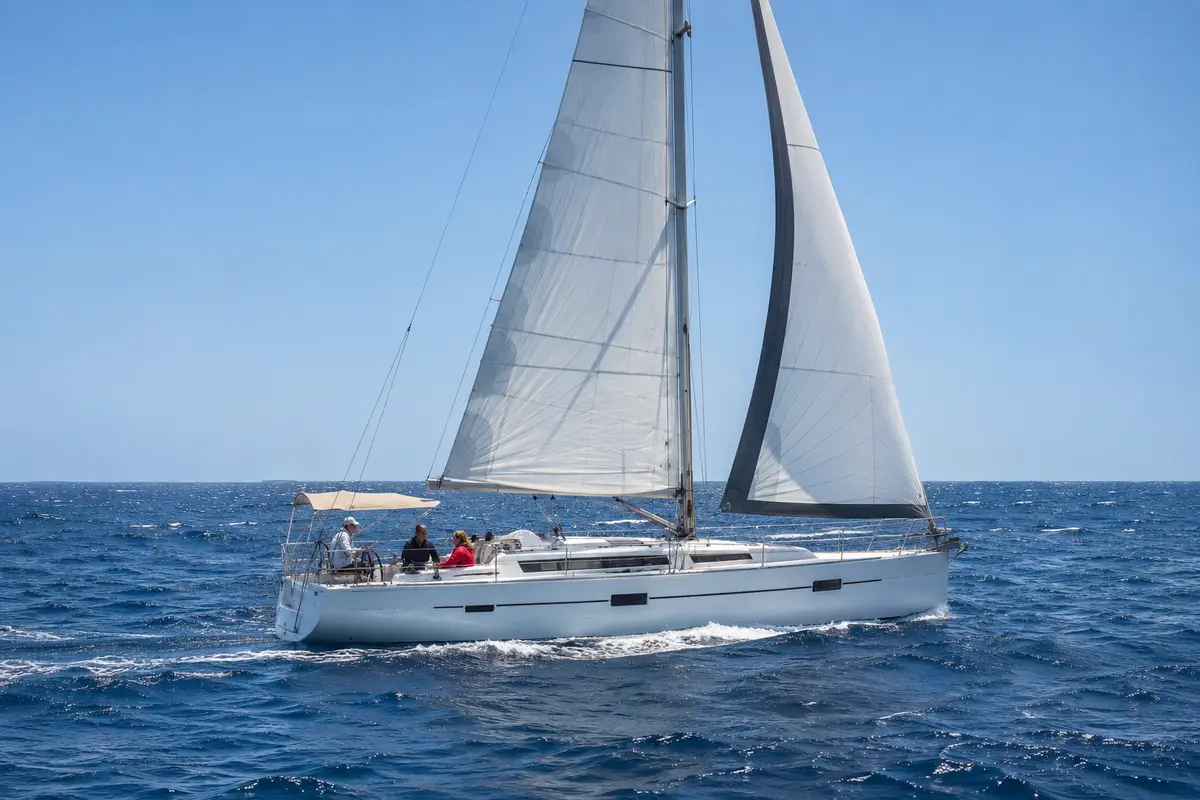
What really changesA wider horizon, with craft still limited to 24 metres
The twelve-mile boundary disappears here: distance from shore is unlimited. Two practical details still matter: your craft must not exceed 24 metres and you must respect the propulsion endorsement written on your licence.
With this licence you can
- Operate recreational craft up to 24 metres with no distance limit from shore
- Navigate under sail and power when that is the endorsement shown on your licence
- Operate under power when the licence shows a power-only endorsement
What falls outside this category
- Operate craft over 24 metres
- Use the licence beyond the propulsion endorsement shown on it
- Treat it as sufficient for professional or commercial work, which has separate requirements
Before you beginRequirements and scope
- Be at least 18 years old
- Choose sail and power or power only, as shown on your licence
- Keep any requirements for professional or commercial work separate
PreparationHow to approach it, step by step
- Start with the full COLREG
Review manoeuvring rules, maritime signals, navigation lights and sound signals carefully.
- Work on offshore chartwork
Prepare route calculations with currents and weather, alongside cartography, tides and the basics of celestial navigation.
- Complete your safety preparation
Include meteorology, safety and distress procedures, including GMDSS.
- Take theory and practical tests
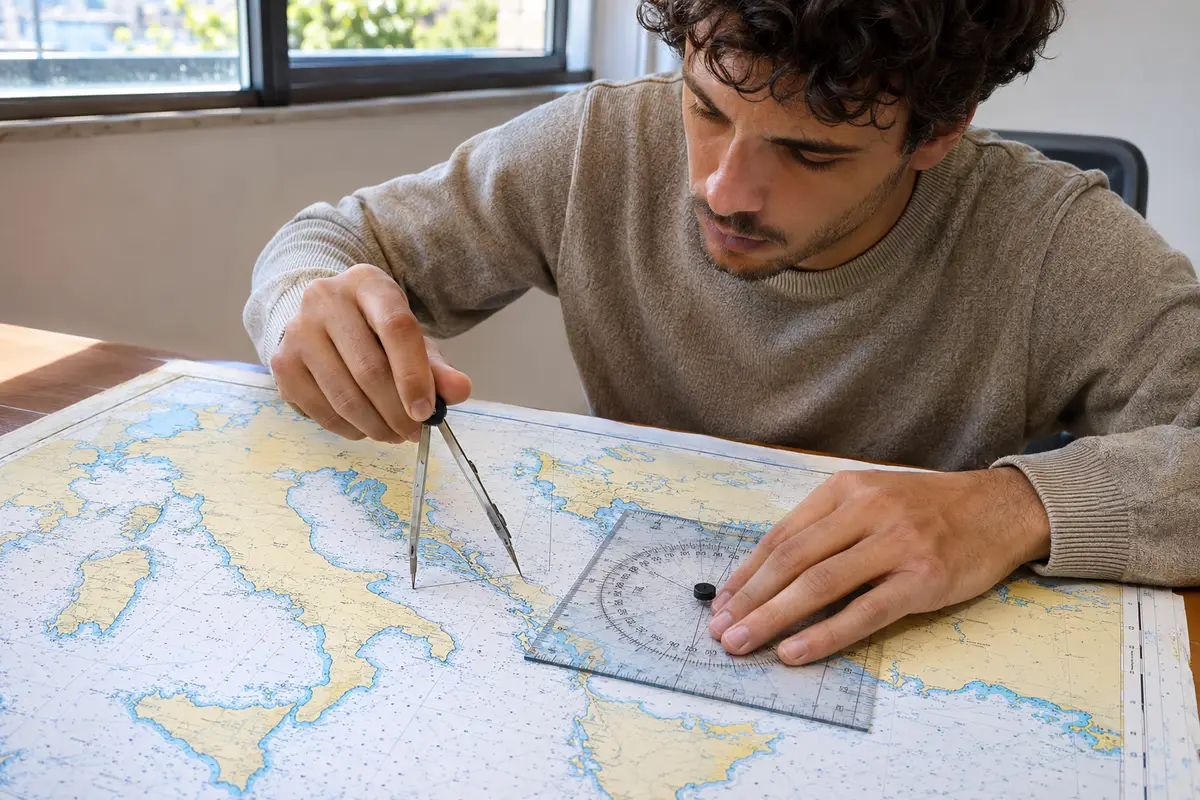
The category includes a basic quiz and chartwork problems, as well as a practical test; sailing adds further questions.
- Check the procedures and syllabus
For the current syllabus and test procedures, refer to the Ministero delle Infrastrutture e dei Trasporti (Ministry of Infrastructure and Transport) / Capitanerie di Porto (harbour captaincies).
Theory and boat handlingThe exam at a glance
| Test | Structure | Required result |
|---|---|---|
| Basic quiz | 20 questions | 16 correct answers |
| Chartwork | 4 problems | 3 correct |
| Sailing endorsement | 5 additional questions | 4 correct answers |
| Practical | Practical test | Required alongside theory |
All the categoriesItaly’s boating licence ladder
- Patente nautica di categoria D, tipo D1 (category D, type D1 licence)By day only; personal watercraft within 1 nautical mile.
- Patente nautica di categoria A — entro dodici miglia dalla costa (category A — within twelve miles of shore licence)Under sail and power, or power only if specified.
- Patente nautica di categoria C — entro dodici miglia dalla costa (category C — within twelve miles of shore licence)For the specified disabilities, with the required support and device.
- Patente nautica di categoria D, tipo D2 — entro dodici miglia dalla costa (category D, type D2 — within twelve miles of shore licence)With restrictions prescribed after medical assessment.
- Patente nautica di categoria A — senza alcun limite dalla costa (category A — no distance limit from shore licence)Under sail and power, or power only if specified.
- Patente nautica di categoria C — senza alcun limite dalla costa (category C — no distance limit from shore licence)For the specified disabilities, with the required support and device.
- Patente nautica di categoria D, tipo D2 — senza alcun limite dalla costa (category D, type D2 — no distance limit from shore licence)With restrictions prescribed after medical assessment.
- Patente nautica di categoria B (category B licence)For navi da diporto (recreational vessels) over 24 metres and smaller recreational craft; requires three years holding category A with no distance limit, at least under power.
The verdict
Why it is valuable
- Removes the distance limit from shore for recreational boating
- Keeps a clear scope of craft up to 24 metres
- Adds solid preparation in COLREG, chartwork, weather and safety
What to allow for
- The craft must not exceed 24 metres
- The propulsion endorsement shown on your licence remains binding
- Professional or commercial use has separate requirements
This is a good choice when twelve miles no longer feels enough and you want to navigate recreationally without a distance limit from shore. Approach it as a step up in skills rather than a simple extension: the full COLREG, chartwork and safety deserve proper study time.
Topics tested
Practice tests
IALACOLREG Exam Pass
Patente Nautica senza limiti: get ready for your exam with the Exam Pass
Unlimited timed mock exams, every mistake back until it's right, and a readiness score that shows when you're ready for the exam.
512 exam-style questions with explanations · 7 timed subject exams · every simulator scenario
One payment for 12 months, so it covers a resit too. No subscription.
Practice questions (with answers)
For a vessel of 50m or more, the masthead light must be visible at:
Show answer
Correct answer: C. 6 nautical miles
Rule 22: masthead light of vessels 50m+ must be visible at a minimum of 6 nautical miles.
An East Cardinal mark shows how many quick flashes?
Show answer
Correct answer: B. 3 flashes
White lights, when fitted: North Q or VQ; East VQ(3) 5 s or Q(3) 10 s; South VQ(6)+LFl 10 s or Q(6)+LFl 15 s; West VQ(9) 10 s or Q(9) 15 s. The long flash lasts at least 2 s.
If fitted, the topmark of an isolated danger mark is:
Show answer
Correct answer: B. Two black spheres vertically
Isolated danger marks have two black spheres (balls) as topmark. (if fitted).
Safe water marks are used as:
Show answer
Correct answer: B. Fairway or mid-channel marks
Safe water marks are used as fairway, mid-channel, or landfall marks.
If fitted, the topmark of a special mark is:
Show answer
Correct answer: B. A yellow X-shape (cross)
Special marks have a yellow X-shaped (St. Andrew's cross) topmark. (if fitted).
Section I of Part B (Rules 4–10) — look-out, safe speed, risk of collision, action to avoid collision — applies:
Show answer
Correct answer: B. In any condition of visibility, day or night
Rule 4 applies Section I in any condition of visibility. Rule 11 limits Section II to vessels in sight of one another. Rule 19 applies to vessels not in sight when navigating in or near restricted visibility.
Which is a clear violation of the look-out requirement?
Show answer
Correct answer: B. Assigning the look-out person administrative paperwork during the watch
A proper look-out must be able to give full attention to the task. Assigning unrelated duties that distract the watch violates the rule.
For vessels with operational radar, safe speed must additionally consider:
Show answer
Correct answer: B. Characteristics and limitations of radar equipment
Rule 6(b) applies to vessels with operational radar and requires consideration of its characteristics, efficiency and limitations, among other radar-related factors.
The full guide
The Italian category-A licence without a distance limit permits recreational navigation on craft up to 24 m, within the propulsion authorisation stated on the licence.
Builds on the entro-12-miglia: full COLREG, celestial navigation basics, chartwork, tides, weather, safety equipment.
Who should take the Patente senza limiti
Recreational skippers who need to navigate beyond the 12-nautical-mile category. Professional or commercial operation has separate requirements.
How to prepare
Master full COLREG, offshore chartwork by hand, weather routing, distress procedures (GMDSS).
Other exams
Reviewed by Ramon Curto, Nautical teacher at IECNPC · Last reviewed: