

 See units
Medical first aid (STCW A-VI/4-1): examining a casualty, toxic hazards (MFAG) and the ship's medical guide
Burns: area, depth and when to call the doctor
1The lesson in plain words
Cool the burn and keep the casualty warm, then measure: how much skin, how deep and where. Those answers decide the advice, the fluids and the evacuation.
First aid recap
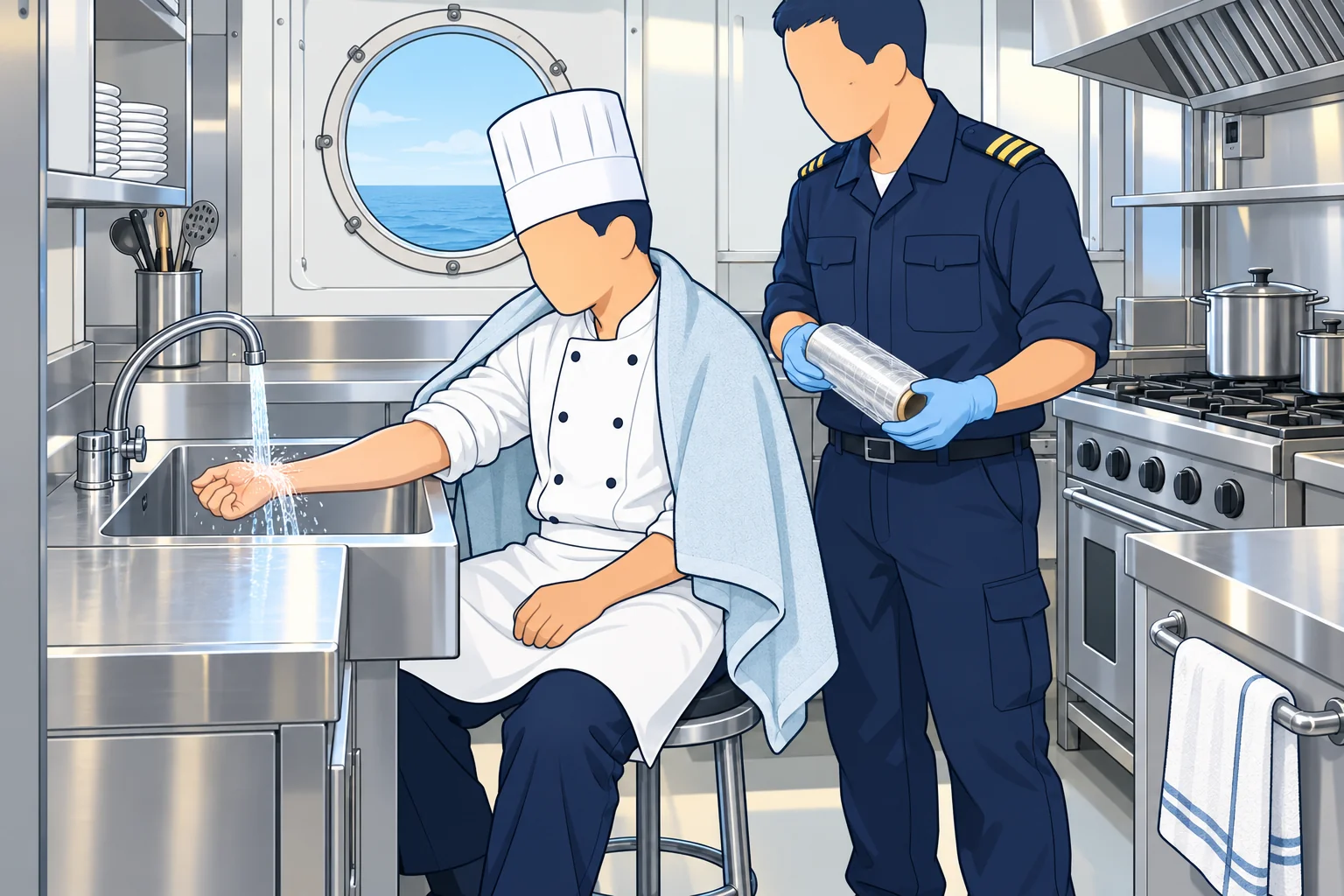
Cool the burn with cool running water for 20 minutes, cover it and keep the casualty warm; see Wounds, burns and fractures.
Measure the area
Burn size is given as a percentage of the total body surface area (TBSA). In an adult the rule of nines gives the head and neck 9 %, each arm 9 %, the front of the trunk 18 %, the back 18 %, each leg 18 % and the genital area 1 %. For scattered burns, use the palm side of the casualty’s whole hand, including fingers held together: about 1 %. Count only blistered or deeper burns, not simple redness.
Judge the depth
A superficial burn is red and painful, without blisters. A partial-thickness burn damages part of the skin depth: it may be pink, moist and painful; deeper areas may be pale and less sensitive. A full-thickness burn is white, brown or charred, leathery, and often painless because the nerves are destroyed. Burns can deepen over the first days, so reassess and record your findings.
When to get advice
Get radio medical advice for any burn larger than the casualty’s whole palmar hand, including fingers, any full-thickness burn, burns of the face, hands, feet, joints or genitals, burns that go all the way round a limb or the chest, and electrical, chemical or inhalation burns. Hoarseness, soot round the mouth or nose, singed nasal hair or a cough after a fire mean the airway may swell: get urgent advice and expect evacuation.
Fluids, pain and infection
Large burns leak fluid and can cause burn shock; in adults the risk is high from about 15 % TBSA. The doctor may advise oral rehydration fluid or, if someone is trained, an intravenous drip, and will advise on pain relief and dressings. Chart pulse, breathing, temperature and urine output. Keep dressings clean and do not burst blisters. Fever, a bad smell or spreading redness later suggest infection.
2Key data
- Cooling
- Cool running water, 20 min, as soon as possible
- Rule of nines (adult)
- Head 9, each arm 9, front 18, back 18, each leg 18, groin 1
- Palm method
- Whole palm-side of casualty’s hand, including fingers ≈ 1 % TBSA
- What to count
- Blistered and deeper burns only, not redness
- Airway burn signs
- Hoarse voice, soot, singed nasal hair, cough after a fire
- Burn shock
- Risk high from about 15 % TBSA in adults
3Key points
- 1
Use the rule of nines for large burns; for scattered burns, the casualty’s whole palmar hand including fingers is about 1 %.
- 2
Do not count simple redness when you estimate the burn area.
- 3
White, leathery, painless skin suggests a full-thickness burn.
- 4
Airway, face, hands, joints, genitals or all round a limb: radio medical advice now.
- 5
Large burns need fluids on radio medical advice and a chart of urine output.
4Frequent mistakes
Wrong: A painless burn must be a mild one.
Right: A painless white or leathery burn may be full thickness: the nerves are destroyed.
Wrong: Add the red skin around the blisters to the burn area.
Right: Count only blistered or deeper burns; redness alone makes the estimate too high.
5Practice case & exam keys
Both arms, including both hands, are blistered over their whole surface; blisters also cover half the front of the trunk. His voice is hoarse after the galley fire. Cooling has started. How large is the burn, and what needs urgent attention?
Show the answer
About 27 %: 9 % for each arm plus half of the 18 % front of the trunk. Blisters mean at least partial thickness. Burns all round the arms and a hoarse voice after a fire are red flags: the airway may swell. Keep him warm, sit him up if breathing is easier and give oxygen if trained. Call for urgent radio medical advice with area, depth and vital signs, and start a fluid and urine chart. Evacuation is likely.
Exam keys
- Rule of nines: head 9, each arm 9, front of trunk 18, back 18, each leg 18, genital area 1.
- Casualty’s whole palmar hand, including fingers held together ≈ 1 % TBSA; count blistered and deeper burns only.
- Advice for: larger than the casualty’s whole palmar hand including fingers, full thickness, face, hands, feet, joints, genitals, circumferential, electrical, chemical, airway.
- Large burns: burn shock risk; fluids on radio medical advice; chart urine output.
Finish this unit
When you've read it, answer three questions. Get all three right to finish the unit; opening the page alone doesn't count.
My notes for this unit
No notes