

 See units
Medical first aid (STCW A-VI/4-1): examining a casualty, toxic hazards (MFAG) and the ship's medical guide
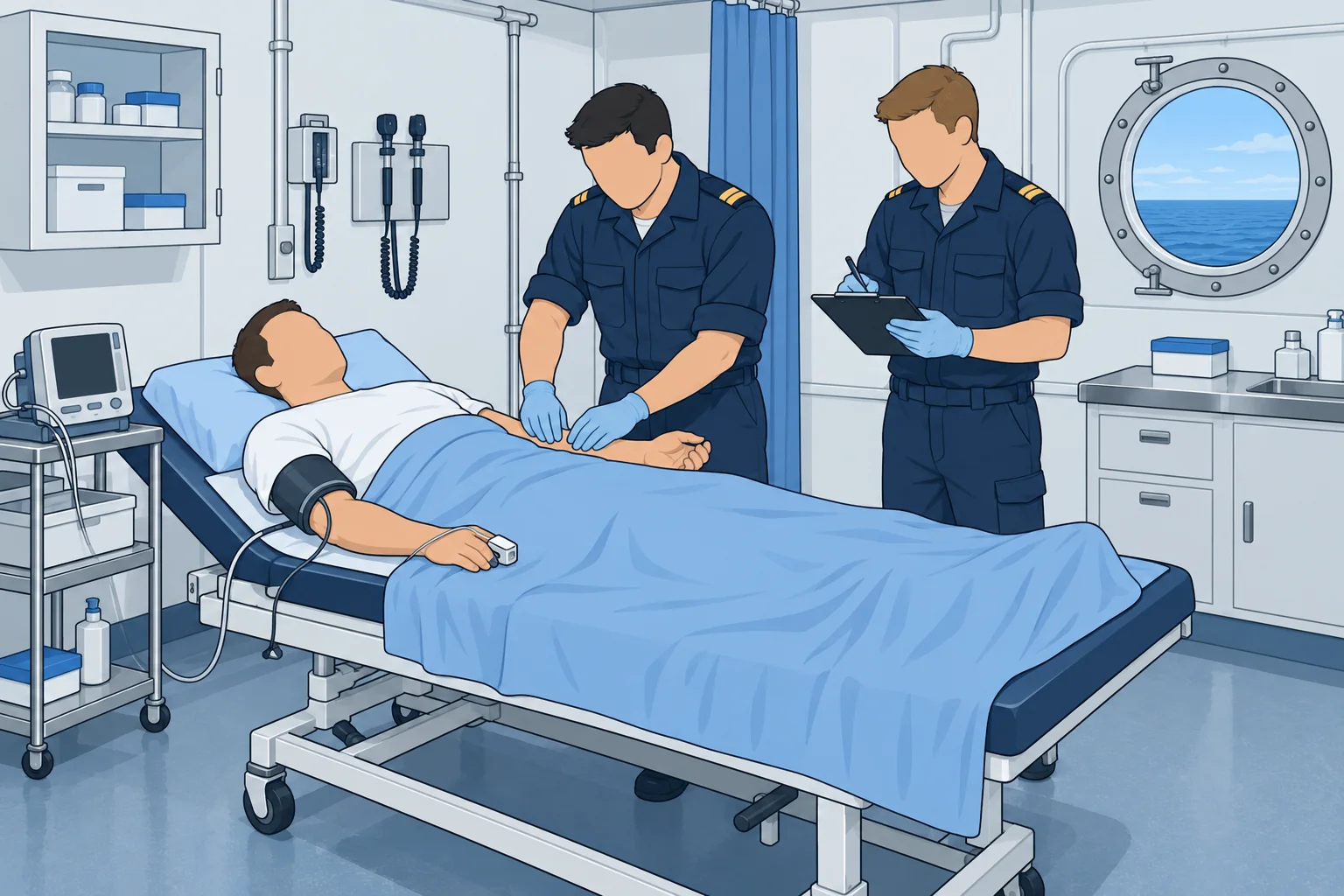
Examining a casualty: surveys, history and vital signs
1The lesson in plain words
Find what kills first, then check the whole body, take the history and measure the vital signs, so you and the radio doctor work from facts.
Two surveys, in order
The primary survey (<C>ABCDE, taught in First aid and resuscitation) finds and treats life threats in the first minutes. Only when they are under control do you start the secondary survey: a calm, complete check from head to toe, the history and a first set of vital signs. At sea the secondary survey is the doctor’s eyes, because the doctor ashore cannot see the patient. If the casualty gets worse at any point, go back to the primary survey.
Head to toe
Explain what you are doing, then work down: scalp and face, ears and nose (blood or clear fluid), eyes and pupils, mouth, neck, collarbones and chest, abdomen, pelvis, back, then each arm and leg. Look for wounds, swelling, deformity and colour; feel gently for tenderness; never test a suspected fracture for movement or rock the pelvis. Compare left with right. Uncover only what you check, then cover again. Check under the casualty for blood. Note each finding with its place and time.
The history: SAMPLE
Ask the casualty, witnesses and crew mates. SAMPLE is a memory aid: Signs and symptoms, Allergies, Medicines taken, Past illnesses, Last food and drink, Events leading up to it. For pain, ask where it is, when it started, what it feels like, whether it spreads, and ask them to rate it from 0 (no pain) to 10 (the worst pain imaginable). Ask separately about urine output.
Vital signs and normal ranges
Vital signs show how the body is coping: pulse, breathing rate, oxygen saturation, blood pressure, temperature, consciousness and, if you carry a meter, blood sugar. In a healthy adult at rest, pulse is about 60–100 a minute, breathing 12–20 a minute, saturation 95–100 % and temperature about 36.5–37.5 °C. Blood pressure is often around 120/80 mmHg; record both numbers. Repeat readings and chart them with times; the trend matters.
Consciousness: AVPU and GCS
Use AVPU for a quick check; its basics are in Radio medical advice. The Glasgow Coma Scale (GCS) scores eyes (4 spontaneous, 3 to speech, 2 to pressure, 1 none), speech (5 oriented, 4 confused, 3 inappropriate words, 2 incomprehensible sounds, 1 none) and movement (6 follows commands, 5 reaches towards pressure, 4 pulls away, 3 abnormal bending, 2 stiff straightening, 1 none). Report each component and the total, 3–15. At 8 or less the airway is at high risk: watch breathing continuously and get urgent advice.
2Key data
- Order
- Primary survey (<C>ABCDE), then the secondary survey
- History
- SAMPLE: symptoms, allergies, medicines, past, last intake, events
- Adult at rest
- Pulse 60–100/min; breathing 12–20/min; saturation 95–100 %
- Temperature
- About 36.5–37.5 °C; note where you measured it
- GCS
- Eyes 1–4, verbal 1–5, motor 1–6; total 3–15
- GCS 8 or less
- Airway at risk: protect it, urgent radio medical advice
3Key points
- 1
Primary survey first; start the secondary survey only when life threats are under control.
- 2
Check head to toe: look, feel, compare sides, and check the back and under the casualty.
- 3
Take the history with SAMPLE and score pain from 0 to 10.
- 4
Chart vital signs with the time: the trend matters more than one reading.
- 5
Report the GCS as three parts and a total; 8 or less means the airway is at risk.
4Frequent mistakes
Wrong: Start the head-to-toe check as soon as you reach the casualty.
Right: Deal with catastrophic bleeding, airway and breathing first; the secondary survey comes after.
Wrong: One normal set of vital signs means the casualty is fine.
Right: Repeat and chart them. A rising pulse or a falling GCS can be the first sign of bleeding or a brain injury.
Wrong: Give the radio doctor only the GCS total.
Right: Give the eye, verbal and motor scores too: E2 V2 M5 and E4 V1 M4 both total 9 but mean different things.
5Practice case & exam keys
A deck rating fell about 2 m from a ladder in a hold. The primary survey is clear: airway open, breathing 18 a minute, no heavy bleeding, alert. He has pain on the left side of his lower chest and in his left wrist. What do you do next?
Show the answer
Start the secondary survey. Keep his head and neck still while you check, as the fall could have hurt his spine. Work head to toe: you find tender lower left ribs and a swollen, deformed wrist. Take a SAMPLE history. Record pulse, breathing, saturation, blood pressure and GCS with the time and repeat them every 15 minutes. Injured lower left ribs can hide a torn spleen, so get radio medical advice with these findings.
Exam keys
- Primary survey (<C>ABCDE) first; secondary survey head to toe once life threats are controlled.
- SAMPLE: signs and symptoms, allergies, medicines, past history, last intake, events.
- Adult at rest: pulse 60–100, breathing 12–20, saturation 95–100 %, temperature about 37 °C.
- GCS 3–15 from eyes 1–4, verbal 1–5, motor 1–6; 8 or less: airway at risk.
Finish this unit
When you've read it, answer three questions. Get all three right to finish the unit; opening the page alone doesn't count.
My notes for this unit
No notes