

 See units
Medical first aid (STCW A-VI/4-1): examining a casualty, toxic hazards (MFAG) and the ship's medical guide
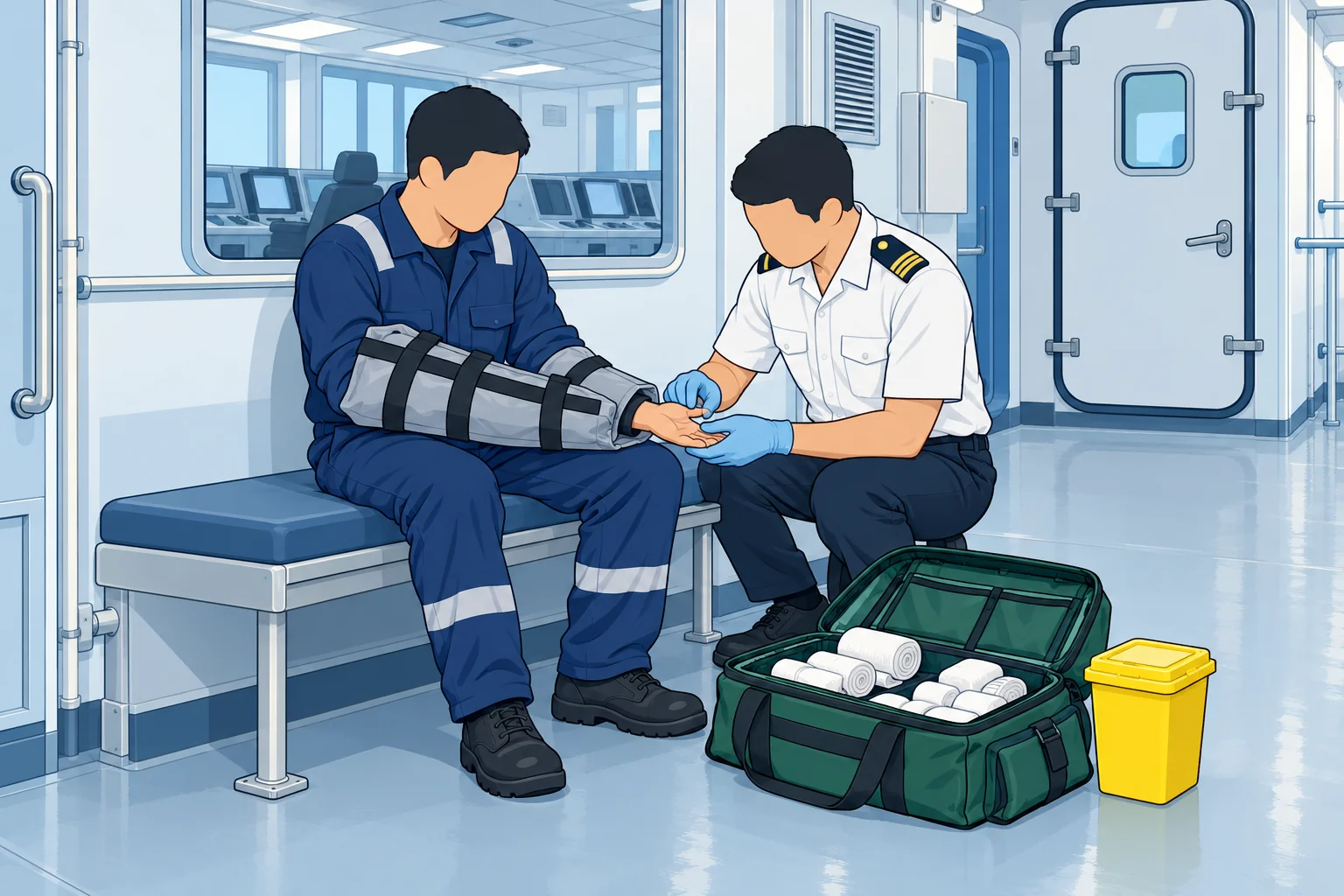
Wounds, bleeding, fractures and dislocations at officer level
1The lesson in plain words
Beyond first aid: judge how serious a wound or break is, prevent infection and shock, spot the injuries that need surgery, and act on the radio doctor’s advice.
Bleeding you cannot see
Pressure, haemostatic dressings and tourniquets are in Wounds, burns and fractures; shock care in Body structure, shock, electric shock and moving a casualty. At officer level you also watch for internal bleeding after a crush, a fall or a blow to the abdomen, chest, pelvis or thigh, even with no wound. Signs: a rising pulse, pale, cold, clammy skin, thirst, fast breathing, then confusion and falling blood pressure. Suspected internal bleeding needs urgent radio medical advice.
Wound care with the ship’s kit
Clean with plenty of drinkable water and judge the wound: length, depth, edges and what lies under it. Use strips only for shallow, clean cuts whose edges meet easily without tension. The ship’s guide also shows sutures (stitches) and staples; use them only if trained and on radio medical advice. Never close bites, punctures, or dirty, crushed or old wounds: dress them open. Check tetanus vaccination records; report unknown or incomplete protection to the doctor, who can arrange preventive treatment. Antibiotics are given only on radio medical advice.
Wounds that need urgent advice
Get urgent advice for deep wounds of the hand, face or joints, numbness or weak movement beyond a wound, wounds of the chest or abdomen, and amputations. A high-pressure injection injury, from a hydraulic hose, fuel injector or grease gun, can look like a pinprick but forces fluid deep into the tissue; it needs surgery within hours. Leave an open chest wound uncovered and get urgent radio medical advice.
Dangerous fractures
Splinting is taught in Wounds, burns and fractures. A broken femur (thigh bone) can bleed heavily into the thigh. A pelvic fracture can bleed heavily inside: suspect it after a fall from height or a crush with hip or groin pain, never rock or spring the pelvis to test it, and keep the casualty still. Both need urgent advice and usually evacuation.
Dislocations
A dislocation is a joint forced out of position: shoulder, finger, kneecap and jaw are common. The joint looks deformed, will not move and is very painful; a fracture may also be present. Support it as found and check colour, warmth and feeling beyond it. Do not try to put it back unless the radio doctor advises it and you have been trained.
Compartment syndrome
After a crush or fracture, swelling inside a closed muscle compartment can cut off the blood supply. Warning signs: pain out of proportion that keeps growing, pain when the fingers or toes are stretched, a tight, swollen limb, then pins and needles. Loosen bandages and splint ties, keep the limb at heart level, and get urgent advice: it needs surgery within hours.
2Key data
- Internal bleeding
- Suspect after crush, fall or blow to trunk, pelvis or thigh
- Closing wounds
- Strips: shallow, clean, low tension; stitches: trained, radio advice
- Never close
- Bites, punctures, dirty, crushed or old wounds
- High-pressure injection
- Tiny wound, deep damage: surgery within hours
- Dislocation
- Support as found; reduce only on radio advice, if trained
- Compartment syndrome
- Growing pain, pain on stretch, tight limb: urgent advice
3Key points
- 1
A rising pulse with pale, cold skin after an injury can mean hidden bleeding.
- 2
Never close bites, punctures or dirty wounds; antibiotics only on radio medical advice.
- 3
A pinprick from a hydraulic line can be a surgical emergency: report it at once.
- 4
Femur and pelvic fractures can bleed heavily inside; handle gently and get urgent advice.
- 5
Do not put a dislocation back unless the radio doctor advises it and you are trained.
4Frequent mistakes
Wrong: A tiny wound from a hydraulic leak can be dressed and forgotten.
Right: High-pressure injection drives fluid deep into the tissue; it needs urgent surgery.
Wrong: Stitch every gaping wound to keep germs out.
Right: Closing a dirty or bite wound traps infection. Close only clean wounds; use sutures or staples only if trained and on radio medical advice.
Wrong: Rock the hips to test for a pelvic fracture.
Right: Moving the pelvis can restart bleeding. Suspect it from the fall and the pain, and keep the casualty still.
5Practice case & exam keys
An oiler’s forearm was trapped under a falling engine part. The skin is intact, but an hour later the forearm is swollen and tight, the pain keeps growing, and stretching his fingers hurts badly. His pulse is 112. What is happening and what do you do?
Show the answer
Suspect compartment syndrome, possibly with a fracture. Loosen any bandage or splint ties and keep the arm at heart level, not raised high. Support it, check colour, warmth and feeling of the fingers, and record pulse and blood pressure every 15 minutes. Get urgent radio medical advice: compartment syndrome needs surgery within hours, so the doctor and the MRCC will consider evacuation.
Exam keys
- Suspect internal bleeding after a crush, fall or blow to the trunk, pelvis or thigh; get urgent advice.
- Close only clean wounds; sutures and staples only if trained and on radio advice. Antibiotics only on radio medical advice.
- High-pressure injection injury and compartment syndrome need surgery within hours.
- Dislocations: support as found; reduce only on radio advice and if trained.
Finish this unit
When you've read it, answer three questions. Get all three right to finish the unit; opening the page alone doesn't count.
My notes for this unit
No notes