

 See units
Medical first aid (STCW A-VI/4-1): examining a casualty, toxic hazards (MFAG) and the ship's medical guide
Toxic hazards: using the MFAG
1The lesson in plain words
Chemicals harm through the lungs, skin, eyes and mouth. The MFAG gives a fixed path: rescue safely, act on the symptoms, then check the few special chemicals.
What the MFAG is
The MFAG (Medical First Aid Guide for Use in Accidents Involving Dangerous Goods) is an IMO, WHO and ILO guide printed in the IMDG Code Supplement. It is the chemical companion of the WHO International Medical Guide for Ships. Use it together with the safety data sheet (SDS) of the substance, the EmS Guide (emergency schedules for fire and spillage) and radio medical advice. Rescue, CPR and gas hazards such as H₂S are covered in Body structure, shock, electric shock and moving a casualty.
Routes of poisoning
A chemical enters by inhalation (gas, vapour, fumes or dust breathed in), through the skin (some pass through intact skin), through the eyes, or by ingestion (swallowing, usually from dirty hands, food or drink). Effects may be immediate, such as burns or collapse, or delayed for hours, such as fluid in the lungs after an irritant gas. Treat any toxic or corrosive exposure as serious until the casualty has fully recovered or a doctor advises otherwise.
Start with Emergency action
The guide opens with a yes/no flow chart. Rescue from a polluted atmosphere? Table 1. Breathing stopped? Tables 2 and 3. Unconscious? Table 4. Fitting? Table 5. Then eyes, skin, inhalation and swallowing: Tables 7, 8, 9 and 10. Severe pain: Table 13. Each table gives short instructions; the matching appendix explains them in more depth.
Identify the chemical
Find the UN number and proper shipping name on the label, packaging or dangerous goods manifest. The EmS code in the IMDG Code leads to fire and spillage schedules, not to medical tables. Most chemicals are treated by their effects. Only a few need special treatment, listed by UN number and by name in Appendix 15: for example hydrofluoric acid (Table 16), organophosphate insecticides (Table 17), cyanides (Table 18), methanol and ethylene glycol (Table 19) and radioactive material (Table 20).
Decontamination
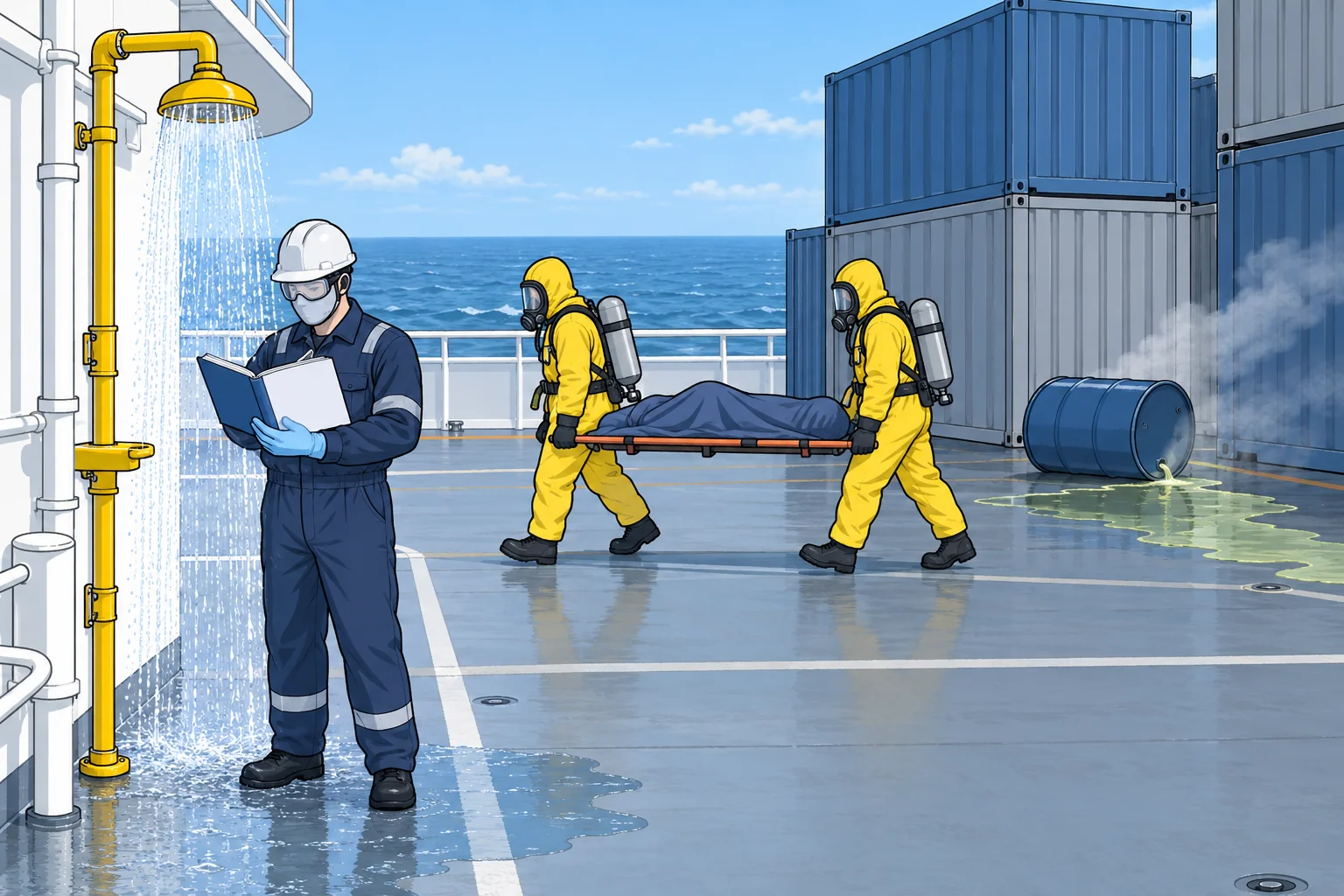
Follow SDS precautions and secure airway and breathing, then decontaminate. Remove contaminated clothing; brush dry powder off the skin. Irrigate eyes immediately with plenty of water or a bag of sodium chloride 0.9 %; never soap or brushes. MFAG Table 7 gives 10 minutes by the clock, repeated if severe pain continues. Table 8 gives at least 10 minutes of rinsing with water, no neutralising agents, then another 10 minutes with soap or shampoo and water. Eyes come first. Bag clothing, contain runoff and get radio medical advice.
Watch and ask
Many chemicals act late. Keep anyone with significant exposure or any symptoms warm and at rest, watch them closely for 48 hours, and get radio medical advice; hospital care ashore is often needed. Give the doctor the UN number, name and SDS.
2Key data
- MFAG
- IMO/WHO/ILO guide in the IMDG Code Supplement
- Order
- Emergency action flow chart, then tables, then appendices
- Tables 7 / 8 / 9 / 10
- Eyes / skin / inhalation / ingestion
- Special chemicals
- Appendix 15, by UN number and name (e.g. Tables 16–20)
- Washing
- Eyes: 10 min water or saline; skin: 10 min water, then 10 min soap
- After real exposure
- Rest, warmth, observe 48 h, radio medical advice
3Key points
- 1
Always start at the Emergency action flow chart, then go to the tables and appendices.
- 2
Most chemicals are treated by their effects; Appendix 15 lists the few that need special tables.
- 3
The EmS code leads to fire and spillage schedules, not to medical treatment.
- 4
Observe any significantly exposed casualty for 48 hours and get radio medical advice.
4Frequent mistakes
Wrong: Look up the MFAG table number in the IMDG Code’s list.
Right: Current editions give none. Use the flow chart, and check Appendix 15 by UN number for the few special chemicals.
Wrong: Make the casualty vomit up a swallowed chemical.
Right: Never induce vomiting. Rinse the mouth; give one glass of water only if fully alert and able to swallow. Get radio medical advice.
Wrong: A casualty who feels fine after inhaling fumes can go back to work.
Right: Irritant gases can fill the lungs with fluid hours later. Rest, observe for 48 hours and get advice.
5Practice case & exam keys
A drum of corrosive liquid, UN 1760, leaks in a container hold. A crew member is splashed on the face and forearms. He is alert, in pain, and his eyes are streaming. What do you do?
Show the answer
Follow SDS precautions and check airway and breathing. Irrigate the eyes first with plenty of water or sodium chloride 0.9 %, holding the lids open, for 10 minutes by the clock. Remove soaked clothing and rinse the skin from the head down for at least 10 minutes, then wash for another 10 with soap and water; never soap in the eyes. Bag clothing and contain runoff. Check the SDS and Appendix 15 for special chemicals. Get radio medical advice.
Exam keys
- MFAG: IMO/WHO/ILO, in the IMDG Code Supplement; chemical supplement to the IMGS.
- Three steps: Emergency action flow chart, tables, appendices.
- Appendix 15 lists the few chemicals needing special treatment, by UN number and name.
- Decontaminate head down, eyes and wounds first; never induce vomiting; observe 48 hours.
Finish this unit
When you've read it, answer three questions. Get all three right to finish the unit; opening the page alone doesn't count.
My notes for this unit
No notes