

False echoes, blind sectors, reflectors and beacons
1The lesson in plain words
Some echoes on the screen are not where they appear, and some real targets do not appear. Know the common false echoes and blind sectors.
Side lobes and multiples
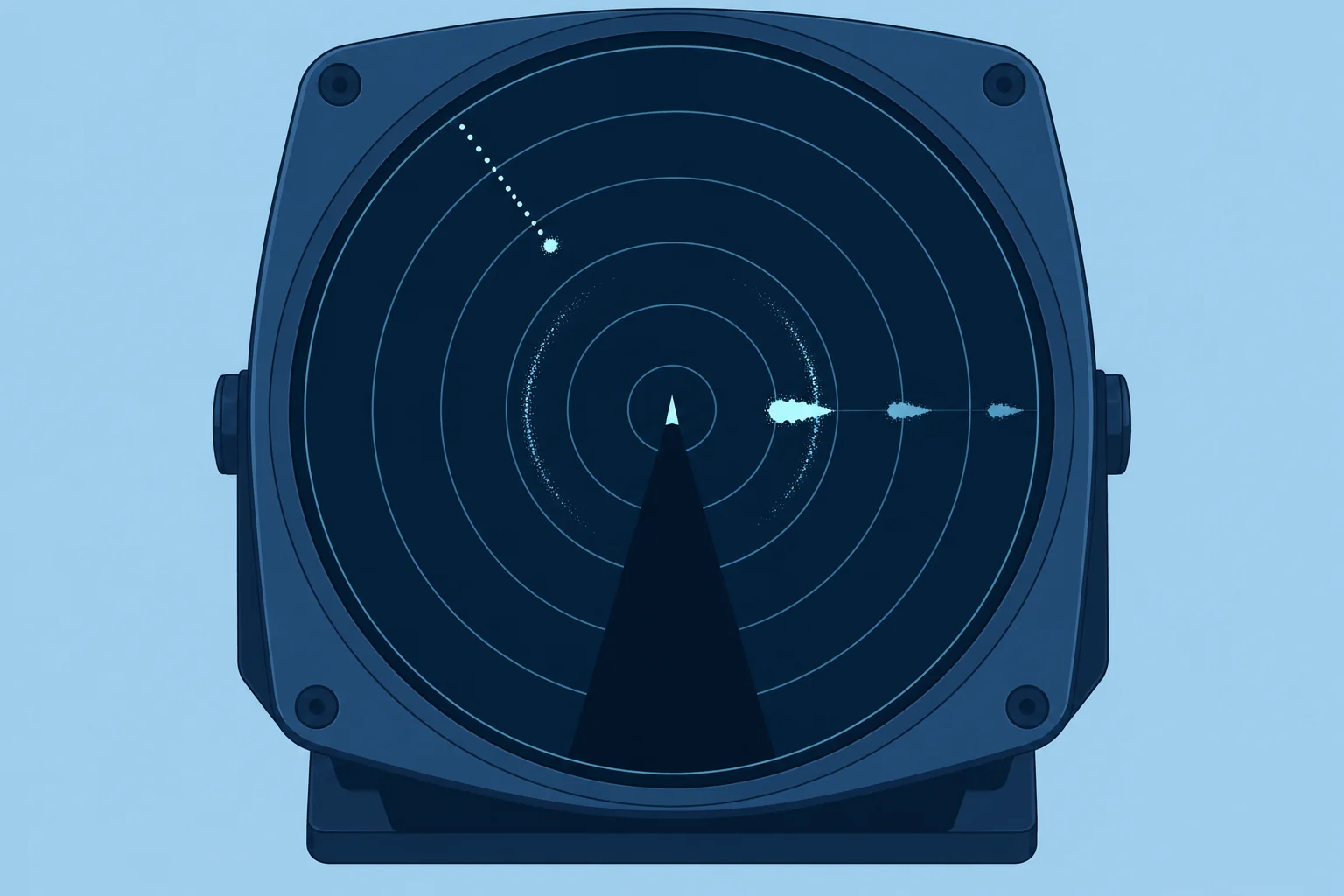
The beam has weak side lobes either side of the main beam. A strong target close by can show as an arc of echoes at the same range on both sides of it. Multiple echoes appear when energy bounces between you and a big target, such as a ship close abeam: you see two or three echoes on the same bearing at twice and three times the true range. Reduce gain cautiously to weaken them; this can also hide weak real targets.
Indirect echoes
An indirect echo reaches you by reflection from an obstruction such as your mast. It appears on that obstruction's bearing, often near the real target's range; the extra path can increase the apparent range. Check other echoes and the view before deciding it is false.
Second-trace echoes
On pulse radar, a distant echo can return after a later pulse has been sent. This second-trace echo appears at a false, shorter range. Super-refraction can make it more likely. If changing scale also changes pulse timing, its measured range may jump or the echo may disappear. This is a clue, not proof: screen position alone changes with scale even for a real target.
Shadows and blind sectors
Your mast or stacked dinghies can block part of the beam, especially if your scanner is mounted low. That blind sector hides targets on those bearings. Behind high land or big ships there are shadow areas too. Find your blind sectors in harbour and alter course now and then at sea to look into them.
Reflectors and beacons
A small yacht is a weak target: carry a good radar reflector or an active one (a radar target enhancer), mounted high. A RACON is a radar beacon on a mark that answers your pulse with a Morse letter on the screen. At several miles, an X-band radar SART (search and rescue transponder) produces 12 dots extending outwards beyond its position. Low-power FMCW sets may not trigger them.
2Key data
- Multiple echoes
- Same bearing, 2× and 3× the true range
- Side lobe echoes
- Arc at the same range either side of a strong close target
- Second-trace echo
- False short range; may jump when pulse timing changes
- SART on screen
- At several miles: 12 dots extending outward beyond the SART
3Key points
- 1
Reduce gain cautiously for side lobes and multiples; check that weak real echoes remain visible.
- 2
Obstructions can create indirect echoes or blind sectors; a blind sector hides targets rather than making an echo.
- 3
Find your blind sectors and alter course now and then to look into them.
- 4
A RACON gives a Morse letter; at several miles, a SART gives 12 dots. Low-power FMCW sets may not trigger them.
4Frequent mistakes
Wrong: Every echo on the screen is a real target where it appears.
Right: Side lobes, multiple, indirect and second-trace echoes are false. Check against the chart and the view.
Wrong: A yacht with a radar reflector is always seen by ships.
Right: Small reflectors give weak, patchy echoes, worse when heeled and in a sea. Keep a lookout and use AIS too.
5Practice case & exam keys
A large ferry passes 0.3 NM abeam. Your screen shows its echo, plus two more on the same bearing at 0.6 and 0.9 NM, and a faint arc at 0.3 NM curving round the bow. Nothing else is visible from the deck. What do these suggest, and how would you check without hiding weak targets?
Show the answer
The echoes at 0.6 and 0.9 NM suggest multiples; the arc at 0.3 NM suggests side lobes from the ferry. Reduce gain slightly, or cautiously increase sea-clutter suppression, while checking known weak echoes. Either adjustment can hide weak real targets, so use the minimum needed. Keep a lookout and check the remaining echoes against the view; do not dismiss them all as false.
Exam keys
- Multiple echoes: same bearing, multiples of the true range.
- Side lobes: arc at the same range as a strong close target.
- Indirect echoes appear on the bearing of the reflecting obstruction; second-trace echoes at a false short range.
- RACON: Morse letter; SART at several miles: 12 dots; reflector mounted high.
Finish this unit
When you've read it, match the terms, then answer three questions. Get them all right to finish the unit; opening the page alone doesn't count.
My notes for this unit
No notes