

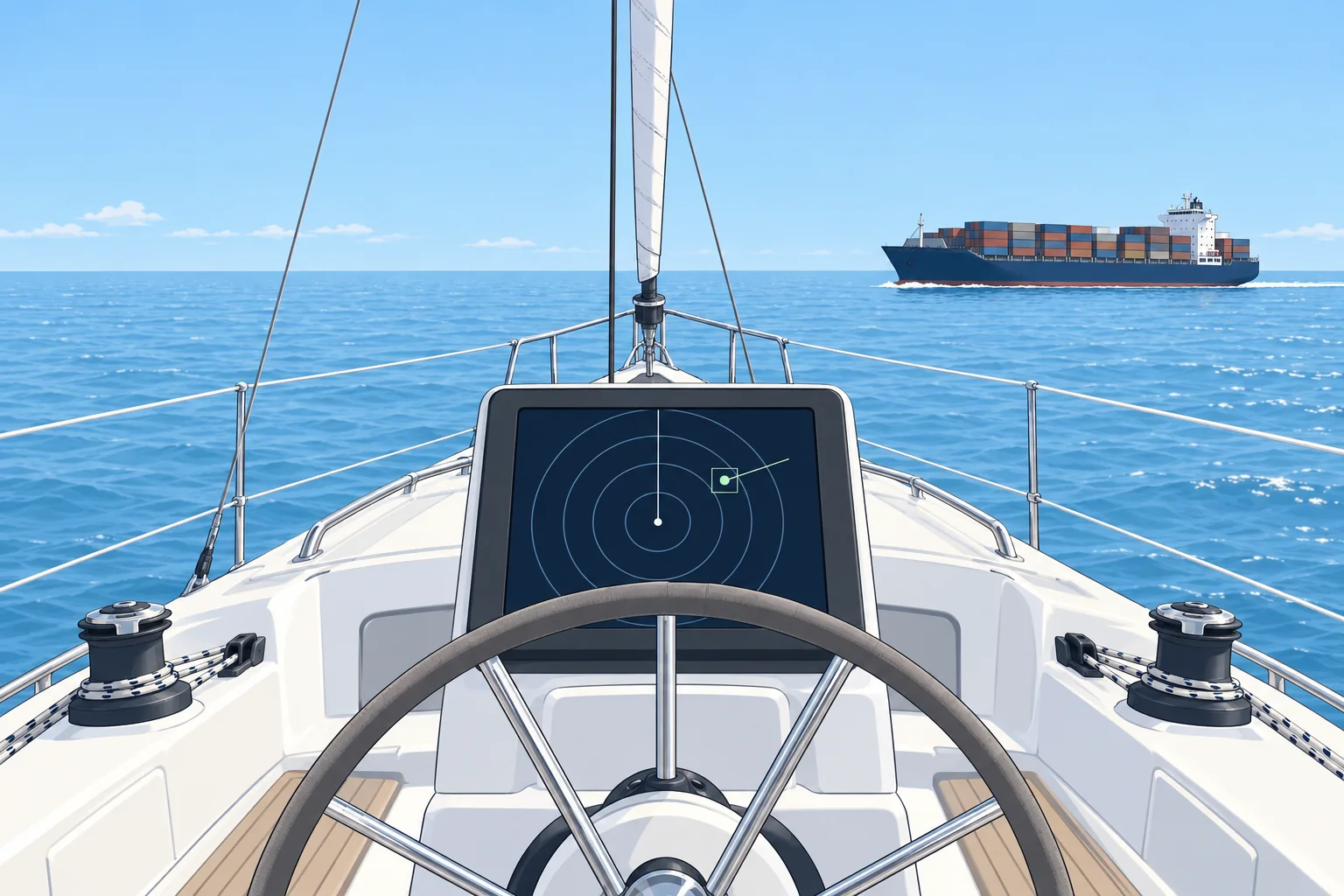
MARPA target tracking: CPA, TCPA and its limits
1The lesson in plain words
MARPA tracks echoes and works out how close they will pass and when. It needs a good heading input and time, and it lags after any manoeuvre.
What it does
You select an echo for MARPA (mini automatic radar plotting aid) to track. A vector is an arrow: its direction shows motion and its length shows the predicted distance covered in the selected vector time. True vectors show target motion; relative vectors show motion relative to you. CPA (closest point of approach) is the predicted closest passing distance; TCPA is the time until it. Both assume that you and the target maintain course and speed.
What it needs
MARPA needs your own heading from a heading sensor, plus speed and course, usually from GNSS. Without accurate heading the target's calculated course is wrong, even when the CPA looks reasonable. Many sets refuse to run MARPA without a heading input.
It takes time
After you acquire a target, the tracker needs several sweeps to build a trend: allow about a minute for a first indication and about three minutes for a steady vector. When the target or your own boat alters course, the old calculation carries on for a while, then catches up. In that gap, the CPA is out of date.
Where it fails
Small, weak echoes in clutter can be lost, and the tracker may swap to another echo when two targets pass close. A ship turning slowly gives a vector that keeps changing. Treat MARPA as an aid: watch the echo's bearing with the EBL as well, compare with AIS when the target has it, and keep a visual lookout.
Where to go next
The rules for acting on what radar shows, including plotting, Rules 7, 8 and 19, belong to the Radar and collision avoidance unit. The Radar simulator lets you practise tracking and judging CPA without risk.
2Key data
- CPA
- Predicted closest distance if both maintain course and speed
- TCPA
- Time to the closest point of approach
- Tracking lag
- About 1 min for a trend, about 3 min for a steady vector
- Inputs
- Heading sensor, plus own speed and course (GNSS)
- Spanish terms
- Punto de máximo acercamiento (CPA), tiempo al CPA (TCPA)
3Key points
- 1
MARPA gives a target's course, speed, CPA and TCPA from successive echoes.
- 2
It needs good heading input; a bad heading gives a wrong target course.
- 3
Allow minutes for a steady vector; after any alteration the result lags.
- 4
Check MARPA with EBL bearings, AIS and the view. Collision rules: Radar and collision avoidance unit.
4Frequent mistakes
Wrong: A CPA shown seconds after acquiring a target is reliable.
Right: Allow about three minutes of steady tracking for a steadier vector. This is approximate and never guarantees accuracy.
Wrong: After the other ship alters course, the CPA updates at once.
Right: The calculation lags. Watch the echo's bearing and range directly while it catches up.
Wrong: MARPA works the same with or without a heading sensor.
Right: It needs accurate heading. Without it the target course is wrong or MARPA will not run.
5Practice case & exam keys
You acquired a ship 6 NM away two minutes ago. MARPA shows CPA 1.2 NM, TCPA 18 minutes. The EBL bearing has hardly changed in those two minutes and the range is closing. Your heading sensor was replaced last week and not yet calibrated. How much do you trust the CPA?
Show the answer
Treat the figures as provisional. The track may still be settling, and the uncalibrated heading sensor makes the target vector unreliable. Cross-check successive EBL bearings and measured ranges, the visual lookout and available AIS data. Keep the observed echo identified. Calibrate the heading input before relying on MARPA. The Radar and collision avoidance unit covers collision decisions and action.
Exam keys
- MARPA: tracked target vector with CPA and TCPA.
- Needs heading sensor plus own speed and course.
- Steady vector after about 3 minutes; lags after manoeuvres.
- Cross-check tracking estimates with successive EBL/VRM observations and AIS when available.
Finish this unit
When you've read it, match the terms, then answer three questions. Get them all right to finish the unit; opening the page alone doesn't count.
My notes for this unit
No notes