

Gain, sea clutter and rain clutter: tuning the picture
1The lesson in plain words
A good picture shows small targets without drowning in noise. Set gain first, then sea clutter, then rain clutter, and check again often.
Gain
Gain sets how strongly the receiver amplifies echoes. Too low, and weak targets vanish. Too high, and the screen fills with speckled noise. The aim is a light speckle in the background on a long range scale, so the weakest echoes still show. Many sets have an automatic gain that is good most of the time.
Sea clutter
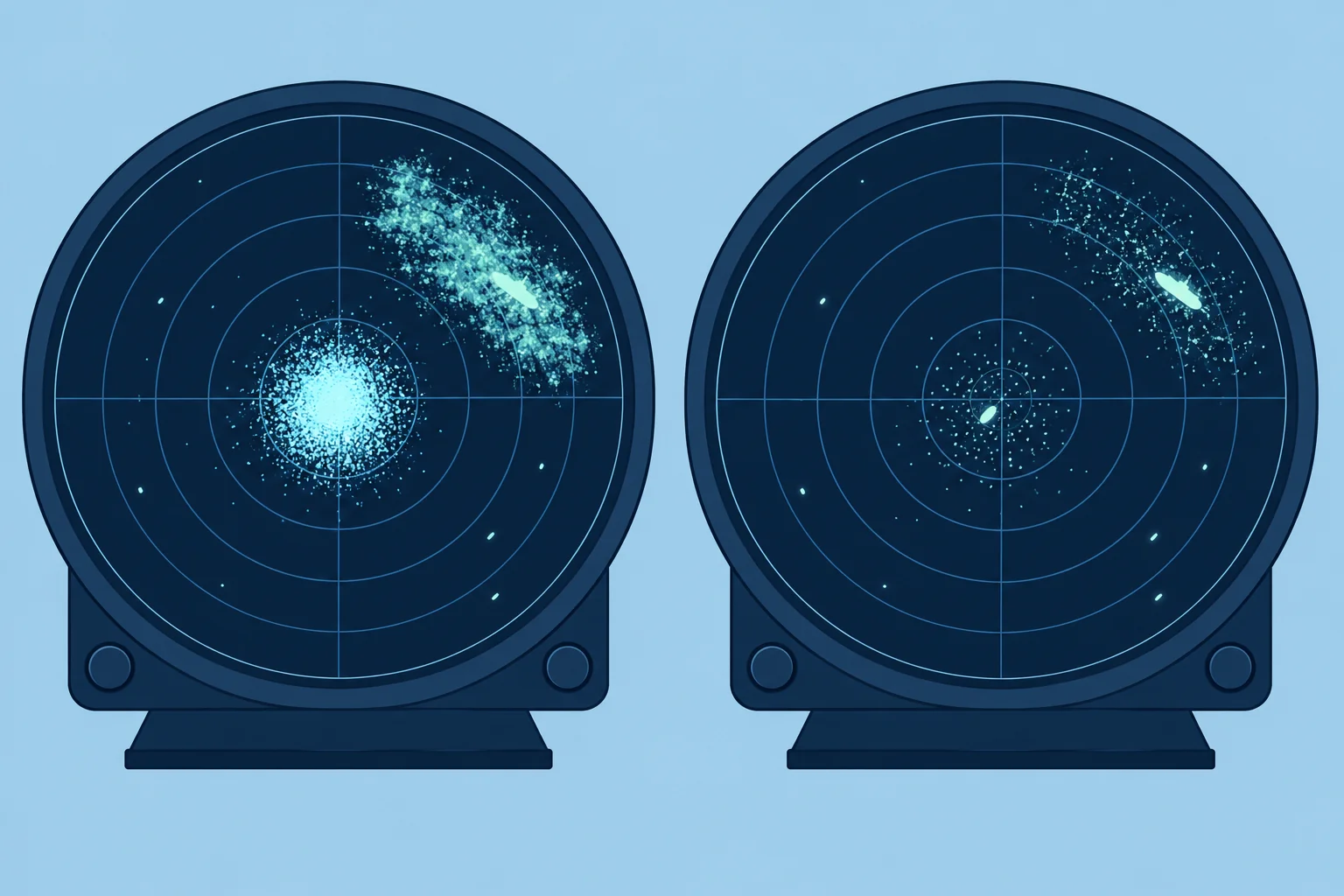
Waves near the boat reflect energy and make a bright patch around the centre: sea clutter. The sea clutter control (also called anti-clutter sea, or STC, sensitivity time control) reduces the gain close in and less further out. Set it so that the clutter breaks into scattered dots, not so that it is clean black. Over-suppression can remove a small boat or a buoy in the clutter.
Rain clutter
Rain and showers form broad patches that can hide targets. Traditional FTC (fast time constant) emphasises echo leading edges to reduce these broad returns. Modern rain controls may use other processing. Use the least suppression needed: it can weaken wanted echoes too. Rain echoes may warn of a squall, a sudden increase in wind; watch whether they approach.
Automatic modes
Most modern sets have auto gain, sea and rain, often with harbour, coastal and offshore presets. They work well in steady conditions but can hide small targets in a steep, short sea. Know how to switch to manual, and try it in calm conditions first.
Keep checking
Conditions change with wind, range scale and heading relative to the sea. Retune after changing range, and every time the sea or rain changes. A target lost in clutter is still there: keep a visual and a listening lookout.
2Step by step
Setting up the picture
- 1
For manual tuning, select a medium-to-long range scale and set sea- and rain-clutter suppression to minimum.
This lets you assess receiver noise before adding clutter suppression.
- 2
Raise the gain until background noise appears, then adjust it to leave a light speckle. Check that a known weak echo remains visible.
This shows the weakest echoes without filling the screen with noise.
- 3
Change to the working range scale and raise sea clutter until the clutter breaks into dots.
Scattered dots suggest moderate suppression, but weak targets can still be hidden. Check known echoes as you adjust.
- 4
Add rain clutter only if rain hides part of the picture.
Rain suppression can weaken wanted echoes, so use the least that works.
- 5
Retune after every range change and when the sea or rain changes.
The correct settings depend on range and conditions.
3Key data
- Order of tuning
- Gain, then sea clutter, then rain clutter
- Sea clutter control
- STC: reduces gain close in, less with distance
- Rain clutter control
- Traditional FTC emphasises leading edges; other processing varies
- Spanish terms
- Ganancia, perturbación del mar (STC), de lluvia (FTC)
4Key points
- 1
Set gain for a light background speckle; too much hides targets in noise, too little loses them.
- 2
Sea clutter: leave a few dots. A clean centre may hide a small boat.
- 3
FTC emphasises leading edges; rain suppression can weaken wanted echoes.
- 4
Retune after a range change and whenever the conditions change.
5Frequent mistakes
Wrong: Turn sea clutter up until the centre is completely clear.
Right: That can remove small targets. Stop when the clutter breaks into scattered dots.
Wrong: Leave auto mode on and never touch the controls.
Right: Auto is good, but check it manually in a short, steep sea or heavy rain.
Wrong: Rain clutter makes rain disappear without any cost.
Right: FTC emphasises leading edges; rain suppression can weaken wanted echoes. Use the least that works.
6Practice case & exam keys
In a force 6 with a steep sea, your crew has turned sea clutter up so far that the centre of the screen is black. Visibility is 1 NM. A fishing boat was seen 0.5 NM ahead a few minutes ago and is no longer on the screen. What do you do?
Show the answer
The fishing boat may be hidden by over-suppression. Reduce sea-clutter suppression gradually until scattered dots remain, and use a suitable short range. Look for a persistent echo moving consistently over successive sweeps; a real target need not stay in one screen position. Keep a visual and listening lookout. A clear screen does not mean clear water. The Radar and collision avoidance unit covers safe speed and fog signals.
Exam keys
- Gain first (light speckle), then sea clutter (STC), then rain clutter (FTC).
- Over-suppressed sea clutter hides small targets near the boat.
- FTC emphasises leading edges; rain suppression can weaken wanted echoes.
- Retune with range scale and conditions.
Finish this unit
When you've read it, match the terms, then answer three questions. Get them all right to finish the unit; opening the page alone doesn't count.
My notes for this unit
No notes