

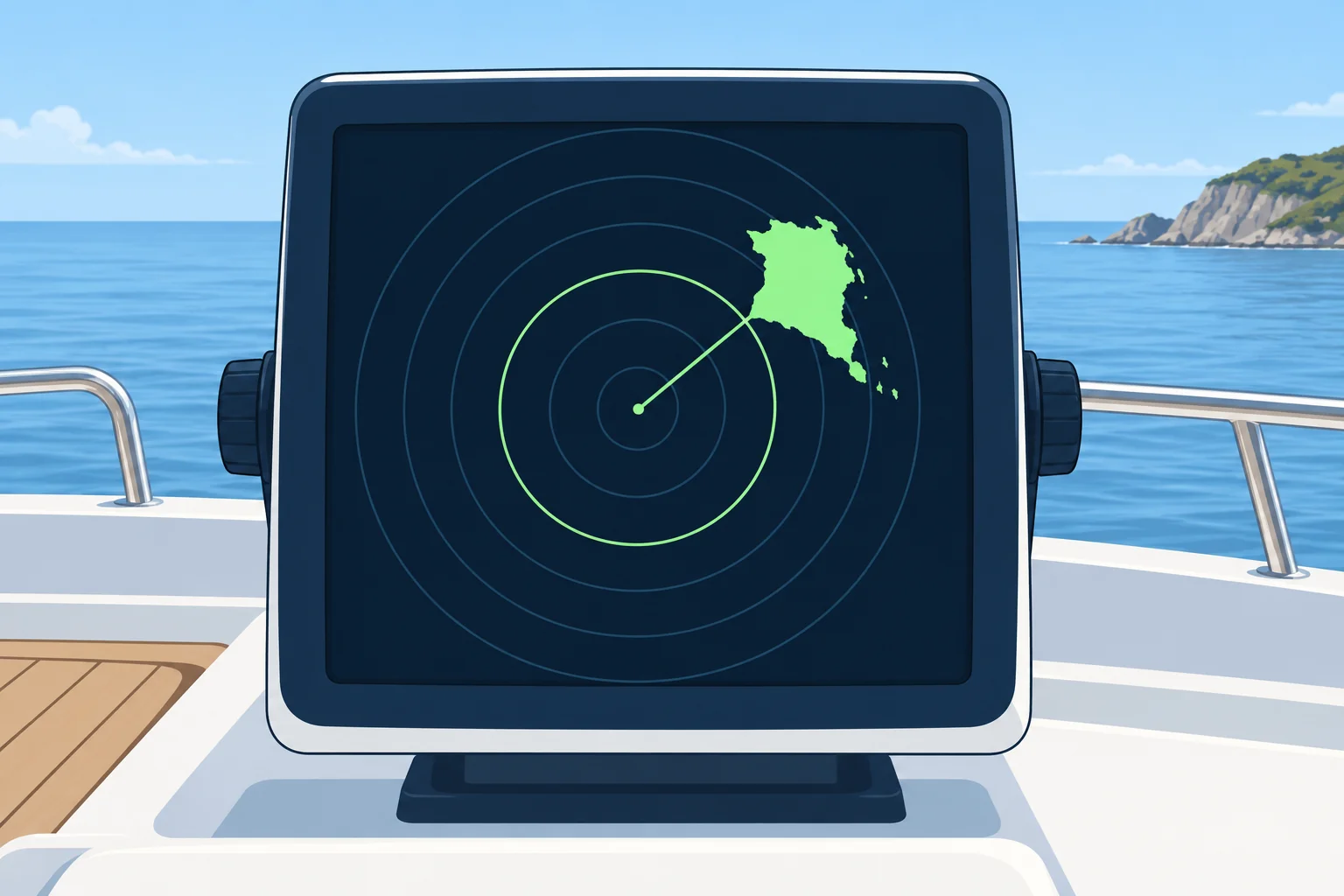
Range rings, VRM and EBL: measuring with radar
1The lesson in plain words
Range rings give a rough distance. The VRM measures range and the EBL measures bearing. Know whether the bearing is relative or true.
Range scale and rings
The range scale is the distance from the centre of the screen to its edge, for example 3 NM. Range rings are fixed circles at set steps, such as every 0.5 NM on that scale. They give a quick estimate. Choose a scale that shows the target well inside the screen; a short scale gives a bigger, more precise picture.
VRM
The VRM (variable range marker) is a circle you can move until it touches the inner edge of an echo. The display then reads its range. Measure to the near edge, the part of the target facing you. For a fix, measure to a steep, charted feature such as a cliff or a pier head. A gently sloping beach may return an echo from inland rather than the charted shoreline.
EBL
The EBL (electronic bearing line) is a line from the centre that you turn until it cuts the middle of an echo. The display reads its bearing. Bisect the echo, because the beam width smears it to both sides. Many sets offer two VRMs and two EBLs. An offset EBL moves its origin away from your boat, letting you measure the bearing from one echo to another.
Relative or true
A relative bearing is measured clockwise from your bow, from 000° to 359°. A true bearing is measured from true north. True bearings need true-heading input from a heading sensor, such as an electronic compass. Correct deviation (compass error caused by your boat) and variation (the difference between magnetic and true north) to obtain true heading. Check the R or T label. Add relative bearing to true heading; subtract 360° if the sum is 360° or more.
Using it for a fix
Radar ranges are the strong part. Two or three ranges of steep, charted objects give a good fix; a visual compass bearing crossed with a radar range of the same object also works. The Position fixing unit covers bearing and range. Check it against depth and the GNSS position.
2Key data
- VRM
- Variable range marker: touch the near edge of the echo
- EBL
- Electronic bearing line: bisect the echo
- True bearing
- Relative bearing + true heading; subtract 360° if sum ≥ 360°
- Spanish terms
- Anillos de distancia, VRM, EBL, marcación, demora verdadera
3Key points
- 1
Use the shortest range scale that shows the target; rings are for estimates, the VRM for measurement.
- 2
VRM to the near edge of a steep, charted object; EBL through the middle of the echo.
- 3
Know whether bearings are relative (from the bow) or true; true needs heading referenced to true north.
- 4
Two or three radar ranges give a better fix than radar bearings.
4Frequent mistakes
Wrong: Set the EBL on the edge of the echo for a precise bearing.
Right: Beam width smears the echo to both sides. Bisect it with the EBL.
Wrong: Any bearing on the screen is a true bearing.
Right: True bearings need heading referenced to true north. Without it, use relative bearings. Check the R or T label.
5Practice case & exam keys
Your heading is 300° true. A steep, identified cliff bears 090° relative on the EBL and measures 2.4 NM on the VRM. Your crew records 090° true and rounds the range to 2 NM from the rings. What should you correct?
Show the answer
Record 030° true: 300° + 090° = 390°, then subtract 360°. Keep the measured range of 2.4 NM; the rings give only an estimate. Check that the VRM touches the cliff's near edge and the EBL bisects its echo. Use the Position fixing unit to plot the measurements.
Exam keys
- VRM to the near edge; EBL bisects the echo.
- Relative bearing + true heading = true bearing (subtract 360° when needed).
- Measure ranges to steep, charted features; radar ranges beat radar bearings.
Finish this unit
When you've read it, match the terms, then answer three questions. Get them all right to finish the unit; opening the page alone doesn't count.
My notes for this unit
No notes