

LPG: the gas and the installation
1The lesson in plain words
Bottled gas is heavier than air. Leaks collect in low spaces and can ignite. A safe installation keeps cylinders outside the cabin.
The gas
LPG (liquefied petroleum gas) is butane or propane, stored as liquid under pressure. Both gases are heavier than air. A leak collects in the bilge, the lowest space inside the hull. Mixed with air at only about 2–10 %, it can explode if ignited. A smell is added so you can detect it.
Butane or propane
Propane keeps working in the cold, down to about −40 °C. Butane stops giving gas near 0 °C, so it suits warm climates. Use a marine regulator (pressure reducer) approved for your gas and matched to the appliance’s rated pressure.
The gas locker
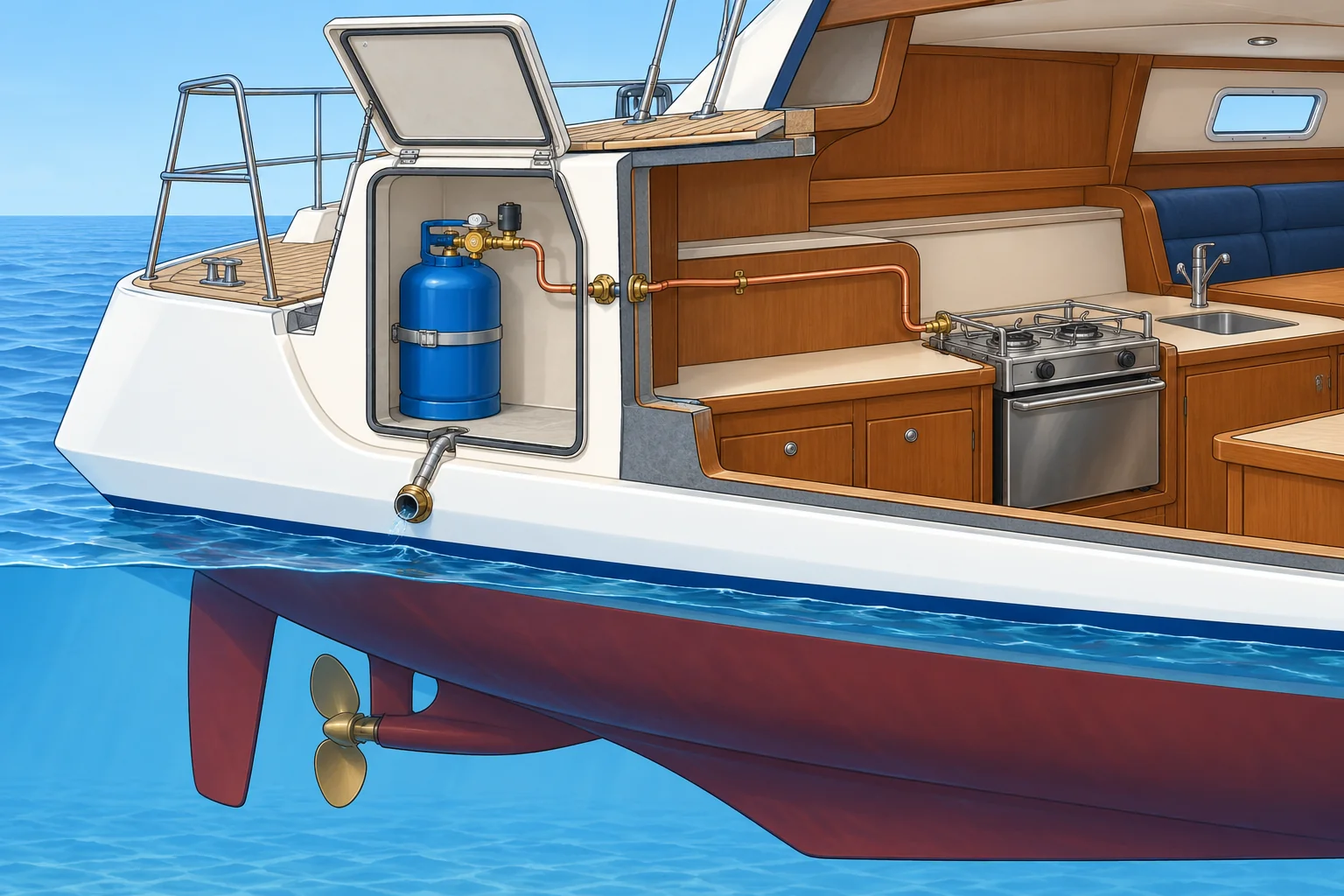
Secure cylinders upright in a gas locker, on deck or opening only to the deck, sealed from the inside of the boat. A drain at the bottom of the locker runs overboard and exits above the waterline, so leaking gas falls out of the boat. Never stow anything that blocks the drain.
From cylinder to stove
A typical installation has a regulator to lower cylinder pressure, a bubble tester after the regulator to check for downstream leaks and a solenoid valve in the locker to shut gas off remotely. Approved pipe or hose carries gas to the galley, the cooking area. A gimballed stove, which pivots as the boat tilts, needs an approved flexible connection. Each burner has a flame failure device that shuts off its gas if the flame goes out.
Standards and checks
Small-craft LPG systems are built to ISO 10239 (current edition 2025) and local rules. Flexible hoses carry a date: replace them as the maker says. Have the system checked by a qualified fitter.
2Key data
- Density
- Propane ≈ 1.5 × air; butane ≈ 2 × air: both sink
- Explosive range
- Roughly 2–10 % gas in air
- Butane
- Little gas below about 0 °C
- Propane
- Works down to about −40 °C
- Standard
- ISO 10239 small-craft LPG systems
3Key points
- 1
LPG is heavier than air: leaks collect in the bilge.
- 2
Cylinders in a sealed deck locker draining overboard above the waterline.
- 3
Regulator, bubble tester, solenoid valve, flame failure devices.
- 4
Use approved LPG pipe and hose; inspect and replace hose as its maker specifies.
- 5
Installed and checked to ISO 10239 and local rules.
4Frequent mistakes
Wrong: Store the spare gas cylinder in a cockpit locker that opens into the cabin.
Right: All cylinders, full or empty, go in a sealed locker that drains overboard. Gas leaking inside the boat sinks into the bilge.
Wrong: Gas rises and escapes through the hatch, like at home.
Right: LPG is heavier than air. It flows down and collects in the lowest part of the boat.
5Practice case & exam keys
A boat you are inspecting has its gas cylinder in a locker under the cockpit seat. The locker has a drain hole, but the drain hose is kinked under a bag of mooring lines and its outlet is below the waterline.
Show the answer
Unsafe. Leaking gas cannot drain away, and with an outlet below the waterline sea water can come in and gas stays trapped. The drain must run down clear of obstructions to an outlet above the waterline, and the locker must be sealed from the inside of the boat. Keep it clear of other gear and have the installation checked.
Exam keys
- LPG (butane/propane) heavier than air; explosive at about 2–10 %.
- Sealed deck locker, drain overboard above the waterline.
- Regulator, bubble tester, solenoid valve, flame failure devices on burners.
- ISO 10239; dated flexible hoses.
Finish this unit
When you've read it, answer three questions. Get all three right to finish the unit; opening the page alone doesn't count.
My notes for this unit
No notes