- 40 questionsin up to 1 hour, mostly multiple choice, with drag-and-drop and hotspot questions tooCBR, recreational boating theory exams (accessed 12-11-2026)
- 56 out of 80points (70 %) to pass, with your result shown immediatelyCBR, KVB1 exam requirements
- € 79,10official costs in 2026 for the exam, health declaration and cardCBR, recreational boating licence costs 2026 (accessed 12-11-2026)
- From age 18to apply for your licenceCBR, all recreational boating licences
- 15 to 25 mfor pleasure craft, with 25 metres itself excludedBinnenvaartbesluit (Inland Navigation Decree), article 16 (version 1 June 2025, accessed 12-11-2026)
- More than 20 km/hwhat a shorter boat can reach, including a jet ski or personal watercraftBinnenvaartbesluit, article 16 (version 1 June 2025, accessed 12-11-2026)
How it works at CBRGet your licence in 5 steps
- Check whether you need a licence
Is your boat shorter than 15 metres and unable to exceed 20 km/h? A licence is optional. If it is 15 to 25 metres long, or a shorter boat capable of more than 20 km/h, such as a speedboat, jet ski or personal watercraft, you need a Klein vaarbewijs. KVB1 covers rivers, canals and lakes. You need KVB2 if you also want to cruise the IJsselmeer, Markermeer, IJmeer, Waddenzee, Oosterschelde, Westerschelde or Eems/Dollard.
- Learn the syllabus
You can choose a book, online course, lessons or a mix. Taking a course is optional. The exam focuses mainly on the Binnenvaartpolitiereglement (BPR, Inland Waterways Police Regulations), covering priority, lights, sound signals, signs and buoyage. It also covers engines and safety, water and weather, and manoeuvring.
- Book your exam in Mijn CBR
Use DigiD (the Dutch digital identity service) to choose a date, time and exam location in Mijn CBR (your CBR online account), then pay straight away. The fee is € 53,15 in 2026. Without DigiD, you can book using an application form or have your training provider arrange the exam.
- Take the theory exam
At a CBR exam centre, you answer 40 questions on screen in up to 1 hour. Your result appears immediately afterwards. You pass with 70 % (56 of the 80 points), and that result remains valid indefinitely.
- Complete the health declaration and get your card
Then complete the Gezondheidsverklaring recreatievaart (recreational boating health declaration) in Mijn CBR (€ 13,25). Within 4 weeks, you will hear whether you are cleared to operate a boat or need to see a doctor first. Once cleared, apply for your licence within 6 months (€ 12,70). Your card arrives by post.
The thresholds in the Binnenvaartbesluit (Inland Navigation Decree)Do you need a boating licence?
The law considers your boat’s length and the speed it can reach under its own engine power relative to the water. The same thresholds apply to hired and privately owned boats. Minimum steering ages also apply where a licence is optional. They are 18 for a fast motorboat (one capable of more than 20 km/h), and 16 for most other motorboats and sailing boats from 7 m (BPR, article 1.09).
| Your boat | Licence required? |
|---|---|
| Shorter than 15 m and unable to exceed 20 km/h, such as most small open launches | No |
| Shorter than 15 m and capable of more than 20 km/h, including speedboats, jet skis, personal watercraft and e-foils | Yes, Klein vaarbewijs 1 or 2 |
| Pleasure craft from 15 to 25 m | Yes, Klein vaarbewijs 1 or 2 |
| Pleasure craft from 25 to 40 m | Yes, Groot pleziervaartbewijs (large pleasure-craft licence) |
| Human-powered only, such as a rowing boat, canoe or pedal boat | No |
Where do you want to cruise with KVB1 or KVB2?
| Licence | Where you may cruise | Exams |
|---|---|---|
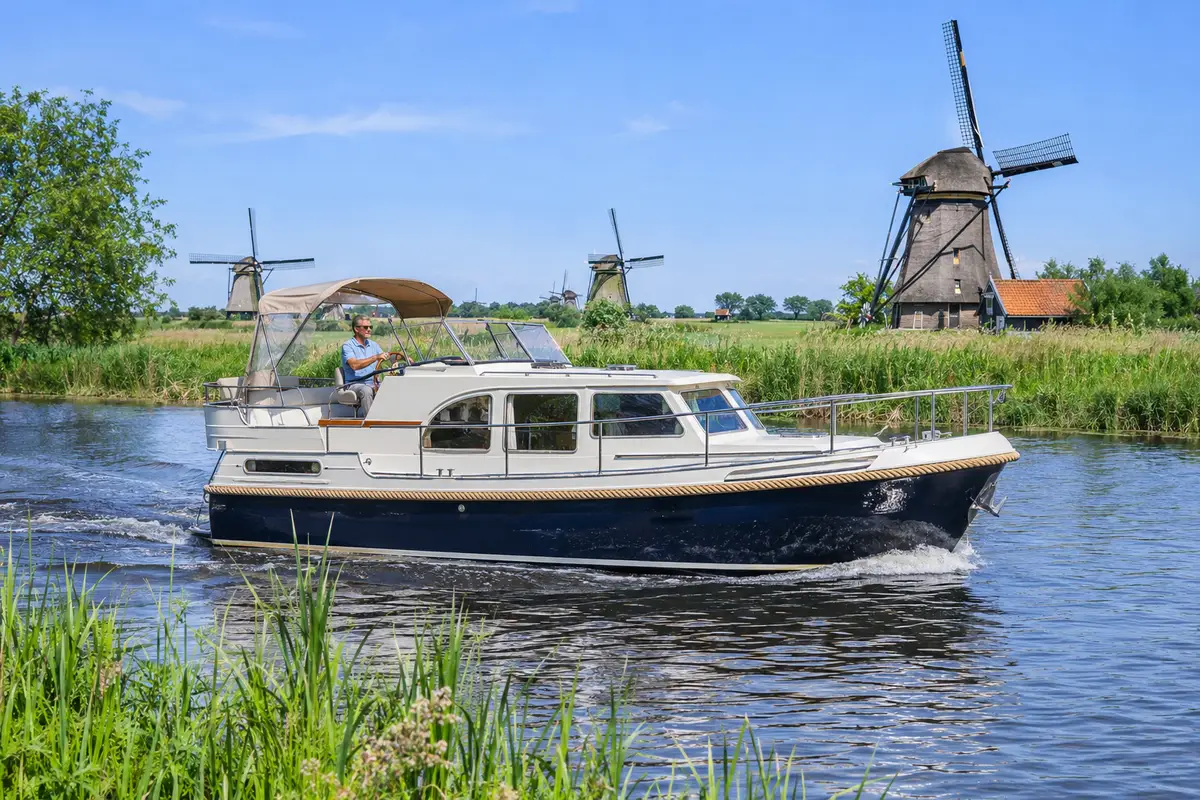
| Klein vaarbewijs 1 | Rivers, canals, lakes and the Gouwzee | KVB1 theory exam |
| Klein vaarbewijs 2 | Also Westerschelde, Oosterschelde, Markermeer, IJmeer, IJsselmeer, Waddenzee and Eems/Dollard | KVB1 and KVB2 theory exams |
What the exam looks likeThe CBR Klein vaarbewijs 1 exam
| Component | What to expect |
|---|---|
| Questions | 40, mostly multiple choice, with CBR also using drag-and-drop and hotspot questions |
| Time | Up to 60 minutes |
| Points | 80 in total, with 56 points or more (70 %) needed to pass |
| A. Legal provisions (BPR) | 18 questions |
| B. Engine, safety and environment | 5 questions |
| C. Waterways, navigable waters and weather | 9 questions |
| D. Boat handling and manoeuvring | 8 questions |
| Result | Immediately on screen, and by email too if CBR has your email address |
Bring these to your exam
- Your booking number from your booking letter or email
- Valid identification
Rescheduling, failing and retaking
- You can reschedule up to 3 times. Until 7 days before your exam, you can move to an earlier or later slot free of charge, with a surcharge for evenings or weekends, or the fee difference payable if moving to 2027
- Within 7 days, you can move only to an earlier slot, subject to availability
- An evening exam (from 18.00) or weekend exam carries a € 6,25 surcharge
- Request extra time (€ 13,50), an interpreter or individual assistance (€ 41,60) when booking
- If you fail, book another exam and pay for each attempt separately
- If you pass, your result stays valid indefinitely, even if you apply for your card later
What does vaarbewijs 1 cost in 2026?
How long does it take?
You decide how long to study. Choose your exam date in Mijn CBR and see your result immediately after the exam. You will hear about your health declaration within 4 weeks, with a longer wait if you need to see a doctor. Then apply for your card and receive it by post.
What you can do herePractise for your exam free
Our free Klein vaarbewijs 1 course follows the CBR exam requirements topic by topic, with a mock exam of 40 questions in 60 minutes. There is also a practice test with 40 questions on international rules (COLREG) for lights, day shapes and sound signals, plus IALA buoyage. The BPR differs from these in some respects. We wrote all the questions in the CBR exam format. CBR’s actual exam questions are unpublished, and our practice uses our own questions. Also try the Klein vaarbewijs 1 sample exam on CBR’s website.
- Klein vaarbewijs 1under 25 metres on rivers, canals, lakes and the Gouwzee
- Klein vaarbewijs 2under 25 metres, also on the IJsselmeer, Waddenzee and Oosterschelde
- Sportpatent (Rhine navigation licence)Rhine navigation document, equivalent to Klein vaarbewijs in the Netherlands
- Groot pleziervaartbewijs 1from 25 to under 40 metres, an existing licence, with CBR now issuing only Groot pleziervaartbewijs 2
- Groot pleziervaartbewijs 2from 25 to under 40 metres on Dutch inland waters
- ICC Coastalcoastal waters only (ICC coastal), with KVB1 and KVB2 themselves already serving as an ICC
Our verdict
Strengths
- A clear starting point for rivers, canals and lakes
- Also relevant for fast motorboats and personal watercraft
- A well-defined theory exam with clear subject areas
Keep in mind
- You need to learn the BPR thoroughly, with international rules providing background
- You need a positive decision on your Gezondheidsverklaring recreatievaart
- For waters such as the IJsselmeer, Waddenzee and Oosterschelde, look at Klein vaarbewijs 2
If you want to use a recreational boat on Dutch inland waters, Klein vaarbewijs 1 gives you a solid, practical foundation. Take the BPR rules seriously. Practise them patiently and you’ll recognise them on the water too.
Related basics (international rules)
Practice tests on the international rules
IALACOLREG Exam Pass
Klein Vaarbewijs I: get ready for your exam with the Exam Pass
Unlimited timed mock exams, every mistake back until it's right, and a readiness score that shows when you're ready for the exam.
512 exam-style questions with explanations · 7 timed subject exams · every simulator scenario
One payment for 12 months, so it covers a resit too. No subscription.
Practice questions (with answers)
An isolated danger mark indicates:
Show answer
Correct answer: B. A danger with navigable water all around
An isolated danger mark is on or near a danger with navigable water around it. Consult charts and nautical publications for the extent of the danger and safe passing distance.
Safe water marks have:
Show answer
Correct answer: A. Red and white vertical stripes
Safe water marks are red and white vertical stripes, indicating navigable water all around.
Special marks are coloured:
Show answer
Correct answer: C. Yellow
Special marks are yellow, indicating special areas like military zones, cables, or pipelines.
How does IALA Region B differ from Region A?
Show answer
Correct answer: B. The colours are reversed — red to starboard
Region A: port-hand red, starboard-hand green. Region B: port-hand green, starboard-hand red. Interpret both in the charted conventional direction of buoyage.
Two vessels navigating in or near restricted visibility are NOT in sight of one another. The crossing provisions of Rule 15:
Show answer
Correct answer: C. Do NOT apply — Rule 19 governs instead
Rule 19 applies when vessels are not in sight. Section II rules (including crossing) only apply when vessels are in sight of each other.
An air-cushion vessel operating in non-displacement mode must additionally show:
Show answer
Correct answer: B. An all-round flashing yellow light
Rule 23(b): an air-cushion vessel in non-displacement mode shows an all-round flashing yellow light.
The day shape for a power-driven vessel towing astern when the tow exceeds 200 metres is:
Show answer
Correct answer: C. A diamond shape
Rule 24(a)(v): a diamond shape is shown where it can best be seen if the tow exceeds 200 metres, measured from the stern of the towing vessel to the after end of the tow.
A vessel under oars at night, if she does not exhibit the lights for sailing vessels, shall:
Show answer
Correct answer: C. Have ready an electric torch or lantern showing a white light, to exhibit in time to prevent collision
Rule 25(d): a vessel under oars may exhibit the lights prescribed for sailing vessels; if she does not, she shall have ready at hand an electric torch or lighted lantern showing a white light to be exhibited in sufficient time to prevent collision.
The full guide
Klein Vaarbewijs I is the Dutch small boat licence for rivers, canals and lakes. A Klein Vaarbewijs is required for a pleasure craft at least 15 m and under 25 m long, or for a motorboat under 15 m capable of exceeding 20 km/h under its own mechanical power relative to the water (including personal watercraft).
The CBR theory exam is about Dutch inland rules, above all the Binnenvaartpolitiereglement (BPR). Our lessons cover the international rules for buoyage, lights and sound signals, which are useful background but not the BPR itself.
Who needs Klein Vaarbewijs I
Recreational skippers on Dutch rivers, canals and lakes. A Klein Vaarbewijs is required for a pleasure craft at least 15 m and under 25 m long, or for a motorboat under 15 m capable of exceeding 20 km/h under its own mechanical power relative to the water (including personal watercraft).
How to prepare
Study the BPR and the CBR exam requirements with a course book or course, and use the CBR sample exam. These lessons only add background on buoyage, lights and sound signals.
Other exams
Reviewed by Ramon Curto, Nautical teacher at IECNPC · Last reviewed: