
- Under 25 mpleasure craft, including fast motorboats
- From 18Dutch boating licences
- 2 examspass both KVB1 and KVB2
- 27 questionsin the KVB2 exam
- 90 minutestime allowed for the KVB2 exam
- 35 out of 50points or more to pass
The extensionWhat Klein Vaarbewijs II adds
Klein Vaarbewijs II extends Klein Vaarbewijs I. KVB1 covers rivers, canals and lakes, and KVB2 adds larger Dutch waters such as the Waddenzee, IJsselmeer and Oosterschelde. You need to pass both exams, KVB1 and KVB2.
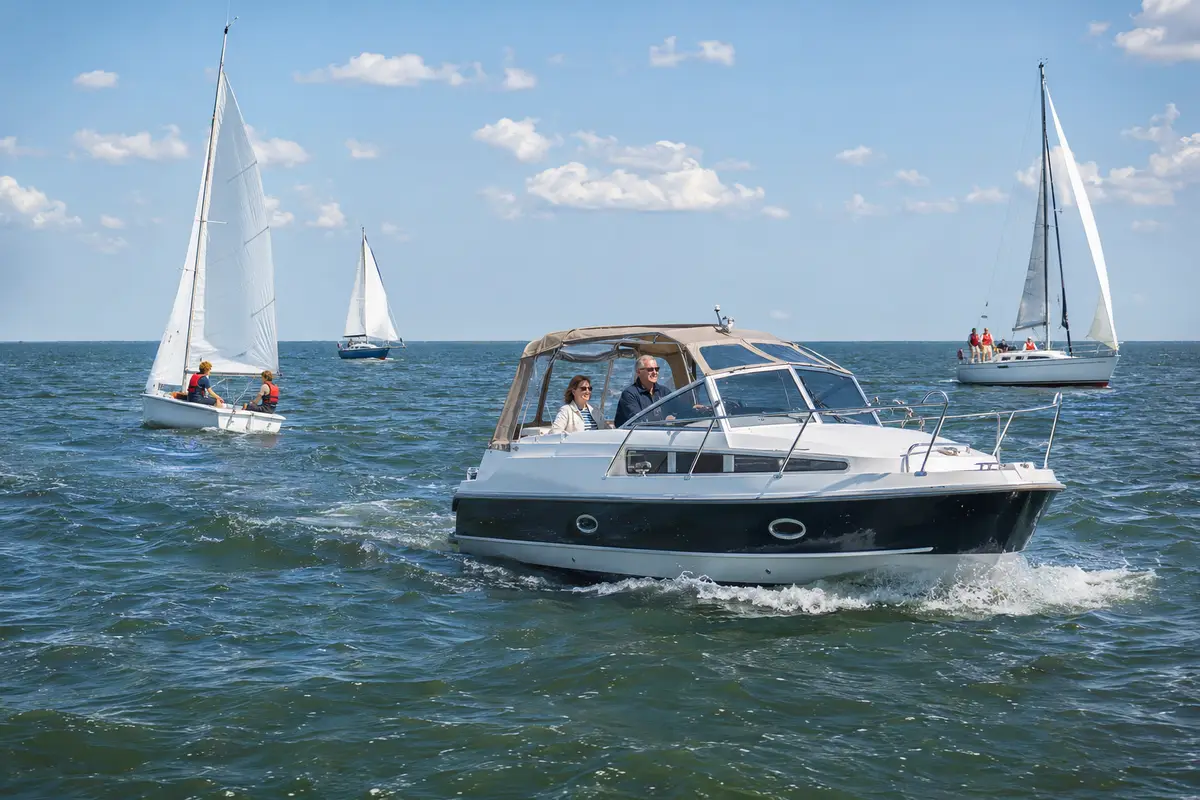
Your cruising areaFrom sheltered routes to broader waters
This is the licence for skippers whose boat requires a licence and whose plans reach beyond familiar river, canal or lake routes. Larger waters bring their own rules and navigation demands. Reading a position on a chart, plotting a course and allowing for tides, currents and weather become practical core skills.
With KVB2 you can
- Operate a boat that requires a licence on the larger Dutch waters covered by KVB II
- Cruise the Westerschelde, Oosterschelde, Markermeer, IJmeer, IJsselmeer, Waddenzee, Eems and Dollard
- Operate a pleasure craft under 25 metres, including fast motorboats, on Dutch inland waters
- Take your KVB2 abroad, where it also serves as an ICC (International Certificate of Competence) for inland and coastal waters, subject to the destination country’s rules
Limits to bear in mind with KVB1 alone
- The larger waters requiring KVB II remain outside its scope
- KVB2 preparation also requires chart use, courses, tides and currents
- Full KVB2 preparation includes more than international boating rules
Before you beginWhat you need
- Be 18 years old, as Dutch boating licences are available from age 18
- Pass both the KVB1 and KVB2 exams
- Check CBR’s current conditions for your boat and cruising area
Focused preparationHow to work towards KVB2
- Master KVB1 first
Start with the KVB1 syllabus. For Klein Vaarbewijs II, you ultimately need to pass both the KVB1 and KVB2 exams.
- Study broader waters separately
Study the rules for larger waters and navigation as a separate subject, for example with our free KVB2 course or a coursebook. Charts, courses, tides, currents and weather all receive attention.
- Work through the navigation yourself
Solve navigation exercises yourself and check them against your course material. This builds your calculation and reasoning skills for courses and positions alongside your knowledge of the rules.
- Use the CBR sample exam
Use CBR’s sample exam to see which areas still need extra attention.
- Complete both exams
KVB2 works together with KVB1. You meet this combination’s requirements once you have passed both exams.
In the exam roomWhat to expect in the KVB2 exam
| Component | What to expect |
|---|---|
| Duration | 90 minutes |
| Questions | 27 in total, with 23 multiple-choice and 4 open questions |
| Points | Each question is worth 1 to 4 points, with 50 points available overall |
| Pass mark | Pass with 35 points or more |
| Sections | 8 questions on rules for larger waters and 19 on navigation |
| Open questions | Work through questions 24 to 27 on the exam charts of the Markermeer and Waddenzee, then type your answer within a specified tolerance |
| Topics | Legal provisions for larger waterways, chart use, courses, tides, currents and weather |
| Bring with you | A course plotter, navigation triangle or parallel ruler, and dividers. CBR provides the exam chart, scrap paper, pen and calculator |
| Cost | € 63,25 for the KVB2 theory exam (2026), with the KVB1 exam paid separately (€ 53,15) |
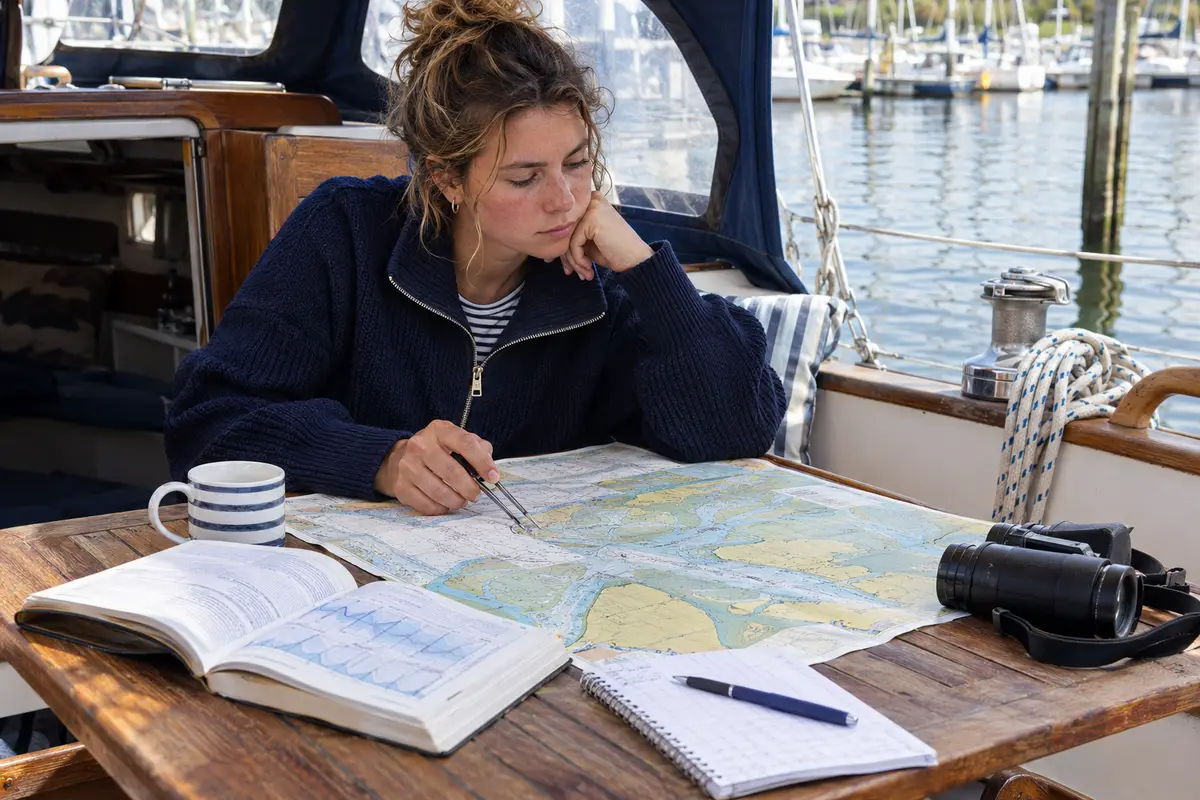
The Dutch routeWhere KVB2 fits
- Klein Vaarbewijs Iunder 25 m on rivers, canals, smaller lakes and the Gouwzee
- Klein Vaarbewijs IIunder 25 m, also on Westerschelde, Oosterschelde, Markermeer, IJmeer, IJsselmeer, Waddenzee and Eems/Dollard
- Sportpatent (Rhine navigation licence)under 25 m on the Rhine upstream of Spijksche Veer
- Groot Pleziervaartbewijs I (large pleasure-craft licence I)from 25 to under 40 m on rivers, canals and smaller lakes
- Groot Pleziervaartbewijs IIfrom 25 to under 40 m on Dutch inland waters
- ICC Coastaloptional international certificate of competence for coastal waters
Our verdict
Strengths
- Extends KVB1 to larger Dutch waters
- Navigation, tides, currents and weather receive the attention broader waters demand
- A clear exam format of 27 questions in 90 minutes
Keep in mind
- You need both the KVB1 and KVB2 exams
- Four open questions require answers within a specified tolerance
- An international-rules practice test covers only part of the KVB2 syllabus
Klein Vaarbewijs II is the logical next step when your cruising plans reach beyond rivers, canals and lakes. Take navigation seriously and build on a solid KVB1 foundation to prepare properly for the Waddenzee, IJsselmeer or Oosterschelde.
Related basics (international rules)
Practice tests on the international rules
IALACOLREG Exam Pass
Klein Vaarbewijs II: get ready for your exam with the Exam Pass
Unlimited timed mock exams, every mistake back until it's right, and a readiness score that shows when you're ready for the exam.
512 exam-style questions with explanations · 7 timed subject exams · every simulator scenario
One payment for 12 months, so it covers a resit too. No subscription.
Practice questions (with answers)
Safe water marks have:
Show answer
Correct answer: A. Red and white vertical stripes
Safe water marks are red and white vertical stripes, indicating navigable water all around.
Special marks are coloured:
Show answer
Correct answer: C. Yellow
Special marks are yellow, indicating special areas like military zones, cables, or pipelines.
A power-driven vessel towing astern with tow length exceeding 200 metres, measured from her stern to the after end of the tow, shows:
Show answer
Correct answer: C. Three masthead lights in a vertical line
Rule 24(a)(i): three masthead lights in a vertical line when the tow exceeds 200 metres.
The towing light is:
Show answer
Correct answer: C. Yellow, with the same arc as the sternlight
Rule 21(d) defines the towing light as yellow with the same characteristics as the sternlight. Rule 24(a)(iv) places it in a vertical line above the sternlight.
The optional pair of all-round lights near the top of a sailing vessel's mast is:
Show answer
Correct answer: B. Red over green
Rule 25(c) permits red over green all-round lights, in addition to separate sidelights and sternlight. These are not masthead lights as defined in Rule 21(a), and must not be combined with the Rule 25(b) combined lantern.
A vessel engaged in trawling shows:
Show answer
Correct answer: B. Green over white all-round lights
Rule 26(b)(i) prescribes green over white all-round lights for a vessel engaged in trawling; the fishing signals also apply while engaged in fishing at anchor.
How does IALA Region B differ from Region A?
Show answer
Correct answer: B. The colours are reversed — red to starboard
Region A: port-hand red, starboard-hand green. Region B: port-hand green, starboard-hand red. Interpret both in the charted conventional direction of buoyage.
An East Cardinal mark shows how many quick flashes?
Show answer
Correct answer: B. 3 flashes
White lights, when fitted: North Q or VQ; East VQ(3) 5 s or Q(3) 10 s; South VQ(6)+LFl 10 s or Q(6)+LFl 15 s; West VQ(9) 10 s or Q(9) 15 s. The long flash lasts at least 2 s.
The full guide
Klein Vaarbewijs II is the extended Dutch small boat licence. Besides rivers, canals and lakes it covers the larger Dutch waters, such as the Wadden Sea, the IJsselmeer and the Oosterschelde.
You need both the KVB I exam and the KVB II exam. The KVB II exam covers the rules for the larger waters and navigation, including tides and chartwork.
Who should take Klein Vaarbewijs II
Skippers who need a small boat licence and want to sail on the larger Dutch waters for which KVB II is required.
How to prepare
Prepare the KVB I material first, then the rules for the larger waters and navigation with a course book or course, using the CBR sample exam.
Other exams
Reviewed by Ramon Curto, Nautical teacher at IECNPC · Last reviewed: