
Plan the tow, including the trip to the ramp
A boat towing a person needs a driver and a separate observer, registration if applicable, a safety label where required and the required safety equipment.
A towing PWC must be registered, display a PWC behaviour label and be designed for at least two people. Boating Handbook, p. 101.
A powerboat driver needs a boat licence at 10 knots or more; a PWC driver needs a PWC licence at any speed. The observer must hold a boat or PWC licence if under 16, be fit to observe, know the hand signals, keep a lookout and always face backwards towards the rider. Their job is to communicate with the rider and warn the driver about trouble and approaching vessels. The driver keeps a proper lookout ahead. Everyone being towed must wear a Level 50S or higher lifejacket; inflatable lifejackets are not recommended for towing. The driver must make sure the rope and equipment do not endanger or obstruct anyone. On a boat, the driver and observer must wear lifejackets when required by the lifejacket rules. On a PWC both must always wear one. Boating Handbook, pp. 13, 34, 101–103.
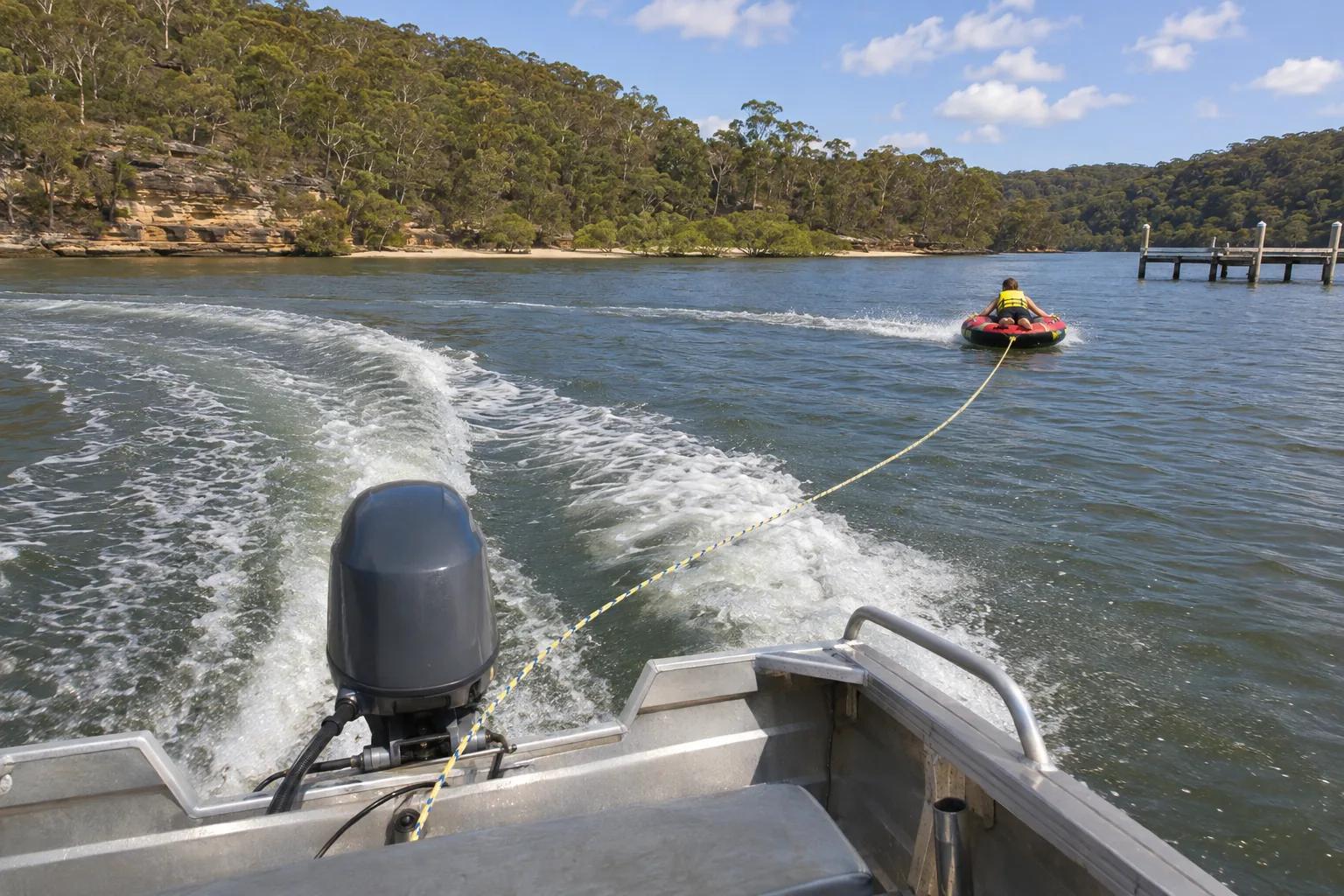
For an ordinary tow, use a rope long enough to keep the rider at least 7 metres behind the vessel. The handbook's shorter-distance exception requires both reduced carbon monoxide risk and a propeller forward of the back of the hull. Do not assume a short rope behind an outboard is safe. Avoid sudden loads on the rope: accelerating sharply while it is slack can seriously injure someone. Never pull someone through the water while they hold onto the back of the vessel. Never tow more than three people at once or tow between sunset and sunrise. Boating Handbook, pp. 101–105.
Page 103 limits towing drivers aged 16 or under to 10 knots, unless exempt in an organised event. For drivers under 16, the licensing webpage and handbook disagree about towing restrictions: use the stricter approach and do not drive while towing a person; check the current TfNSW page. Do not treat 10 knots as permission for an under-16 driver to tow. If the rider or anyone aboard is under 18, the maximum towing speed is 60 knots; conditions and local limits may require far less. Boating Handbook, pp. 20, 101–105.
The boat, tow equipment and rider must all keep the required distances: 60 metres from people in the water, swimming and surf-zone boundaries, and dive flags or floats; 30 metres from vessels, shore and structures at 6 knots or more. If those distances are not possible, safe distance and speed still apply. Allow extra room when turning: the rider swings wider than the boat, especially on an inflatable. Follow local no-towing signs. Aerial towing has a separate 200-metre clearance from other vessels, cables, wires, pipelines, bridges and structures. Tow-in surfing has its own special rules; do not use its observer exception for ordinary towing. Boating Handbook, pp. 104–105.
Wakeboarders and wakesurfers must stay at least 7 metres from the centreline of the stern, even without a rope, unless the same carbon-monoxide and forward-propeller conditions are met. They must wear lifejackets. Keep wash from affecting others unreasonably. When returning a rider to shore, keep clear of people and use a safe speed; a fast whip turn or fling finish can be fatal. If safe, stop and bring the rider aboard instead. Boating Handbook, pp. 103–106.
On the road, never carry a person in a trailer or the boat being trailered. Tow only one trailer and keep it under control. Learner drivers must not tow; P1 drivers may tow only a light trailer weighing less than 250 kg empty. If your vehicle and trailer combination is over 7.5 metres long, stay at least 60 metres behind other vehicles over 7.5 metres, except on a multi-lane road, in a built-up area or when overtaking. Check the road towing and dimension requirements for your combination. Boating Handbook, p. 107.
- Driver looks ahead; observer faces backwards and watches the rider.
- Every rider wears a lifejacket, including on an inflatable.
- Allow for the rider's wider path and stop towing before sunset.
- Recover a rider safely; stopping and bringing them aboard is recommended when safe.
Check this lesson
A wakesurfer has let go of the rope behind an outboard runabout whose propeller is behind the hull. What minimum separation still applies?