
Look after it before you need it
Check for damage, rinse off salt after use and store lifejackets dry, ventilated and out of sunlight.
Keep them away from oil and fuel. Do not use them as cushions or fenders, and remove new jackets from their plastic wrapping before storage (Boating Handbook, p. 44).
Service an inflatable once a year, or in accordance with the manufacturer's instructions. Record the service date inside the jacket and keep receipts or certificates. You must show the service record if a TfNSW authorised officer or police asks. Self-servicing is only an option where the manufacturer's instructions allow it; follow the instructions for that model (pp. 44–47).
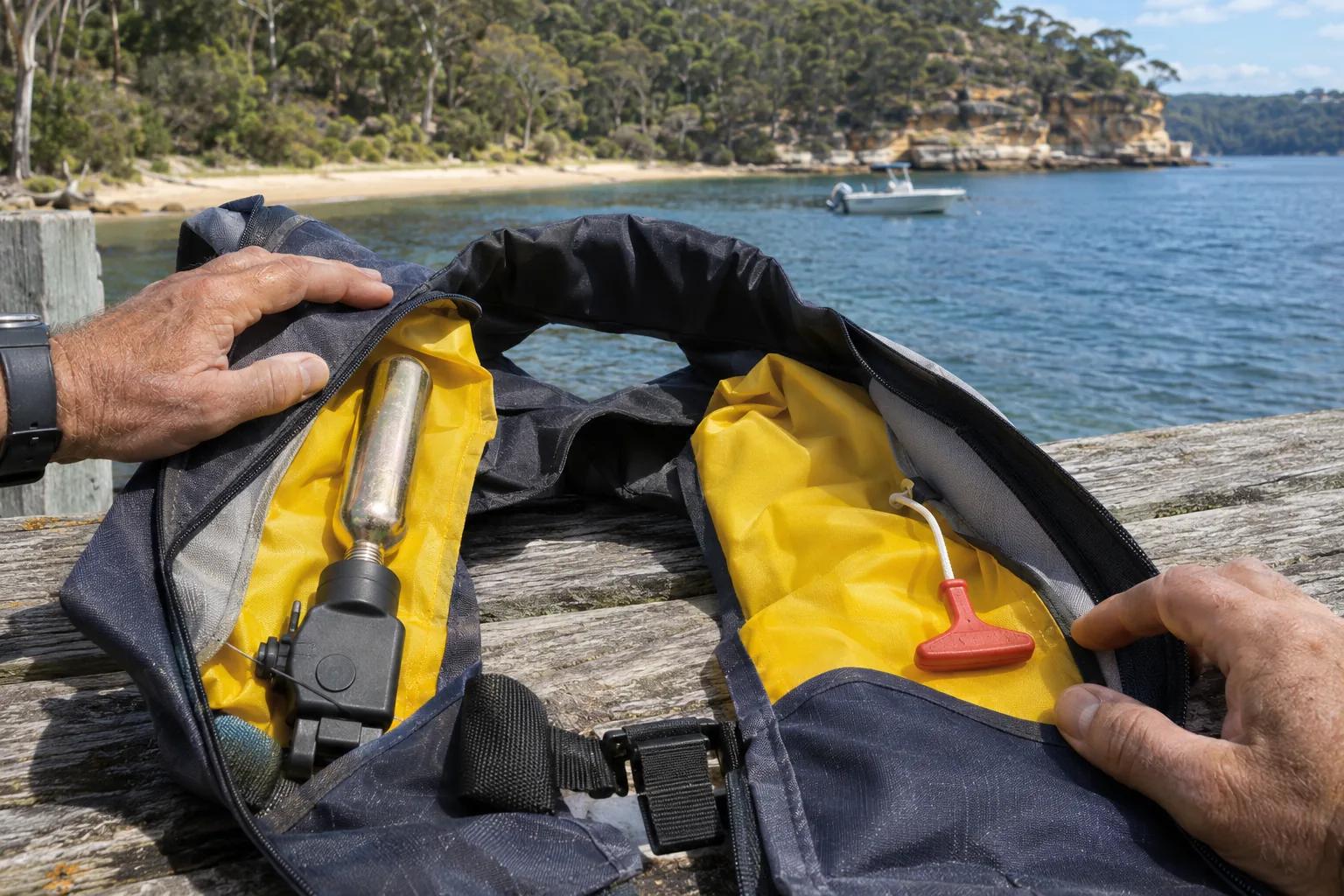
Before wearing an inflatable, inspect for wear. Check that the CO2 cylinder is unpierced and hand tight, any automatic cartridge is hand tight and in date, and the pull cord is free. A quick check does not replace the scheduled service. If the bladder loses pressure during the prescribed overnight check, or another part fails inspection, do not use it: take it to an accredited service agent (pp. 45–47).
- Know whether your jacket inflates manually by pulling a tab or automatically on contact with water; spray can activate an automatic jacket. After use, remove the automatic cartridge before rinsing with fresh water, dry the jacket and reconnect the cartridge before storing (p. 45).
- For permitted self-servicing, check fabric, seams, buckles, fastenings and straps; inflate the bladder through its oral tube and leave it overnight to check for leaks. Deflate with the inverted tube cap, never by inserting another object into the valve (p. 46).
- Remove and inspect the CO2 cylinder for rust, corrosion or piercing. Weigh it: the handbook says its weight should match the marked minimum gross weight or be within 2 grams. Check the pull cord and firing pin, and that automatic components are armed and in date. Follow the model instructions for replacements and hand-tight refitting; take failed inspections to an accredited service agent (pp. 46–47).
- Repack exactly as the manufacturer directs, with the pull cord accessible.
- Foam jackets do not need inflatable servicing, but still need inspection and care (p. 41).
Check this lesson
During permitted self-servicing, a CO2 cylinder looks intact. Which further check does the handbook describe?