
The equipment you use on both kinds of water
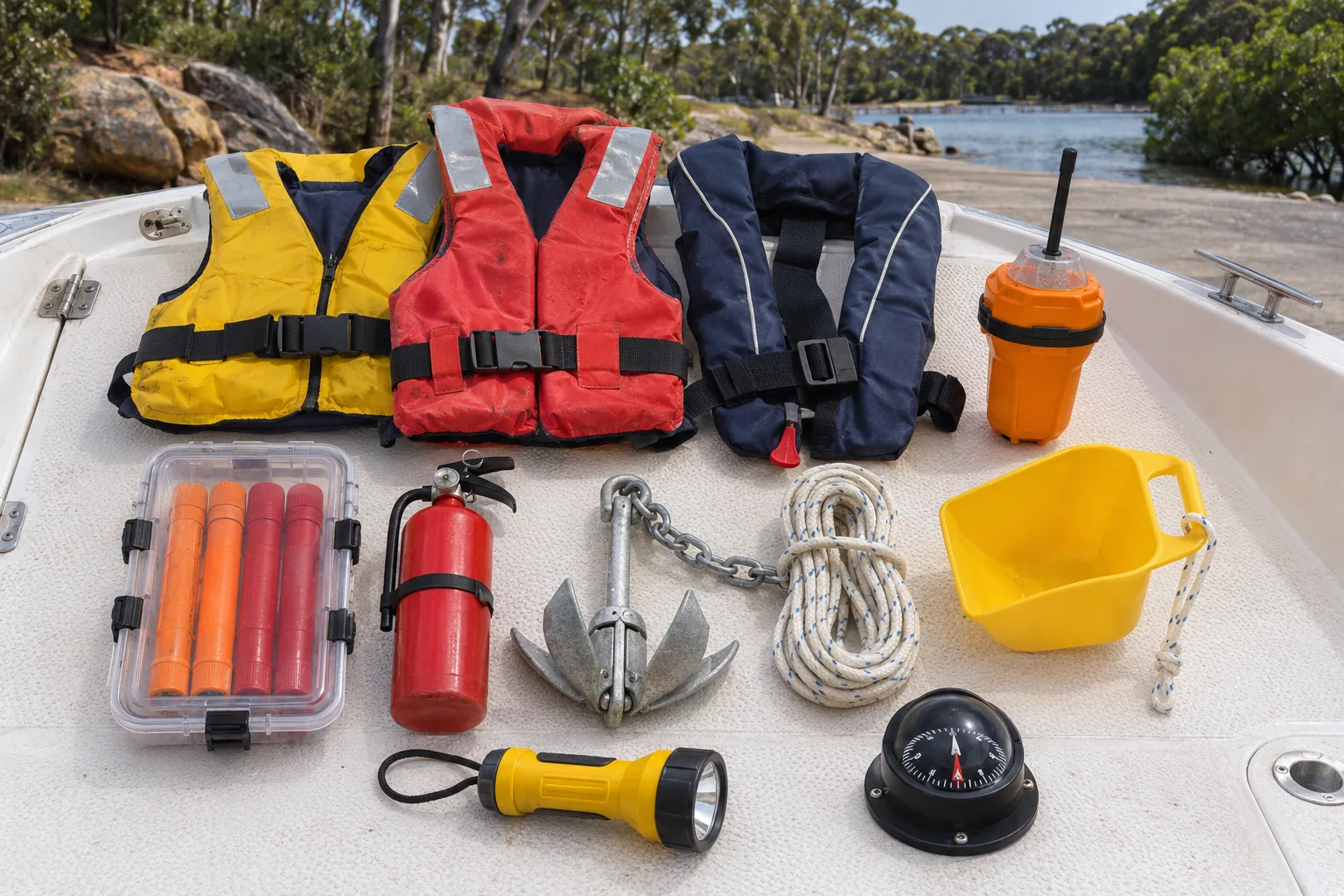
An anchor can stop a broken-down boat drifting onto rocks or breaking waves.
Carry the right type and size for your boat and the seabed. Sand (Danforth) anchors suit sand or mud; reef anchors (grapnels) suit rocky areas; plough anchors suit larger, heavier boats in sand or mud but may catch on rocks. Include chain and allow about three times the water depth in anchor line, plus extra for bad weather or emergencies. The checklist exempts sailing boats up to 6 metres from carrying an anchor. Boating Handbook, pp. 48 and 56.
A bailer or bucket removes water by hand; it must have a lanyard. Covered bilges or closed underfloor compartments, other than airtight void spaces, need a manual or electric bilge pump able to drain each compartment. Pumps need strainers to prevent choking. There is a source conflict: handbook p. 56 lists a bailer exemption for some powerboats with these compartments, while the web checklist does not. Carry a sturdy bailer or bucket with a lanyard as well as the required pump, and check the current TfNSW page before relying on an exemption. Both checklists exempt sailing boats with permanently enclosed, self-draining hulls.
A fire extinguisher is required for a boat with electric start, an electric engine, a battery, gas installation or a fuel stove. It must meet AS 1841 and be securely fixed where it is easy to reach. Additional extinguishers are required if you carry flammable liquids below deck, have LPG or other flammable gas aboard, or have sleeping accommodation. Choose an extinguisher suited to the fire risks aboard: not every type is safe for every fire class. Use the suitability table on p. 52 and advice from an authorised dealer. Boating Handbook, pp. 51–52 and 57.
Protect the extinguisher from saltwater and inspect for rust, dents, corrosion or other damage. Check that the gauge is green; replace it if the gauge is red. The cylinder date should be less than five years old or within the expiry date, and servicing must follow the manufacturer's instructions through the manufacturer or an authorised agent before expiry. Give it a gentle shake before boating. Boating Handbook, p. 51.
The handbook recommends at least a 5B rating for less than 25 litres of fuel and at least 20B for more than 25 litres; it does not specify exactly 25 litres, so seek advice from an authorised dealer for that case. Boating Handbook, pp. 51 and 57.
- Lifejackets: one approved lifejacket for each person.
- Paddles or oars with rowlocks: required on boats up to 6 metres unless there is a second means of propulsion, such as a second engine.
- Safety label: it shows the maximum number of people and load, plus other safety information. Display it on an ordinary powerboat where everyone aboard can see it. Sailing boats and PWC are excluded from this powerboat label rule.
- Sound signal: carry an air horn, whistle or bell to signal to other vessels or attract attention.
- Torch: carry a working, floating waterproof torch, including on daytime trips. Use it for signalling or working on the engine. Store it with spare bulbs and batteries in an accessible, sealed waterproof container.
Check this lesson
What information does the ordinary powerboat's safety label give passengers?