
Add the open-water equipment before you leave
For a powerboat or sailing boat covered by the main checklist, open waters require extra navigation, signalling and drinking-water supplies.
These are needed even for a short trip close to shore. Charts must show navigation features such as shallows, reefs, hazards and channels. Download digital charts before departure so you can use them without reception. You must be able to show the chart to TfNSW authorised officers or police if asked. Satellite navigation does not remove the compass requirement. Boating Handbook, pp. 49 and 56–57.
Use the checklist's stricter threshold: carry a registered, in-date 406 MHz EPIRB and a marine radio at 2 nautical miles or more from shore on open waters. There is a conflict: handbook p. 57 and the web checklist say '2nm or more', but the descriptive text on pp. 50 and 53 and the essential-equipment web page say 'more than 2nm'. Include exactly 2 nautical miles in your preparation and check the current TfNSW page. Both items are recommended even closer to shore.
An EPIRB alerts search and rescue services through a distress signal, transmitted for at least 48 hours once activated. It must meet AS/NZS 4280.1 and transmit on 406 MHz. Register it with AMSA and keep it accessible without risking accidental activation. If it activates accidentally, switch it off immediately and contact AMSA. A personal locator beacon (PLB) is extra protection for a person; it does not replace a required EPIRB. Boating Handbook, pp. 49–50.
A marine radio lets you call nearby vessels or shore stations, report your trip and receive warnings. VHF and 27 MHz are line-of-sight radios. VHF is recommended because it is more reliable, has a longer range and is more widely monitored. HF suits longer-range communication beyond sight of land. VHF channel 16 is for distress, safety and calling. Using VHF or HF requires a radio operator's certificate. A mobile phone does not replace a required marine radio. Boating Handbook, pp. 49–50 and 53–54.
- Navigation: a chart of your operating area, printed or digital, and a fluid-filled magnetic compass.
- Flares: two in-date orange smoke flares for daytime use and two in-date red hand flares for day or night. Store them in an accessible, sealed waterproof container; everyone should know how to use them.
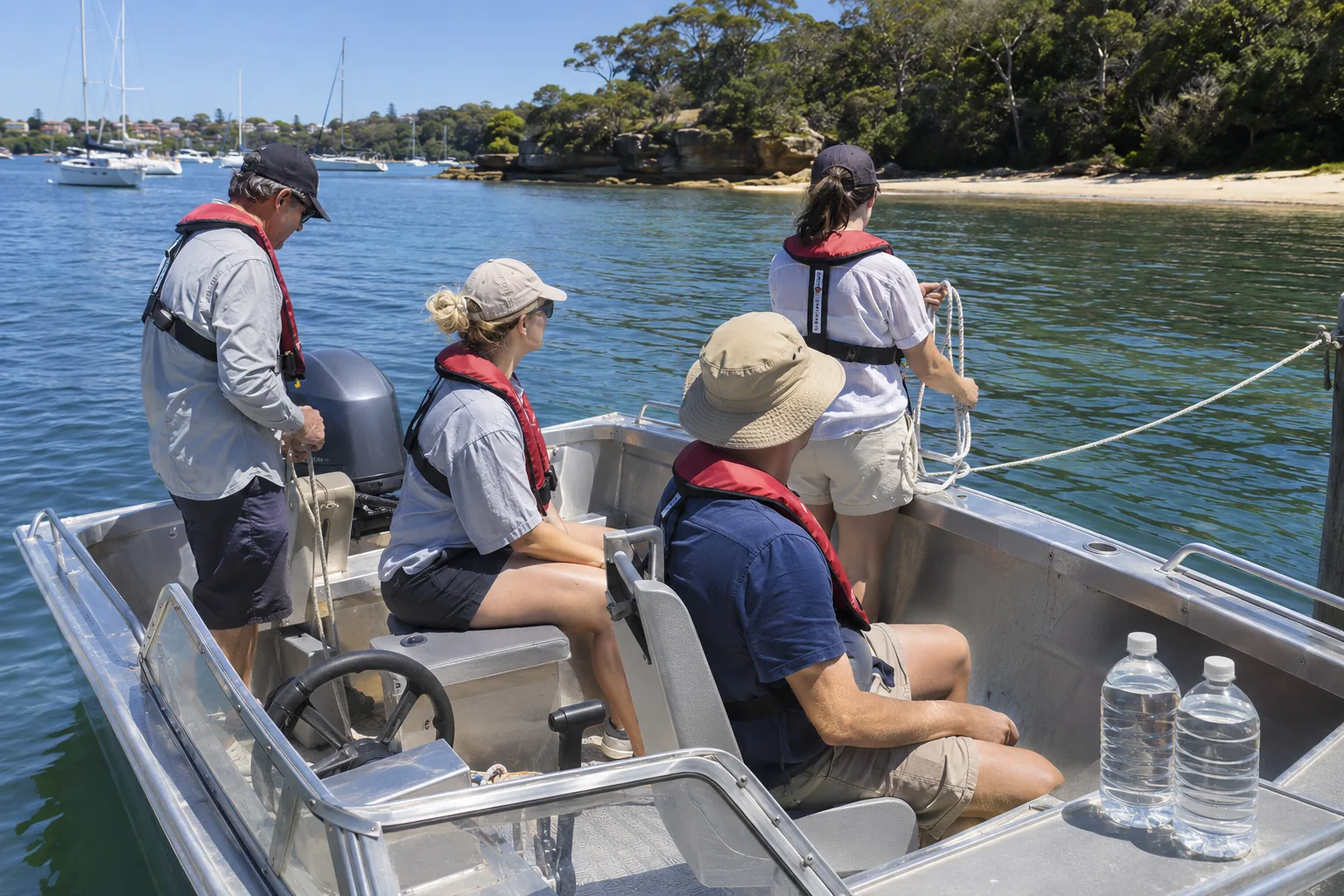
- Water: at least 2 litres of fresh drinking water for each person aboard.
- V sheet: one fluorescent orange-red sheet with a black V, at least 1.8 metres by 1.2 metres. Spread it on deck or fly it to show you are in trouble. Keep it in an accessible, sealed waterproof container.
- Use flares when there is a chance they will be seen. Replace them before expiry and use an approved disposal service for expired flares.
Check this lesson
Which description helps you choose a marine radio for a trip beyond sight of land?