
Astronomy and celestial navigation · Level R5 · 4 parts · about 13 min
Compass error by azimuth and amplitude
4 short parts: The principle · By azimuth · By amplitude · Using results. Each part explains the idea, then gives the points to remember, the common mistakes, a worked case and a practice question; the Academy unit adds all 22 check questions.
1 · The principle
Compass error from a celestial body
Calculate a body's true bearing for the moment you take its compass bearing. The difference is your compass error, anywhere in the ocean.
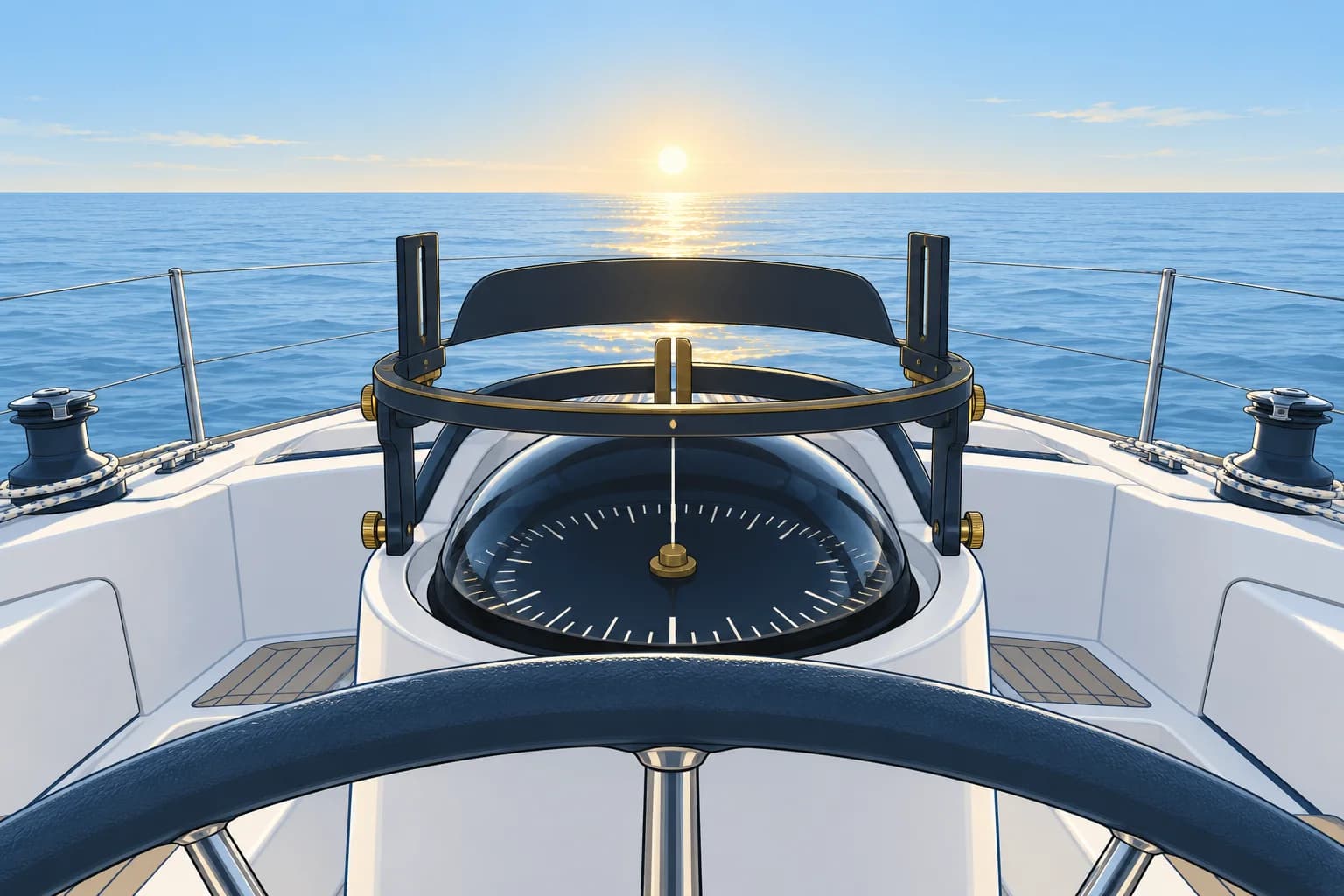
The idea
Far from land, a celestial body gives you a reference bearing. Its true azimuth is its bearing clockwise from true north. Calculate it for your position and the observation time. Compare it with the compass bearing taken at that moment. Compass error = true − compass. Add or subtract 360° if needed to keep the result between −180° and +180°. Positive is east; negative is west.
Two methods
An azimuth observation can be made whenever the body is low enough to bear accurately over the compass; you calculate its true azimuth for the exact time. An amplitude observation is made as the body rises or sets; its true bearing then needs only latitude and declination. Polaris gives a third check at night.
Why the Sun
The Sun is the usual body: bright, easy to bear and up every day. Use the compass sight's solar filter, and take a bearing of the centre of the disc. Bright planets and stars work as well, low in twilight.
How often
On an ocean passage, check the steering compass at least once a day, and after a large change of heading or when new gear is stowed near it. Log every check: date, UT, heading, true bearing, compass bearing, error, variation and deviation.
Ships too
A ship's gyrocompass has no variation or deviation but can still have a small error. The same observation finds it: gyro error = true − gyro bearing. The magnetic standby compass is checked the same way.
Key figures
- Compass error
- True − compass; + is east, − is west
- Azimuth method
- Any time the body is low; true azimuth for the exact UT
- Amplitude method
- At rising or setting; needs only latitude and declination
- Frequency at sea
- At least daily, and after big heading changes
- Gyro error
- True − gyro bearing, by the same observations
- Spanish terms
- Corrección total (Ct) por azimut o por amplitud
Remember
- The sky gives a true bearing anywhere: compass error = true − compass.
- Azimuth: any time the body is low, timed exactly. Amplitude: at rising or setting.
- Check the steering compass at least daily on passage, and log every check.
- The same method finds a ship's gyro error.
Common mistakes
Wrong: Compass error = compass bearing − true bearing.
Right: Subtract compass from true. For 005°T and 355°C, add 360° to −350°: the error is 10°E.
Wrong: Once the deviation card is made, the compass needs no more checks at sea.
Right: Deviation changes with heading and with gear moved near the compass. Check it daily on passage.
Worked case
Two heading displays disagree by 6°. You have a reliable DR position, accurate UT and a low afternoon Sun. Sunrise visibility looks poor. Which compass check do you make now, and what do you log?
Show the answer
Make an azimuth check now. Take the Sun's compass bearing on a steady heading and note the exact UT. Calculate its true bearing, then find compass error and, with variation, deviation. Log the date, UT, heading, true and compass bearings, error, variation and deviation. Use the corrected steering compass to check the other display.
Practice question
The Sun's true azimuth is 241.7°T and it bears 255.6°C. What is the compass error?
- 13.9°E
- 13.9°W
- 16.1°W
- 4.0°E
Show the answer
Answer: B. Error = true − compass = 241.7 − 255.6 = −13.9°, so 13.9°W.
2 · By azimuth
Worked: compass error by azimuth, 4 December 2026
Note the exact UT of the bearing, work out LHA, then the Sun's true azimuth by formula or tables. Worked on an Atlantic crossing.
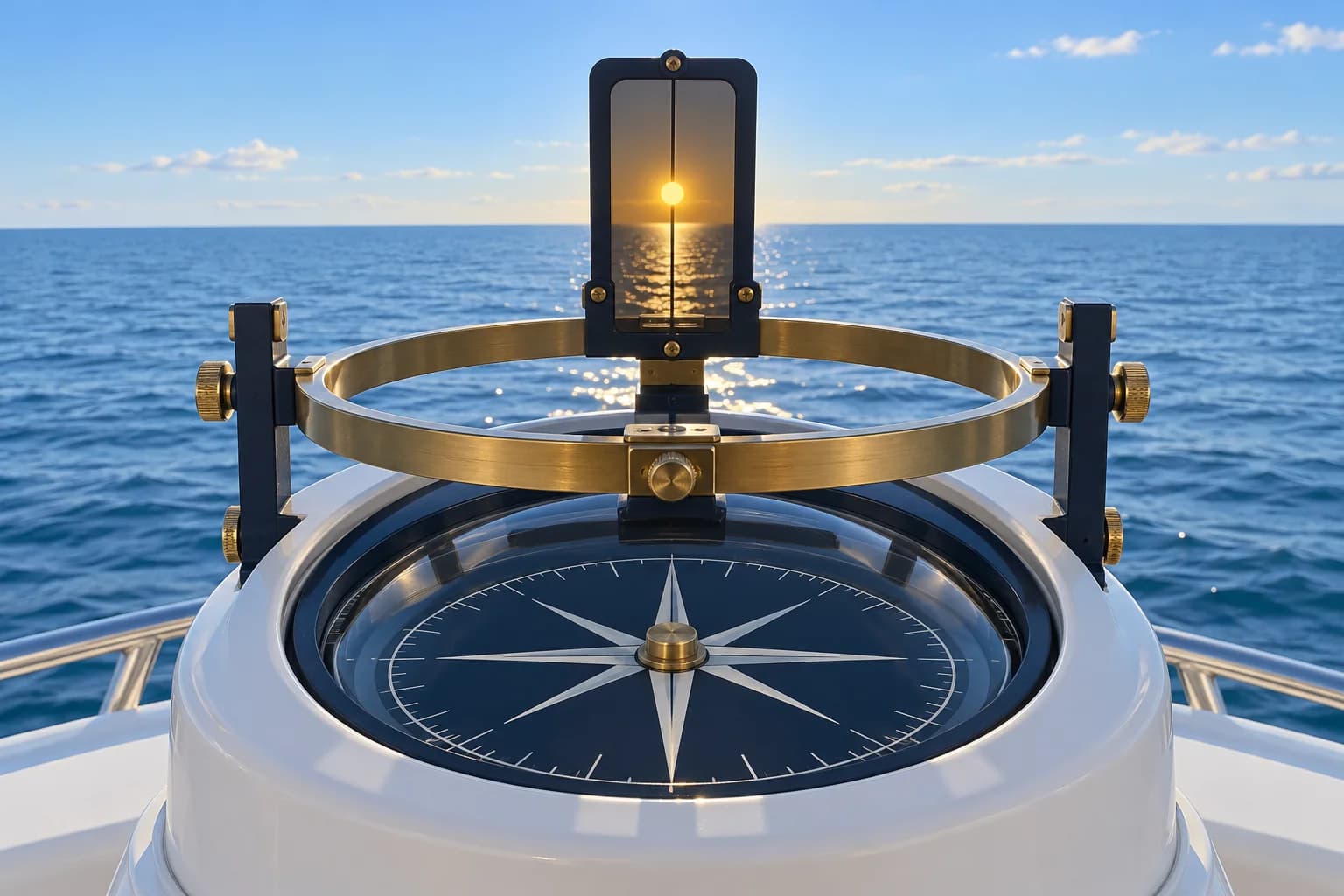
The method
Steady the boat on the heading you want to check. Take the body's compass bearing and note the UT to the second, the heading and the log. From the almanac, find GHA and Dec for that UT; then LHA from your DR longitude. Compute the true azimuth by formula or tables.
The formula
tan Z = abs(sin LHA) ÷ (cos Lat × tan Dec − sin Lat × cos LHA). Here abs means positive magnitude. Use N-positive, S-negative latitude and declination. Z is 0°–180° from north; a negative denominator puts it above 90°. LHA under 180°: Zn = 360° − Z; over 180°: Zn = Z. HO 229 and Norie's ABC tables also give azimuth; follow their printed naming rules.
Worked: the data
4 December 2026, late afternoon, DR 15°56′N 041°32′W. Heading 262°C. At 1908 UT the Sun bears 255.6°C. Almanac for 1908 UT: GHA 109°25.5′; Dec S22°18.7′. LHA = 109°25.5′ − 41°32′ = 067°53.5′.
Worked: the answer
The numerator is 0.9265 and the denominator −0.4979, so tan Z = −1.861. Inverse tan gives −61.7°. Positive numerator and negative denominator select quadrant II: Z = 118.3°. LHA under 180° puts the Sun west: Zn = 360° − 118.3° = 241.7°T. Error = 241.7 − 255.6 = −13.9°: 13.9°W.
Deviation
The plotter's World Magnetic Model (WMM2025) gives a variation of 14.8°W there. Deviation = error − variation = −13.9 − (−14.8) = +0.9°: 0.9°E on heading 262°C.
Timing tolerance
Here the Sun's azimuth changes about 0.1° a minute, so a timing error of a minute or two matters little. Near noon or with a high Sun it changes much faster; time those bearings carefully, or wait for a lower Sun.
Key figures
- Azimuth formula
- tan Z = abs(sin LHA) ÷ (cos Lat tan Dec − sin Lat cos LHA)
- Worked inputs
- 1908 UT, 15°56′N 041°32′W, LHA 067°53.5′, Dec S22°18.7′
- Worked true azimuth
- Z 118.3°, body west: Zn = 241.7°T
- Worked error
- 241.7 − 255.6 = −13.9°: 13.9°W
- Worked deviation
- −13.9 − (−14.8) = 0.9°E on 262°C
Compass error by azimuth
- Steady on the heading to check; note heading and log. — Deviation belongs to the heading, not to the bearing.
- Take the body's compass bearing; note the UT to the second. — The true azimuth depends on the time through GHA and LHA.
- Find GHA and Dec for that UT; LHA from your DR longitude. — These, with latitude, fix the body's direction.
- Compute Z by formula or tables, and name it as Zn. — This is the true bearing at the moment of your compass bearing.
- Error = Zn − compass bearing; name it E (+) or W (−). — This is the total correction: variation plus deviation.
- Deviation = error − variation; log it against the heading. — Variation comes from the chart or the WMM; the rest is the boat's.
Remember
- Time the compass bearing to the second; find GHA, Dec and LHA for that UT.
- Formula Z is from north; with tables, use their printed naming rules.
- Error = Zn − compass; deviation = error − variation, for that heading.
- Prefer a low body: easier to bear, and its azimuth changes slowly.
Common mistakes
Wrong: Record the deviation against the Sun's bearing, 255.6°C.
Right: Deviation depends on the boat's heading. Record it against the heading steered, here 262°C.
Wrong: Take Z from the formula as the true azimuth.
Right: For north-referenced Z, LHA under 180° means Zn = 360° − Z, here 241.7°T. LHA over 180° means Zn = Z.
Wrong: Use the variation printed on an old chart's rose without updating it.
Right: Variation changes year by year. Update the rose to this year, or use the current WMM in the plotter.
Worked case
Same day and position. A crew member bears the Sun at 255.6°C but logs the time as 1900 instead of 1908 UT. They work out Zn 241.0°T and a deviation of 0.2°E. How much does the timing slip matter here, and what do you do?
Show the answer
About 0.7°: the Sun's azimuth changes nearly 0.1° a minute here, so eight minutes moves Zn from 241.7° to 241.0°. The deviation comes out 0.2°E instead of 0.9°E. Rework it for 1908 UT. Small, but a check is only as good as its time; always note the UT at the moment of the bearing.
Practice question
GHA 109°25.5′ and DR longitude 041°32′W. What is LHA?
- 150°57.5′
- 067°53.5′
- 292°06.5′
- 041°32.0′
Show the answer
Answer: B. LHA = GHA − west longitude = 109°25.5′ − 41°32′ = 067°53.5′.
3 · By amplitude
Worked: compass error by amplitude at sunrise
At rising or setting, the true bearing needs only latitude and declination: sin A = sin Dec ÷ cos Lat. Time it to when the Sun's centre is on the celestial horizon.
Amplitude
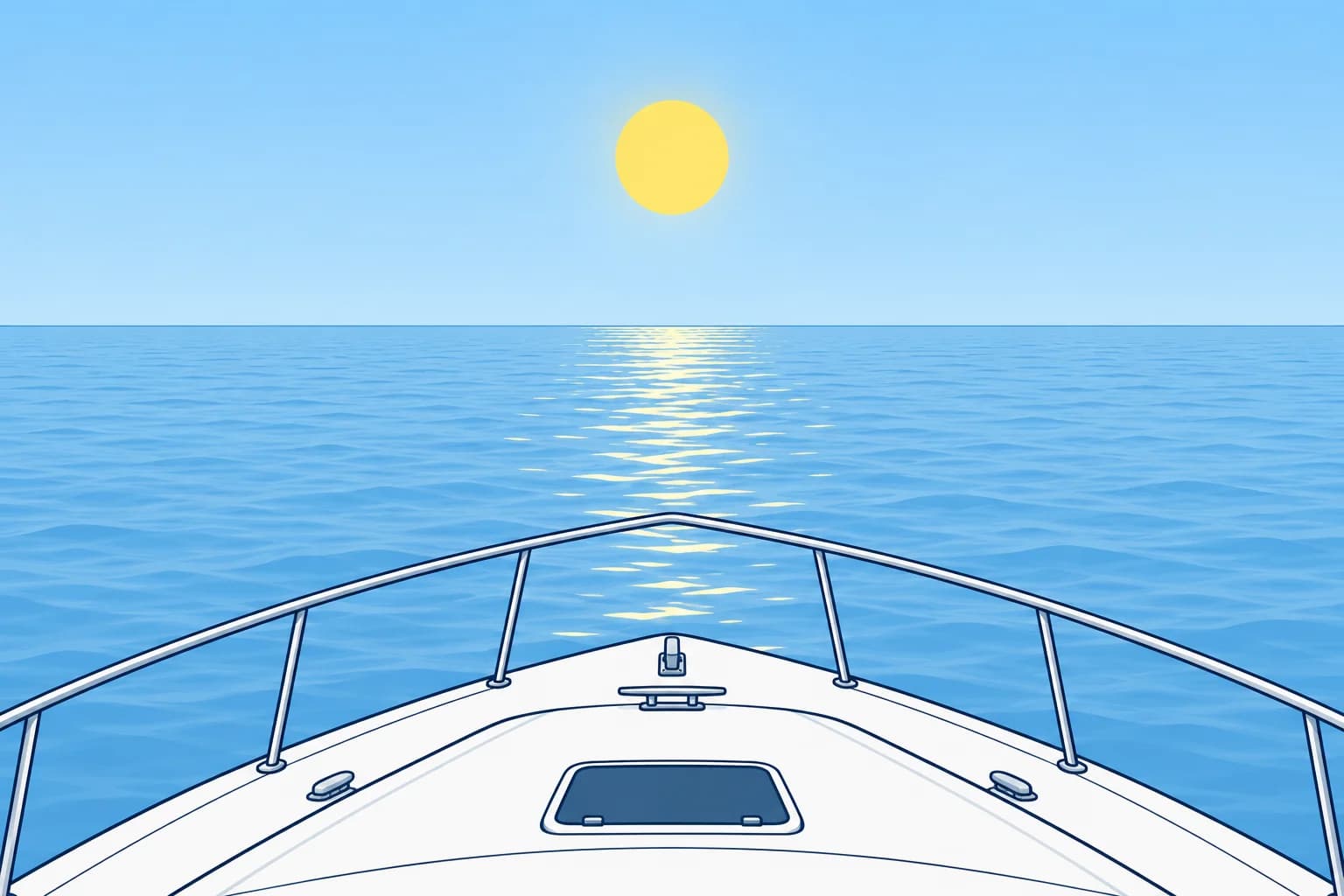
The amplitude (A) is the angle between due east or west and the body's bearing at rising or setting. It is named E when rising, W when setting, then N or S with the declination's name. With the body's centre on the celestial horizon (true altitude 0°): sin A = sin Dec ÷ cos Lat. No exact time is needed, only latitude and declination.
Which moment
A limb is the edge of the disc. When the Sun's centre is on the celestial horizon, its lower limb is about two-thirds of a diameter above the visible horizon. For the Moon, observe when its upper limb touches the visible horizon; for stars and planets, about one Sun diameter above it.
Visible horizon instead
At higher latitudes, a misjudged observing moment causes a larger bearing error. Instead, take the bearing with the Sun's centre on the visible horizon. Apply Bowditch Table 23 to the observed bearing, away from the elevated pole (the north pole in northern latitudes; the south pole in southern latitudes). Then compare the corrected compass bearing with the calculated celestial-horizon bearing. Near 16°N in this example, the correction is about 0.2°.
Worked: sunrise
4 December 2026, about 0859 UT, DR 16°07′N 040°25′W, heading 262°C. Dec S22°15.3′. sin A = sin 22°15.3′ ÷ cos 16°07′ = 0.3787 ÷ 0.9607 = 0.3942, so A = E 23.2° S. True bearing = 090° + 23.2° = 113.2°T.
Worked: the error
With the Sun's lower limb about two-thirds of a diameter above the visible horizon, its centre bears 126.6°C. Error = 113.2 − 126.6 = −13.4°: 13.4°W. WMM2025 gives variation 14.5°W here. Deviation = −13.4 − (−14.5) = 1.1°E on 262°C, close to the 0.9°E found by azimuth that afternoon.
Key figures
- Formula
- sin A = sin Dec ÷ cos Lat (centre on the celestial horizon)
- Naming
- E rising, W setting; then N or S with the declination
- Sun's centre on celestial horizon
- Lower limb about two-thirds of a diameter above the visible horizon
- Moon; stars and planets
- Moon: upper limb on the horizon; stars: about one Sun diameter up
- Worked amplitude
- Dec S22°15.3′, lat 16°07′N: E 23.2° S = 113.2°T
- Worked error
- 113.2 − 126.6 = 13.4°W; variation 14.5°W → deviation 1.1°E
Remember
- sin A = sin Dec ÷ cos Lat: latitude and declination only, no exact time.
- Name A from east (rising) or west (setting), towards the declination's pole.
- Bear the Sun when its lower limb is about two-thirds of a diameter above the horizon.
- At higher latitudes, observe the Sun's centre on the visible horizon and apply Bowditch Table 23.
Common mistakes
Wrong: Take the bearing just as the Sun's upper edge appears.
Right: Then the centre is still below the celestial horizon. Wait until the lower limb is about two-thirds of a diameter up.
Wrong: A rising Sun with southerly declination bears 090° − A.
Right: E 23.2° S means 23.2° south of east: 090° + 23.2° = 113.2°T.
Wrong: The amplitude is the same at every latitude for the same declination.
Right: It grows with latitude: for Dec 22°15′, about 22.2° at the equator, 25.9° at 30° and 36.1° at 50°.
Worked case
Evening, heading 280°C, latitude 50°N, Dec N20°00′. The Sun's centre is on the celestial horizon and bears 312.0°C. Variation is 2.0°W; the card says 0.5°W on 280°C. A mate wants to replace the card value. Calculate the amplitude, true bearing, error and deviation, and decide.
Show the answer
A = W 32.1° N, so Zn = 302.1°T. Error = 302.1 − 312.0 = 9.9°W. Deviation = −9.9 − (−2.0) = 7.9°W on 280°C. Neither this single check nor the old card is yet confirmed. Repeat the observation, check inputs and magnetic objects, and cross-check with another method. Use an independently checked heading source meanwhile. Log the confirmed deviation before adopting it.
Practice question
At 50°N sunrise, the Sun's centre is on the visible horizon, bearing 075.0°C. Table 23 gives 0.8°. Correct the observed bearing away from the elevated pole. What bearing do you use?
- 074.2°C
- 075.8°C
- 254.2°C
- 255.8°C
Show the answer
Answer: B. At 50°N the elevated pole is north. At sunrise, moving away from north increases the bearing: 075.0° + 0.8° = 075.8°C. Compare this corrected compass bearing with the calculated celestial-horizon bearing.
4 · Using results
From compass error to deviation: using the results
Remove the variation to find deviation, compare with the card for that heading, and decide what to trust. One check is one heading.
Variation first
Deviation = compass error − variation, east plus, west minus. In mid-ocean, take variation from an ocean chart's lines of equal variation, updated to the year, or from the plotter's World Magnetic Model (WMM2025, valid 2025 to 2030). Mid-Atlantic, near 16°N 40°W, it is about 14° to 15°W in late 2026.
Compare with the card
Look up the deviation card for that heading. Two checks on 4 December 2026, both on 262°C, gave 1.1°E by amplitude and 0.9°E by azimuth. If the card says about 1°E on 262°C, the compass is behaving. Use the average, 1.0°E.
A big change
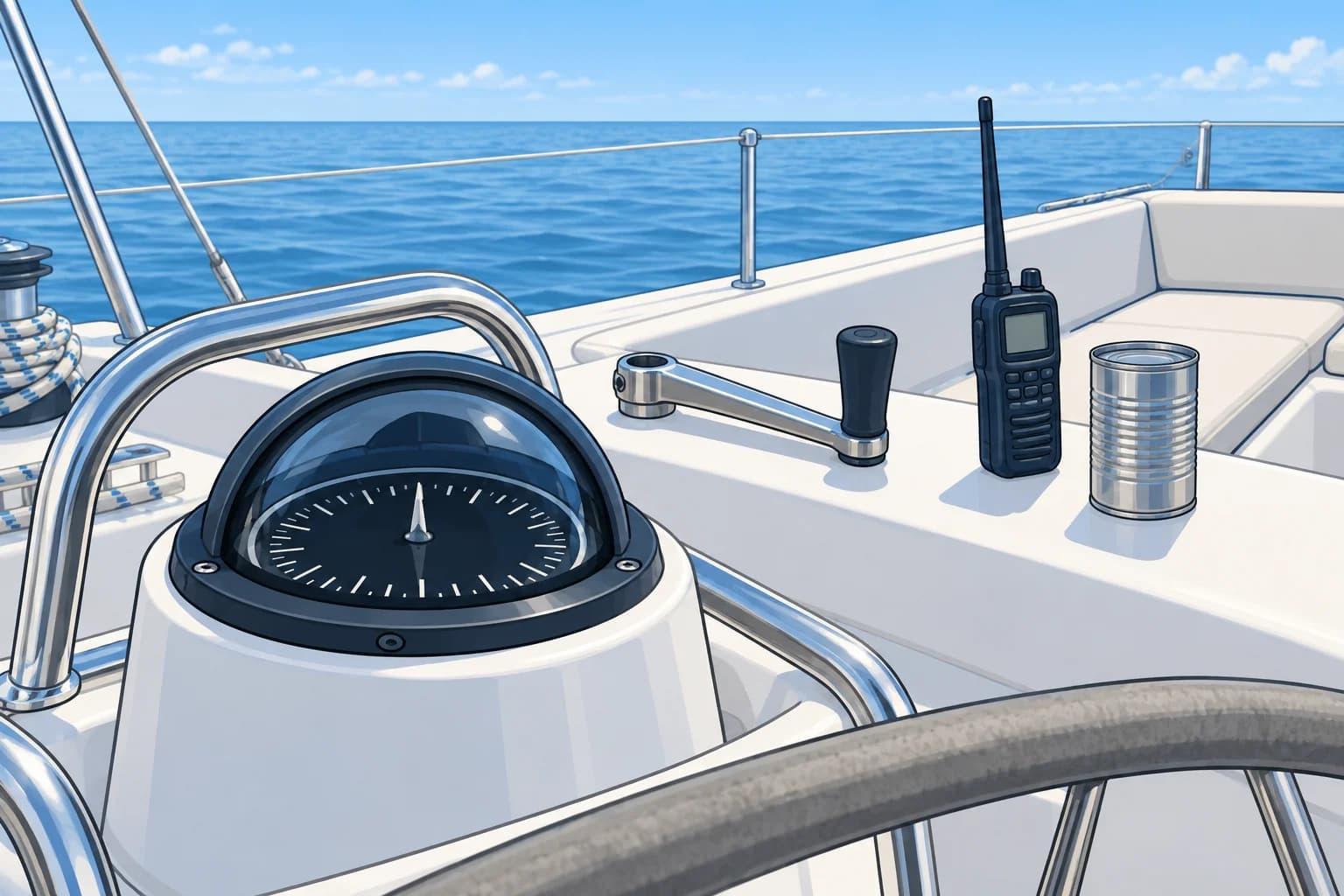
A deviation several degrees from the card is a warning. Check what has moved near the compass: a winch handle, a speaker, a phone, a tin of food, a new instrument. Repeat the check. If it stays, steer by the observed deviation on that heading and plan a proper compass swing in port.
Other headings
Deviation varies with heading, so one check fixes one heading only. On a long reach you may keep one heading for days: that is the one that matters. After a big course change, check again on the new heading.
Errors
A sloppy bearing is the main error: aim for 0.5° on a steady boat. Also: a wrong time (azimuth), a misjudged rising moment (amplitude), an outdated variation. Two methods that agree within a degree give confidence.
Key figures
- Deviation
- Compass error − variation (east +, west −)
- Variation at sea
- Updated chart lines of equal variation, or WMM2025 (2025–2030)
- Mid-Atlantic, late 2026
- About 14° to 15°W near 16°N 40°W
- Worked checks on 262°C
- Amplitude 1.1°E, azimuth 0.9°E: use about 1.0°E
- One check
- Gives the deviation on one heading only
Remember
- Deviation = error − variation; variation from the ocean chart or the current WMM.
- Compare with the deviation card for the heading steered; two methods should agree.
- A large change needs checking: repeat the observation, check magnetic gear nearby, and log the confirmed result.
- Re-check after any big change of heading.
Common mistakes
Wrong: Variation is small in the open ocean, so ignore it.
Right: Mid-Atlantic near 16°N 40°W it is about 14° to 15°W. Ignoring it would put that whole error into the deviation.
Wrong: Apply today's deviation on 262°C to every heading.
Right: Deviation changes with heading. Check again after a big course change.
Wrong: A single check that disagrees with the card proves the card wrong.
Right: Repeat it, try another method, and look for loose magnetic objects first.
Worked case
Heading 262°C. Yesterday the azimuth check gave deviation 0.9°E. Today, same heading, the amplitude gives 5.8°E. Nothing else has changed, says the crew. What do you do?
Show the answer
Treat it as a warning, not a new value. Look round the compass for anything magnetic moved since yesterday: a handheld radio, a winch handle, a new speaker. Remove it and repeat the check, then confirm with an afternoon azimuth. If 5.8°E persists, steer with it on this heading, log it, and have the compass swung in port.
Practice question
Compass error 13.4°W; variation 14.5°W. What is the deviation?
- 27.9°W
- 1.1°W
- 1.1°E
- 27.9°E
Show the answer
Answer: C. Deviation = −13.4 − (−14.5) = +1.1°: 1.1°E.