
Astronomy and celestial navigation · Level R5 · 4 parts · about 12 min
Time, the almanac and the Sun's position
4 short parts: UT and the watch · Daily pages · Increments · LMT and noon. Each part explains the idea, then gives the points to remember, the common mistakes, a worked case and a practice question; the Academy unit adds all 24 check questions.
1 · UT and the watch
UT, the deck watch and its error
Every sight except the noon latitude needs its UT to the second: 4 seconds of time error is 1′ of longitude. Know your watch's error and rate.
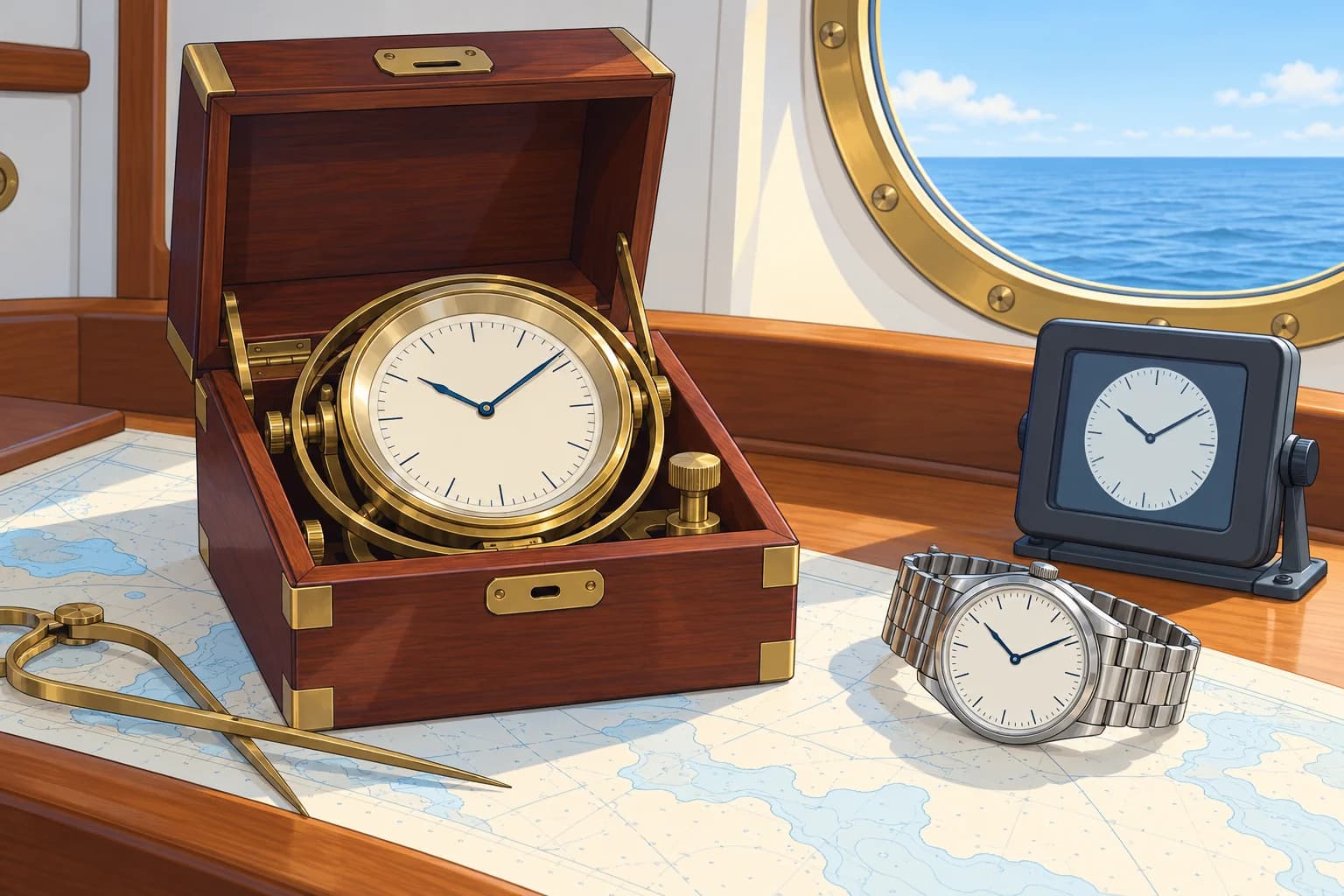
Why time matters
The Sun's GHA changes by 15′ every minute of time, so 4 seconds of time error gives 1′ of longitude error: up to 1 M at the equator. A noon sight for latitude hardly depends on time, but every other sight needs the UT of the observation to the second.
UT and UTC
The almanac is tabulated in UT, Universal Time. Radio time signals and GNSS receivers give UTC, kept within 0.9 s of UT1, the rotation-based scale. Treat UTC as UT; the small difference, DUT1, matters only in very precise work. Zone time and the zone description are in Navigation: Polaris and time. Log all sights in UT.
Chronometer and deck watch
A chronometer is a precise clock kept below and never reset. A deck watch, or a good quartz watch, is compared with it or with GNSS and taken on deck for sights. Its error is how much it is fast or slow on UT: UT = watch − fast error, or + slow error. Write it down at every check.
Rate
A watch's rate is how much it gains or loses each day. Keep a time log of date, error and daily rate. For calculations, make fast errors and gaining rates positive; slow errors and losing rates negative. Predicted signed error = last signed error + signed daily rate × days. Positive means fast; negative means slow. A steady, known rate matters more than a small one.
Taking the time
Check the watch daily against GNSS or a radio time signal; NP282 lists time signals. A helper can read the watch when you call 'stop'. Alone, start a stopwatch at the sight. Later, read the watch and stop the stopwatch together. Subtract the elapsed time, then apply the watch error. Check AM or PM on a 12-hour dial and confirm the UT date.
Key figures
- Time and longitude
- 4 s of time = 1′ of longitude; 1 min = 15′
- UTC and UT1
- Within 0.9 s (DUT1): treat UTC as UT
- Watch error
- UT = watch − fast error, or + slow error
- Predicted error
- Signed error + signed rate × days; fast/gain +, slow/loss −
- Time signals
- Listed in ADMIRALTY List of Radio Signals NP282
- Spanish terms
- Cronómetro, estado absoluto, movimiento diario
Remember
- 4 s of time = 1′ of longitude: time sights to the second.
- The almanac is in UT; treat UTC from GNSS or radio as UT.
- UT = watch − fast error, or + slow error.
- Keep a time log: error and rate; a steady rate is what you need.
- Check the hour and the date: a 12-hour dial can be 12 hours out.
Common mistakes
Wrong: A watch that is fast must have its error added.
Right: Fast means it reads too late: subtract the error to get UT. Add a slow error.
Wrong: The deck watch keeps zone time, so the sight can be worked in zone time.
Right: Convert to UT before opening the almanac. Many navigators set the deck watch to UT.
Worked case
On 20 November 2026 your deck watch was 4 s slow on GNSS UTC, losing 1 s a day. On 26 November the GNSS fails before a morning sight. The watch reads 10-14-17 at the sight. What UT do you use?
Show the answer
Six days at 1 s a day losing adds 6 s: the watch is now 4 + 6 = 10 s slow. Add a slow error: UT = 10h 14m 17s + 10 s = 10h 14m 27s, on 26 November. An error of a few seconds in that estimate costs about 1′ of longitude per 4 s.
Practice question
Your deck watch is 14 s slow and reads 10-14-12 at a sight. What is the UT?
- 10-13-58
- 10-14-26
- 10-14-12
- 10-14-40
Show the answer
Answer: B. A slow watch reads too early: add the 14 s, giving 10-14-26.
2 · Daily pages
The Nautical Almanac's daily pages
Each opening covers three days: hourly GHA of Aries, hourly GHA and Dec of the Sun, Moon and planets, and the Sun's meridian passage.

One opening, three days
The Nautical Almanac (NP314), produced by HM Nautical Almanac Office and the US Naval Observatory, gives one double page for every three days. Left page: GHA of Aries, GHA and Dec of the four planets for every hour of UT, and the SHA and Dec of the 57 selected stars. Right page: the Sun and Moon, twilight, sunrise, sunset and moonrise.
The Sun's columns
Each hour, 00h to 23h UT, gives GHA and Dec to 0.1′. At the foot, SD is the Sun's semi-diameter: half its apparent angular diameter. d gives the Sun's mean hourly change in declination. It has no sign. With N/S labels, compare the numerical magnitudes at successive hours: add if the magnitude grows, subtract if it shrinks.
Equation of time and Mer. Pass.
In the lower corner of the right page: the Sun's equation of time at 00h and 12h, and its Mer. Pass., the local mean time of meridian passage, to the minute. When the Sun runs ahead of mean time, as in November, Mer. Pass. is before 1200; when it runs behind, as in February, it is after 1200.
Reading an entry
26 November 2026 at 10h UT: Sun GHA 333°11.2′, Dec S 20°58.5′; foot of the column d 0.5, SD 16.2′; Mer. Pass. 1147. At 11h Dec is S 20°59.0′: the Sun is moving south, so add the d correction to the S magnitude.
v and d
Between whole hours you add an increment at a standard rate (next part). For planets and the Moon the real rate differs from that standard; the hourly excess is v, printed beside them. The Sun's GHA values are adjusted so the standard rate works without v. d gives the hourly declination change for the Sun, Moon and planets; selected-star declinations have no d correction.
Key figures
- Coverage
- Three days per double page, every hour of UT
- Left page
- Aries, Venus, Mars, Jupiter, Saturn; 57 stars
- Right page
- Sun, Moon, twilight, sunrise/sunset, Mer. Pass.
- d
- Mean hourly Dec change; compare N/S magnitudes
- 26 Nov 2026, 10h
- Sun GHA 333°11.2′, Dec S 20°58.5′, d 0.5, SD 16.2′
- Spanish terms
- Almanaque Náutico (ROA): páginas diarias, horario, declinación
Remember
- One opening = three days, every hour of UT.
- Sun: hourly GHA and Dec; SD and d at the foot.
- With N/S labels, add the d correction if the magnitude grows next hour; subtract if it shrinks.
- Mer. Pass. is the LMT of the Sun's meridian passage.
- Planets and the Moon carry v; the Sun does not.
Common mistakes
Wrong: d is always added because it is printed without a sign.
Right: With N/S labels, compare the numerical magnitudes at successive hours: add if the magnitude grows, subtract if it shrinks.
Wrong: Mer. Pass. is the UT of noon at your position.
Right: It is local mean time. Add west longitude in time (subtract east) to get the UT of your local noon.
Worked case
At 10h, Dec is S 20°58.5′; at 11h, S 20°59.0′. A crew member subtracts a 0.1′ correction from the magnitude and writes S 20°58.4′ because south is negative. Is that right?
Show the answer
No. The southward magnitude is increasing, so use S 20°58.6′. With signed numbers, −20°58.5′ − 0.1′ gives the same result. Keep your convention consistent.
Practice question
What does d at the foot of the Sun column give?
- The mean daily change of GHA
- The Sun's apparent semi-diameter
- The mean hourly change of Dec
- The error of the deck watch
Show the answer
Answer: C. d gives the Sun's mean hourly change in declination.
3 · Increments
Increments and corrections: the Sun's GHA and Dec, worked
Take hourly GHA and Dec. Add the time increment to GHA, add or subtract the d correction, then use longitude to find LHA.

The tinted pages
The Increments and Corrections tables, on tinted pages near the back, have one table for each minute, 0m to 59m. Each lists, second by second, the GHA increment for the Sun and planets (15° an hour exactly), Aries (15°02.46′ an hour) and the Moon (14°19.0′ an hour). Beside them, the v or d corrections give the extra for a given v or d at that minute.
Worked: the time
26 November 2026, morning, DR 21°05′N 027°20′W. Sun lower limb observed at deck watch 10-14-38. The watch was checked against GNSS: 12 s fast. UT = 10h 14m 38s − 12 s = 10h 14m 26s, still 26 November. With ZD +2 the ship's clock read about 0814.
Worked: GHA
GHA at 10h from the daily page: 333°11.2′. Increment for 14m 26s, from the 14m table, Sun and planets column: 3°36.5′. Check: 14 min × 15′ = 3°30.0′, plus 26 s × 15″ = 6.5′. GHA = 333°11.2′ + 3°36.5′ = 336°47.7′.
Worked: Dec
Dec at 10h: S 20°58.5′; at 11h S 20°59.0′, so the S magnitude is increasing: add. d = 0.5. The 14m table's v or d column gives 0.1′ for d 0.5. Dec = S 20°58.6′. Enter 26 November 2026, 10:14:26 UT in USNO's celestial-navigation service: GHA 336°47.6′, Dec S 20°58.6′. The GHA differs by only 0.1′.
Worked: LHA
LHA = GHA − west longitude = 336°47.7′ − 27°20.0′ = 309°27.7′. It is over 180°, so the Sun is east of you, as it should be in the morning. DR latitude, Dec and LHA are the inputs to sight reduction (Celestial: sight reduction).
Key figures
- Sun and planet increment
- 15° an hour: 15′ a minute, 15″ a second
- Aries increment
- 15°02.46′ an hour
- Moon increment
- 14°19.0′ an hour, plus v
Sun's GHA, Dec and LHA for a sight
- Correct the watch time to UT and check the date. — The almanac is in UT; a wrong hour or day ruins the sight.
- Take GHA and Dec for the whole hour from the daily page. — The page gives them only on the hour.
- Add the increment for the minutes and seconds, Sun column. — The tinted table for that minute gives it second by second.
- Apply the d correction to Dec, with the sign from the trend. — Dec changes up to about 1′ an hour.
- Find LHA: add east longitude, subtract west, keep within 0–360°. — Sight reduction needs the angle from your own meridian.
Remember
- Whole hour from the daily page, minutes and seconds from the increments.
- Use the column for your body: Sun and planets, Aries or Moon.
- Apply d from the v or d column, sign from the trend.
- LHA over 180° means the body is east of you: morning for the Sun.
Common mistakes
Wrong: Use the Aries column for the Sun's increment.
Right: Aries runs 15°02.46′ an hour; the Sun and planets column uses 15° an hour. The difference grows to about 1.2′ by the 30th minute.
Wrong: Apply the d correction for the whole hour.
Right: Take it from the table for the minutes past the hour; at 14 minutes, d 0.5 gives only 0.1′.
Worked case
Same day, 26 November 2026, a sight at 13h 38m 00s UT, DR longitude 027°45.0′W. Daily page at 13h: GHA 18°10.6′, Dec S 20°59.9′, d 0.5, S magnitude increasing. A crew member gets a negative LHA and changes to adding west longitude. Is that justified? Give the corrected results.
Show the answer
Increment 38m 00s = 9°30.0′, so GHA = 18°10.6′ + 9°30.0′ = 27°40.6′. d correction at 38m for d 0.5: 0.3′, added: Dec S 21°00.2′. LHA = 27°40.6′ − 27°45.0′ = −0°04.4′, plus 360° = 359°55.6′. Reject that change: subtract west longitude, then add 360° to wrap the negative result. The Sun is just east of your meridian, approximately local noon.
Practice question
What is the Sun's GHA increment for 22m 40s?
- 5°40.9′
- 5°24.5′
- 5°30.4′
- 5°40.0′
Show the answer
Answer: D. 22 × 15′ = 5°30′, plus 40 s × 15″ = 10′: 5°40.0′. 5°40.9′ is the Aries increment and 5°24.5′ the Moon's.
4 · LMT and noon
Arc to time, local mean time and the time of local noon
Longitude converts to time at 15° an hour. Add west longitude in time to the almanac's Mer. Pass. and you have the UT of your local noon.
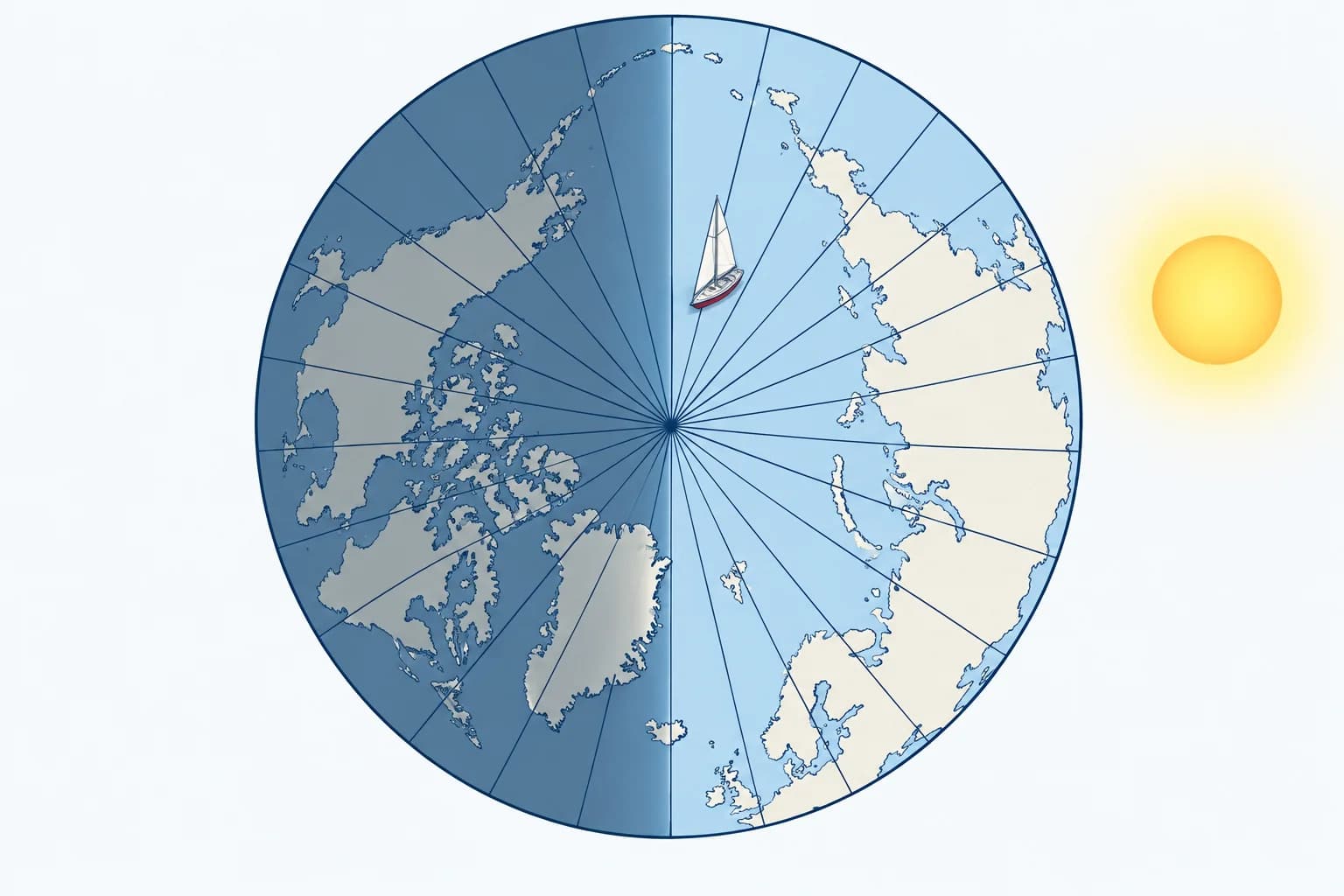
Arc and time
The Earth turns 360° in 24 hours: 15° = 1 hour, 1° = 4 minutes, 15′ = 1 minute, 1′ = 4 seconds. The almanac has an arc-to-time table, but the arithmetic is easy. For 027°45′W: 27° = 1h 48m, 45′ = 3m, total 1h 51m.
Local mean time
Local mean time (LMT) is mean solar time on your own meridian: LMT = UT − west longitude in time, or + east longitude in time. It is not zone time, which is the time of the zone's central meridian (Navigation: Polaris and time). At 027°45′W, with ZD +2, LMT runs 9 minutes ahead of zone time.
Local noon
The almanac's Mer. Pass. is the LMT of the Sun's meridian passage. It changes by only seconds a day, so it holds at any longitude to the minute. So UT of local noon = Mer. Pass. + west longitude in time, or − east longitude in time.
Worked: 26 November 2026
DR at noon 21°10′N 027°45′W. Mer. Pass. 1147. Longitude in time 1h 51m, west: add. Noon is at 1338 UT. With ZD +2 the ship's clock reads 1138. Use the longitude you expect at noon: each 15′ of longitude made westward makes noon 1 minute later.
Longitude from noon
Turned round, the time of noon gives longitude: noon at 1338 UT with Mer. Pass. 1147 means 1h 51m west, 027°45′W. But near noon the Sun's altitude hardly changes for minutes, so the timing is rough: 1 minute of time is 15′ of longitude. Better longitude comes from timed sights (Celestial: sight reduction).
Key figures
- Arc to time
- 15° = 1 h; 1° = 4 min; 15′ = 1 min; 1′ = 4 s
- LMT
- UT − W long in time, or + E long in time
- UT of local noon
- Mer. Pass. + W long in time (− E)
- Worked noon
- 1147 + 1h 51m = 1338 UT; ZT 1138 at 027°45′W
- Timing and longitude
- 1 min of time = 15′ of longitude
- Spanish terms
- Hora civil del lugar, paso del Sol por el meridiano
Remember
- 15° = 1 h, 1° = 4 min, 15′ = 1 min, 1′ = 4 s.
- LMT is your own meridian's mean time; zone time is the zone's.
- UT of noon = Mer. Pass. + W long in time (− E).
- Use the DR longitude expected at noon.
- Longitude from the time of noon is rough: 1 min = 15′.
Common mistakes
Wrong: Local noon is at 1200 zone time.
Right: It differs by the equation of time and by your offset from the zone's central meridian: 1138 ZT in the worked example.
Wrong: Subtract west longitude in time from Mer. Pass. to get UT.
Right: West of Greenwich, noon comes later in UT: add west, subtract east.
Worked case
Mer. Pass. is 1156. You are now at 045°00′W but expect 045°30′W at noon, keeping ZD +3. A crew member predicts noon at 1456 UT using your present longitude. Accept the plan?
Show the answer
Use the expected noon longitude. 045°30′W equals 3h 02m, so noon is about 1458 UT, or 1158 zone time. The original forecast is two minutes early because it uses the present longitude.
Practice question
What is 052°30′ of longitude in time?
- 3h 52m
- 3h 20m
- 5h 15m
- 3h 30m
Show the answer
Answer: D. 52° × 4 min = 3h 28m, plus 30′ × 4 s = 2 min: 3h 30m.