
Astronomy and celestial navigation · Level R5 · 5 parts · about 14 min
The sextant and its corrections
5 short parts: The instrument · Errors · Taking a sight · Corrections · Worked Hs to Ho. Each part explains the idea, then gives the points to remember, the common mistakes, a worked case and a practice question; the Academy unit adds all 31 check questions.
1 · The instrument
The marine sextant: parts and principle
A sextant measures the angle between a body and the sea horizon. Two mirrors show both together, so the angle can be read on a moving boat.
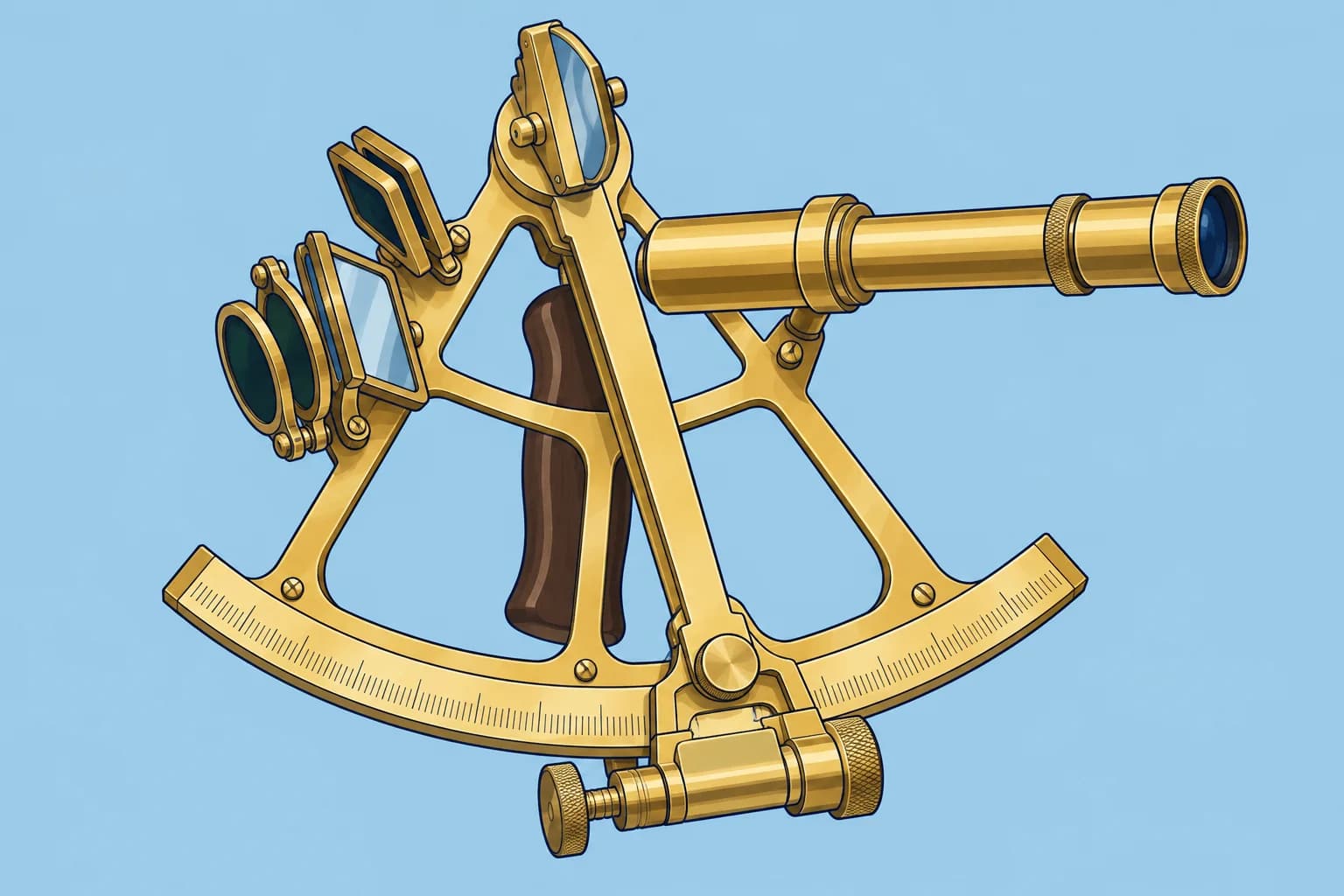
What it measures
A sextant measures the angle between two objects. For a celestial sight that is the angle between a body and the sea horizon below it: the sextant altitude, Hs. It works on a rolling boat because you see the body and the horizon together in the eyepiece. They move together, so the angle between them stays readable.
Parts
A frame carries the arc, graduated in degrees. The index arm pivots at the arc's centre and carries the index mirror. The horizon mirror, fixed to the frame, is half silvered or semi-transparent, so you see the horizon through it and the body reflected in it. A telescope looks through it; shade glasses protect your eye. A micrometer drum on the arm reads minutes, and a vernier beside it reads tenths.
Double reflection
Light from the body hits the index mirror, then the horizon mirror, then your eye. The angle between the incoming ray and the ray reaching your eye is twice the angle between the mirrors. So moving the arm 10° changes the reading by 20°. The arc is about one-sixth of a circle, 60°, hence 'sextant', but it is marked to read up to about 120°.
Reading it
Read whole degrees on the arc at the index mark, minutes on the micrometer drum, then tenths on the vernier. Arc 47°, drum 31′ and vernier 0.4 give 47°31.4′. Readings just below zero, used when checking index error, are off the arc.
Types and care
Metal sextants are the standard. Plastic ones are cheaper and lighter but change shape with temperature, so check index error at every use. Lift a sextant by its frame or handle, never by the arm or the mirrors. Stow it in its box, and rinse off salt with fresh water, then dry it. Never look at the Sun without shades in place.
Key figures
- Measures
- Angle between body and horizon: sextant altitude Hs
- Principle
- Reading = 2 × angle between the mirrors
- Arc
- About 60° of frame, marked to about 120°
- Reading
- Arc degrees + drum minutes + vernier tenths
- Eye safety
- Shades in before the Sun enters the view
- Spanish terms
- Alidada, espejo grande, espejo chico, tambor, nonio
Remember
- A sextant measures Hs, the angle between body and horizon.
- Index mirror moves with the arm; horizon mirror is fixed.
- Reading = twice the angle between the mirrors.
- Read arc, then drum, then vernier: 47°31.4′.
- Lift by the frame; shades before the Sun; rinse and dry.
Common mistakes
Wrong: A plastic sextant gives the same accuracy without extra checks.
Right: It is lighter and cheaper but changes with temperature: measure index error each time you use it.
Wrong: Lift the sextant by the index arm.
Right: Lift it by the frame or handle. Pressure on the arm or mirrors can put it out of adjustment.
Worked case
A new crew member picks up the sextant by the index arm, points it at the Sun with no shades and reads '47 degrees and 31, then 4 on the little scale'. Correct what went wrong and give the reading.
Show the answer
Lift it only by the frame or handle, and put the shades in before the Sun can enter the view: a direct look can damage the eye. The reading is 47° on the arc, 31′ on the drum and 0.4′ on the vernier: 47°31.4′. Then check the index error before the sight.
Practice question
You move the index arm through 15°. By how much does the reading change?
- 15°
- 7.5°
- 60°
- 30°
Show the answer
Answer: D. Double reflection: the reading is twice the angle between the mirrors, so 30°.
2 · Errors
Adjustable errors and index error
Check the mirrors in order: perpendicularity, side error, index error. Index error is usually measured and allowed for, not adjusted away each time.
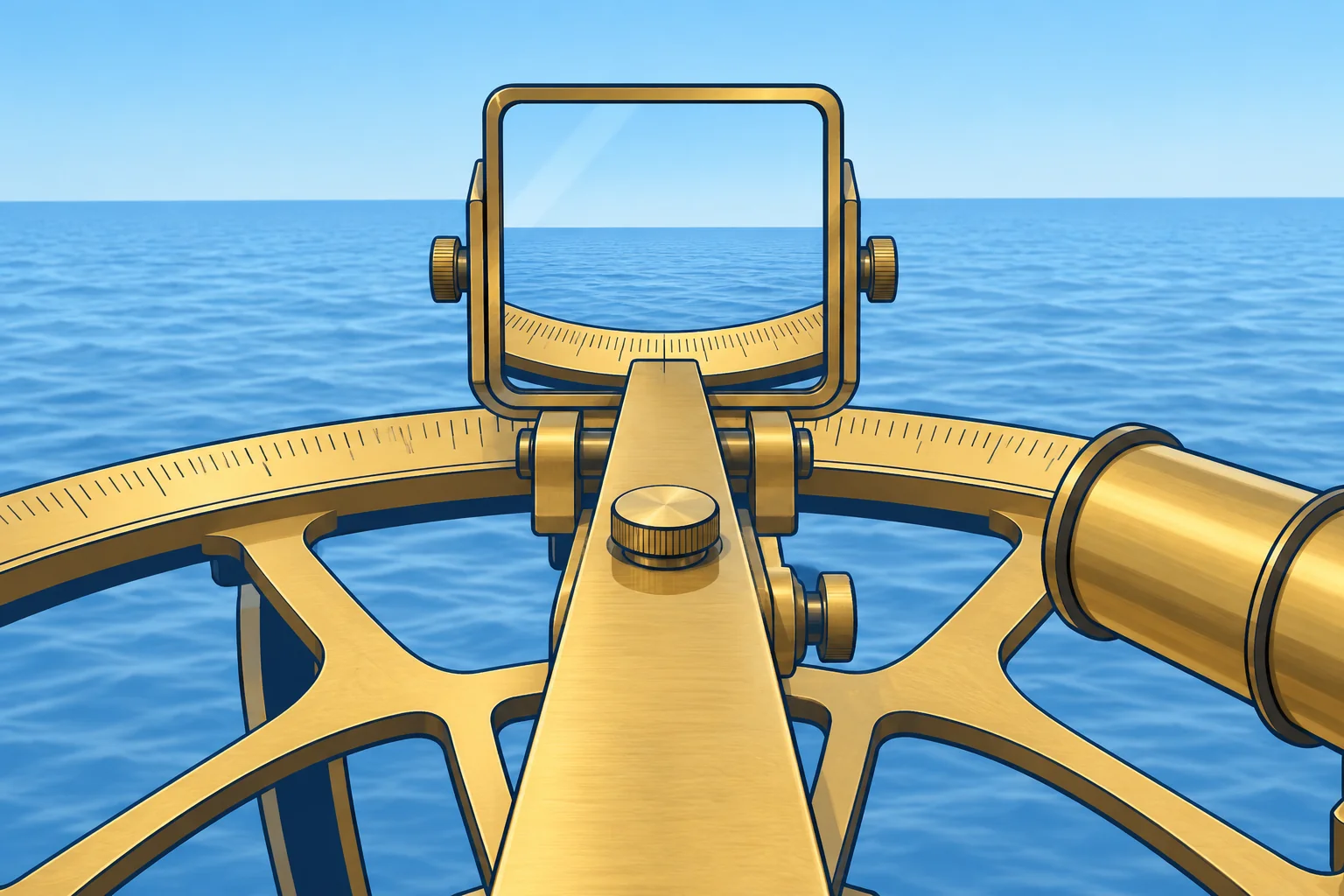
Three adjustable errors
Check them in this order, because each adjustment can upset the next: perpendicularity, the index mirror square to the frame; side error, the horizon mirror square to the frame; then index error, the two mirrors parallel when the reading is zero. Errors you cannot adjust, such as small faults in the arc, appear on the maker's certificate.
Perpendicularity
Set the arm near the middle of the arc. Hold the sextant flat, arc away from you, and look obliquely into the index mirror. The arc you see reflected and the real arc beside it should form one unbroken line. If the reflection looks raised or lowered, adjust the index mirror with its screw, as the maker's instructions show.
Side error
Set the reading near zero and look at a star. Turn the drum to move the reflected image past the direct image. If it passes beside the direct image instead of through it, there is side error. Adjust the horizon mirror as the maker instructs.
Index error
With the reading at zero, the real and reflected horizons should form one straight line. Usually they do not quite. Turn the drum until they do and read the index error (IE). A reading above zero is on the arc. Below zero, it is off the arc: read the drum backwards, 60′ − drum reading, so a drum reading of 58.2′ means 1.8′ off the arc.
Applying it
Index correction (IC) has the opposite sign to the error: on the arc, subtract; off the arc, add. Measure IE before each set of sights.
Sun method
With shades in place, view the Sun and its reflected image. Turn the drum until opposite limbs (edges) just touch, once on each side of zero. Use positive angular magnitudes in minutes; convert the off-arc drum reading first. IE = (on − off) ÷ 2; positive means on the arc. Check (on + off) ÷ 4 against the almanac's semi-diameter (SD), half the Sun's angular diameter. Repeat the contacts to check that IE is repeatable.
Key figures
- Order of checks
- Perpendicularity, side error, then index error
- Index error
- Reading when the mirrors are parallel: on or off the arc
- Index correction
- On the arc subtract; off the arc add
- Off-arc reading
- 60′ − drum reading: 58.2′ → 1.8′ off the arc
- Sun method
- IE = (on − off) ÷ 2; check (on + off) ÷ 4 = SD
- Spanish terms
- Error de perpendicularidad, error lateral, error de índice
Remember
- Adjust in order: perpendicularity, side error, index error.
- IE on the arc: subtract; off the arc: add.
- Off the arc, read the drum backwards: 60′ − reading.
- Sun method: IE = (on − off) ÷ 2, checked against SD.
- Measure IE before every set of sights.
Common mistakes
Wrong: Index error on the arc is added to the sextant altitude.
Right: On the arc the sextant reads too high: subtract it. Add only an off-the-arc error.
Wrong: A drum reading of 58.2′ off the arc means an error of 58.2′.
Right: Off the arc the drum is read backwards: 60′ − 58.2′ = 1.8′ off the arc.
Worked case
Before a noon sight you measure the Sun's diameter: 33.6′ on the arc and 30.4′ off the arc. The almanac gives SD 16.0′. Find the index error and index correction, and say whether the readings are trustworthy.
Show the answer
IE = (33.6 − 30.4) ÷ 2 = 1.6′, positive, so on the arc; index correction −1.6′. Check: (33.6 + 30.4) ÷ 4 = 16.0′, which matches the almanac SD. The pair passes this consistency check, but that does not prove IE is correct. Repeat the contacts to check that IE is repeatable.
Practice question
Index error is 2.4′ on the arc. What correction do you apply to Hs?
- +2.4′
- +4.8′
- −4.8′
- −2.4′
Show the answer
Answer: D. On the arc the sextant reads too high: subtract 2.4′.
3 · Taking a sight
Taking a Sun sight
Shades first, bring the Sun down to the horizon, rock the sextant and touch the lower limb at the bottom of the swing. Then call the time.
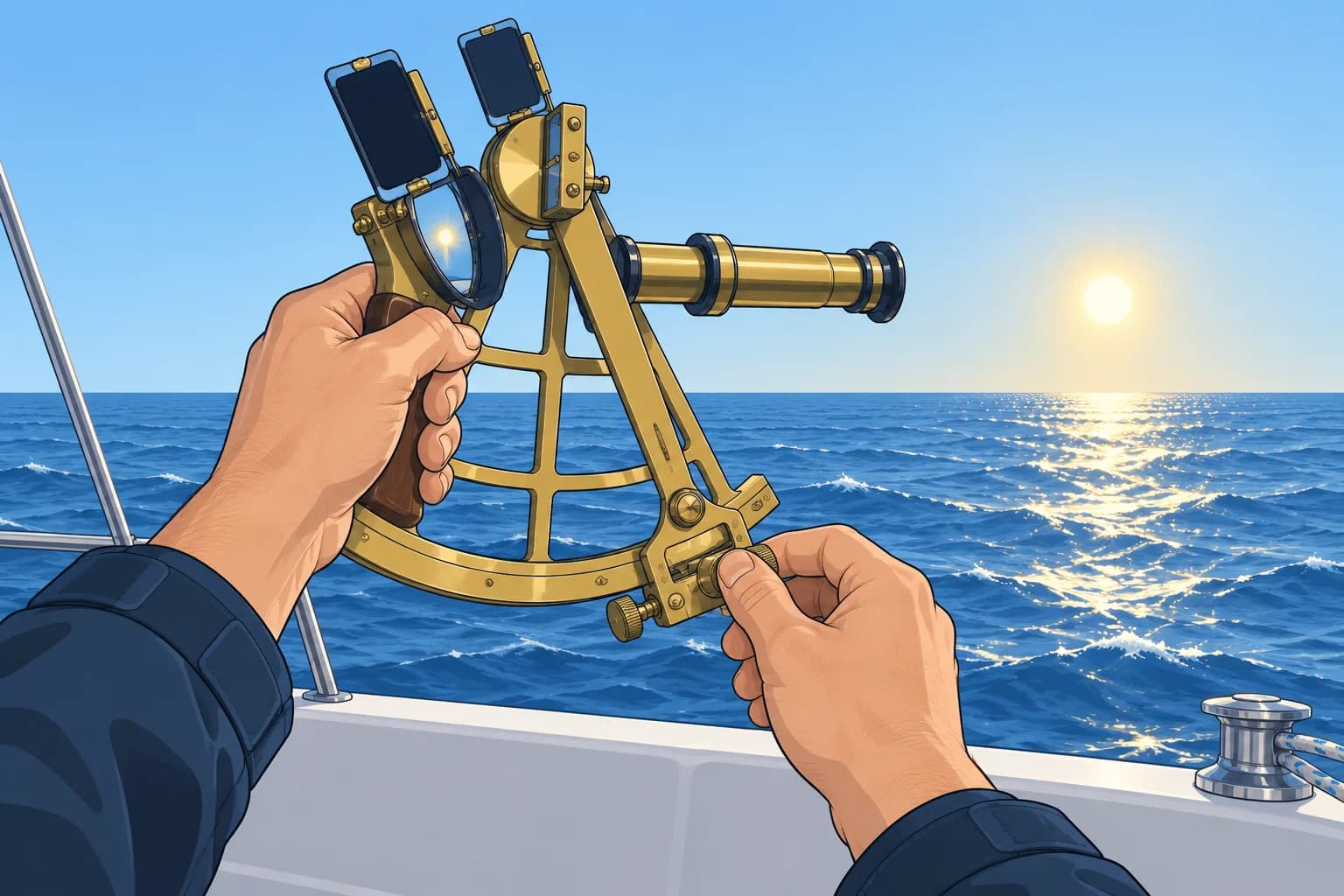
Where to stand
Stand where you can brace yourself and see a clean horizon, often by the shrouds or in the companionway, and clip on. Note your height of eye above the sea, often 2–3 m on a yacht. A higher eye helps you see the horizon over a swell, but the dip correction must use the height you actually had.
Rocking the arc
Rock the sextant gently from side to side about the line of sight. The Sun appears to swing in an arc above the horizon. At the lowest point of the swing the sextant is vertical. Measure there: a tilted sextant gives an altitude that is too large.
Which limb
The Sun is a disc. Normally bring its lower limb, the bottom edge, down to touch the horizon. If cloud hides the bottom edge, use the upper limb and apply the semi-diameter the other way (Corrections part).
Waves and the horizon
Observe near a swell crest to reduce obstruction by nearby waves; use only a clearly defined sea horizon. A hazy horizon gives the largest errors. Bright sunlight on the water under the Sun can dazzle; use the right shades rather than guessing the horizon.
Recording
Record the date, dead-reckoning position (DR, estimated from course and distance run), height of eye, index error (IE), body, limb, Universal Time (UT) and sextant altitude (Hs). Take three to five sights, half a minute apart; reject clear outliers.
Key figures
- Rock the arc
- Measure at the lowest point of the swing
- Limb
- Lower limb normally; upper limb if the bottom is hidden
- Height of eye
- Often 2–3 m on a yacht: use it for dip
- Swell
- Observe from the top of a swell
- Set of sights
- 3–5 sights; reject one that breaks the trend
- Spanish terms
- Limbo inferior, limbo superior, altura instrumental
Taking a Sun sight
- Put the shades in, then aim at the horizon under the Sun. — Protect your eye before the Sun can enter the view.
- Bring the Sun down to the horizon with the arm, then use the drum. — The clamp gives coarse movement; the drum gives fine control.
- Rock the sextant gently about the line of sight. — The Sun swings in an arc; its lowest point marks the vertical.
- Touch the lower limb on the horizon at the bottom of the swing. — With the sextant vertical, you measure Hs to the visible horizon; corrections come later.
- Call 'stop', note the exact time, then read the sextant. — Time to the second; altitude to 0.1′.
- Take three to five sights and compare them. — A steady trend shows which sights are good.
Remember
- Shades first, every time.
- Rock the arc and measure at the lowest point of the swing.
- Lower limb normally; upper limb if the bottom is hidden.
- Observe from the top of a swell; record time to the second.
- Take a set of sights and reject an outlier.
Common mistakes
Wrong: Hold the sextant still; rocking it only blurs the sight.
Right: Rocking finds the vertical. Measure at the bottom of the swing, or the altitude will be too large.
Wrong: Use the height of the deck for dip.
Right: Use the height of your eye above the water at the sight, standing where you were.
Worked case
Five morning sights at half-minute intervals read 32°05.2′, 32°10.9′, 32°13.6′, 32°22.4′ and 32°28.1′. The Sun is rising at about 5.7′ every half minute. Which sight do you reject, and why?
Show the answer
Successive increases are 5.7′, 2.7′, 8.8′ and 5.7′. The third sight should be about 32°16.6′, so 32°13.6′ is 3.0′ low. A nearby wave crest may have raised the apparent horizon. Tilt would make the reading too high, so it cannot explain this low outlier. Reject that sight and retain the other four with their recorded times.
Practice question
Why do you rock the sextant when taking a sight?
- To find when it is vertical
- To remove the index error
- To steady the Sun's image
- To reduce the dip correction
Show the answer
Answer: A. The lowest point of the Sun's swing shows the sextant is vertical, where the altitude is measured correctly.
4 · Corrections
From sextant altitude to true altitude
Hs becomes the apparent altitude after index error and dip; refraction, semi-diameter and parallax then turn it into the observed altitude Ho.
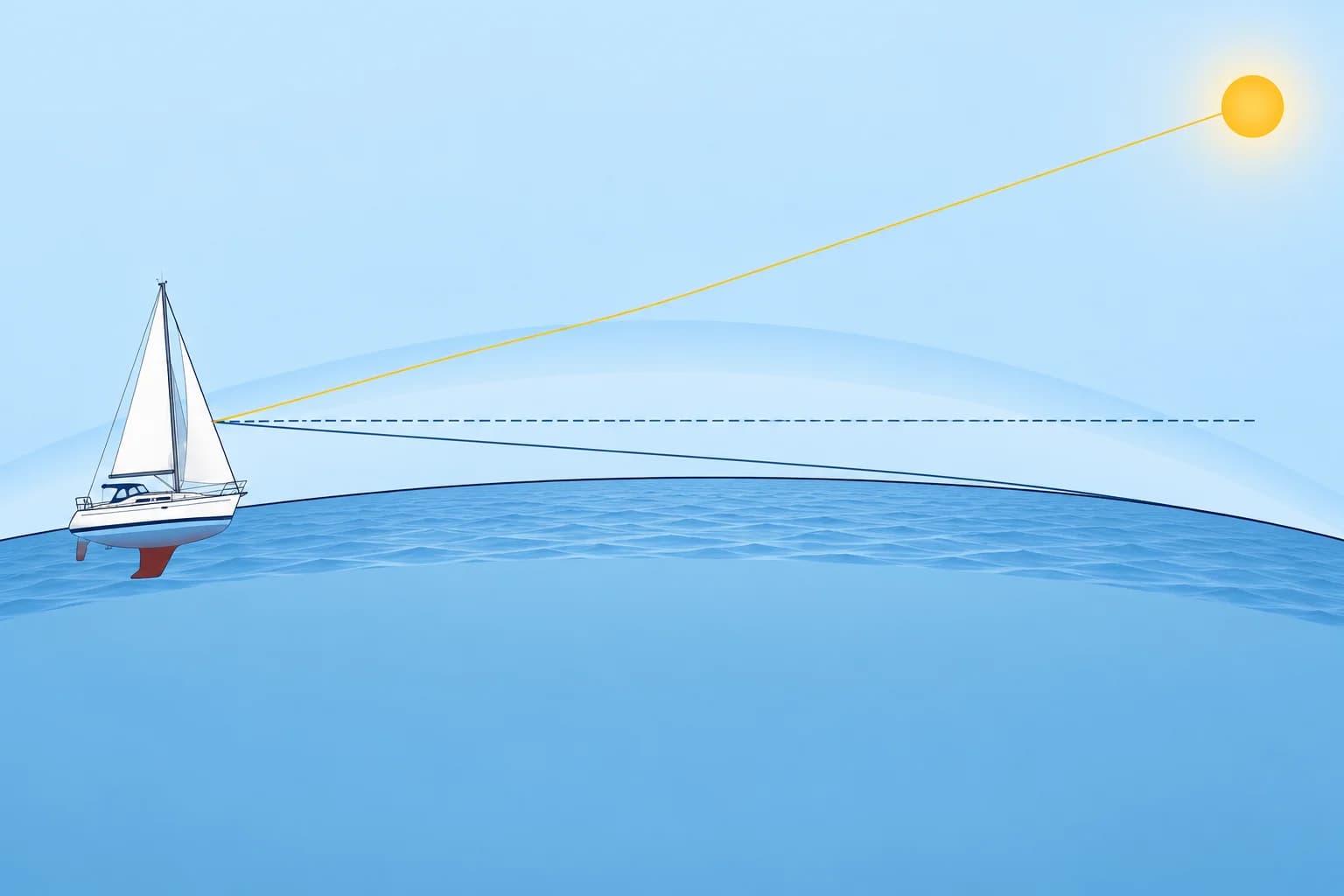
The chain
Hs, the sextant altitude, becomes Ha, the apparent altitude, after the index correction and dip. Ha becomes Ho, the observed altitude measured from the celestial horizon at the Earth's centre, after refraction, semi-diameter and parallax. The Nautical Almanac's altitude correction tables combine those last three for the Sun, stars and planets, and separately for the Moon.
Dip
Your eye is above the sea, so the visible horizon lies below the true horizontal. Dip = 1.76′ × √(height of eye in metres), always subtracted. At 2.5 m it is 2.8′; at 9 m, 5.3′. The almanac has a dip table by height of eye.
Refraction
The atmosphere bends light, so every body looks higher than it is: refraction is always subtracted. In standard conditions it is about 5.4′ at 10°, 2.7′ at 20°, 1.0′ at 45° and zero at 90°. Avoid sights below about 10°; for non-standard temperature or pressure, apply the signed additional correction as the almanac directs.
Semi-diameter
The almanac's positions are for the centre of the Sun, but you measured its edge. Add the semi-diameter (SD, 15.7′–16.3′, at the foot of the daily page) for a lower limb; subtract it for an upper limb. Stars are points: they have no SD.
Parallax
Ho is measured as if from the Earth's centre, but you stand on its surface. The difference, parallax in altitude, is always added. It is tiny for the Sun, 0.1′ or less, small for Venus and Mars, and large for the Moon: up to about 1° (Celestial: stars, planets and the Moon).
In practice
Choose the table for your body. For the Sun, enter with Ha and select October–March or April–September, then lower or upper limb. For stars, enter the stars-and-planets table with Ha. Planets use that table with any further correction directed by the almanac. The Moon has separate tables. Detailed planetary and lunar adjustments belong to the later unit. Apply the combined correction once: do not add its components again.
Key figures
- Chain
- Hs + IC − dip = Ha; Ha + main corr. = Ho
- Dip
- Always −: 1.76′ × √(height of eye in m)
- Refraction
- Always −: about 5.4′ at 10°, 1.0′ at 45°, 0 at 90°
- Semi-diameter
- Sun lower limb + SD; upper limb − SD (15.7′–16.3′)
- Parallax
- Always +: Sun ≤ 0.1′; Moon up to about 1°
- Spanish terms
- Depresión, refracción, semidiámetro, paralaje
Remember
- Hs → Ha with index correction and dip.
- Ha → Ho with refraction, SD and parallax.
- Dip and refraction are always subtracted; parallax always added.
- SD: add for the lower limb, subtract for the upper; none for stars.
- Avoid sights below about 10°: refraction is large and uncertain.
Common mistakes
Wrong: Refraction makes bodies look lower, so add it.
Right: Refraction lifts the image: bodies look higher, so it is always subtracted.
Wrong: Apply the Sun's semi-diameter to a star sight.
Right: Stars are points of light: no semi-diameter. Use the stars and planets table.
Wrong: Dip depends on the body's altitude.
Right: Dip depends only on your height of eye; refraction depends on altitude.
Worked case
Two observers sight the same star at the same moment over a clear horizon. Their index corrections are equal. Eye heights are 2.0 m and 4.0 m; the higher observer reads Hs 1.0′ greater. Does dip explain the difference?
Show the answer
Yes. Only dip differs: 1.76 × √2.0 = 2.5′ and 1.76 × √4.0 = 3.5′, so the higher observer reads 1.0′ more. After each adds the same IC and subtracts their own dip, both Ha agree; refraction then depends on altitude, the same for both. A star has no semi-diameter, and its parallax is negligible.
Practice question
Height of eye 4.0 m. What is the dip?
- 7.0′
- 2.0′
- 3.5′
- 4.0′
Show the answer
Answer: C. Dip = 1.76 × √4.0 = 3.5′, subtracted.
5 · Worked Hs to Ho
Hs to Ho, worked: the noon Sun
A worked lower-limb Sun sight, corrected step by step from 47°31.4′ on the sextant to a true altitude of 47°45.8′.
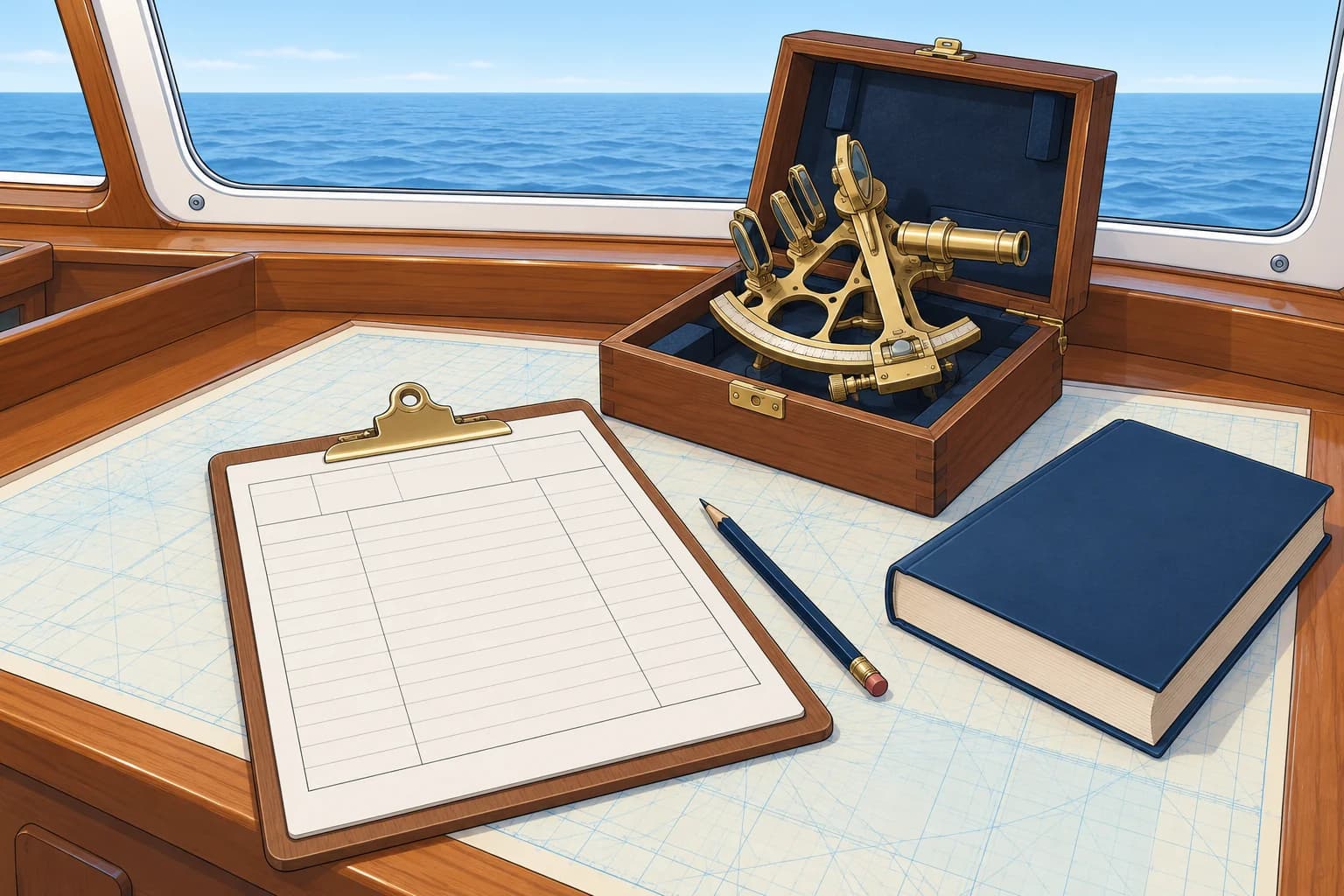
The data
26 November 2026, noon sight at DR 21°10′N 027°45′W; the noon-sight unit uses this sight. Sun lower limb, Hs 47°31.4′. Index error 1.8′ off the arc. Height of eye 2.5 m. Daily page: SD 16.2′. Standard temperature and pressure.
Hs to Ha
Index correction: off the arc, so +1.8′. Dip: 1.76 × √2.5 = 2.78′, so −2.8′. Ha = 47°31.4′ + 1.8′ − 2.8′ = 47°30.4′.
Ha to Ho
Refraction at 47°30′: −0.9′. Semi-diameter, lower limb: +16.2′. Parallax: +0.1′. Total +15.4′. Ho = 47°30.4′ + 15.4′ = 47°45.8′. The almanac's combined October–March lower-limb table, built on a mean SD, gives the same within 0.1′.
Check it
At this altitude and height of eye, Ho should exceed Hs if the index correction is small: +SD outweighs dip and refraction. A lower result is a reason to check the signs. For the upper limb at the same Ha, the main correction would be −16.2′ − 0.9′ + 0.1′ = −17.0′.
What remains
The arithmetic is to 0.1′, but sights from a yacht are rarely better than about 1′: the horizon is wavy, your height of eye changes and refraction near the sea can be abnormal. Each 1′ of altitude error moves the position line 1 M.
Key figures
- Hs
- 47°31.4′, Sun lower limb, 26 Nov 2026
- Index correction and dip
- +1.8′ (off the arc), −2.8′ (2.5 m)
- Ha
- 47°30.4′
- Main correction
- −0.9′ refraction + 16.2′ SD + 0.1′ parallax = +15.4′
- Ho
- 47°45.8′
- Spanish terms
- Altura aparente, altura verdadera, corrección total
Remember
- Hs 47°31.4′ + 1.8′ − 2.8′ = Ha 47°30.4′.
- Ha + 15.4′ = Ho 47°45.8′ for the lower limb.
- At this altitude and height of eye, with a small index correction, lower-limb Sun Ho exceeds Hs.
- Upper limb at the same altitude: about −17.0′.
- Expect about 1′ accuracy from a yacht: 1′ = 1 M.
Common mistakes
Wrong: Enter the almanac correction table with Hs.
Right: Enter it with Ha, after index correction and dip.
Wrong: Every 0.1′ in the result is real accuracy.
Right: The working keeps 0.1′, but a yacht's sights are usually good to about 1′.
Worked case
At effectively the same time and place as your lower-limb sight, a crew member records the upper limb at Hs 48°06.8′, with the same IE and eye height. Your lower-limb Ho is 47°45.8′. Calculate their Ho. Is the pair consistent?
Show the answer
Ha = 48°06.8′ + 1.8′ − 2.8′ = 48°05.8′; subtracting 17.0′ gives Ho 47°48.8′. That is 3′ above your result, larger than the expected agreement of about 1–2′. Investigate the limb, reading, contact and correction signs; repeat the sights if possible.
Practice question
In the worked sight, if the index error had been 1.8′ on the arc instead, what would Ho be?
- 47°49.4′
- 47°42.2′
- 47°45.8′
- 47°44.0′
Show the answer
Answer: B. The correction changes from +1.8′ to −1.8′, a difference of 3.6′: 47°45.8′ − 3.6′ = 47°42.2′.