
Astronomy and celestial navigation · Level R5 · 5 parts · about 15 min
Star, planet and Moon sights; latitude by Polaris
5 short parts: Twilight · Finding stars · Three-star fix · Planets, Moon · Polaris latitude. Each part explains the idea, then gives the points to remember, the common mistakes, a worked case and a practice question; the Academy unit adds all 27 check questions.
1 · Twilight
Twilight: the window for star sights
Twilight usually gives you visible stars and a clear horizon together. Plan your sights from the almanac's twilight times.

Why twilight
A star sight needs two things at once: the star visible in the sextant, and a sharp horizon under it. At night the horizon is usually lost; by day most stars are invisible. Your usual observing window is twilight, before sunrise and after sunset. That window lasts roughly 20 to 40 minutes in the tropics and longer in high latitudes.
Civil and nautical
Civil twilight ends in the evening when the Sun's centre is 6° below the horizon: the brightest stars and planets are out and the horizon is still crisp. Nautical twilight ends at 12° below: the horizon is usually too dark by then. Most star sights fall between the two. In the morning, the same window runs the other way.
The almanac's times
The Nautical Almanac's daily pages list sunrise, sunset, and civil and nautical twilight for latitudes from 60°S to 72°N. The times are local mean time (LMT); add west longitude in time, or subtract east, to get UT. Interpolate for your latitude.
Worked: 24 November 2026
Two days out of Las Palmas, at DR 26°05′N 019°10′W. Sunset is at about 1825 UT, civil twilight ends about 1850 UT and nautical twilight about 1918 UT. Plan to be ready at 1845 UT, with the stars precomputed and the deck watch checked.
Order of sights
In the evening, the eastern horizon darkens first, so take the stars in the east first and finish in the west. In the morning, stars fade first in the east as the sky brightens: take them first. Note the UT of each sight to the second.
Key figures
- Civil twilight
- Sun's centre 6° below the horizon
- Nautical twilight
- Sun's centre 12° below the horizon
- Star-sight window
- Mostly between the end of civil and nautical twilight
- Almanac times
- LMT for latitude; UT = LMT + W longitude in time (− E)
- Worked, 24 Nov 2026
- 26°05′N 019°10′W: sunset 1825, civil 1850, nautical 1918 UT
- Spanish terms
- Crepúsculo civil, crepúsculo náutico, hora civil del lugar
Remember
- Twilight usually provides the visible stars and sharp horizon you need.
- Civil twilight: Sun 6° below. Nautical twilight: 12° below. Most sights fall between.
- The almanac gives twilight in LMT: convert with longitude in time to UT.
- Evening: eastern stars first, as that horizon fades first. Morning: eastern stars first, as they fade first.
Common mistakes
Wrong: Wait for full darkness so that more stars are visible.
Right: By the end of nautical twilight the horizon is usually lost. Sight the bright stars while the horizon is still sharp.
Wrong: The almanac's twilight times are in UT.
Right: They are local mean time for your latitude. Add west longitude in time, or subtract east, to get UT.
Worked case
Evening, 24 November 2026, at 26°05′N 019°10′W. A crew member wants to start star sights at 1930 UT 'when it is properly dark'. What do you advise?
Show the answer
Too late. Nautical twilight ends about 1918 UT, and by then the horizon is usually too dark to trust. Start soon after the end of civil twilight, about 1850 UT, with the precomputed stars, taking the eastern ones first while that horizon is still sharp.
Practice question
How far below the horizon is the Sun's centre at the end of civil twilight?
- 18°
- 12°
- 6°
- 0°50′
Show the answer
Answer: C. Civil twilight ends at 6°. Nautical twilight ends at 12°, astronomical at 18°.
2 · Finding stars
Precomputing and identifying stars
Work out in advance where each star will be: its altitude and azimuth at the planned time. Then set the sextant, look along the bearing and find it.
GHA of a star
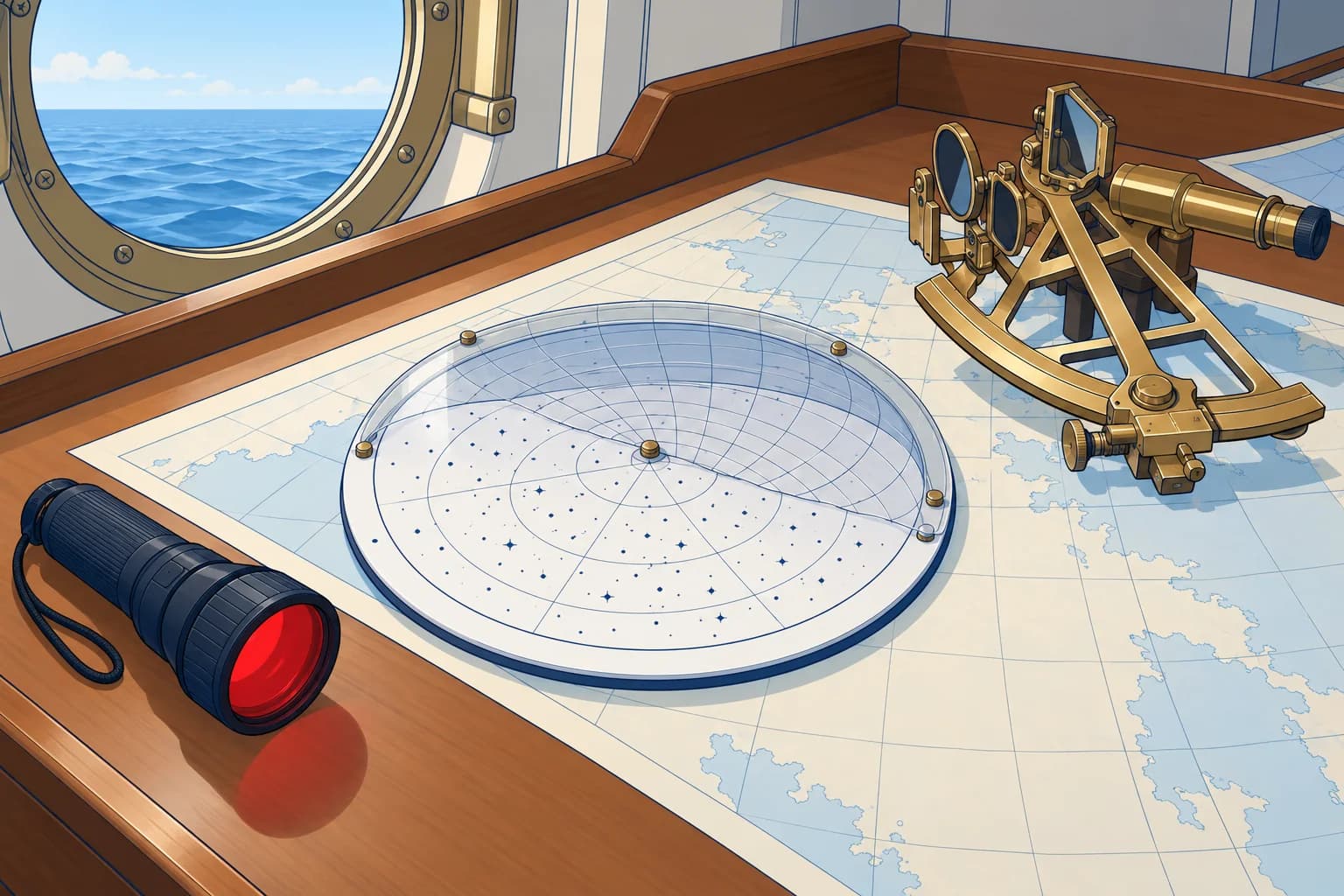
The almanac does not list each star's GHA. It lists GHA Aries hourly, and for 57 selected stars their SHA (sidereal hour angle) and declination, which change only slowly. GHA star = GHA Aries + SHA; subtract 360° if needed. Then LHA = GHA − west longitude, + east, as for the Sun.
Precomputing
Choose a time, say 1912 UT. For each candidate star, reduce from your DR as if you had a sight: Hc and Zn. Pick three or four stars at 15°–70° altitude, spread around the horizon. Set the sextant to each Hc, face the Zn, and the star appears in the horizon mirror.
Worked: 1912 UT, 24 November 2026
DR 26°05′N 019°10′W. GHA Aries at 19h 348°45.0′, plus 3°00.5′ for 12 min: 351°45.5′. Hamal (SHA 327°49.2′, N23°35.5′): Hc 36°21′, Zn 079°. Fomalhaut (SHA 015°12.8′, S29°28.8′): Hc 33°13′, Zn 167°. Vega (SHA 080°32.5′, N38°48.7′): Hc 44°04′, Zn 300°.
Other tools
A star finder, such as the 2102-D, does the same with a plastic disc and an overlay for your latitude. HO 249 Volume 1 lists seven well-placed stars for each LHA Aries and latitude, marking three for a good fix. Navigation apps precompute too. Use any of them, but learn one way that needs no battery.
Unknown star
Measure the star's sextant altitude, compass bearing and exact UT. Correct the altitude to Ho and the bearing to true (allowing for compass error). From your DR latitude, solve backwards for declination and LHA. SHA = LHA star − LHA Aries; add 360° if negative. Match both SHA and declination in the almanac's star list. A planet needs its own almanac data.
Key figures
- GHA of a star
- GHA Aries + SHA (subtract 360° if needed)
- Almanac stars
- 57 selected stars: SHA and Dec on the daily pages
- Good choice
- Three or four stars, 15°–70° up, spread round the horizon
- Worked GHA Aries
- 24 Nov 2026, 1912 UT: 348°45.0′ + 3°00.5′ = 351°45.5′
- Worked stars
- Hamal 36°21′/079°, Fomalhaut 33°13′/167°, Vega 44°04′/300°
- Tools
- Star finder 2102-D; HO 249 Volume 1; apps
Remember
- GHA star = GHA Aries + SHA; then LHA as for any body.
- Precompute Hc and Zn for the planned time; set the sextant and look along Zn.
- Choose three or four stars, 15°–70° up, spread around the horizon.
- An unknown star: work backwards to its SHA and declination, then search the list.
Common mistakes
Wrong: GHA star = GHA Aries − SHA.
Right: SHA is measured westward from Aries, like GHA, so you add: GHA star = GHA Aries + SHA.
Wrong: Choose the brightest stars, wherever they are.
Right: Spread matters more than brightness. Three stars bunched in one quarter cut badly and hide a constant error.
Wrong: A star very low on the horizon is as good as any other.
Right: Below about 15°, refraction is larger and less certain. Above about 70°, the sextant is hard to swing. Prefer the middle.
Worked case
At 1912 UT on 24 November 2026, near 26°N 019°W, a crew member sets the sextant to 44°04′ and looks north-east for Vega. Nothing appears. What has gone wrong, and where should they look?
Show the answer
They are looking in the wrong direction. The precomputed azimuth is 300°T, west-north-west, not north-east. Keep the sextant at 44°04′, face 300°T, and sweep the horizon gently: Vega should appear close to the horizon in the mirror.
Practice question
GHA Aries is 351°45.5′ and Hamal's SHA 327°49.2′. What is Hamal's GHA?
- 023°56.3′
- 319°34.7′
- 679°34.7′
- 179°34.7′
Show the answer
Answer: B. 351°45.5′ + 327°49.2′ = 679°34.7′; subtract 360° to get 319°34.7′.
3 · Three-star fix
The three-star fix and the cocked hat
Bring three star lines to one time for a fix. With stars about 120° apart, the equidistant point cancels an equal altitude error alone.
Reducing
Reduce each star exactly like a Sun sight: GHA (from Aries and SHA), LHA, Dec, then Hc and Zn and the intercept. With tables, each star has its own AP. With a calculator, reduce all from one DR. Correct each sextant altitude for index error, dip and refraction; stars need no semi-diameter or parallax (Celestial: the sextant).
A common time
The sights are minutes apart, and the boat moves. Bring them to one time, usually the last sight. At 6.5 kn, a sight 5 minutes earlier is 0.5 M behind: move its line along the ground track, or its AP, by that distance.
The cocked hat
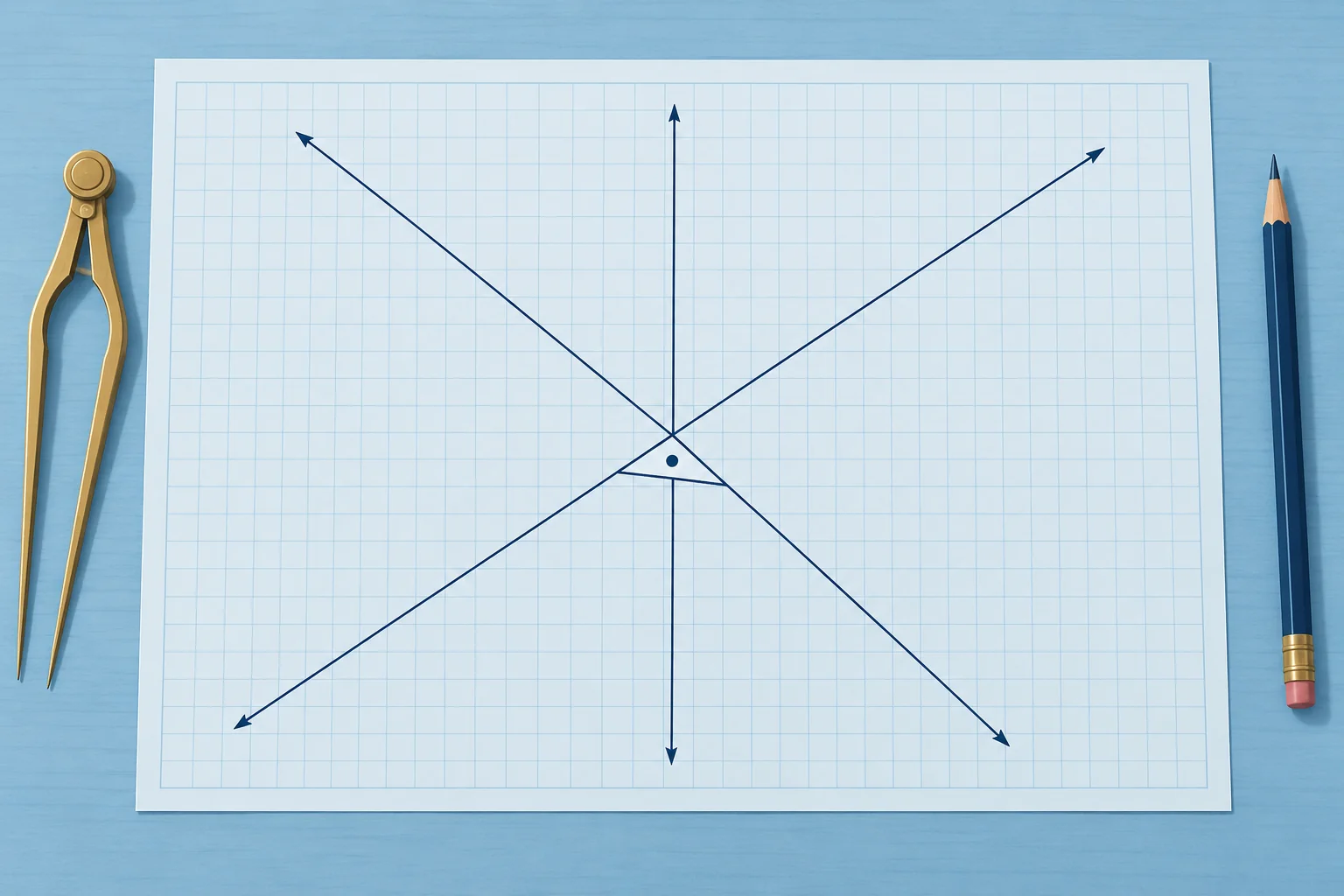
Three position lines usually form a triangle, the cocked hat. Its size depends on sight errors and crossing angles. A small triangle shows agreement but does not prove accuracy. A large one calls for checking times, identification, corrections and plotting.
Constant error
A wrong index correction or height of eye can shift all three lines equally, towards or away from their bodies. With stars surrounding you, about 120° apart, the point equally distant from the lines cancels a common altitude error if other errors are negligible. Random errors can put your true position outside the cocked hat. Check corrections and repeat doubtful sights.
Worked plan
For 24 November 2026: Hamal at 079°, Fomalhaut at 167° and Vega at 300°. The gaps are 88°, 133° and 139°: a good spread, all three between 33° and 44° altitude. Take a fourth star, if time allows, to check agreement between the lines.
Key figures
- Reduction
- As for the Sun; stars have no semi-diameter or parallax
- Common time
- Move earlier lines by the run: 6.5 kn × 5 min ≈ 0.5 M
- Cocked hat
- Size shows agreement; a small triangle can still give a poor fix
- Best spread
- Three stars about 120° apart in azimuth
- Constant error
- Equal altitude errors cancel ideally with well-spread stars
Remember
- Reduce each star like the Sun; stars need no semi-diameter or parallax.
- Bring all lines to one time by the run between sights.
- A small cocked hat shows agreement but does not guarantee accuracy.
- For an equal altitude error alone, stars about 120° apart preserve the point equidistant from the lines.
Common mistakes
Wrong: Plot every line for its own time; a few minutes do not matter.
Right: At 6.5 kn, five minutes is half a mile. Advance earlier lines to the time of the last sight.
Wrong: Three stars within 40° of azimuth make a strong fix because the lines are close together.
Right: Bunched azimuths give a long, thin triangle and hide a constant error. Spread them round the horizon.
Worked case
Your three star lines form a triangle about 14 M along each side. You applied a 2.0′ off-the-arc index error as on-the-arc. The stars were 120° apart. Assume other errors are negligible. What happens when you correct it?
Show the answer
The wrong sign made every altitude 4.0′ too low, shifting each line 4 M away from its body. At 120° spacing, this produces a triangle with sides about 13.9 M. Correct the index correction and replot. In this ideal case, the lines meet at the previous equidistant point.
Practice question
Which correction does a star sight not need?
- Index error
- Dip of horizon
- Refraction
- Semi-diameter
Show the answer
Answer: D. A star is a point of light: you bring the star itself to the horizon, so there is no limb or semi-diameter.
4 · Planets, Moon
Planets and the Moon: what is different
Planets and the Moon are reduced like the Sun, but their almanac data need extra corrections. The Moon's large parallax makes its altitude correction big.
The four planets
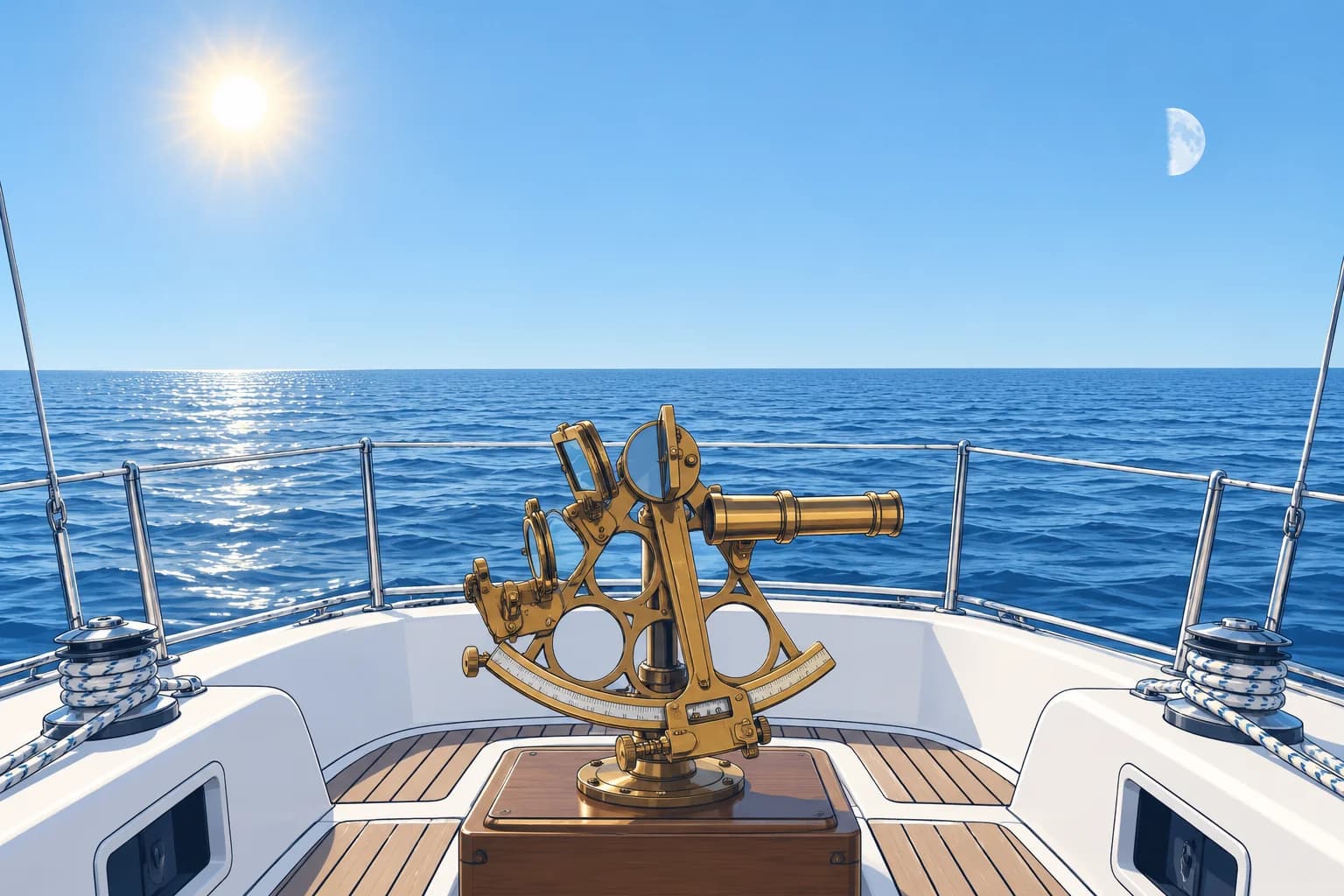
The almanac tabulates four navigational planets: Venus, Mars, Jupiter and Saturn. They are often the brightest objects in twilight, and Venus can be seen in daylight. Like the Sun, each has its own GHA and Dec every hour on the daily pages. They do not keep fixed SHAs like stars.
v and d
The increments tables assume a standard rate of change of GHA. A planet's actual rate differs slightly; the difference per hour is v, printed at the foot of its column. Correct GHA with v for the minutes past the hour, and Dec with d, as for the Sun. Venus's v can be negative. Altitude corrections are as for stars, with small additional ones for Venus and Mars.
The Moon
Parallax is the change in the Moon's apparent direction between Earth's centre and your position. Horizontal parallax (HP) is this angle when the Moon is on your horizon: about 54′–61′, listed hourly. Its v and d are also large. Use the Moon tables with apparent altitude, HP and the observed lower or upper limb—the bottom or top edge. They combine refraction, semi-diameter and parallax.
A daytime fix
When the Moon and the Sun are both up, with a good angle between their azimuths, you can cross a Sun line with a Moon line: a fix by day without waiting for noon. Around full Moon, the Moon is often too close to the horizon or opposite the Sun.
This evening
On 24 November 2026, the Moon was full at 1453 UT, with HP about 60.8′. By evening twilight it had just risen in the east-north-east. Saturn stood about 47° up in the east-south-east: a good fourth line. A bright Moon can light the horizon under it after twilight, but treat such sights with caution.
Key figures
- Navigational planets
- Venus, Mars, Jupiter, Saturn
- Planet v
- Hourly excess of GHA over the standard rate; Venus can be negative
- Moon HP
- About 54′ to 61′; listed hourly on the daily pages
- Moon tables
- Enter with apparent altitude and HP; lower or upper limb
- 24 Nov 2026
- Full Moon 1453 UT, HP about 60.8′; Saturn about 47° up
Remember
- Four planets: Venus, Mars, Jupiter, Saturn, each with hourly GHA and Dec.
- Correct planet GHA with v and Dec with d; Venus and Mars get small extra corrections.
- The Moon's HP is large: use its own tables with apparent altitude, HP and limb.
- A Moon line can cross a Sun line for a fix by day.
Common mistakes
Wrong: Find a planet's GHA from GHA Aries and a fixed SHA, like a star.
Right: Planets move against the stars. Take each planet's own GHA and Dec from its column, with v and d.
Wrong: Correct a Moon sight with the star tables plus semi-diameter.
Right: The Moon's parallax is large and changes with HP. Use the almanac's Moon tables with apparent altitude, HP and limb.
Wrong: Ignore v because it is printed only at the foot of the column.
Right: Apply v for the minutes past the hour. For the Moon it can exceed 10′ an hour, worth several miles.
Worked case
Mid-morning, the Sun bears 120°T and a half Moon bears 230°T, about 40° up. You have one Sun line and no noon sight for three hours. What can you do?
Show the answer
Take a Moon sight now. The azimuths differ by about 110°, a good angle. Reduce it with the Moon's own GHA, v, Dec and d, and correct the altitude with the Moon tables using HP and the limb you observed. Advance the earlier Sun line to the Moon sight's time, then cross the two lines for your daytime fix.
Practice question
Which body is not one of the almanac's four navigational planets?
- Venus
- Mercury
- Jupiter
- Saturn
Show the answer
Answer: B. The four are Venus, Mars, Jupiter and Saturn. Mercury stays too close to the Sun to be useful.
5 · Polaris latitude
Worked: latitude by Polaris
Polaris's altitude is close to your latitude. Apply three almanac corrections to find the latitude line. Worked on 24 November 2026.
Why it works
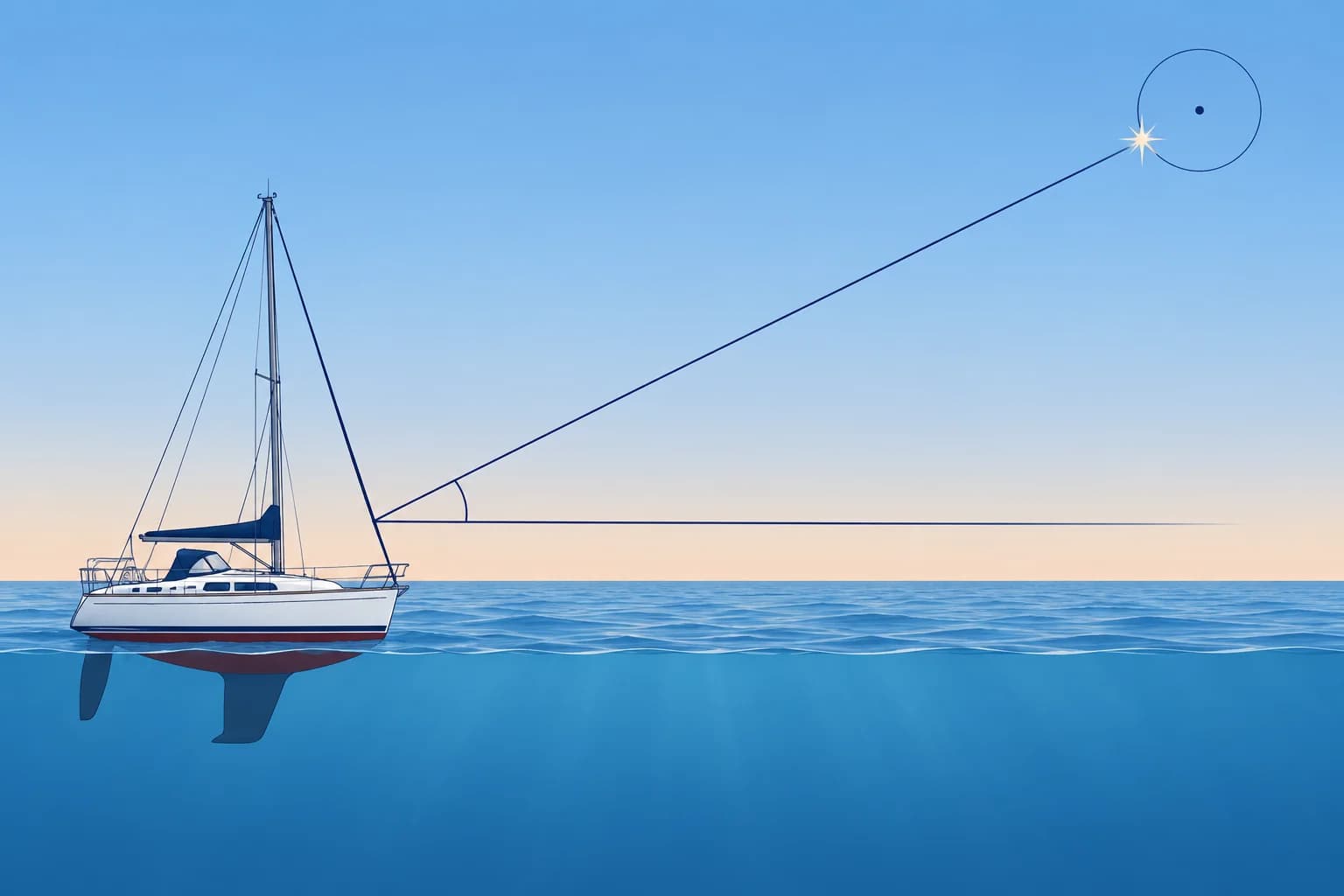
Polaris lies only about 37′ from the north celestial pole in 2026 (Navigation: compass error by Polaris). The pole's altitude equals your latitude. Polaris circles the pole once a sidereal day, so its altitude is up to about 37′ more or less than your latitude, depending on LHA Aries.
The tables
The Nautical Almanac's Polaris tables give Latitude = Ho − 1° + a0 + a1 + a2. Ho is the sextant altitude corrected for index error, dip and refraction. Use LHA Aries throughout: interpolate a0 from LHA Aries, then use the matching LHA column for a1 with approximate latitude and a2 with month. All three are positive; the −1° balances the constants built into them.
Worked: the sight
24 November 2026, 1912 UT, at DR 26°05′N 019°10′W. GHA Aries 351°45.5′ − 19°10′ = LHA Aries 332°35.5′. Ho of Polaris is 26°21.8′.
Worked: the answer
For this worked example, use these supplied corrections: a0 = 0°48.7′, a1 = 0.5′, a2 = 1.1′. The lookup arguments are LHA Aries 332°35.5′ throughout, plus latitude about 26° for a1 and November for a2. Latitude = 26°21.8′ − 1° + 48.7′ + 0.5′ + 1.1′ = 26°12.1′N: a position line running east–west, about 7 M north of the DR.
Limits
Polaris is only of magnitude 2, so find it early in twilight with a precomputed altitude, close to your latitude. Near the equator it is very low, with large and uncertain refraction; south of the equator it is normally out of sight. Cross its latitude line with a star line from the east or west for a fix.
Key figures
- Formula
- Latitude = Ho − 1° + a0 + a1 + a2
- Arguments
- a0: LHA; a1: LHA + latitude; a2: LHA + month
- Ho
- Corrected for IE, dip and refraction; no semi-diameter
- Worked LHA Aries
- 351°45.5′ − 19°10′ = 332°35.5′
- Worked latitude
- 26°21.8′ − 1° + 48.7′ + 0.5′ + 1.1′ = 26°12.1′N
- Spanish terms
- Latitud por la Polar; correcciones de la Polar
Remember
- Polaris's altitude is within about 37′ of your latitude in 2026.
- Latitude = Ho − 1° + a0 + a1 + a2. All use LHA Aries; a1 also uses latitude, a2 also month.
- Find LHA Aries from GHA Aries for the UT of the sight and your longitude.
- Low near the equator and normally unseen south of it; cross the line with an east or west star.
Common mistakes
Wrong: Polaris's altitude is your latitude; no correction is needed.
Right: It can differ by up to about 37′, depending on LHA Aries. Apply the Polaris tables.
Wrong: Forget the −1° because all three corrections are positive.
Right: The constants built into a0, a1 and a2 add up to 1°. Without the −1°, you are 60 M too far north.
Wrong: Enter the a0 table with your longitude.
Right: Enter it with LHA Aries: GHA Aries for the exact UT, minus west longitude or plus east.
Worked case
Another evening, LHA Aries is 227°, so Polaris is near its lowest, about 37′ below the pole. Your corrected altitude is 23°40.0′. A crew member writes latitude 23°40′N. Is that right, roughly?
Show the answer
No. Below the pole, its altitude is less than your latitude, so add about 37′: roughly 24°17′N. Use Latitude = Ho − 1° + a0 + a1 + a2. All use LHA Aries 227°; a1 also needs approximate latitude, a2 the month. Never take the altitude as latitude without the corrections.
Practice question
Which formula gives latitude from Polaris with the almanac's tables?
- Ho + a0 − a1 − a2
- Ho − 1° + a0 + a1 + a2
- 90° − Ho + a0
- Ho + 1° − a0 − a1 − a2
Show the answer
Answer: B. All three corrections are positive, and the −1° balances the constants built into them.