
Astronomy and celestial navigation · Level R5 · 5 parts · about 15 min
The celestial sphere, stars and planets
5 short parts: The sphere · Dec and GHA · Altitude · PZX triangle · The bodies. Each part explains the idea, then gives the points to remember, the common mistakes, a worked case and a practice question; the Academy unit adds all 31 check questions.
1 · The sphere
The celestial sphere: a model of the sky
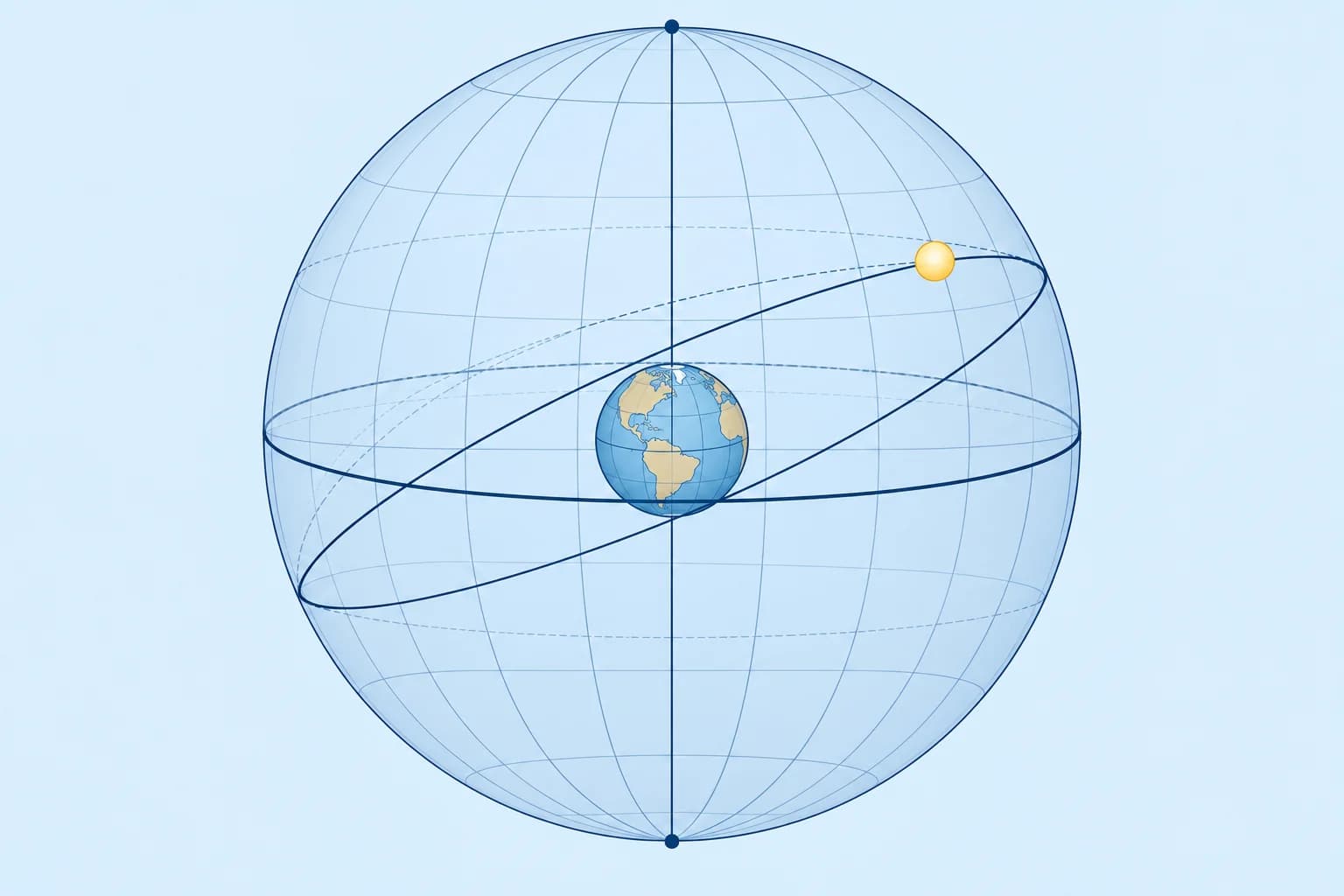
Navigators draw every body on one huge sphere centred on the Earth. Its poles and equator are the Earth's own, projected out into the sky.
A working model
The celestial sphere is an imaginary sphere of very large radius with the Earth at its centre. Every body, the Sun, Moon, planets and stars, is drawn on its surface where you see it. Only directions matter, not distances. The model is old, but the almanac and the sight-reduction formulas use exactly this picture, so it is the right one for navigation.
Poles and equator
Extend the Earth's axis and it meets the sphere at the north and south celestial poles. Project the Earth's equator outwards and you get the celestial equator, also called the equinoctial. A great circle divides the sphere into equal halves. Half of one through both poles and a body is its hour circle, a celestial meridian. As the Earth spins eastward, this whole grid seems to turn westward once a day.
The ecliptic
Over a year the Sun moves eastward against the stars along a great circle called the ecliptic. It is tilted to the equinoctial by the obliquity, about 23°26′. So the Sun is about 23°26′ north of the celestial equator at the June solstice (21 June 2026) and 23°26′ south at the December solstice (21 December 2026).
The First Point of Aries
The ecliptic crosses the equinoctial at two points. The one the Sun passes going north, around 20 March, is the First Point of Aries, written ♈ or simply Aries. It is the zero point for star positions in the almanac. It now lies in the constellation Pisces, not Aries, because the Earth's axis slowly wobbles: precession.
Why it matters
Every point of the sphere has one point on the Earth directly beneath it. That is what turns an angle measured in the sky into a line on your chart, as the next parts show. The Polaris unit already used two of these ideas: the celestial pole and Aries (Navigation: Polaris and time).
Key figures
- Celestial poles
- The Earth's axis extended to the sphere
- Equinoctial
- The Earth's equator projected onto the sphere
- Obliquity
- About 23°26′ between ecliptic and equinoctial
- First Point of Aries
- Sun crosses the equinoctial going north, about 20 March
- Solstices 2026
- 21 June: Sun about 23°26′N; 21 December: about 23°26′S
- Spanish terms
- Esfera celeste, ecuador celeste, eclíptica, punto Aries
Remember
- The celestial sphere is centred on the Earth; only directions matter.
- The equinoctial is the Earth's equator projected onto the sky.
- The Sun follows the ecliptic, tilted about 23°26′ to the equinoctial.
- Aries is where the Sun crosses the equinoctial northward, around 20 March.
Common mistakes
Wrong: The celestial sphere is a real shell at one distance.
Right: It is a model. Stars lie at very different distances; the model keeps only their directions.
Wrong: The First Point of Aries lies in the constellation Aries.
Right: Precession has moved it into Pisces. The name is historical; it is simply the zero of star positions.
Worked case
A crew member asks why the Sun is high at noon in June and low in December off the Canaries, when the Earth turns the same way every day. Explain with the celestial sphere.
Show the answer
The Sun moves along the ecliptic, tilted about 23°26′ to the equinoctial. In June it is about 23°26′ north of the celestial equator, so it stands higher above a northern horizon at noon. In December it is about 23°26′ south and stands lower. Daily rotation turns the whole sphere; the Sun's yearly path changes its place on it.
Practice question
What is the celestial equator?
- The Sun's yearly path among the stars
- The Earth's equator projected onto the sky
- The great circle through your zenith and poles
- The circle 90° away from your zenith
Show the answer
Answer: B. The celestial equator, or equinoctial, is the Earth's equator projected. The Sun's path is the ecliptic; the last two are your meridian and horizon.
2 · Dec and GHA
Declination, hour angles and the geographical position
Declination is the sky's latitude; Greenwich hour angle is its longitude, always measured west. Together they give the point beneath each body.
Declination
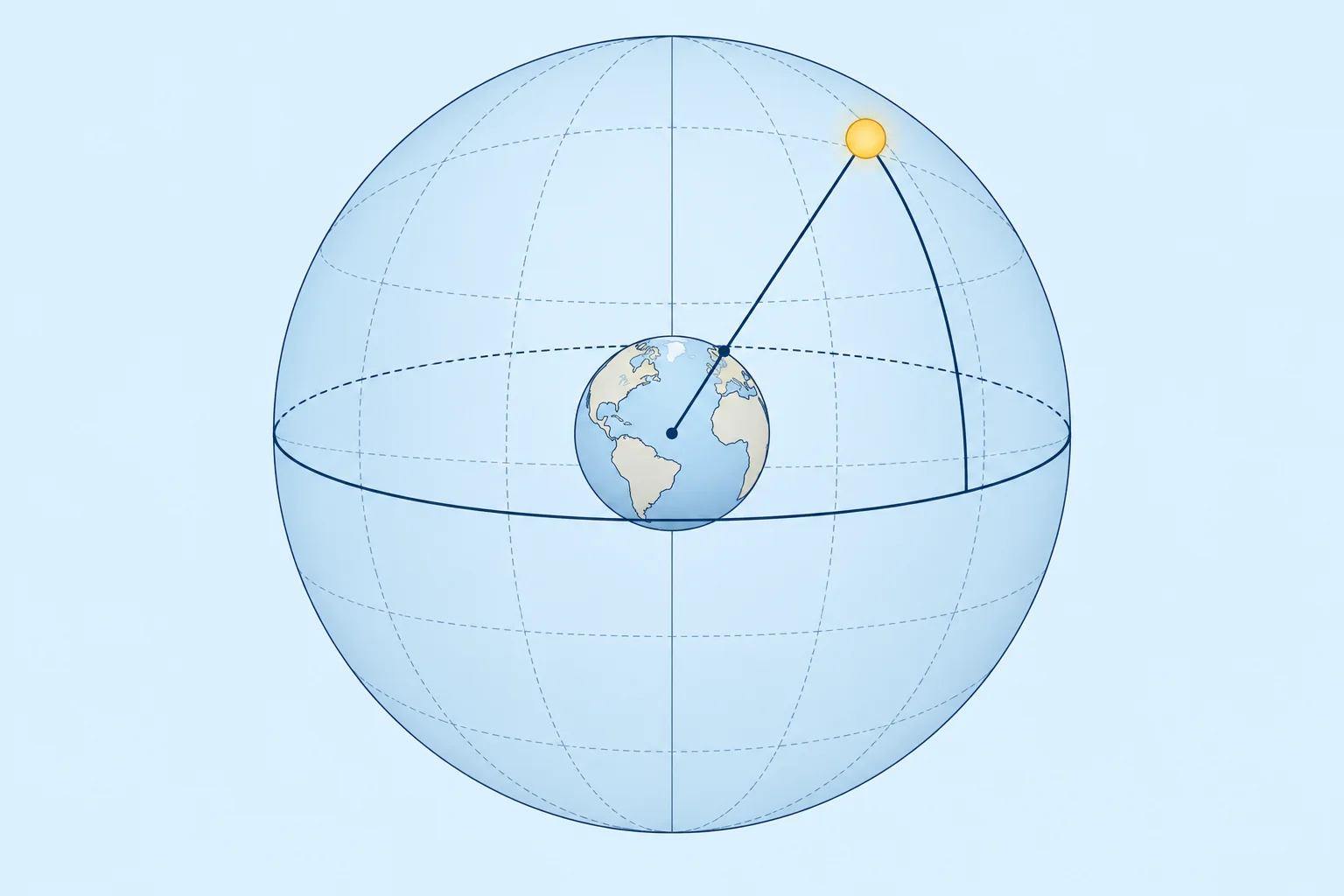
Declination (Dec) is a body's angle north or south of the celestial equator, measured along its hour circle, 0° to 90° N or S. It is the sky's version of latitude. The Sun's declination changes slowly, by at most about 1′ an hour; a star's hardly changes in a year.
Greenwich hour angle
Greenwich hour angle (GHA) is the angle at the pole measured westward from the Greenwich meridian to the body's hour circle, 0° to 360°. It is like longitude, but always counted west. The Sun's GHA increases by about 15°00′ an hour; Aries's increases by 15°02.5′.
Local hour angle
Local hour angle (LHA) is the same angle measured westward from your meridian: LHA = GHA + east longitude, or − west longitude, adding or removing 360° to keep it from 0° to 360°. LHA 0° means the body is on your meridian. Under 180°, it is west of you; over 180°, east of you.
Sidereal hour angle
Stars keep almost fixed places against each other. So the almanac gives each star's sidereal hour angle (SHA), measured westward from Aries, and its Dec, and tabulates only GHA Aries hour by hour. Then GHA star = GHA Aries + SHA, less 360° if the sum passes 360°.
The geographical position
The point on Earth directly beneath a body is its geographical position (GP). Its latitude equals the declination. Its longitude is the GHA, west, when GHA is 180° or less; otherwise 360° − GHA, east. At 1300 UT on 26 November 2026 the Sun's GHA is 18°10.6′ and its Dec S 20°59.9′: its GP is 20°59.9′S 018°10.6′W, in the South Atlantic.
Key figures
- Declination
- 0–90° N or S of the celestial equator
- GHA
- 0–360°, measured westward from Greenwich
- LHA
- GHA + E long − W long; keep within 0–360°
- GHA of a star
- GHA Aries + SHA (− 360° if over)
- GP
- Lat = Dec; long = GHA (W) or 360° − GHA (E)
- Spanish terms
- Declinación, horario en Greenwich, horario del lugar, ángulo sidéreo
Remember
- Dec is like latitude; GHA is like longitude but always measured west, 0–360°.
- LHA = GHA + E long − W long, kept between 0° and 360°.
- LHA under 180°: body west of you. Over 180°: east of you.
- GHA star = GHA Aries + SHA.
- The GP is the point beneath the body: lat = Dec, long from GHA.
Common mistakes
Wrong: GHA is measured east or west, up to 180°, like longitude.
Right: GHA is always measured westward, from 0° to 360°. Convert to east or west only for the GP.
Wrong: Add west longitude to GHA to get LHA.
Right: Subtract west longitude and add east longitude: LHA is measured from your meridian, which lies west or east of Greenwich.
Wrong: Each star's GHA is tabulated hourly in the almanac.
Right: Only GHA Aries is hourly. Add the star's SHA from the star list.
Worked case
At 1300 UT on 26 November 2026 the Sun's GHA is 18°10.6′, Dec S 20°59.9′. You are at 21°10′N 027°45′W. Find the Sun's GP and LHA, and say whether the Sun has crossed your meridian yet.
Show the answer
GP: latitude = Dec, 20°59.9′S. GHA is under 180°, so longitude 018°10.6′W. LHA = 18°10.6′ − 27°45.0′ = −9°34.4′, plus 360° = 350°25.6′. Over 180°, so the Sun is still east of you: your noon is still to come, about 38 minutes later.
Practice question
A body's GHA is 200°10′. What is the longitude of its geographical position?
- 159°50.0′W
- 020°10.0′E
- 159°50.0′E
- 020°10.0′W
Show the answer
Answer: C. GHA over 180° gives an east longitude: 360° − 200°10′ = 159°50′E.
3 · Altitude
Altitude, azimuth and the circle of equal altitude
A body's altitude tells you how far you are from the point beneath it: 1′ of zenith distance is 1 nautical mile. That is why a sight gives a position line.
Your own sky
The zenith is the point directly above you; the nadir is directly below. The celestial horizon is the great circle 90° from your zenith. Its plane passes through the Earth's centre, perpendicular to your vertical. Your observer's meridian runs through the poles and your zenith. Sextant altitudes are corrected to the celestial horizon (Celestial: the sextant).
Altitude and azimuth
A body's altitude (H) is its angle above the celestial horizon, 0° to 90°. Its zenith distance (ZD) is 90° − altitude. Its azimuth (Zn) is its true bearing, 000° to 360° clockwise from true north. At meridian passage it bears north or south, unless overhead, when azimuth is undefined. Upper passage has LHA 0°; lower passage has LHA 180°.
Pole height = latitude
The elevated celestial pole, the one on your side of the equator, stands above your horizon at an altitude equal to your latitude. At 40°N it is 40° up.
The circle of equal altitude
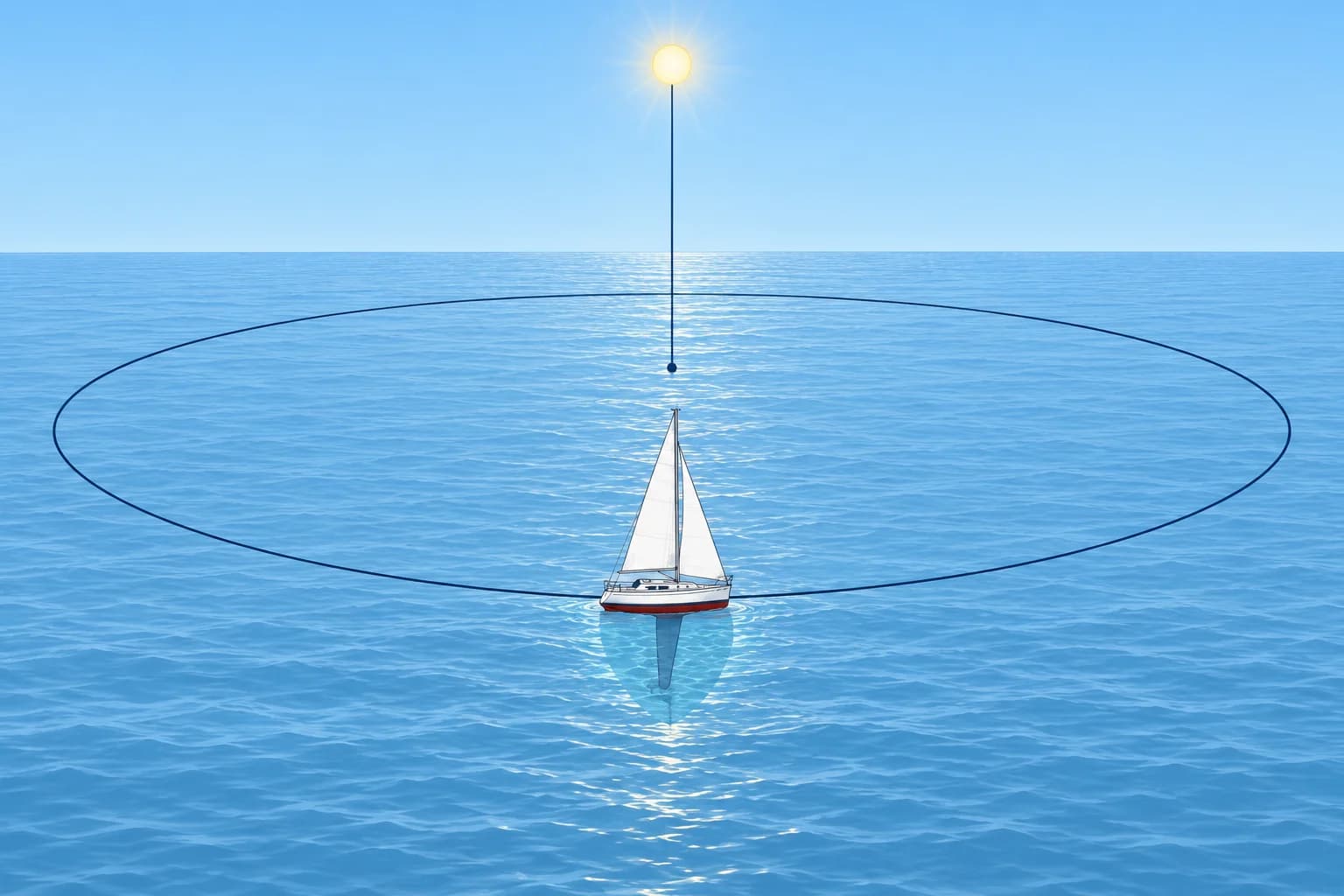
The angle between your zenith and the body equals the angle at the Earth's centre between you and the GP. Each 1′ of arc is 1 nautical mile. So everyone who measures the same altitude at the same instant stands on one circle around the GP: the circle of equal altitude. Its radius is the zenith distance in minutes, in miles.
From circle to position line
An altitude of 47°45.8′ gives a ZD of 42°14.2′: a circle of about 2,534 M radius. Your dead-reckoning (DR) position is estimated from a known position using course and distance travelled. Near it, a short arc of the circle is almost straight, at right angles to the azimuth: your position line. Time each sight: the GP moves about 15′ of longitude a minute, up to about 15 M.
Key figures
- Zenith distance
- ZD = 90° − altitude
- 1′ of arc
- 1 nautical mile on the Earth's surface
- Circle radius
- ZD in minutes = miles from the GP
- Elevated pole
- Its altitude equals your latitude
- GP motion
- 15′ of longitude a minute (up to 15 M)
- Spanish terms
- Cenit, horizonte, altura, azimut, distancia cenital
Remember
- Altitude above the celestial horizon; zenith distance = 90° − altitude.
- Azimuth Zn is the body's true bearing, 000°–360°.
- The elevated pole's altitude equals your latitude.
- Same altitude, same instant: you are on a circle of equal altitude around the GP.
- Near your DR the circle is a straight position line at right angles to the azimuth.
Common mistakes
Wrong: A position line runs towards the body, along its bearing.
Right: It runs at right angles to the azimuth: it is a short piece of a circle centred on the GP.
Wrong: A few seconds of error in time do not matter for a sight.
Right: The GP moves up to about 15 M a minute. Record every sight's time to the second.
Worked case
You observe the Sun at an altitude of 47°45.8′ (corrected). A crew member asks: 'So where are we?' Explain what that single altitude tells you.
Show the answer
ZD = 90° − 47°45.8′ = 42°14.2′, about 2,534 M. You are somewhere on a circle of about 2,534 M radius around the Sun's GP at that instant. Near your DR, that circle is almost a straight position line at right angles to the Sun's bearing. A fix needs two nonparallel position lines referred to the same time.
Practice question
Your corrected altitude is 47°45.8′. How far are you from the body's GP?
- 2,866 M
- 1,267 M
- 2,534 M
- 47.8 M
Show the answer
Answer: C. ZD = 90° − 47°45.8′ = 42°14.2′ = 2,534.2′, and 1′ = 1 M. 2,866 M would wrongly use the altitude itself.
4 · PZX triangle
The PZX triangle: why a sight works
Pole, zenith and body form a spherical triangle. Your DR and the almanac give two sides; corrected sextant altitude gives the third by subtraction from 90°.
Three points
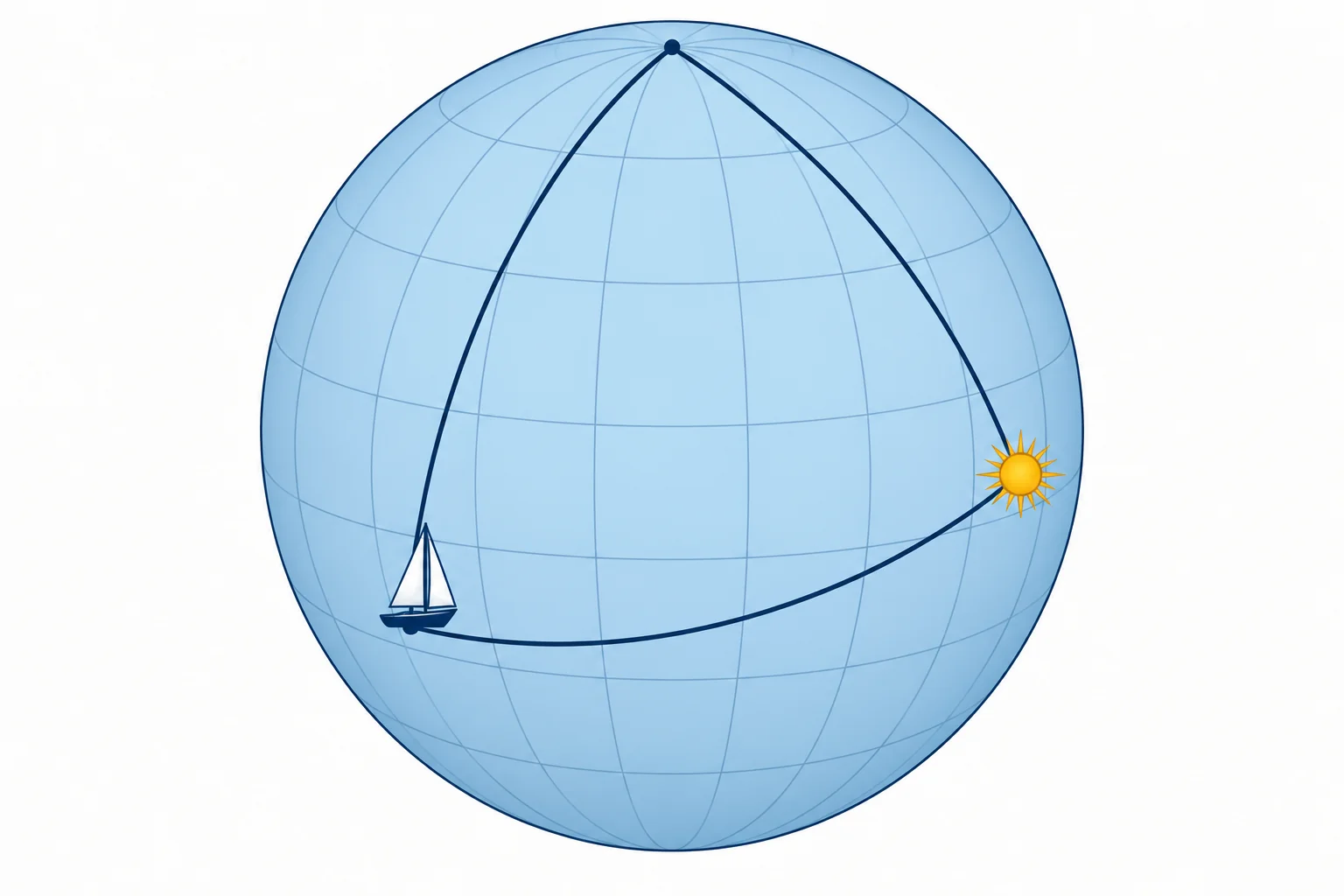
Join three points of the celestial sphere with great-circle arcs: P, the elevated pole; Z, your zenith; X, the body. This is the PZX triangle, also called the astronomical or position triangle. On the Earth the same triangle joins the pole, your position and the body's GP.
The sides
PZ = 90° − latitude, the co-latitude. PX, the polar distance, is 90° − Dec when latitude and Dec are both N or both S, or 90° + Dec when one is N and the other S. Use positive angle sizes. ZX = 90° − Ho, the zenith distance, where Ho is corrected observed altitude. PZ comes from your DR, PX from the almanac; corrected observed altitude gives ZX.
The angles
The angle at P is the meridian angle (t): equal to LHA when LHA is under 180°, named west; otherwise 360° − LHA, named east. The azimuth angle at Z runs 0–180° from the direction of the elevated pole towards the body. Name its reference north or south and its side east or west. Zn expresses the same direction clockwise from true north.
Solving it
From your DR latitude, the Dec and the LHA, spherical trigonometry gives Hc, the altitude calculated for your DR, and the azimuth Zn. Your raw sextant reading is Hs; after correction it becomes Ho, your corrected observed altitude. Comparing Ho with Hc gives the intercept, a difference used to find your position line (Celestial: sight reduction).
A special case
At upper meridian passage, LHA is 0° and P, Z and X all lie on one great circle, your meridian. The triangle collapses into a line. This is the special geometry used for the noon sight (Celestial: the noon sight). At lower passage, LHA is 180° and the points also lie on your meridian.
Key figures
- PZ
- Co-latitude = 90° − latitude
- PX
- 90° − Dec if lat/Dec both N or both S; 90° + Dec if N/S differ
- ZX
- Zenith distance = 90° − Ho (corrected observed altitude)
- Angle at P
- Meridian angle t, from LHA
- Angle at Z
- Azimuth angle, converted to true bearing Zn
- Spanish terms
- Triángulo de posición: colatitud, codeclinación, distancia cenital
Remember
- P elevated pole, Z zenith, X body.
- PZ = 90° − lat; PX = 90° ∓ Dec; ZX = 90° − Ho (corrected observed altitude).
- Angle at P comes from LHA; angle at Z gives the azimuth.
- Your DR, Dec and LHA give Hc and Zn; Ho is your corrected observed altitude.
- At upper passage (LHA 0°), the triangle lies along the meridian: the noon sight.
Common mistakes
Wrong: Polar distance is always 90° − Dec.
Right: Use 90° − Dec when latitude and Dec are both N or both S; use 90° + Dec when one is N and the other S. Use positive angle sizes.
Wrong: The sextant gives the azimuth angle at Z.
Right: The sextant measures altitude. After correction, subtract it from 90° to find ZX. Solve the triangle for azimuth.
Worked case
Your DR latitude is 21°10′N. A body's Dec is S 21°00.2′, and your corrected altitude is 47°45.8′. Find PZ, PX and ZX.
Show the answer
PZ = 90° − 21°10′ = 68°50′. Latitude is north and declination is south, so PX = 90° + 21°00.2′ = 111°00.2′. ZX = 90° − 47°45.8′ = 42°14.2′.
Practice question
At latitude 40°N, what is the side PZ?
- 40°
- 130°
- 50°
- 90°
Show the answer
Answer: C. PZ is the co-latitude, 90° − 40° = 50°.
5 · The bodies
Sun, stars, planets and the Moon
The Sun is your main daytime body. Twilight is the usual window for stars and planets. Each body moves differently, so the almanac treats each differently.

The Sun
The Sun is the yachtsman's main body: bright, easy to find and usable whenever it and a sharp horizon are visible. Its declination swings between about 23°26′N and 23°26′S over the year, and its GHA grows by about 15° an hour. The almanac gives its GHA and Dec for every hour of UT.
Stars
Stars are so distant that their SHA and Dec change only slowly. The Nautical Almanac daily pages list 57 selected stars, with SHA and Dec for each three-day opening; Polaris has its own tables, and a list at the back covers 173 stars. The stars rise about 4 minutes earlier each day, so the night sky shifts slowly through the year.
Planets
Venus, Mars, Jupiter and Saturn are the navigational planets. They move against the stars, so the almanac gives their GHA and Dec hourly, like the Sun. Venus and Jupiter are often brighter than any star. A very bright, steady 'star' near the ecliptic, not in the star list, is usually a planet.
The Moon
The Moon moves about 13° a day eastward among the stars. Its GHA grows by about 14½° an hour; its Dec can change by more than 10′ an hour. It is close, so its direction differs when viewed from the Earth's centre rather than its surface. This shift, called parallax, can approach 1°. You can often observe the Moon in daylight alongside the Sun.
When to observe
You usually observe stars and planets at twilight, the period around sunrise and sunset. You need both a visible body and a sharp sea horizon. Moonlight can sometimes reveal a usable horizon at night; bright planets can sometimes be observed in daylight. The daily pages give civil and nautical twilight times; star selection is in Celestial: stars, planets and the Moon.
Key figures
- Navigational planets
- Venus, Mars, Jupiter and Saturn
- Almanac stars
- 57 on the daily pages; Polaris tables; 173 at the back
- Sun's Dec range
- About 23°26′N to 23°26′S
- Stars
- Rise about 4 minutes earlier each day
- Moon
- GHA about 14½° an hour; parallax up to about 1°
- Spanish terms
- Astros: Sol, Luna, planetas, estrellas; crepúsculo
Remember
- Use the Sun by day; twilight usually gives both visible stars or planets and a clear horizon.
- Stars: SHA and Dec nearly constant; the almanac lists 57 plus Polaris.
- Venus, Mars, Jupiter, Saturn are tabulated hourly, like the Sun.
- The Moon moves fast and has a large parallax: it needs its own corrections.
Common mistakes
Wrong: Star sights can be taken at any time of night.
Right: You need both the body and a clear horizon. Twilight usually provides them; moonlight can sometimes reveal the sea horizon at night.
Wrong: A bright 'star' not in the list is an error in the almanac.
Right: It is usually a planet. Check the planet columns and the almanac's planet notes.
Worked case
On an Atlantic passage you see, at evening twilight, a very bright steady light low in the west, near the Sun's path, brighter than any star. It is not in the almanac star list. What is it most likely to be, and how do you check?
Show the answer
Venus is a likely candidate; Jupiter is another. Both can outshine every star and lie near the ecliptic. Check the almanac's planet notes for the date and the planet's visibility. Brightness alone does not confirm its identity. For detailed identification, see Celestial: stars, planets and the Moon.
Practice question
Which are the four navigational planets?
- Mercury, Venus, Mars, Jupiter
- Venus, Jupiter, Saturn, Uranus
- Venus, Mars, Jupiter, Saturn
- Mars, Jupiter, Saturn, Neptune
Show the answer
Answer: C. The Nautical Almanac tabulates Venus, Mars, Jupiter and Saturn. Mercury, Uranus and Neptune are not used.