- From 18minimum age for the licence
- 20 questionsin the theory exam
- Written or oraltheory exam conducted by a three-member committee
- 18 correctminimum answers needed to pass
- Theory + practicalboth exams conducted by the Λιμεναρχείο
- Jet skia licence is required to operate oneΓενικός Κανονισμός Λιμένα αριθ. 20 (General Port Regulation No. 20)
The licence at a glanceWhat is the Δίπλωμα Ταχυπλόου Σκάφους?
The Δίπλωμα Ταχυπλόου Σκάφους is the operator licence for craft classified as speedboats under the Γενικός Κανονισμός Λιμένα (General Port Regulation). It is required for jet skis and hovercraft, and for recreational motorboats above a power threshold that depends on the engine and hull. For a conventional hull, the thresholds are above 30 HP with an outboard, 40 HP with a sterndrive or inboard petrol engine, and 70 HP with an inboard diesel. For an inflatable, multihull or V-shaped hull, they are above 15, 30 and 50 HP respectively. For a water jet, the threshold is above 15 HP. Traditional wooden boats with inboard engines (τσερνίκι, βαρκαλάς, πέραμα, τρεχαντήρι, λίμπερτυ, κούντουλα, υδραίικο, traditional boat types) and craft designated as traditional or sailing vessels are excluded from the speedboat classification [Γενικός Κανονισμός Λιμένα αριθ. 20 (General Port Regulation No. 20), article 2 paragraph 1].
What it coversWhere the licence applies
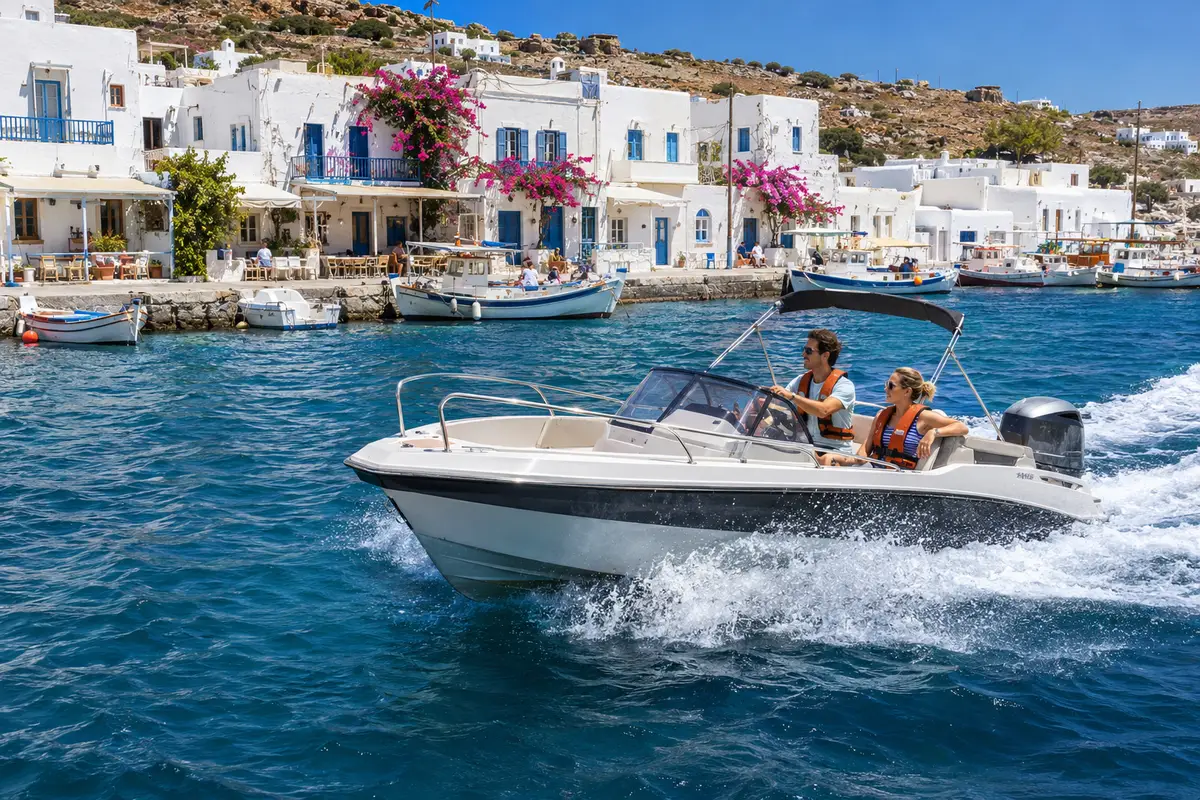
Start with the legal definition. The licence applies to craft classified as speedboats under the current Γενικός Κανονισμός Λιμένα, as well as jet skis and hovercraft. Check that classification for the motorboat you want to use.
With the licence you can
- Operate speedboats under the legal definition
- Operate jet skis
- Operate hovercraft if you also have the manufacturer’s training authorisation
Check further requirements when
- You want to operate a hovercraft without the manufacturer’s training authorisation
- Your foreign certificate has yet to be checked against the current flag-state and coastal-state rules
- The charter operator has requirements you have yet to confirm before booking
Before you beginWhat you need
- Be at least 18 years old
- Complete the short compulsory training at a licensed school
- Be ready for theory and practical exams conducted by the Λιμεναρχείο of the Λιμενικό Σώμα (Hellenic Coast Guard)
From school to licenceHow to earn it
- Start at a licensed school
Begin with the short compulsory training required for the process.
- Work on the theory
The syllabus includes ΔΚΑΣ (COLREG, the collision-prevention rules), IALA Region A buoyage, lights and day shapes, sound signals, basic seamanship and Greek regulations.
- Take the theory exam
The Λιμεναρχείο conducts the written or oral theory exam. It has 20 questions, and you pass with at least 18 correct answers.
- Complete the practical exam
The Λιμεναρχείο also conducts a practical exam. Contact the relevant Λιμενική Αρχή (port authority) for its details.
Theory explainedWhat the exam looks like
| Element | What to expect |
|---|---|
| Format | Written or oral exam with 20 questions |
| Pass mark | At least 18 correct answers |
| Syllabus | ΔΚΑΣ (COLREG), IALA Region A, lights and day shapes, sound signals, basic seamanship and Greek regulations |
Our verdict
What stands out
- A clear route to operating craft classified as speedboats
- Covers jet skis and hovercraft
- The theory exam has a defined format, timing and pass threshold
Keep in mind
- Compulsory training at a licensed school comes before the exams
- A practical exam conducted by the Λιμεναρχείο is also required
- Hovercraft require the manufacturer’s additional training authorisation
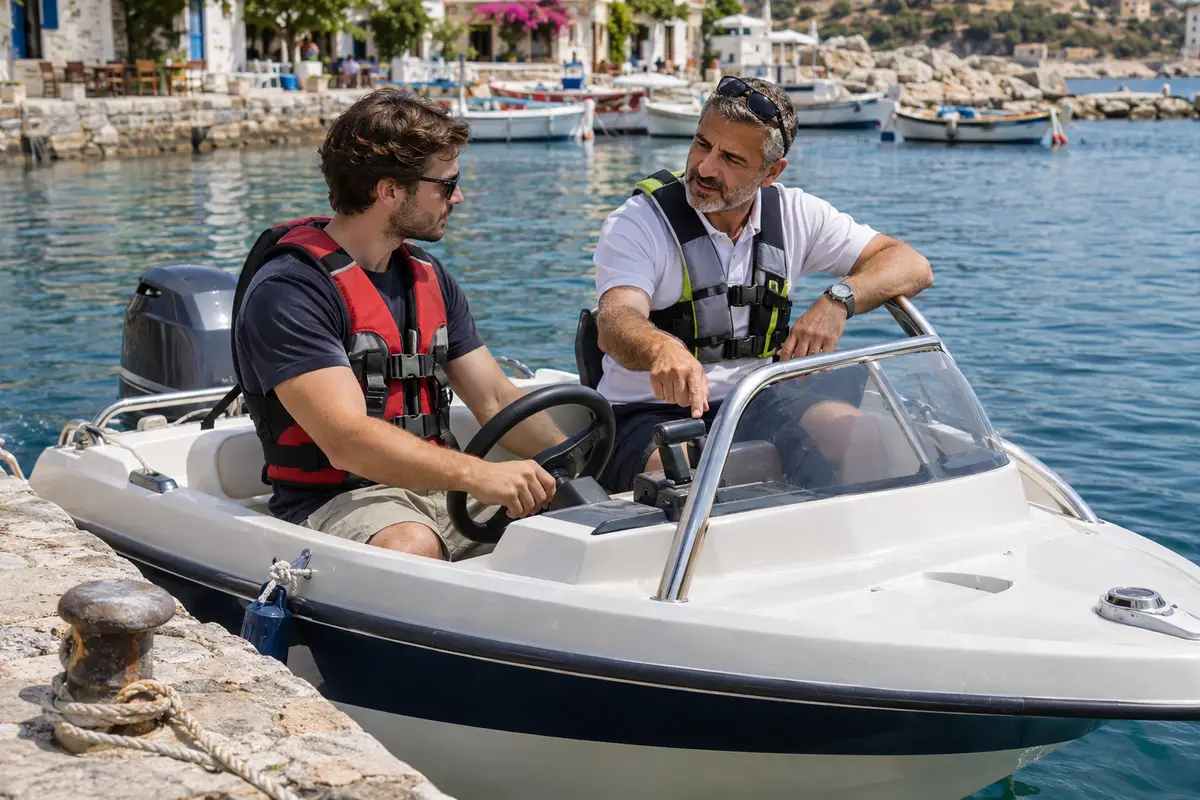
If the boat you want to operate falls within the legal definition of a speedboat, this is the licence you need. Prepare the theory methodically, give the practical exam proper attention and check any additional requirements for a hovercraft or foreign certificate early.
Topics tested
Practice tests
IALACOLREG Exam Pass
Δίπλωμα Ταχυπλόου Σκάφους: get ready for your exam with the Exam Pass
Unlimited timed mock exams, every mistake back until it's right, and a readiness score that shows when you're ready for the exam.
512 exam-style questions with explanations · 7 timed subject exams · every simulator scenario
One payment for 12 months, so it covers a resit too. No subscription.
Practice questions (with answers)
Compliance with the COLREGs:
Show answer
Correct answer: B. Does not exonerate a vessel from the consequences of neglecting good seamanship
Rule 2(a) states nothing in the rules exonerates any vessel from the consequences of neglecting good seamanship.
A 'vessel not under command' (NUC) is one that:
Show answer
Correct answer: C. Through exceptional circumstances cannot manoeuvre as required and therefore cannot keep out of another vessel's way
Rule 3(f) requires both inability to manoeuvre as required because of exceptional circumstances and consequent inability to keep out of another vessel's way.
A proper look-out requires the use of:
Show answer
Correct answer: C. Sight, hearing and all available means appropriate to the conditions
Rule 5 requires look-out by sight AND hearing as well as by all available means appropriate to the circumstances.
Which factor is NOT listed in Rule 6 for determining safe speed?
Show answer
Correct answer: C. Vessel's commercial schedule
Rule 6 lists visibility, traffic density, manoeuvrability, etc. Commercial schedule is never a factor in safe speed determination.
Emergency wreck marking buoys are used for:
Show answer
Correct answer: B. Marking new dangers, including newly discovered wrecks
The emergency wreck marking buoy marks new dangers, including newly discovered wrecks. The competent authority determines further marking once the danger is removed or its information has been sufficiently promulgated.
The topmark of a West Cardinal mark is:
Show answer
Correct answer: C. Two cones point to point
Two separate black cones with their points facing each other. The cones must remain clearly separated.
You are entering a river where the chart shows the conventional direction of buoyage is upstream from the sea entrance. What should determine whether a lateral mark is port-hand or starboard-hand?
Show answer
Correct answer: C. The charted conventional direction of buoyage
Lateral marks are interpreted in the conventional direction of buoyage. The chart, not guesswork, determines which side is port-hand and which is starboard-hand.
You sight a cardinal mark with both cones pointing down and a light showing six quick flashes followed by one long flash. What is the safe action?
Show answer
Correct answer: C. Pass south of the mark
Two cones down and the 6+1 light rhythm identify a South Cardinal mark, meaning the safe water lies to the south of the mark.
The full guide
The Δίπλωμα Ταχυπλόου Σκάφους is the Greek licence required to operate craft classified as speedboats under the applicable Hellenic Port Regulation; the Hellenic Coast Guard handles the examination route.
Core: COLREG 1972, IALA Region A buoyage, lights and shapes, sound signals, basic seamanship.
Who should take it
Greek recreational skippers operating craft classified as speedboats under the applicable Hellenic Port Regulation.
How to prepare
Master COLREG rules 5–37, IALA Region A marks. Practise the current syllabus and verify the examination requirements with the Hellenic Coast Guard.
Other exams
Reviewed by Ramon Curto, Nautical teacher at IECNPC · Last reviewed: