
- 20 nautical milesfrom shore, within coastal navigation limitsNORMAM-211/DPC (maritime authority regulations)
- 40 questionsmultiple choice in the examNORMAM-211/DPC (annex 5-A, item 2)
- 4 using a chartnautical chart questions in the examNORMAM-211/DPC (annex 5-A, item 2)
- Up to 3 hoursto complete the examNORMAM-211/DPC (annex 5-A, item 2)
- 5.0 out of 10.0minimum mark to passNORMAM-211/DPC (annex 5-A, item 2)
- From age 18with a valid Arrais-AmadorNORMAM-211/DPC
The next horizonWhat Mestre-Amador is
Mestre-Amador is a category of the Carteira de Habilitação de Amador (recreational boating licence) for existing Arrais-Amador holders who want to navigate along the coast. It lets you operate boats between domestic and foreign ports within coastal navigation limits, up to 20 nautical miles from shore. This is a qualification for planning your route with more attention to the chart, weather and signals than on a typical inland outing.
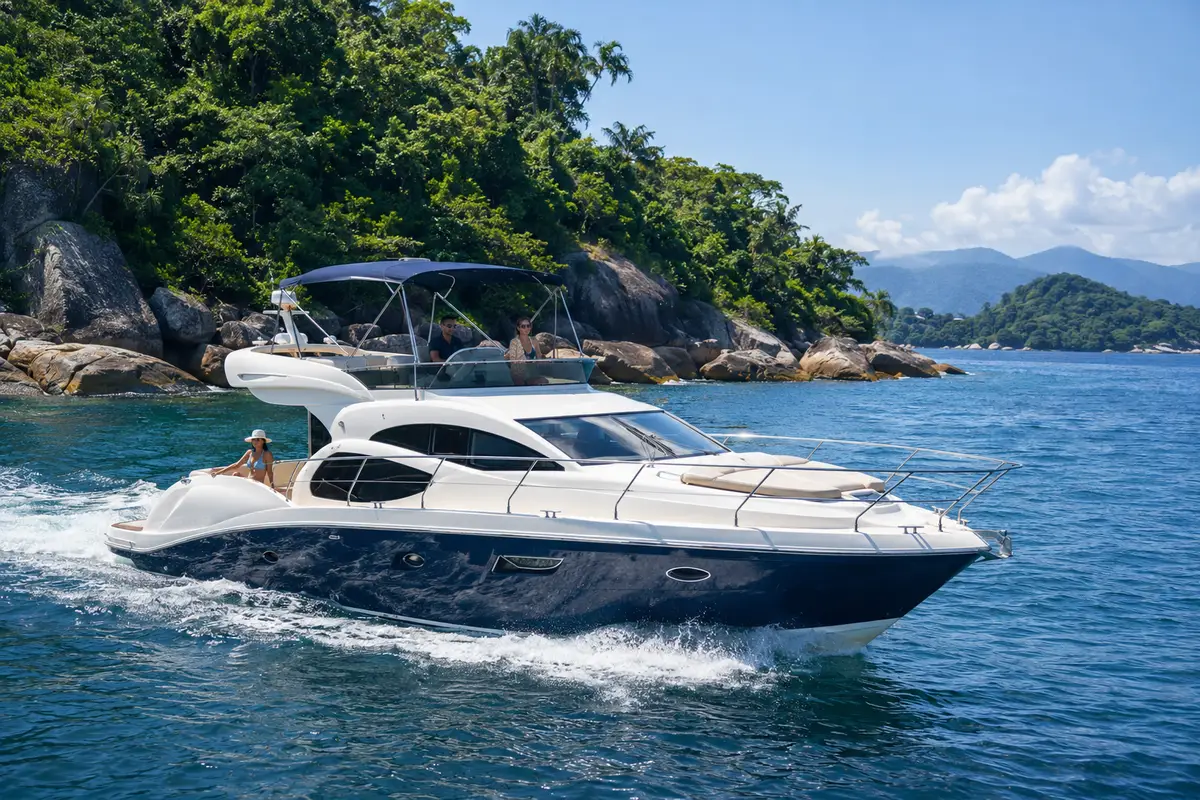
Your cruising rangeHow far this qualification takes you
The coast is your reference: Mestre-Amador allows you to navigate within sight of it, up to 20 nautical miles offshore. That range includes trips between Brazilian and foreign ports, always within coastal navigation limits. The qualification does not cover personal watercraft.
With Mestre-Amador you can
- Operate recreational boats within sight of the coast, up to 20 nautical miles offshore
- Navigate between domestic and foreign ports within coastal navigation limits
- Move beyond the inland waters covered by Arrais-Amador
What falls outside this category
- Operate a personal watercraft with this qualification alone
- Navigate more than 20 nautical miles from shore
- Use Mestre-Amador as a qualification with no distance limit from shore
Before you registerRequirements for taking the exam
- Be at least 18 years old
- Be able to read and write
- Hold a valid Arrais-Amador and present it when registering at the CP/DL/AG
- Take the exam in Brazilian Portuguese
The route to your qualificationHow to prepare and take the exam
- Confirm the responsible office
Exams are scheduled by the CP/DL/AG: Capitanias, Delegacias ou Agências (harbour captaincies, delegations or agencies). Check registration, documents and the instructions for your circumstances with the responsible office.
- Present your Arrais-Amador
Present your valid Arrais-Amador when registering. It is the prerequisite for the Mestre-Amador exam.
- Study coastal navigation
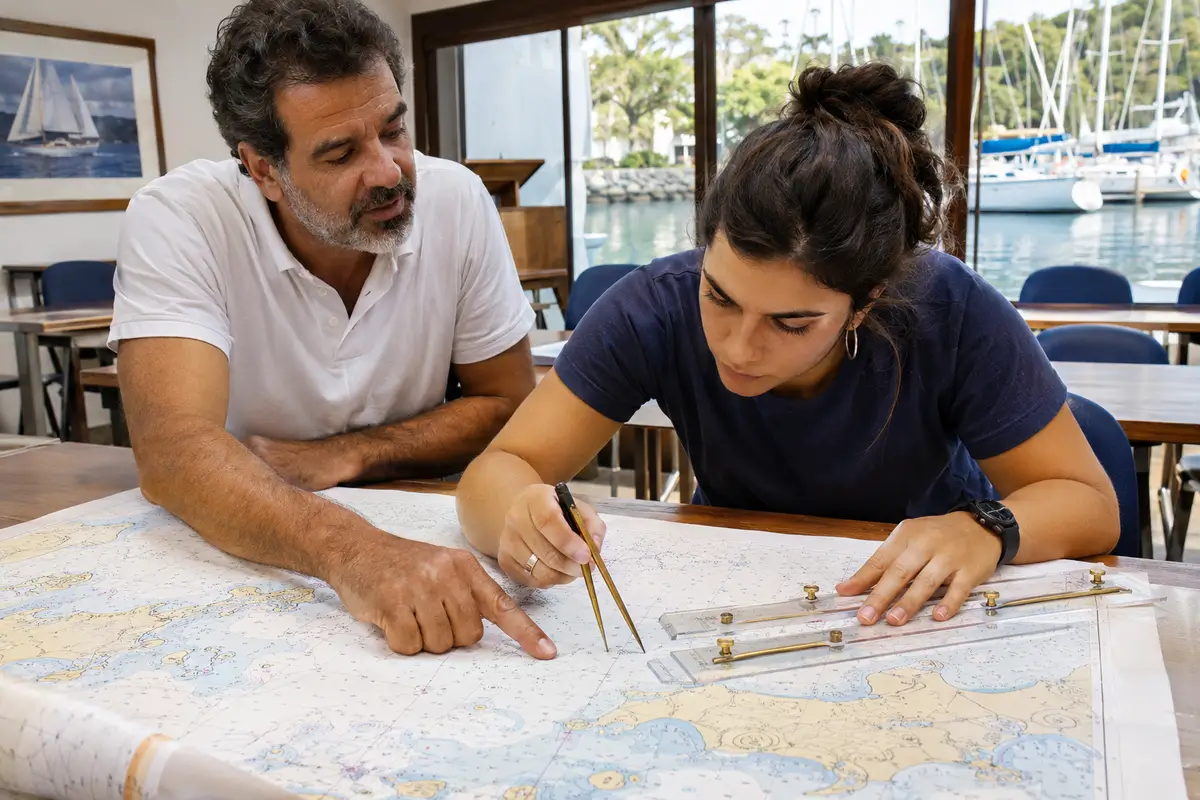
Work with nautical charts and the reading list in annex 5-A. The syllabus includes charts, dead reckoning and coastal navigation, instruments and GNSS, tides, IALA Region B buoyage, radar, echo sounders and meteorology, among other topics.
- Bring your exam equipment
Bring your registration receipt, official identification, a blue or black pen and drawing equipment: pencil or mechanical pencil, ruler, set squares or parallel ruler, protractor, dividers and eraser.
- Sit the scheduled exam
The exam may be electronic or written. Set aside time for the nautical chart questions and aim for at least 5.0 out of a maximum of 10.0.
In the exam roomWhat the Mestre-Amador exam is like
| Aspect | How it works |
|---|---|
| Format | Electronic or written |
| Questions | 40 multiple-choice questions, four of them using a nautical chart |
| Duration | Up to three hours |
| Pass mark | At least 5.0 out of a maximum of 10.0 |
| Content | Coastal navigation, nautical charts, tides, buoyage, signals, radar, echo sounders and meteorology |
The Brazilian progressionWhere Mestre-Amador sits on the ladder
- Veleiro (sailing qualification)optional, for sail-only craft on inland waters
- Motonauta Especial (rental personal watercraft qualification)for rented personal watercraft, by day and without passengers
- Motonauta (personal watercraft qualification)for personal watercraft within local inland navigation limits, by day only
- Arrais-Amadorfor recreational boats within local inland navigation limits
- Mestre-Amadorwithin sight of the coast, including trips abroad
- Capitão-Amadoron domestic or international trips, with no distance limit from shore
The magazine’s verdict
What it offers
- Takes your recreational boating into coastal waters, up to 20 nautical miles from shore
- Allows trips between domestic and foreign ports within coastal navigation limits
- Has a clear syllabus to guide your study of charts, tides, buoyage and meteorology
Points to watch
- Your Arrais-Amador must be valid when you register
- Four questions use a nautical chart, so reviewing theory questions alone is not enough
- Personal watercraft remain outside this category and may require the Motonauta qualification
If you already hold Arrais-Amador and want to navigate further along the coast, Mestre-Amador is the natural progression. Study chartwork carefully, organise your exam equipment and confirm registration directly with the responsible CP/DL/AG.
Topics you can practise here
Practice tests
IALACOLREG Exam Pass
Mestre Amador: get ready for your exam with the Exam Pass
Unlimited timed mock exams, every mistake back until it's right, and a readiness score that shows when you're ready for the exam.
512 exam-style questions with explanations · 7 timed subject exams · every simulator scenario
One payment for 12 months, so it covers a resit too. No subscription.
Practice questions (with answers)
To which vessels do the COLREGs apply?
Show answer
Correct answer: C. All vessels on the high seas and connected navigable waters
Rule 1 states the COLREGs apply to all vessels upon the high seas and in all waters connected therewith navigable by seagoing vessels.
According to Rule 2, departure from the COLREGs is permitted when:
Show answer
Correct answer: B. It is necessary to avoid immediate danger
Rule 2(b) allows departure from the rules when necessary to avoid immediate danger.
A vessel under sail also being propelled by her engine is classified as:
Show answer
Correct answer: B. A power-driven vessel
Rule 3(c): a sailing vessel means any vessel under sail provided that propelling machinery, if fitted, is not being used.
A proper look-out must be maintained:
Show answer
Correct answer: C. At all times
Rule 5 requires every vessel to maintain a proper look-out at ALL times.
Emergency wreck marking buoys are coloured:
Show answer
Correct answer: C. Blue and yellow vertical stripes
equal numbers and widths of blue and yellow vertical stripes; 4 to 8 stripes in total. 1 s blue + 0.5 s darkness + 1 s yellow + 0.5 s darkness; period 3 s.
Emergency wreck marking buoys are used for:
Show answer
Correct answer: B. Marking new dangers, including newly discovered wrecks
The emergency wreck marking buoy marks new dangers, including newly discovered wrecks. The competent authority determines further marking once the danger is removed or its information has been sufficiently promulgated.
The topmark of a West Cardinal mark is:
Show answer
Correct answer: C. Two cones point to point
Two separate black cones with their points facing each other. The cones must remain clearly separated.
You are entering a river where the chart shows the conventional direction of buoyage is upstream from the sea entrance. What should determine whether a lateral mark is port-hand or starboard-hand?
Show answer
Correct answer: C. The charted conventional direction of buoyage
Lateral marks are interpreted in the conventional direction of buoyage. The chart, not guesswork, determines which side is port-hand and which is starboard-hand.
The full guide
Mestre-Amador is the Brazilian recreational category (CHA) for navigation between national and foreign ports within coastal navigation, up to 20 nautical miles from the coast, except personal watercraft.
Candidates must already hold Arrais-Amador. The written or electronic exam has 40 multiple-choice questions, four of them using a nautical chart, with up to 3 hours and a pass mark of 5.0 out of 10.0.
Who should take Mestre Amador
Arrais-Amador holders who want to sail along the coast beyond inland waters, within the 20-nautical-mile coastal limit.
How to prepare
The exam programme is coastal navigation: chart symbols, dead reckoning and coastal plotting, instruments and GNSS, tides, IALA Region B buoyage, radar and weather. Use these lessons for buoyage, lights, sound signals and RIPEAM, and follow the official programme in Annex 5-A for the rest.
Other exams
Reviewed by Ramon Curto, Nautical teacher at IECNPC · Last reviewed: