
Cardinal marks: pass on the side in the name
A cardinal mark tells you the safe side of a hazard.
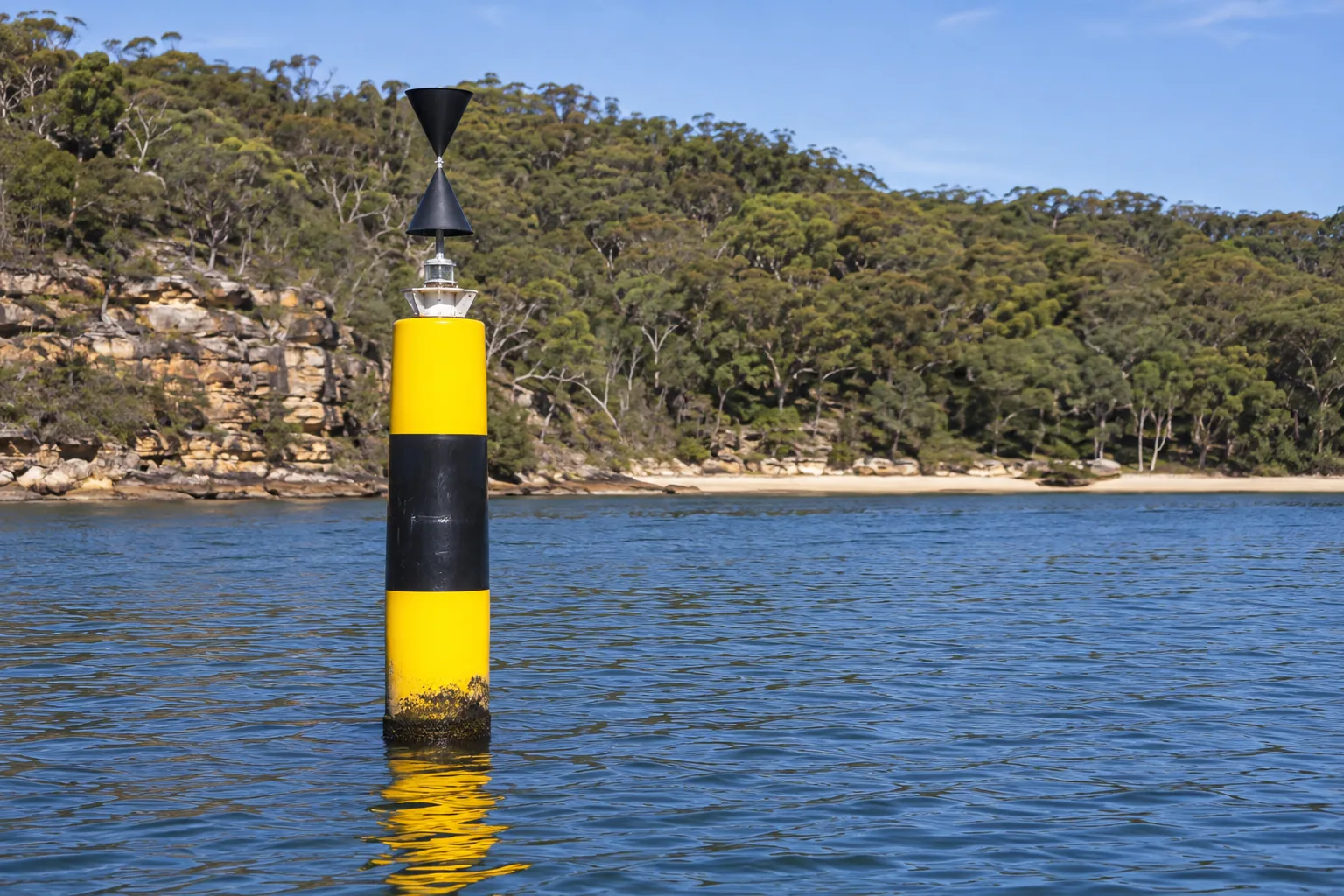
Pass north of a north cardinal, east of an east cardinal, south of a south cardinal and west of a west cardinal. These are compass directions, not the left and right sides of your boat. For a north cardinal, the handbook specifies the safe quadrant between north-west and north-east of the mark; do not treat the whole northern half of the waterway as guaranteed safe. Read the black and yellow bands as well as the two black cone topmarks. The bands help identify the mark even if its cones are missing or hard to see. Boating Handbook, pp. 111–112.
When lit, cardinal marks show a quick or very quick flashing white light. Think of a clock face: east is 3, south is 6 plus a long flash, west is 9. North flashes continuously. The extra long flash is part of the south signal; do not leave it out when identifying the mark.
- North: both cones point up; black above yellow; continuous quick or very quick white flashes.
- East: cones point away from each other, bases together; black-yellow-black; groups of 3 quick or very quick white flashes.
- South: both cones point down; yellow above black; groups of 6 quick or very quick white flashes followed by a long flash.
- West: cones point towards each other, tips together; yellow-black-yellow; groups of 9 quick or very quick white flashes.
Check this lesson
A charted cardinal light gives groups of three very quick white flashes. Which side do you pass?