
Medical care on board · Level R3 · 5 parts · about 16 min
First aid and resuscitation
5 short parts: Scene and survey · CPR and AED · Drowning · Recovery position · Choking. Each part explains the idea, then gives the points to remember, the common mistakes, a worked case and a practice question; the Academy unit adds all 30 check questions.
1 · Scene and survey
Scene safety, the primary survey and calling for help
Make yourself and the boat safe first. Then check the casualty in a fixed order, deal with what kills first, and call for help early.
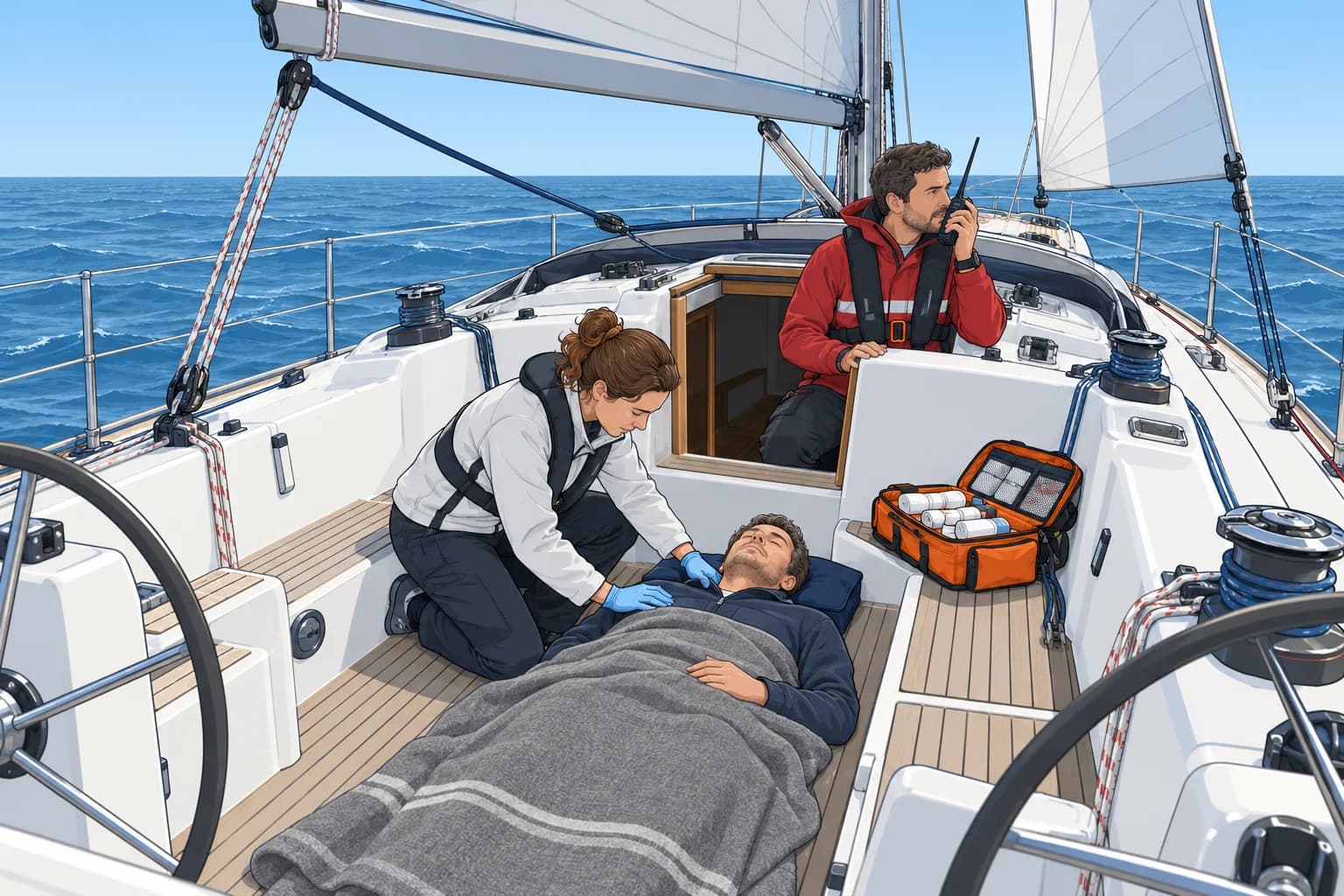
Danger first on a moving boat
Scene safety means you do not become the second casualty. Check for a swinging boom (the spar along the bottom of the mainsail), loaded sheets (sail-control ropes), a turning propeller, hot machinery, fumes and sudden movement. Ask the person steering to steady the boat and control the boom. Stop the engine if anyone is near the propeller. Attach your safety harness to a secure point when needed. Wear gloves when handling blood.
The primary survey
The primary survey finds life-threatening problems in order. DR ABCDE means Danger, Response, Airway, Breathing, Circulation (look for serious bleeding), Disability and Exposure. Make the scene safe, check response, open the airway and check breathing. If breathing is absent or abnormal, start CPR; do not finish the survey first. Otherwise look for serious bleeding, check how alert the person is, then look for hidden injuries and cover them again. Treat each problem as you find it.
Catastrophic bleeding comes first
After an injury, blood pouring or spurting from a wound can kill in a few minutes. Many courses therefore put a C in front: <C>ABCDE, where the first C stands for catastrophic bleeding. If you see it, press hard on the wound at once, even before you check the airway. The Injuries unit shows how to control it.
Response and breathing
Speak loudly and tap the shoulders. If there is no answer, call for help immediately. Open the airway with head tilt, chin lift: one hand on the forehead, two fingertips lifting the chin. Look, listen and feel for normal breathing for no more than 10 seconds. Slow, noisy gasps are agonal breathing. They are not normal breathing: treat them as cardiac arrest.
Call for help early
Call as soon as someone is unresponsive, seriously ill or injured; delegate the radio while you treat, and see Radio medical advice for the call.
Key figures
- Memory aid
- DR ABCDE; <C>ABCDE for catastrophic bleeding
- Breathing check
- No more than 10 seconds
- Spanish courses (PER)
- PAS: Proteger, Avisar, Socorrer (protect, alert, help)
Remember
- Make the scene safe first: boom, sheets, propeller, fumes and the motion of the boat.
- Check in a fixed order: DR ABCDE, or <C>ABCDE when there is catastrophic bleeding.
- Unresponsive with absent or gasping breathing means cardiac arrest.
- Call for help early and give the radio to another crew member.
Common mistakes
Wrong: Rush to the casualty as soon as you see them fall.
Right: Take a second to check for danger: a swinging boom or a turning propeller can injure you too.
Wrong: Gasping breaths mean the casualty is still breathing.
Right: Slow, noisy gasps are agonal breathing. Treat an unresponsive person who gasps as being in cardiac arrest.
Wrong: Call for help only once you know what is wrong.
Right: Call early. Help at sea takes time, and the radio doctor can guide you while you treat.
Worked case
Sailing into the wind in a fresh breeze, a crew member is hit by the boom and lies still in the cockpit. A small scalp cut is oozing, without pooling blood or rapidly soaking clothing. What do you do first?
Show the answer
Ask the person steering to steady the boat and secure the boom against swinging. Approach when safe. Check response; if there is none, send a crew member to call for help at once. Open the airway and check breathing for no more than 10 seconds. If absent or abnormal, start CPR. Otherwise, keep the airway open and press on the cut. The small, oozing cut is not life-threatening.
Practice question
A crew member collapses in the cockpit while the boom swings across it. What is your first action?
- Start chest compressions straight away
- Make sure the boom cannot hit you both
- Lift the casualty down into the cabin
- Look for injuries on the head and neck
Show the answer
Answer: B. Danger comes first. A second injured person makes the situation far worse.
2 · CPR and AED
Adult CPR and the AED
If an adult is unresponsive, call for help at once. If they are not breathing normally, start CPR and use an AED as soon as it arrives.
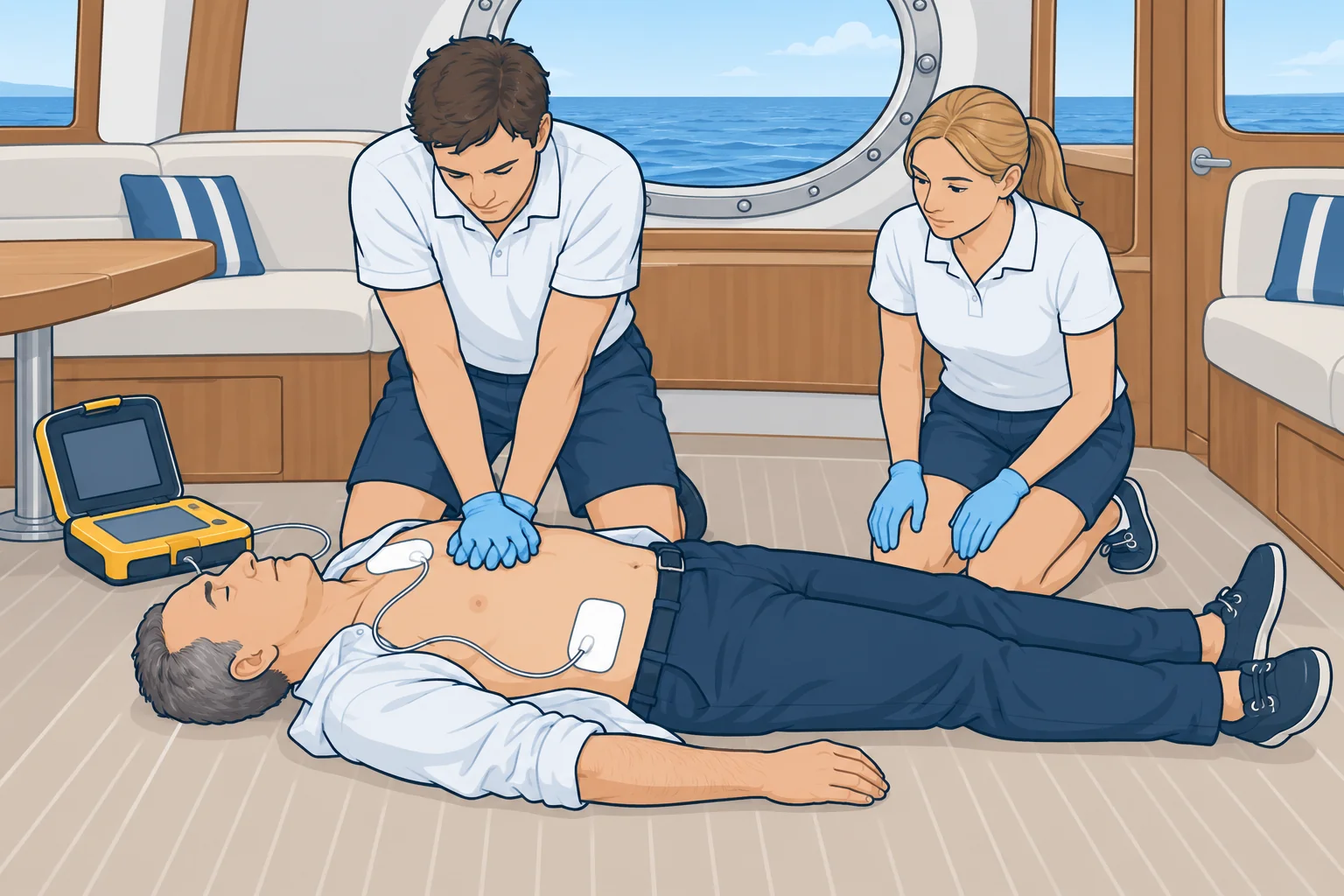
Recognise cardiac arrest
In cardiac arrest the heart stops pumping blood. The person is unresponsive and not breathing normally: no breathing at all, or slow gasps. A short burst of jerking, like a fit, can happen at the start. If you are in any doubt, assume cardiac arrest and start CPR (cardiopulmonary resuscitation). CPR on someone who turns out not to need it rarely causes serious harm.
Chest compressions
Start where the casualty lies; do not lose time moving them. Kneel beside them, put the heel of one hand on the lower half of the breastbone, in the centre of the chest, and the other hand on top. Keep your arms straight, shoulders above your hands, and push down 5 to 6 cm at 100 to 120 a minute. Let the chest come fully back up after each push. On a soft bunk, push further to allow for mattress movement; aim for 5–6 cm of chest compression.
Rescue breaths and 30:2
If trained and willing, give 30 compressions, then 2 rescue breaths. Tilt the head and lift the chin. For mouth-to-mouth, pinch the nose, seal your mouth over theirs and blow for about 1 second, just until the chest rises. Let the chest fall before the next breath. Keep the total pause under 10 seconds. If you cannot give breaths, give continuous compressions.
The AED
An AED (automated external defibrillator) is a box that reads the heart rhythm and gives an electric shock if one is needed. Anyone can use one: switch it on and follow the voice. Bare and dry the chest, stick the pads where the picture shows, and make sure nobody touches the casualty while it analyses or shocks. Restart compressions immediately after a shock or a no-shock message.
Keep going
Swap the person doing compressions every 2 minutes if possible. If clear signs of life appear, check breathing for no more than 10 seconds. Resume CPR if breathing is absent or abnormal. If breathing is normal, stop compressions, keep the airway open and monitor. Otherwise continue until professional help takes over, the scene becomes unsafe or you are too exhausted to continue.
Key figures
- Compression depth
- 5–6 cm in an adult
- Compression rate
- 100–120 a minute
- Ratio
- 30 compressions : 2 breaths (trained rescuers)
- Breath size
- Just enough to make the chest start to rise
- Swap rescuers
- Every 2 minutes if you can
Adult CPR, step by step
- Check for danger, then shout and tap the shoulders. — You must be safe, and a person who answers is not in cardiac arrest.
- If there is no response, send a crew member to call for help and fetch the AED and kit. — Help and the AED take time to arrive; ask now, not later.
- Open the airway and check breathing for no more than 10 seconds. — Absent or gasping breathing means cardiac arrest.
- Give 30 compressions in the centre of the chest, 5–6 cm deep, 100–120 a minute. — Compressions push some blood to the brain and heart.
- Give 2 rescue breaths, then repeat 30:2; or give compressions without stopping. — Breaths add oxygen; unbroken compressions keep blood moving.
- Switch on the AED as soon as it arrives and follow its prompts. — A shock can restart a heart that is quivering instead of pumping.
Remember
- Unresponsive: call for help at once. If not breathing normally, start CPR.
- Push 5–6 cm deep at 100–120 a minute and let the chest recoil fully.
- Trained rescuers give 30:2; otherwise give continuous compressions.
- Use the AED as soon as it arrives; nobody touches the casualty during analysis or shock.
- Keep pauses short and swap rescuers every 2 minutes.
Common mistakes
Wrong: Check the pulse carefully before starting CPR.
Right: Lay rescuers do not check a pulse. Unresponsive and not breathing normally is enough to start.
Wrong: Compress gently so you do not break a rib.
Right: Push 5–6 cm deep. Broken ribs heal; too-shallow compressions do not move enough blood.
Wrong: Wait for the AED before doing anything.
Right: Start compressions at once and attach the AED while someone else keeps pushing.
Worked case
Your friend collapses on the pontoon beside your boat. He does not respond, and his breathing is slow and gasping. Another skipper says there is an AED at the marina office. You are trained in CPR.
Show the answer
Send the other skipper to call the emergency number and bring the AED. Start compressions at once in the centre of the chest, 5–6 cm deep at 100–120 a minute, giving 2 breaths after every 30. When the AED arrives, keep compressing while the pads go on, stand clear during analysis and shock, then restart compressions immediately.
Practice question
What compression depth is recommended for an adult?
- 2–3 cm
- 5–6 cm
- 8–9 cm
- 10–12 cm
Show the answer
Answer: B. At least 5 cm but not more than 6 cm in an adult.
3 · Drowning
Resuscitation after drowning
After drowning, if an adult is unresponsive and not breathing normally, give 5 rescue breaths, then CPR at 30:2. Send someone to call for help.

Why drowning is different
Drowning means breathing problems from being under or in water. In most cardiac arrests the heart fails first. In drowning the lungs fail first: water blocks breathing, oxygen runs out, and only then does the heart stop. That is why getting oxygen in, through rescue breaths, matters more here than after a sudden collapse on deck.
Rescue without becoming a casualty
Do not jump in unless you are trained, equipped and it is safe. Reach with a boathook, throw a line or a lifebuoy, and keep pointing at the person. Recovery manoeuvres are taught in the Emergencies module.
Five breaths, then CPR
Once the casualty is aboard, check response. If they are unresponsive, open the airway and check breathing. If it is absent or abnormal, give 5 initial rescue breaths. Then start CPR at 30:2. Compressions alone help less in drowning because the problem is oxygen, but they are still better than nothing. Give breaths in the water only if trained in this technique and it is safe.
Water and vomit
Do not try to drain water from the lungs or press on the stomach: it wastes time and makes vomiting more likely. Vomiting during CPR is common. Turn the casualty onto their side, let the mouth drain, roll them back and carry on. Dry the chest before you attach AED pads, and move the casualty out of standing water if you can.
Everyone gets checked
Anyone who inhaled water needs medical assessment, even if they seem well. Get radio medical advice and keep watching their breathing. Persistent coughing, breathlessness, drowsiness or confusion needs urgent help. Anyone who needed rescue breaths or CPR needs hospital care.
Key figures
- Initial rescue breaths
- 5
- Then
- CPR at 30:2 and an AED
- AED pads
- Dry the chest first; keep out of standing water
- After rescue
- Medical check for anyone who inhaled water
Remember
- In drowning the lungs fail first, so oxygen is the priority.
- Unresponsive and not breathing normally: 5 rescue breaths, then CPR at 30:2.
- Never try to drain water from the lungs; manage vomit by turning to the side.
- Dry the chest before attaching AED pads.
- Anyone who inhaled water needs medical assessment, even if they seem well.
Common mistakes
Wrong: Hold the casualty upside down or push on the stomach to get the water out.
Right: Trying to drain the lungs delays resuscitation and can cause vomiting. If unresponsive and not breathing normally, give 5 rescue breaths, then CPR at 30:2.
Wrong: Give compressions only, as for any collapse.
Right: In drowning, breaths matter most. If you are trained, give 5 initial breaths and then 30:2.
Wrong: Worry about ‘dry’ or ‘secondary’ drowning days later.
Right: Doctors no longer use those terms. Watch for coughing, breathlessness or drowsiness in the first hours and get them checked.
Worked case
You pull a swimmer onto your boarding ladder after several minutes face down near the anchorage. On the cockpit floor she does not respond and is not breathing. Your crew has the AED from the chart table.
Show the answer
Send a crew member to call for help by VHF. Open her airway and give 5 rescue breaths, then start CPR at 30:2. If she vomits, turn her on her side, let the mouth drain, roll her back and continue. Dry her chest, move her out of any standing water, attach the AED and follow the prompts. She needs hospital care even if she recovers.
Practice question
Why do drowning casualties get rescue breaths before compressions?
- Breaths push water out of the lungs
- Their heart stops for lack of oxygen
- Compressions are unsafe in wet clothes
- Breaths warm the casualty from inside
Show the answer
Answer: B. The lungs fail first in drowning, so getting oxygen in is the priority.
4 · Recovery position
The recovery position
If an unresponsive person breathes normally and has no suspected injury, turn them onto their side to help keep the airway clear. Keep watching breathing.
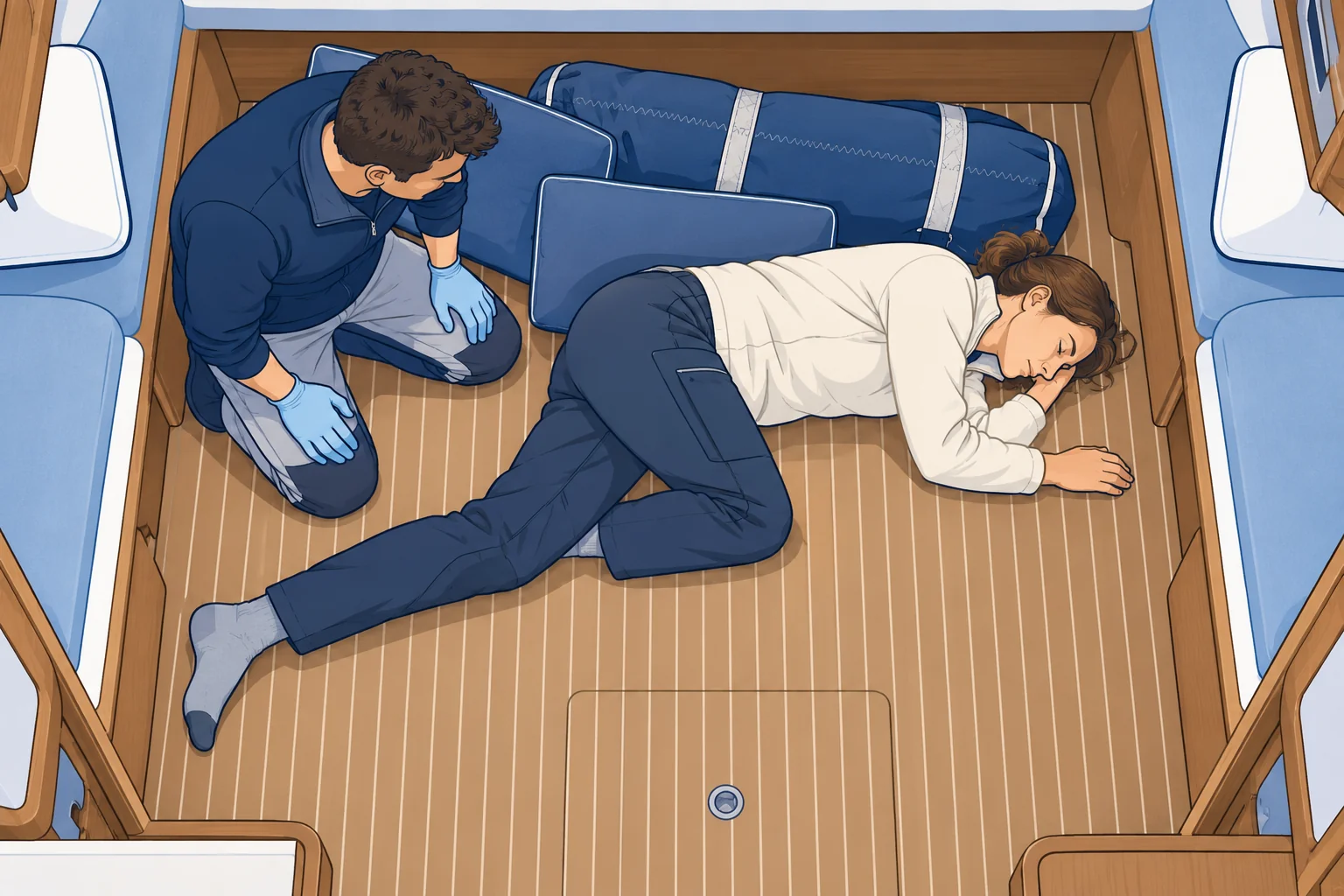
When to use it
Use the recovery position for someone who does not respond but is breathing normally, unless you suspect an injury. Lying on their back, an unconscious person’s tongue can fall back and block the airway, and vomit can be breathed in. Turning them onto their side helps keep the airway open and lets fluid drain. Someone who is not breathing normally needs CPR instead.
How to turn them
Kneel beside them. Place the near arm at a right angle to the body, palm up. Hold the back of their far hand against their near cheek. Bend the far knee, keeping the foot on the floor, and roll them towards you. Bend the top hip and knee to right angles. Tilt the head back and adjust the hand under the cheek to hold the airway open, with the mouth pointing down so fluid can drain.
On a moving boat
Choose a place where they cannot roll or fall: the cabin sole (the cabin floor), a wide bunk with a lee cloth (a canvas side that stops you falling out), or the cockpit floor wedged with cushions or sail bags. Keep them out of spray and wind and put something insulating underneath. Stay with them. If they stay in the position for more than 30 minutes, turn them to the other side.
Keep checking
A casualty in the recovery position can stop breathing. Watch their breathing all the time and be ready to roll them onto their back and start CPR. Note the times and any changes; the radio doctor will ask.
After an injury
After a fall or head or neck injury, keep them on their back and minimise neck movement, but never at the expense of an open airway. If you cannot keep the airway open, or blood or vomit threatens it, turn them onto their side with help if available, keeping head and body aligned.
Key figures
- Use for
- Unresponsive, breathing normally, no suspected injury
- Not for
- Abnormal or no breathing (start CPR)
- Breathing
- Check continuously
- Change sides
- After about 30 minutes
Remember
- Recovery position: unresponsive, breathing normally, no suspected injury.
- Lying on their side helps keep the airway open and lets fluid drain.
- Wedge the casualty so the boat’s motion cannot roll them.
- Keep checking breathing; if it stops or becomes abnormal, start CPR.
- After an injury, keep them on their back unless the airway is at risk.
Common mistakes
Wrong: Put a gasping casualty in the recovery position to help them breathe.
Right: Gasping is not normal breathing. Start CPR.
Wrong: Leave the casualty in a bunk and check them every half hour.
Right: Stay with them and watch breathing all the time; it can stop without warning.
Worked case
Motoring across a bay with a short chop, a guest faints in the cockpit after a long day in the sun. She does not answer but is breathing normally, and there is no sign of a fall or injury.
Show the answer
Put her in the recovery position on the cockpit floor, wedged with cushions so she cannot roll, in the shade and away from spray. Ask the person steering to slow down to ease the motion. Stay beside her and watch her breathing all the time. Call for radio medical advice. If her breathing stops or becomes abnormal, roll her onto her back and start CPR.
Practice question
With no suspected injury, which casualty should go into the recovery position?
- Unresponsive and breathing normally
- Unresponsive with slow gasping breaths
- Awake and complaining of neck pain
- Unresponsive and not breathing at all
Show the answer
Answer: A. The recovery position is for unresponsive casualties who breathe normally and have no suspected injury. Abnormal breathing needs CPR.
5 · Choking
Choking in an adult
If a choking adult coughs strongly, encourage it. If the cough is weak or absent, give up to 5 back blows, then up to 5 abdominal thrusts; repeat if needed.
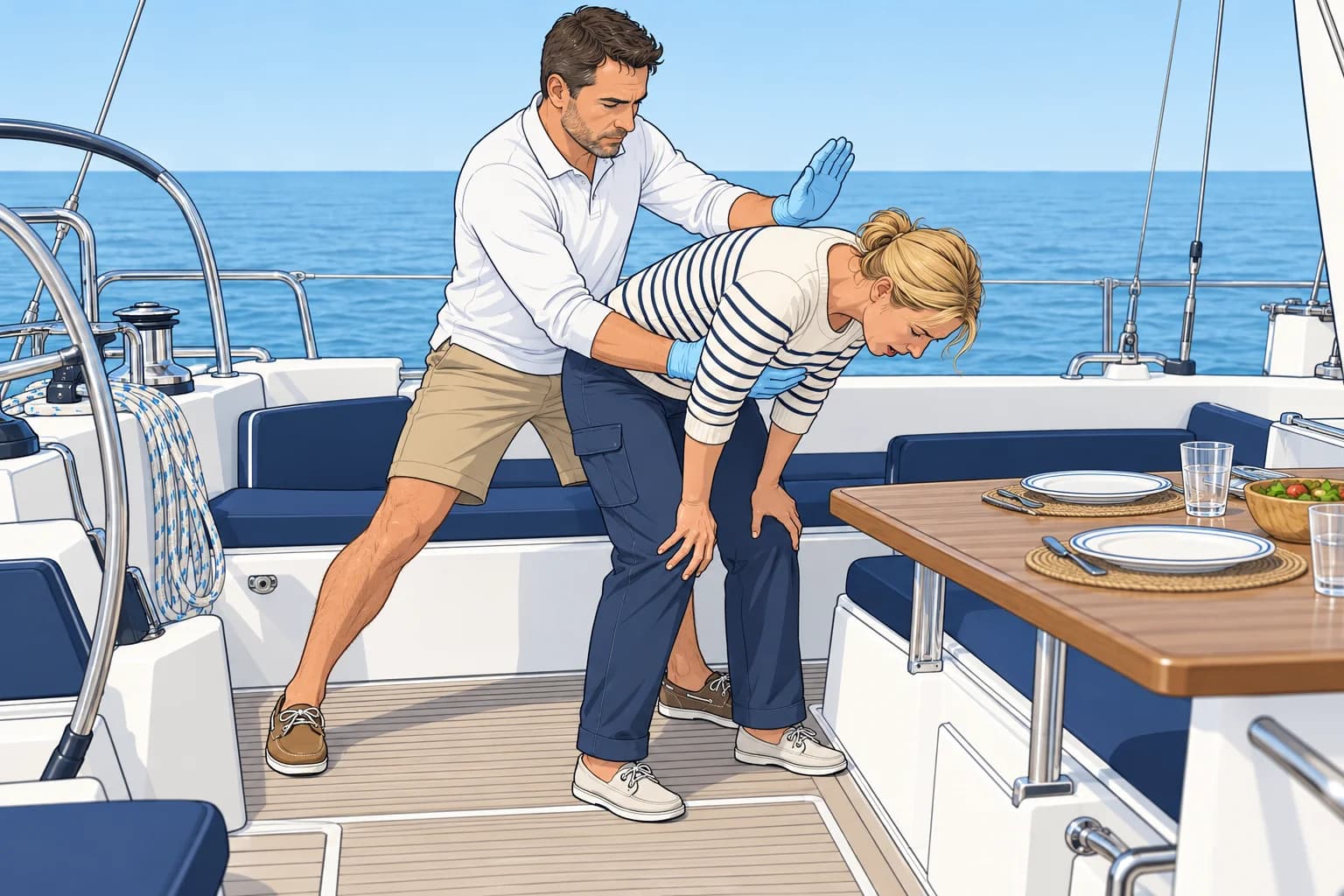
Mild or severe
Choking means food or an object blocking the airway. In mild obstruction the person can speak, breathe and cough strongly and effectively: encourage them to keep coughing and stay with them. In severe obstruction they cannot speak or cough effectively; breathing may be very difficult or absent. They may clutch their throat. Severe choking needs action now.
Back blows
Stand to the side and slightly behind. Support the chest with one hand and lean them well forward, so the object comes out of the mouth rather than going further down. Give up to 5 sharp back blows between the shoulder blades with the heel of your other hand. Check after each blow whether the obstruction has cleared. Brace your feet wide on a moving deck.
Abdominal thrusts
If back blows fail, give up to 5 abdominal thrusts. Stand behind them, put both arms round the upper abdomen and lean them forward. Make a fist between the navel and the bottom of the breastbone, grasp it with your other hand and pull sharply inwards and upwards. Check after each thrust. Stop as soon as the blockage clears. If it remains, alternate up to 5 back blows and up to 5 thrusts, and call for help.
If they become unresponsive
Lower them carefully to the cabin sole or deck, make sure help is being called and start CPR. Chest compressions can push the object out. Look in the mouth before giving breaths and remove anything you can see and reach easily, but never sweep blindly with your fingers.
Afterwards
Anyone who had abdominal thrusts or chest compressions needs a medical check: thrusts can injure organs inside the abdomen. A cough that will not stop, difficulty swallowing or the feeling that something is still stuck also needs advice. At sea, ask the radio doctor.
Key figures
- Mild choking
- Strong, effective cough: encourage coughing
- Severe choking
- Up to 5 back blows, then up to 5 abdominal thrusts
- Becomes unresponsive
- Call for help and start CPR
- Finger sweeps
- Never blind; remove only what you can see
Remember
- Encourage a strong, effective cough; a weak or silent cough needs treatment.
- Severe choking: up to 5 back blows, then up to 5 abdominal thrusts. Stop as soon as the blockage clears.
- If they become unresponsive, start CPR: compressions can clear the airway.
- No blind finger sweeps.
- Anyone given abdominal thrusts needs a medical check.
Common mistakes
Wrong: Slap the back of someone who is coughing hard.
Right: A strong cough is the best way to clear the airway. Encourage it and act only if the cough fails.
Wrong: Sweep a finger round the mouth to find the object.
Right: Blind sweeps can push it deeper. Remove only what you can see.
Wrong: Once the food is out, there is nothing more to do.
Right: After abdominal thrusts, get medical advice: they can cause internal injury.
Worked case
At anchor, a guest initially coughs strongly and can speak after swallowing food. His cough then becomes silent and he cannot speak. Another crew member is beside you; the cockpit is rolling.
Show the answer
Encourage the strong cough at first. Once it becomes ineffective, brace yourself and have the other crew member call for help. Lean him forward and give up to 5 back blows, then up to 5 abdominal thrusts if needed. Check after each and stop when clear. Keep alternating if needed. If he becomes unresponsive, lower him to the floor and start CPR. Arrange medical assessment afterwards.
Practice question
A crew member is choking but coughing hard and can speak. What do you do?
- Give five abdominal thrusts at once
- Give five firm back blows straight away
- Encourage the cough and stay with them
- Lay them down and start chest compressions
Show the answer
Answer: C. A strong cough is effective. Act only if it becomes weak or stops.