
Medical care on board · Level P3 · 6 parts · about 22 min
Medical first aid (STCW A-VI/4-1): examining a casualty, toxic hazards (MFAG) and the ship's medical guide
6 short parts: Examining · Toxic hazards · Wounds, fractures · Burns · Cold and rescue · Guide and TMAS. Each part explains the idea, then gives the points to remember, the common mistakes, a worked case and a practice question; the Academy unit adds all 37 check questions.
1 · Examining
Examining a casualty: surveys, history and vital signs
Find what kills first, then check the whole body, take the history and measure the vital signs, so you and the radio doctor work from facts.
Two surveys, in order
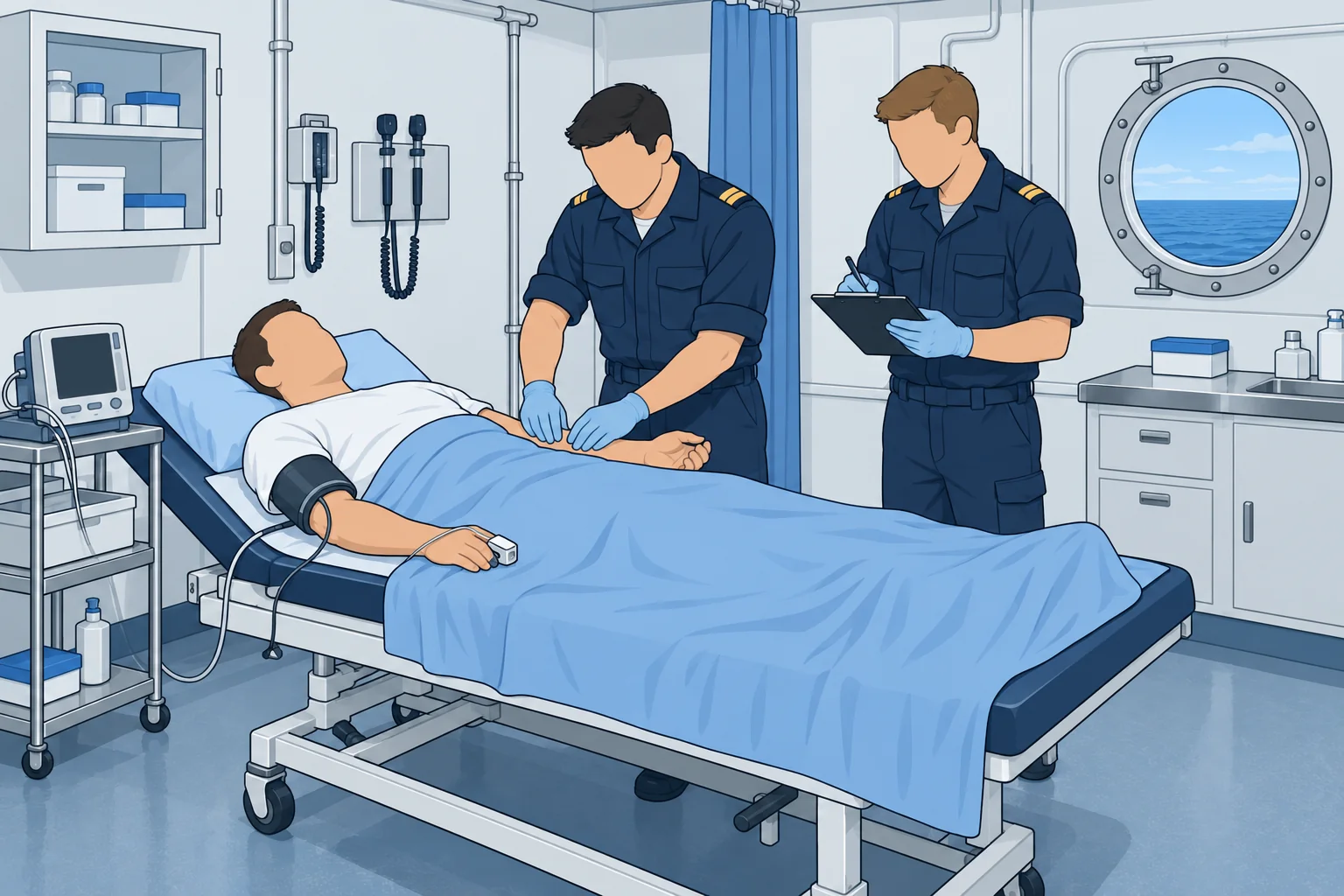
The primary survey (<C>ABCDE, taught in First aid and resuscitation) finds and treats life threats in the first minutes. Only when they are under control do you start the secondary survey: a calm, complete check from head to toe, the history and a first set of vital signs. At sea the secondary survey is the doctor’s eyes, because the doctor ashore cannot see the patient. If the casualty gets worse at any point, go back to the primary survey.
Head to toe
Explain what you are doing, then work down: scalp and face, ears and nose (blood or clear fluid), eyes and pupils, mouth, neck, collarbones and chest, abdomen, pelvis, back, then each arm and leg. Look for wounds, swelling, deformity and colour; feel gently for tenderness; never test a suspected fracture for movement or rock the pelvis. Compare left with right. Uncover only what you check, then cover again. Check under the casualty for blood. Note each finding with its place and time.
The history: SAMPLE
Ask the casualty, witnesses and crew mates. SAMPLE is a memory aid: Signs and symptoms, Allergies, Medicines taken, Past illnesses, Last food and drink, Events leading up to it. For pain, ask where it is, when it started, what it feels like, whether it spreads, and ask them to rate it from 0 (no pain) to 10 (the worst pain imaginable). Ask separately about urine output.
Vital signs and normal ranges
Vital signs show how the body is coping: pulse, breathing rate, oxygen saturation, blood pressure, temperature, consciousness and, if you carry a meter, blood sugar. In a healthy adult at rest, pulse is about 60–100 a minute, breathing 12–20 a minute, saturation 95–100 % and temperature about 36.5–37.5 °C. Blood pressure is often around 120/80 mmHg; record both numbers. Repeat readings and chart them with times; the trend matters.
Consciousness: AVPU and GCS
Use AVPU for a quick check; its basics are in Radio medical advice. The Glasgow Coma Scale (GCS) scores eyes (4 spontaneous, 3 to speech, 2 to pressure, 1 none), speech (5 oriented, 4 confused, 3 inappropriate words, 2 incomprehensible sounds, 1 none) and movement (6 follows commands, 5 reaches towards pressure, 4 pulls away, 3 abnormal bending, 2 stiff straightening, 1 none). Report each component and the total, 3–15. At 8 or less the airway is at high risk: watch breathing continuously and get urgent advice.
Key figures
- Order
- Primary survey (<C>ABCDE), then the secondary survey
- History
- SAMPLE: symptoms, allergies, medicines, past, last intake, events
- Adult at rest
- Pulse 60–100/min; breathing 12–20/min; saturation 95–100 %
- Temperature
- About 36.5–37.5 °C; note where you measured it
- GCS
- Eyes 1–4, verbal 1–5, motor 1–6; total 3–15
- GCS 8 or less
- Airway at risk: protect it, urgent radio medical advice
Remember
- Primary survey first; start the secondary survey only when life threats are under control.
- Check head to toe: look, feel, compare sides, and check the back and under the casualty.
- Take the history with SAMPLE and score pain from 0 to 10.
- Chart vital signs with the time: the trend matters more than one reading.
- Report the GCS as three parts and a total; 8 or less means the airway is at risk.
Common mistakes
Wrong: Start the head-to-toe check as soon as you reach the casualty.
Right: Deal with catastrophic bleeding, airway and breathing first; the secondary survey comes after.
Wrong: One normal set of vital signs means the casualty is fine.
Right: Repeat and chart them. A rising pulse or a falling GCS can be the first sign of bleeding or a brain injury.
Wrong: Give the radio doctor only the GCS total.
Right: Give the eye, verbal and motor scores too: E2 V2 M5 and E4 V1 M4 both total 9 but mean different things.
Worked case
A deck rating fell about 2 m from a ladder in a hold. The primary survey is clear: airway open, breathing 18 a minute, no heavy bleeding, alert. He has pain on the left side of his lower chest and in his left wrist. What do you do next?
Show the answer
Start the secondary survey. Keep his head and neck still while you check, as the fall could have hurt his spine. Work head to toe: you find tender lower left ribs and a swollen, deformed wrist. Take a SAMPLE history. Record pulse, breathing, saturation, blood pressure and GCS with the time and repeat them every 15 minutes. Injured lower left ribs can hide a torn spleen, so get radio medical advice with these findings.
Practice question
When do you start the secondary survey?
- As soon as the scene is safe to approach
- When the radio doctor asks you to examine
- Once the life threats are under control
- After moving the casualty to the ship’s hospital
Show the answer
Answer: C. The primary survey finds and treats what kills first. The full head-to-toe check, history and vital signs come after.
2 · Toxic hazards
Toxic hazards: using the MFAG
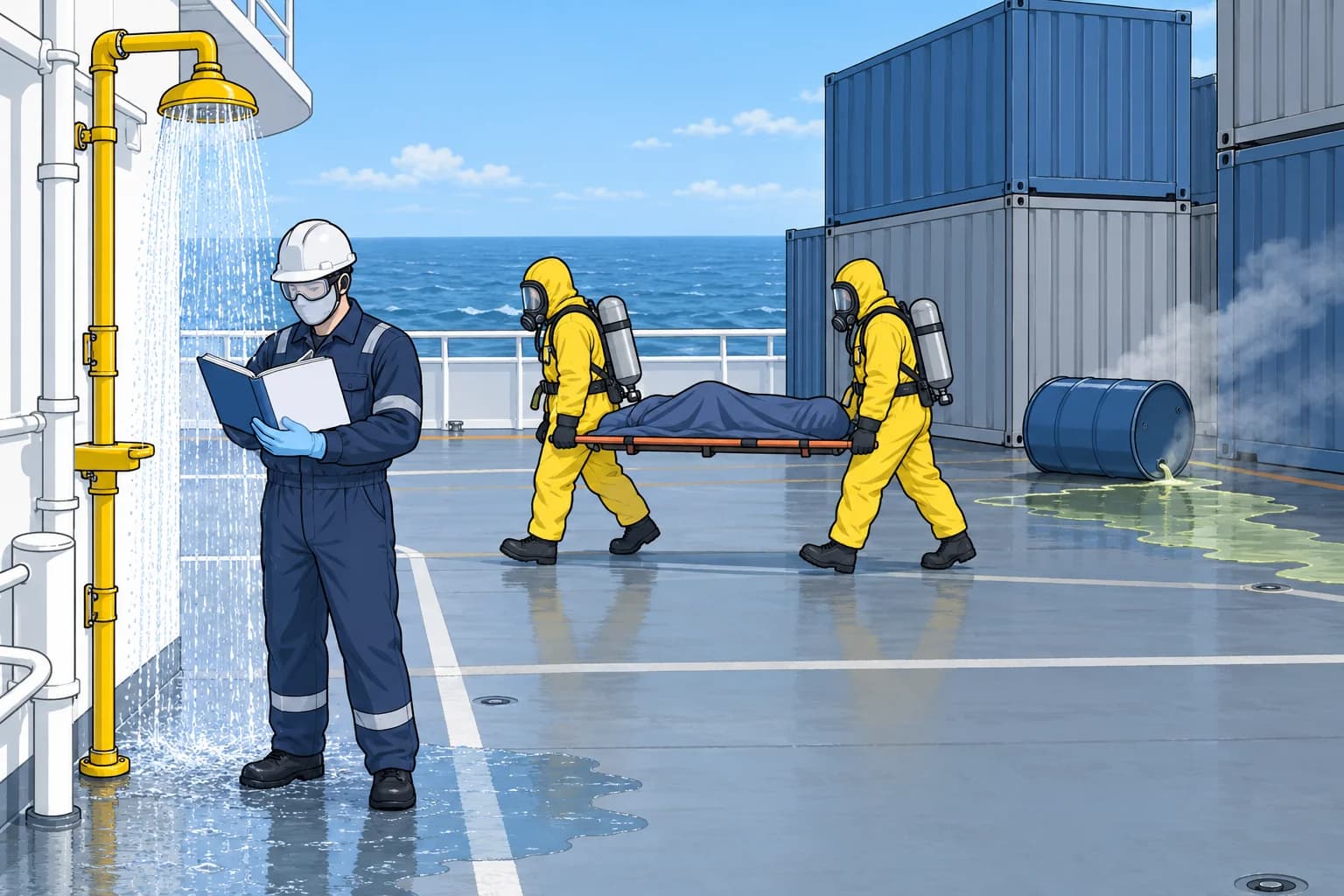
Chemicals harm through the lungs, skin, eyes and mouth. The MFAG gives a fixed path: rescue safely, act on the symptoms, then check the few special chemicals.
What the MFAG is
The MFAG (Medical First Aid Guide for Use in Accidents Involving Dangerous Goods) is an IMO, WHO and ILO guide printed in the IMDG Code Supplement. It is the chemical companion of the WHO International Medical Guide for Ships. Use it together with the safety data sheet (SDS) of the substance, the EmS Guide (emergency schedules for fire and spillage) and radio medical advice. Rescue, CPR and gas hazards such as H₂S are covered in Body structure, shock, electric shock and moving a casualty.
Routes of poisoning
A chemical enters by inhalation (gas, vapour, fumes or dust breathed in), through the skin (some pass through intact skin), through the eyes, or by ingestion (swallowing, usually from dirty hands, food or drink). Effects may be immediate, such as burns or collapse, or delayed for hours, such as fluid in the lungs after an irritant gas. Treat any toxic or corrosive exposure as serious until the casualty has fully recovered or a doctor advises otherwise.
Start with Emergency action
The guide opens with a yes/no flow chart. Rescue from a polluted atmosphere? Table 1. Breathing stopped? Tables 2 and 3. Unconscious? Table 4. Fitting? Table 5. Then eyes, skin, inhalation and swallowing: Tables 7, 8, 9 and 10. Severe pain: Table 13. Each table gives short instructions; the matching appendix explains them in more depth.
Identify the chemical
Find the UN number and proper shipping name on the label, packaging or dangerous goods manifest. The EmS code in the IMDG Code leads to fire and spillage schedules, not to medical tables. Most chemicals are treated by their effects. Only a few need special treatment, listed by UN number and by name in Appendix 15: for example hydrofluoric acid (Table 16), organophosphate insecticides (Table 17), cyanides (Table 18), methanol and ethylene glycol (Table 19) and radioactive material (Table 20).
Decontamination
Follow SDS precautions and secure airway and breathing, then decontaminate. Remove contaminated clothing; brush dry powder off the skin. Irrigate eyes immediately with plenty of water or a bag of sodium chloride 0.9 %; never soap or brushes. MFAG Table 7 gives 10 minutes by the clock, repeated if severe pain continues. Table 8 gives at least 10 minutes of rinsing with water, no neutralising agents, then another 10 minutes with soap or shampoo and water. Eyes come first. Bag clothing, contain runoff and get radio medical advice.
Watch and ask
Many chemicals act late. Keep anyone with significant exposure or any symptoms warm and at rest, watch them closely for 48 hours, and get radio medical advice; hospital care ashore is often needed. Give the doctor the UN number, name and SDS.
Key figures
- MFAG
- IMO/WHO/ILO guide in the IMDG Code Supplement
- Order
- Emergency action flow chart, then tables, then appendices
- Tables 7 / 8 / 9 / 10
- Eyes / skin / inhalation / ingestion
- Special chemicals
- Appendix 15, by UN number and name (e.g. Tables 16–20)
- Washing
- Eyes: 10 min water or saline; skin: 10 min water, then 10 min soap
- After real exposure
- Rest, warmth, observe 48 h, radio medical advice
Remember
- Always start at the Emergency action flow chart, then go to the tables and appendices.
- Most chemicals are treated by their effects; Appendix 15 lists the few that need special tables.
- The EmS code leads to fire and spillage schedules, not to medical treatment.
- Observe any significantly exposed casualty for 48 hours and get radio medical advice.
Common mistakes
Wrong: Look up the MFAG table number in the IMDG Code’s list.
Right: Current editions give none. Use the flow chart, and check Appendix 15 by UN number for the few special chemicals.
Wrong: Make the casualty vomit up a swallowed chemical.
Right: Never induce vomiting. Rinse the mouth; give one glass of water only if fully alert and able to swallow. Get radio medical advice.
Wrong: A casualty who feels fine after inhaling fumes can go back to work.
Right: Irritant gases can fill the lungs with fluid hours later. Rest, observe for 48 hours and get advice.
Worked case
A drum of corrosive liquid, UN 1760, leaks in a container hold. A crew member is splashed on the face and forearms. He is alert, in pain, and his eyes are streaming. What do you do?
Show the answer
Follow SDS precautions and check airway and breathing. Irrigate the eyes first with plenty of water or sodium chloride 0.9 %, holding the lids open, for 10 minutes by the clock. Remove soaked clothing and rinse the skin from the head down for at least 10 minutes, then wash for another 10 with soap and water; never soap in the eyes. Bag clothing and contain runoff. Check the SDS and Appendix 15 for special chemicals. Get radio medical advice.
Practice question
Where do you start in the MFAG for any chemical exposure?
- The list of medicines and equipment
- Table 20, radioactive material
- The alphabetical list of substances
- The Emergency action flow chart
Show the answer
Answer: D. The guide tells you to start with Emergency action in every case and to follow the flow chart to the right tables.
3 · Wounds, fractures
Wounds, bleeding, fractures and dislocations at officer level
Beyond first aid: judge how serious a wound or break is, prevent infection and shock, spot the injuries that need surgery, and act on the radio doctor’s advice.
Bleeding you cannot see
Pressure, haemostatic dressings and tourniquets are in Wounds, burns and fractures; shock care in Body structure, shock, electric shock and moving a casualty. At officer level you also watch for internal bleeding after a crush, a fall or a blow to the abdomen, chest, pelvis or thigh, even with no wound. Signs: a rising pulse, pale, cold, clammy skin, thirst, fast breathing, then confusion and falling blood pressure. Suspected internal bleeding needs urgent radio medical advice.
Wound care with the ship’s kit
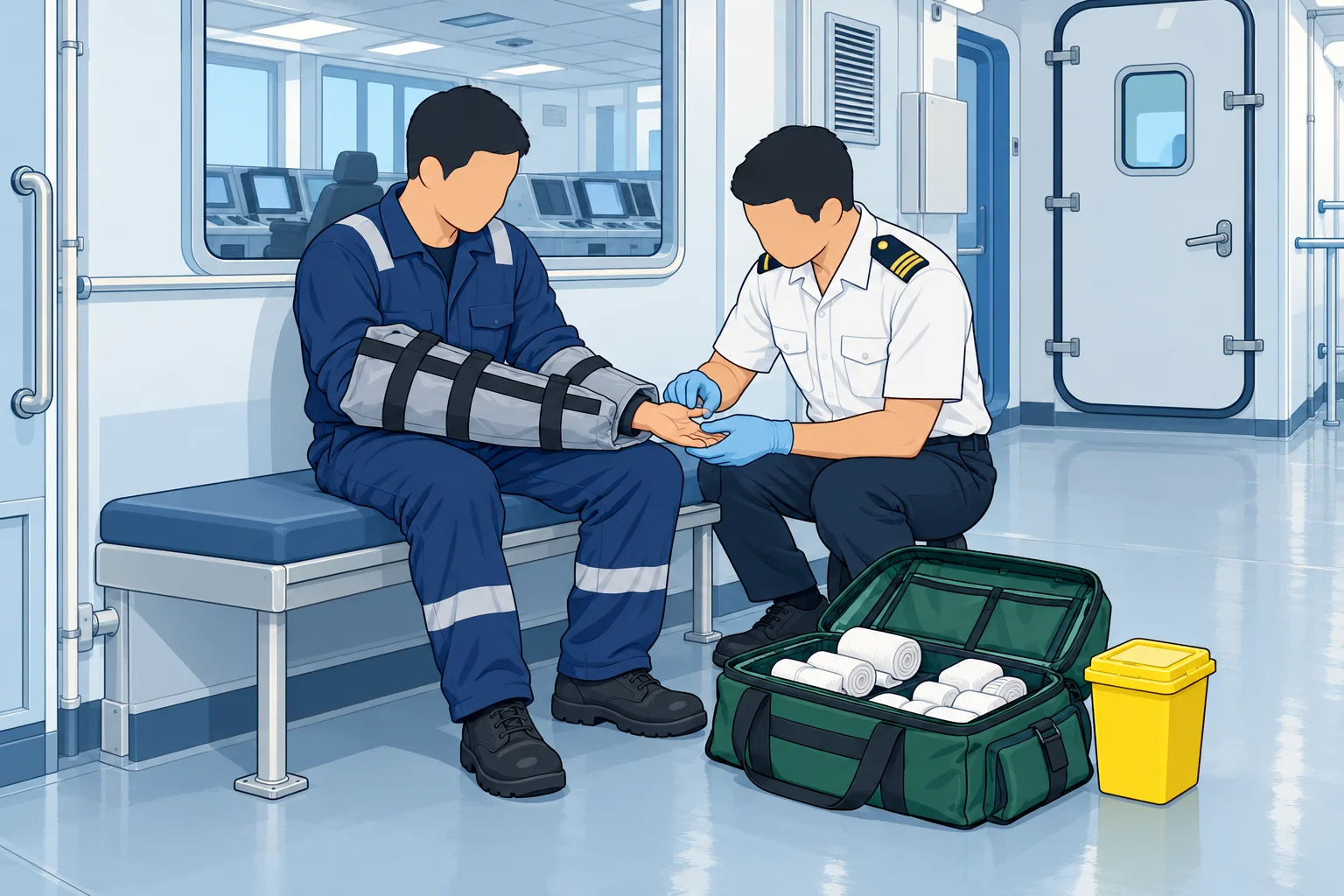
Clean with plenty of drinkable water and judge the wound: length, depth, edges and what lies under it. Use strips only for shallow, clean cuts whose edges meet easily without tension. The ship’s guide also shows sutures (stitches) and staples; use them only if trained and on radio medical advice. Never close bites, punctures, or dirty, crushed or old wounds: dress them open. Check tetanus vaccination records; report unknown or incomplete protection to the doctor, who can arrange preventive treatment. Antibiotics are given only on radio medical advice.
Wounds that need urgent advice
Get urgent advice for deep wounds of the hand, face or joints, numbness or weak movement beyond a wound, wounds of the chest or abdomen, and amputations. A high-pressure injection injury, from a hydraulic hose, fuel injector or grease gun, can look like a pinprick but forces fluid deep into the tissue; it needs surgery within hours. Leave an open chest wound uncovered and get urgent radio medical advice.
Dangerous fractures
Splinting is taught in Wounds, burns and fractures. A broken femur (thigh bone) can bleed heavily into the thigh. A pelvic fracture can bleed heavily inside: suspect it after a fall from height or a crush with hip or groin pain, never rock or spring the pelvis to test it, and keep the casualty still. Both need urgent advice and usually evacuation.
Dislocations
A dislocation is a joint forced out of position: shoulder, finger, kneecap and jaw are common. The joint looks deformed, will not move and is very painful; a fracture may also be present. Support it as found and check colour, warmth and feeling beyond it. Do not try to put it back unless the radio doctor advises it and you have been trained.
Compartment syndrome
After a crush or fracture, swelling inside a closed muscle compartment can cut off the blood supply. Warning signs: pain out of proportion that keeps growing, pain when the fingers or toes are stretched, a tight, swollen limb, then pins and needles. Loosen bandages and splint ties, keep the limb at heart level, and get urgent advice: it needs surgery within hours.
Key figures
- Internal bleeding
- Suspect after crush, fall or blow to trunk, pelvis or thigh
- Closing wounds
- Strips: shallow, clean, low tension; stitches: trained, radio advice
- Never close
- Bites, punctures, dirty, crushed or old wounds
- High-pressure injection
- Tiny wound, deep damage: surgery within hours
- Dislocation
- Support as found; reduce only on radio advice, if trained
- Compartment syndrome
- Growing pain, pain on stretch, tight limb: urgent advice
Remember
- A rising pulse with pale, cold skin after an injury can mean hidden bleeding.
- Never close bites, punctures or dirty wounds; antibiotics only on radio medical advice.
- A pinprick from a hydraulic line can be a surgical emergency: report it at once.
- Femur and pelvic fractures can bleed heavily inside; handle gently and get urgent advice.
- Do not put a dislocation back unless the radio doctor advises it and you are trained.
Common mistakes
Wrong: A tiny wound from a hydraulic leak can be dressed and forgotten.
Right: High-pressure injection drives fluid deep into the tissue; it needs urgent surgery.
Wrong: Stitch every gaping wound to keep germs out.
Right: Closing a dirty or bite wound traps infection. Close only clean wounds; use sutures or staples only if trained and on radio medical advice.
Wrong: Rock the hips to test for a pelvic fracture.
Right: Moving the pelvis can restart bleeding. Suspect it from the fall and the pain, and keep the casualty still.
Worked case
An oiler’s forearm was trapped under a falling engine part. The skin is intact, but an hour later the forearm is swollen and tight, the pain keeps growing, and stretching his fingers hurts badly. His pulse is 112. What is happening and what do you do?
Show the answer
Suspect compartment syndrome, possibly with a fracture. Loosen any bandage or splint ties and keep the arm at heart level, not raised high. Support it, check colour, warmth and feeling of the fingers, and record pulse and blood pressure every 15 minutes. Get urgent radio medical advice: compartment syndrome needs surgery within hours, so the doctor and the MRCC will consider evacuation.
Practice question
An engineer has a pinprick wound on a finger from a leaking hydraulic hose. How serious is it?
- Minor: clean, cover and recheck tomorrow
- Minor unless it bleeds through a dressing
- Serious only if the finger turns black
- Serious: fluid may be deep; report it now
Show the answer
Answer: D. High-pressure injection forces oil deep into the tissue through a tiny hole. It needs surgery within hours.
4 · Burns
Burns: area, depth and when to call the doctor
Cool the burn and keep the casualty warm, then measure: how much skin, how deep and where. Those answers decide the advice, the fluids and the evacuation.
First aid recap
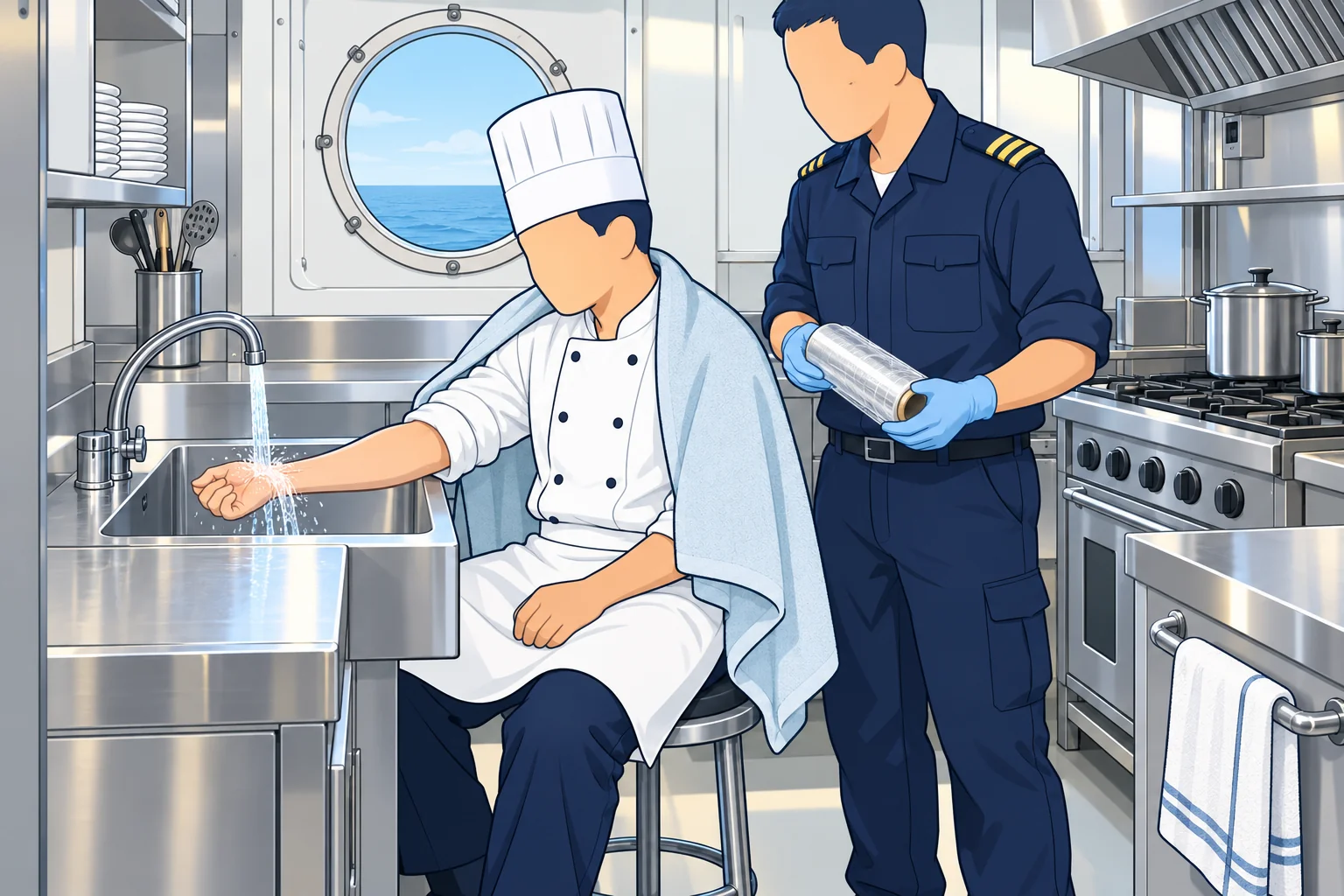
Cool the burn with cool running water for 20 minutes, cover it and keep the casualty warm; see Wounds, burns and fractures.
Measure the area
Burn size is given as a percentage of the total body surface area (TBSA). In an adult the rule of nines gives the head and neck 9 %, each arm 9 %, the front of the trunk 18 %, the back 18 %, each leg 18 % and the genital area 1 %. For scattered burns, use the palm side of the casualty’s whole hand, including fingers held together: about 1 %. Count only blistered or deeper burns, not simple redness.
Judge the depth
A superficial burn is red and painful, without blisters. A partial-thickness burn damages part of the skin depth: it may be pink, moist and painful; deeper areas may be pale and less sensitive. A full-thickness burn is white, brown or charred, leathery, and often painless because the nerves are destroyed. Burns can deepen over the first days, so reassess and record your findings.
When to get advice
Get radio medical advice for any burn larger than the casualty’s whole palmar hand, including fingers, any full-thickness burn, burns of the face, hands, feet, joints or genitals, burns that go all the way round a limb or the chest, and electrical, chemical or inhalation burns. Hoarseness, soot round the mouth or nose, singed nasal hair or a cough after a fire mean the airway may swell: get urgent advice and expect evacuation.
Fluids, pain and infection
Large burns leak fluid and can cause burn shock; in adults the risk is high from about 15 % TBSA. The doctor may advise oral rehydration fluid or, if someone is trained, an intravenous drip, and will advise on pain relief and dressings. Chart pulse, breathing, temperature and urine output. Keep dressings clean and do not burst blisters. Fever, a bad smell or spreading redness later suggest infection.
Key figures
- Cooling
- Cool running water, 20 min, as soon as possible
- Rule of nines (adult)
- Head 9, each arm 9, front 18, back 18, each leg 18, groin 1
- Palm method
- Whole palm-side of casualty’s hand, including fingers ≈ 1 % TBSA
- What to count
- Blistered and deeper burns only, not redness
- Airway burn signs
- Hoarse voice, soot, singed nasal hair, cough after a fire
- Burn shock
- Risk high from about 15 % TBSA in adults
Remember
- Use the rule of nines for large burns; for scattered burns, the casualty’s whole palmar hand including fingers is about 1 %.
- Do not count simple redness when you estimate the burn area.
- White, leathery, painless skin suggests a full-thickness burn.
- Airway, face, hands, joints, genitals or all round a limb: radio medical advice now.
- Large burns need fluids on radio medical advice and a chart of urine output.
Common mistakes
Wrong: A painless burn must be a mild one.
Right: A painless white or leathery burn may be full thickness: the nerves are destroyed.
Wrong: Add the red skin around the blisters to the burn area.
Right: Count only blistered or deeper burns; redness alone makes the estimate too high.
Worked case
Both arms, including both hands, are blistered over their whole surface; blisters also cover half the front of the trunk. His voice is hoarse after the galley fire. Cooling has started. How large is the burn, and what needs urgent attention?
Show the answer
About 27 %: 9 % for each arm plus half of the 18 % front of the trunk. Blisters mean at least partial thickness. Burns all round the arms and a hoarse voice after a fire are red flags: the airway may swell. Keep him warm, sit him up if breathing is easier and give oxygen if trained. Call for urgent radio medical advice with area, depth and vital signs, and start a fluid and urine chart. Evacuation is likely.
Practice question
An adult’s whole front of one leg is blistered; its back is only red, without blisters. What TBSA do you report?
- 4.5 %
- 9 %
- 18 %
- 36 %
Show the answer
Answer: B. A whole leg is 18 %, so its front is 9 %. Do not include redness without blistering.
5 · Cold and rescue
Hypothermia, immersion and care of rescued persons
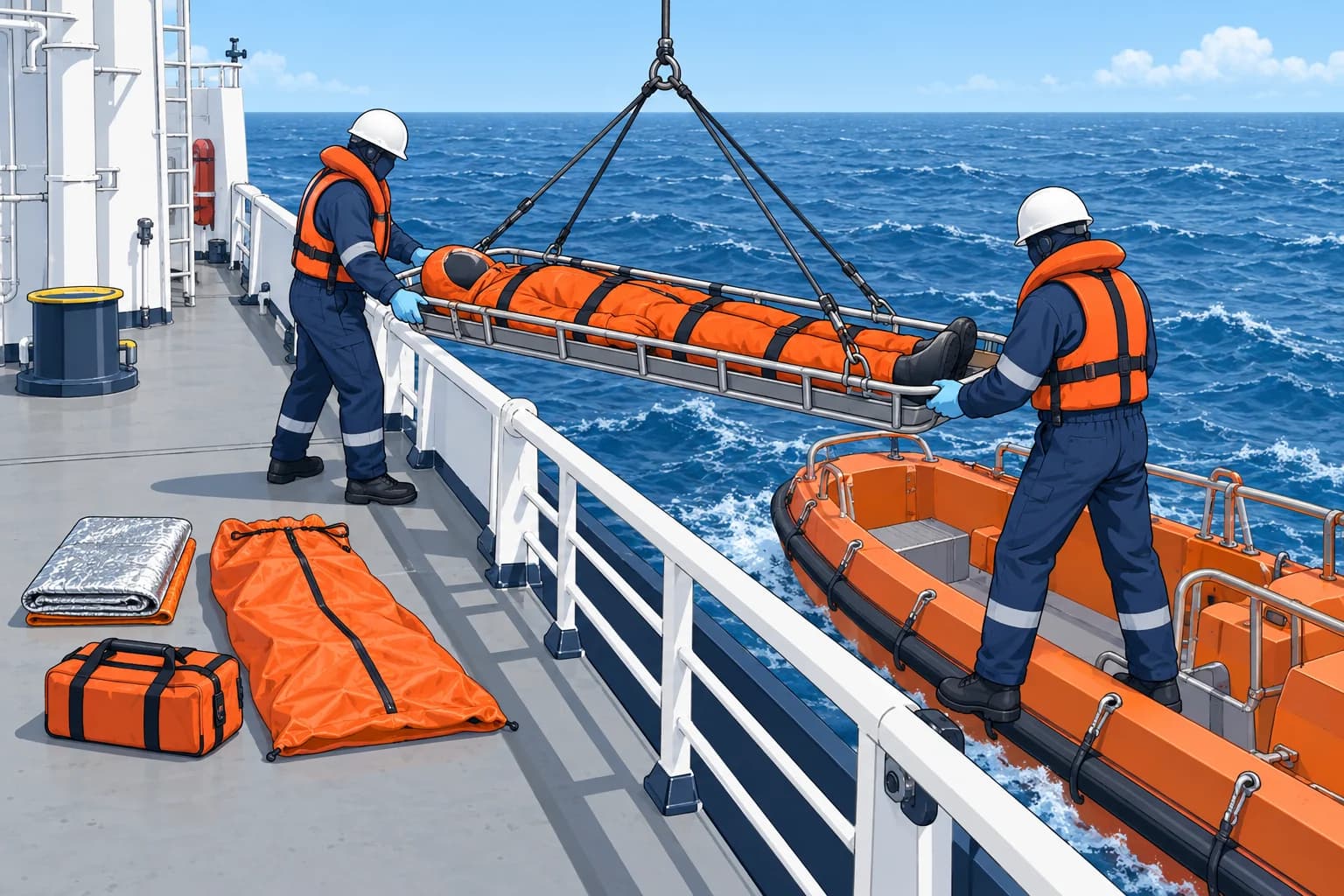
At officer level you measure, stage and monitor the cold casualty, avoid harm while rewarming, and care for survivors taken from the sea.
What is new here
Cold shock, Float to Live and basic rewarming are taught in Hypothermia, cold-water immersion, drowning and heat illness. Here you add core temperature, the temperature deep inside the body. Use a low-reading thermometer designed for core measurement, following its approved method and measurement site. A low measuring range alone is not enough: skin and ordinary forehead readings are unreliable in a cold casualty. Record the value, time and site. Do not delay care to obtain a reading.
Stages
By core temperature: mild is 32 to below 35 °C; moderate, 28 to below 32 °C; severe, below 28 °C. Typical signs progress from shivering and clumsiness, through confusion and weaker shivering, to unconsciousness with very slow pulse and breathing. These signs vary and do not reliably predict core temperature. When measurement is unavailable, report consciousness, shivering and vital signs to the radio doctor.
Rewarming without harm
After-drop is a further fall in core temperature after rescue, as cold blood returns from the limbs. Keep the casualty flat, still and horizontal; do not rub the limbs or put a cold casualty in a hot shower. Mild: dry clothes, insulation and warm sweet drinks if fully alert. Moderate or severe: insulate, put wrapped heat packs on the chest, armpits and back, and get urgent radio medical advice: severe cases need hospital treatment; continue gentle warming while evacuation is arranged.
Cardiac arrest in the cold
A cold heart is irritable: rough handling can trigger cardiac arrest. Check breathing and pulse for up to a minute in a severely cold, unresponsive casualty. With no signs of life, start CPR and use the AED. Cold may protect the brain: do not stop just because CPR has lasted a long time. Continue until signs of life return, rescuers take over, continuing is unsafe or impossible, or the radio doctor advises stopping.
Survivors from the sea
Rescued persons, from the water or a liferaft, may have hypothermia, dehydration, sunburn, salt-water sores, cold injury of the feet, injuries and inhaled sea water. Examine each one fully and record vital signs and temperature. Give fluids by mouth slowly if alert, and handle cold feet gently. Anyone who inhaled water needs radio medical advice even if well. Expect shock, grief and fear: stay calm, give information and keep companions together.
Key figures
- Thermometer
- Low-reading device designed for core-temperature measurement
- Mild
- 32 to below 35 °C; typically shivering, alert, clumsy
- Moderate
- 28 to below 32 °C; often confused, shivering weak or stopped
- Severe
- Below 28 °C; often unconscious, slow pulse and breathing
- Breathing check
- Up to 1 minute in a severely cold casualty
- After-drop
- Core keeps falling after rescue: flat, still, insulated
Remember
- Use a low-reading thermometer suitable for core measurement; record the value, time and site.
- Stage by core temperature; if unavailable, report consciousness, shivering and vital signs. Signs vary.
- Handle gently and horizontally: rough handling can trigger cardiac arrest.
- Do not stop solely because CPR has lasted a long time; follow standard CPR stopping rules and radio medical advice.
- Examine every rescued person fully; inhaled water always needs radio medical advice.
Common mistakes
Wrong: Put a cold, drowsy survivor in a hot shower to warm him quickly.
Right: Fast surface warming can make the blood pressure collapse. Insulate, use wrapped heat packs and get advice.
Wrong: A survivor who stops shivering is warming up.
Right: Stopped shivering while still cold and drowsy warns of worsening hypothermia. Get urgent advice; signs alone cannot reliably show core temperature.
Wrong: Stop CPR on a cold casualty after 20 minutes.
Right: Do not stop solely because CPR has lasted a long time; follow standard CPR stopping rules and radio medical advice.
Worked case
Your rescue boat recovers a fisherman who was in 12 °C water for about 50 minutes. He is drowsy, mumbles answers and is no longer shivering. His core temperature reads 30 °C. What do you do?
Show the answer
This is moderate hypothermia. Keep him horizontal and still: carry him, never let him walk. Cut off wet clothing, insulate him with blankets and a wind- and waterproof cover, and put wrapped heat packs on his chest, armpits and back. Give nothing by mouth, as he is not fully alert. Monitor breathing, pulse and temperature, keep the AED ready, and get urgent radio medical advice: he needs hospital rewarming, so evacuation is likely.
Practice question
A survivor’s core temperature is 33 °C; he shivers hard and answers clearly. What stage is this?
- Mild hypothermia
- Moderate hypothermia
- Severe hypothermia
- No hypothermia
Show the answer
Answer: A. Mild hypothermia is a core temperature from 32 to below 35 °C. Shivering and clear answers are typical, but clinical signs vary.
6 · Guide and TMAS
Using the ship’s medical guide and preparing a radio consultation
The medical guide tells you what to look for and how to treat; the radio doctor decides what this patient needs. Prepare well and the call is short and safe.
The guides on board
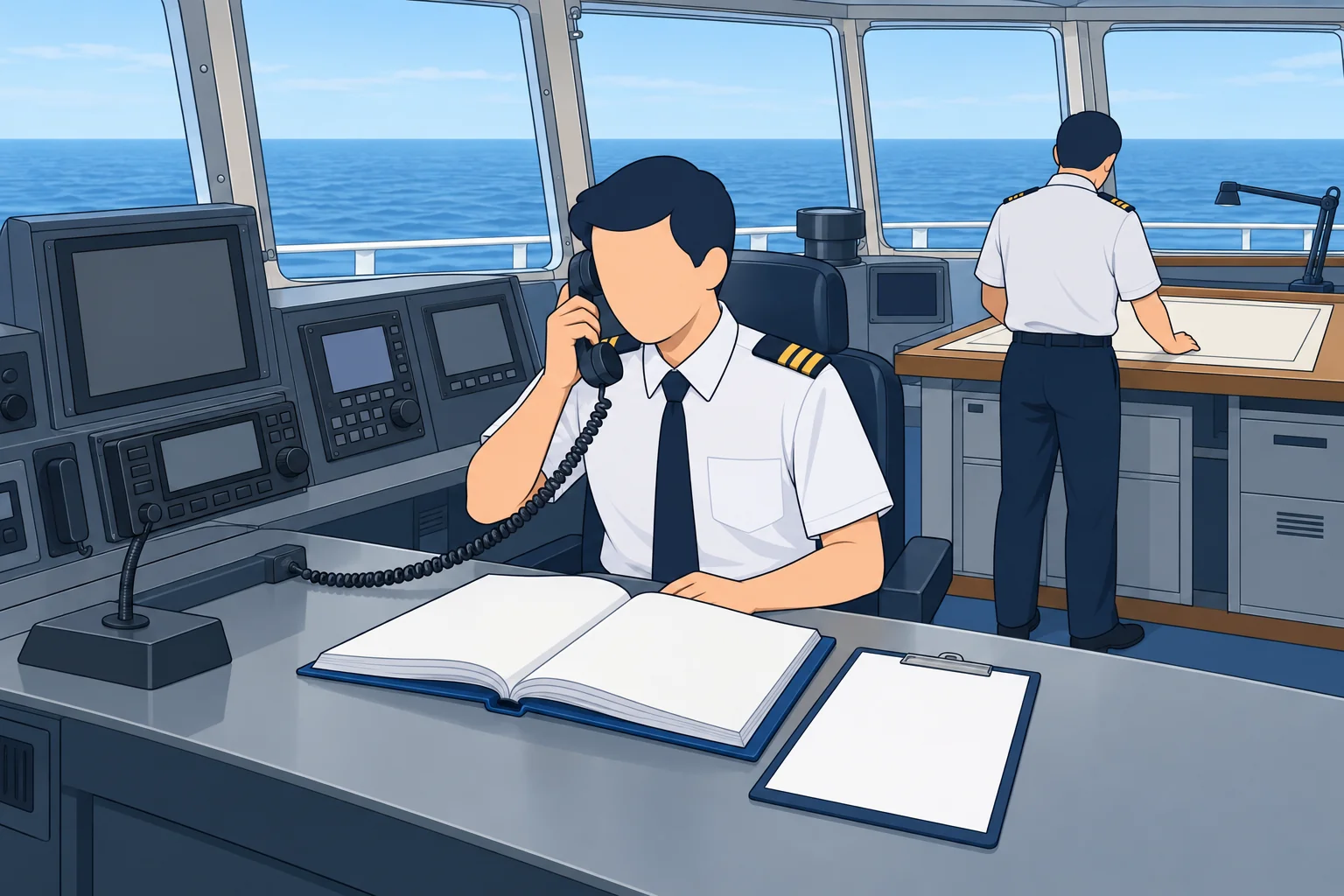
Ships carry the WHO International Medical Guide for Ships (IMGS), 3rd edition (2007), or a national equivalent, such as the UK Ship Captain’s Medical Guide or the Spanish Guía sanitaria a bordo. It is written for the seafarers who give first aid and medical care. Its medicine-chest chapter lists medicines by generic name, and the WHO Quantification Addendum (2010) gives the quantities. The MFAG is its chemical supplement.
Finding your way
Learn the guide before you need it. Use the contents and index: the first-aid chapters for emergencies, the chapter on examining a patient, then the condition itself. Follow its cross-references to procedures, such as giving an injection or caring for a patient in bed, and to the medicine chest list. Mark the medical report form, the observation chart and the medicine list so you can open them in seconds.
Before the call
Unless it is an emergency, examine the patient and take the history first. Fill in the guide’s medical report form: ship details, position and nearest port; the patient’s age, sex and weight; complaint, history, allergies and medicines; findings; vital signs with times; and what you have given. Open the medicine chest list, and prepare photos of wounds or rashes if you can send them. The call itself is in Radio medical advice.
During the call
Put the officer who examined the patient on the line, beside the patient if possible. Describe what you saw and measured, not your diagnosis. Name medicines exactly as in your list: generic name and strength. Write down the advice, read it back, and ask how to monitor and when to call again. Prescription medicines are given only on radio medical advice.
After the call
Record everything in the treatment record: times, advice, who gave what, dose, route and the patient’s response; keep it confidential. Repeat vital signs as asked and call back early if the patient gets worse. Tell the master about every consultation. Send a copy of the record with the patient.
Key figures
- IMGS
- WHO, 3rd edition 2007; medicine list by generic name
- Quantities
- WHO Quantification Addendum, 2010
- Chemical supplement
- MFAG, in the IMDG Code Supplement
- Before a call
- Examine, history, report form, vitals with times, medicine list
- Prescription medicines
- Only on radio medical advice
- After a call
- Read back, record, monitor, agree the next call
Remember
- Learn the guide’s layout before an emergency; mark the report form and medicine list.
- Examine, take the history and fill in the report form before a non-urgent call.
- Report what you see and measure; leave the diagnosis to the doctor.
- Give prescription medicines only on radio medical advice, and record every dose.
- Read the advice back and agree when to call again.
Common mistakes
Wrong: Call the doctor first and examine the patient while you talk.
Right: Except in an emergency, examine and fill in the report form first; the call is shorter and clearer.
Wrong: Give the doctor the brand name on the box.
Right: Use the generic name and strength from the medicine chest list, so nothing is confused.
Wrong: Start antibiotics from the guide if the patient seems infected.
Right: The guide explains medicines, but prescription medicines are given only on radio medical advice.
Worked case
At night, 900 nautical miles from port, the bosun has had abdominal pain for 10 hours, now worst low on the right, with a temperature of 38.4 °C and vomiting. His vital signs are stable. Should you delay the call until the report form is complete?
Show the answer
Get radio medical advice promptly; stable vital signs do not make this safe to postpone. While a colleague prepares the form, report the pain’s course, fever, vomiting, intake/output, allergies, medicines and timed vital signs. Have the medicine list ready. Read back advice and agree monitoring and the next call.
Practice question
What does the WHO Quantification Addendum add to the IMGS?
- Antidote tables for chemical cargoes
- Recommended quantities of the chest’s medicines
- Rules on recording a death and a burial at sea
- Radio frequencies of the medical services
Show the answer
Answer: B. The 2010 addendum gives recommended quantities for the medicines and supplies in the IMGS list.