
Medical care on board · Level R4 · 5 parts · about 15 min
Radio medical advice and evacuation
5 short parts: Who to call · Making the call · Prepare the report · Vital signs · Evacuation. Each part explains the idea, then gives the points to remember, the common mistakes, a worked case and a practice question; the Academy unit adds all 30 check questions.
1 · Who to call
Telemedical advice: who answers and how to reach them
Doctors ashore give free medical advice to any vessel at sea, day and night. You reach them through the coastguard, which can also arrange an evacuation.
What TMAS is
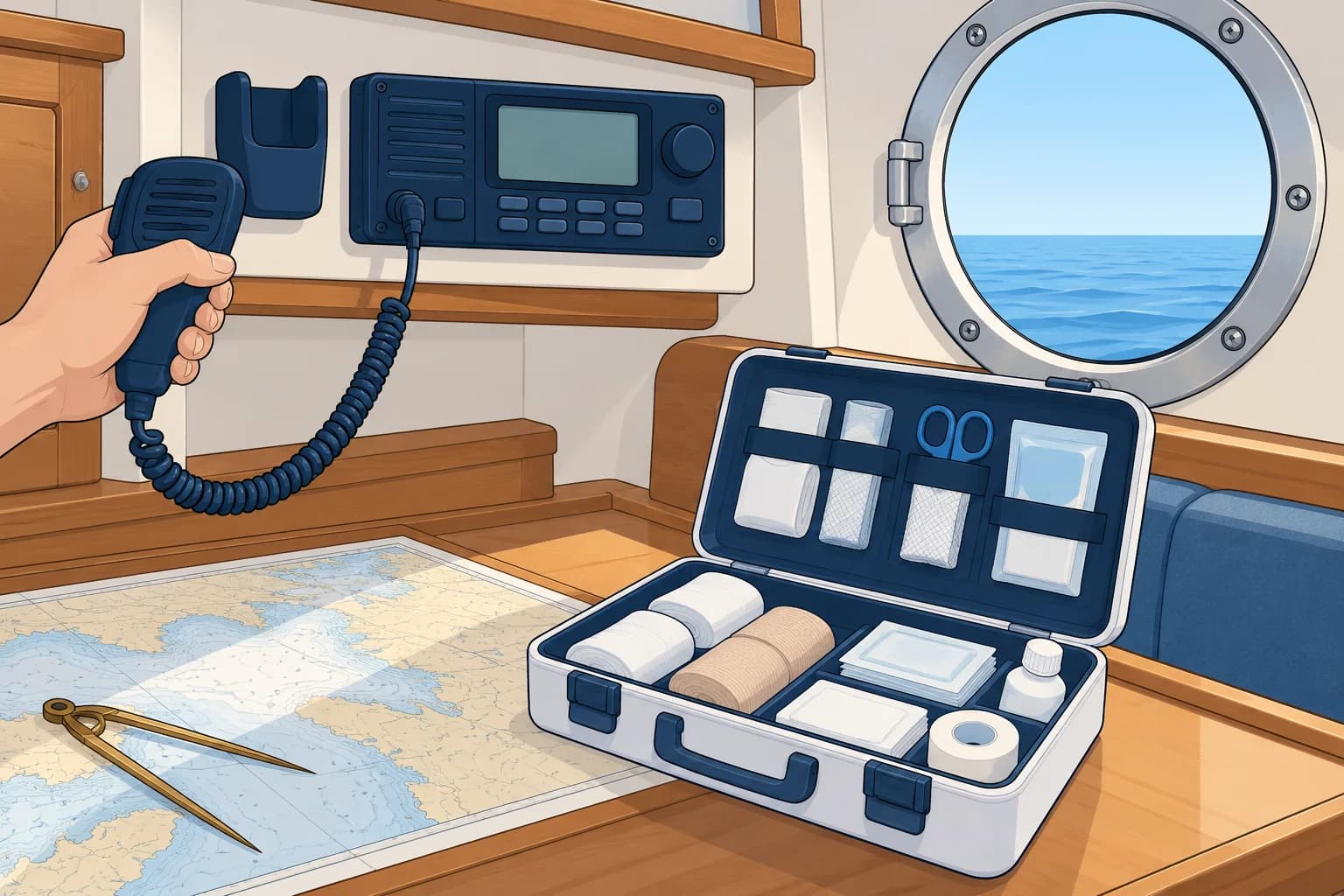
A TMAS (telemedical assistance service) provides doctors’ advice to vessels at sea, 24 hours a day, free of charge. Guidance from the International Maritime Organization (IMO) and the International Aeronautical and Maritime Search and Rescue (IAMSAR) Manual links TMAS with maritime rescue coordination centres (MRCCs). In the European Union, Directive 92/29/EEC requires each member state to designate one or more medical advice centres.
Call the coastguard first
Contact the coastguard or MRCC, not a hospital directly. It records your position and problem, then connects you to the TMAS doctor. If the doctor advises an evacuation, the MRCC is already involved and can arrange rescue. Calling a friend who is a doctor does not automatically alert the MRCC.
Some national services
In the UK, call HM Coastguard: it links you to Queen Alexandra Hospital, Portsmouth, or Aberdeen Royal Infirmary. In France, call CROSS, France’s coastguard centres, for the maritime medical consultation centre (CCMM) in Toulouse. In Spain, call Salvamento Marítimo, the maritime rescue service, for the Centro Radio-Médico Español of the Instituto Social de la Marina in Madrid. Italy’s International Radio Medical Centre (CIRM) in Rome advises vessels of any flag.
How to make contact
Use very high frequency (VHF) radio: digital selective calling (DSC) or Channel 16. Farther offshore, use medium-frequency (MF) DSC. Mobile and satellite phones are backups: a radio call also reaches nearby vessels and coast stations. Far offshore, contact the responsible MRCC by satellite; see GMDSS (Global Maritime Distress and Safety System).
Key figures
- TMAS
- Doctors advising vessels at sea, 24 h, free of charge
- First contact
- Coastguard/MRCC, which connects you to the TMAS
- UK
- HM Coastguard → QA Hospital Portsmouth or Aberdeen Royal Infirmary
- France
- CROSS → CCMM Toulouse
- Spain
- Salvamento Marítimo → Centro Radio-Médico Español (ISM, Madrid)
- Italy
- CIRM, Rome: vessels of any flag
Remember
- TMAS doctors advise any vessel at sea, day and night, free of charge.
- Call the coastguard/MRCC first; it connects you to the doctor.
- Going through the MRCC means an evacuation can be arranged without delay.
- Use VHF DSC, Channel 16 or MF DSC; phones only as a backup.
- Know your area's service before you sail: HM Coastguard, CROSS, Salvamento Marítimo.
Common mistakes
Wrong: Phone the nearest hospital directly from your mobile.
Right: Call the coastguard. It connects you to the TMAS doctor and can start an evacuation at once.
Wrong: Radio medical advice is only for merchant ships.
Right: Any vessel at sea, including yachts, can ask for telemedical advice, free of charge.
Worked case
Twenty-five miles off Brittany, a crew member has severe abdominal pain that is getting worse. You have a mobile phone signal and a friend ashore who is a nurse. What do you do?
Show the answer
Call the CROSS on VHF DSC or Channel 16 and ask for medical advice. The CROSS records your position and the problem, then connects you to the CCMM doctor in Toulouse. If the doctor advises evacuation, the CROSS arranges it. Calling your friend alone does not alert the CROSS; contact it directly. Keep the phone as a backup line.
Practice question
Who should a yacht contact first for medical advice at sea?
- The nearest hospital
- The boat's insurance firm
- A pharmacy ashore
- The coastguard or MRCC
Show the answer
Answer: D. The coastguard connects you to the TMAS doctor and can arrange an evacuation if needed.
2 · Making the call
PAN-PAN or MAYDAY: making the medical call
Most medical calls are PAN-PAN urgency calls. Use MAYDAY only when a life is in grave and imminent danger and immediate help is needed.
Which priority
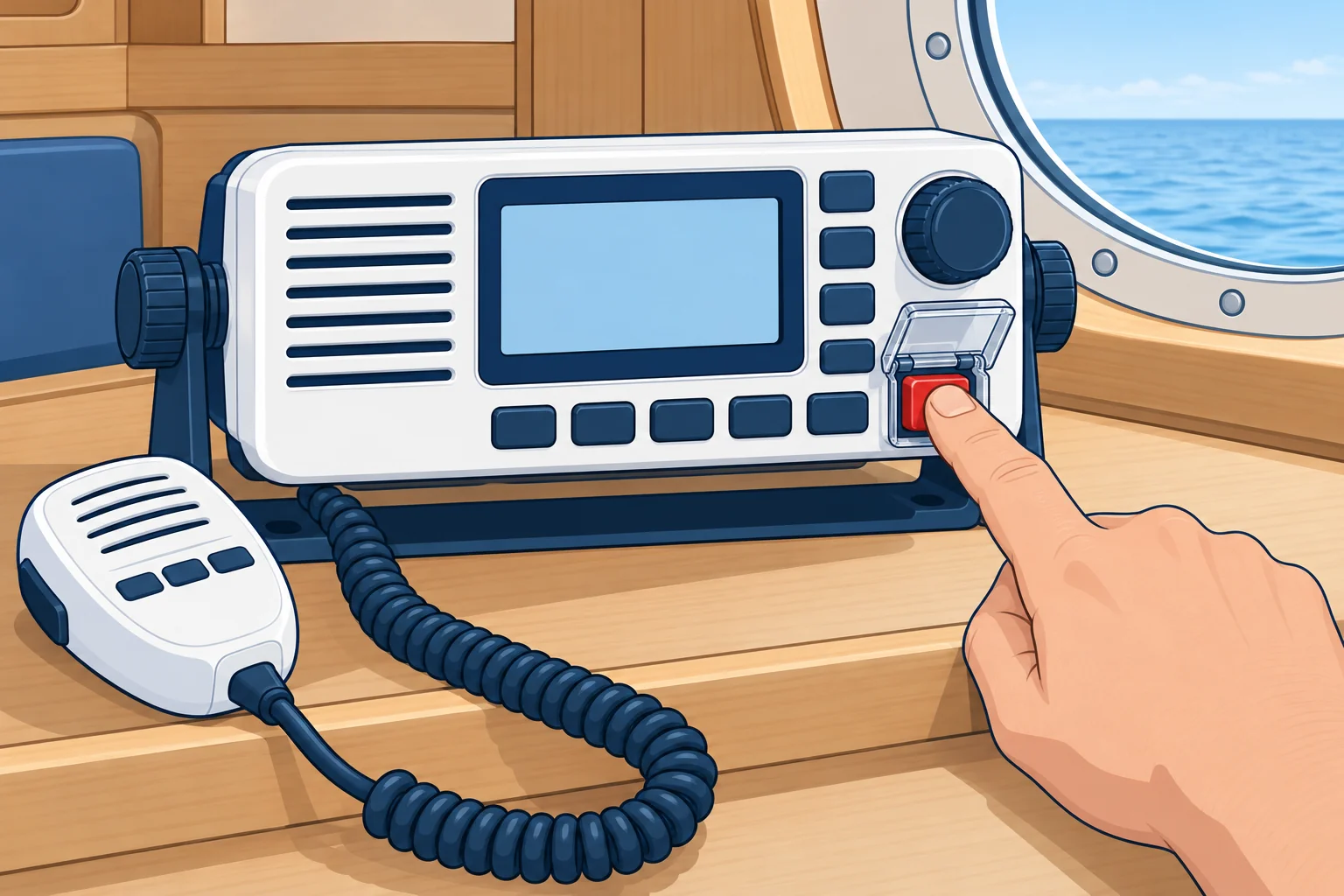
MAYDAY is a distress call: a person or vessel is in grave and imminent danger and needs immediate assistance. PAN-PAN is an urgency call: a serious problem that needs prompt help, but not that level of danger. A crew member who is unresponsive, not breathing normally or bleeding heavily despite treatment can justify MAYDAY. A worsening illness that needs a doctor's advice is usually PAN-PAN.
DSC first
With a DSC radio, send an urgency alert, to all stations or to the coast station, then speak on Channel 16. Use distress alerting only for a MAYDAY. The buttons differ between radios; see GMDSS: DSC and distress calls. Without DSC, call by voice on Channel 16. The coastguard will move you to a working channel and connect the doctor.
What to say
Say PAN-PAN three times. Name the station three times, or say "All stations" three times. Say "This is", your boat’s name three times, your call sign and MMSI (your radio’s nine-digit identity). Say "I require medical advice". Give your position and a brief description of the problem. End with "Over".
No "PAN-PAN MEDICO"
Some older courses taught PAN-PAN MEDICO. It is not an international procedure word. In the radio rules, PAN-PAN followed by the word MEDICAL, pronounced "MAY-DEE-CAL", identifies protected medical transports such as hospital ships. For a yacht, use a normal PAN-PAN and say that you require medical advice.
If it gets worse
Upgrade to MAYDAY if there is grave and imminent danger and immediate help is needed. If help is no longer needed, tell the coastguard and agree stand-down. Cancel any all-stations urgency message by voice to all stations on the original broadcast channel, coordinated with the coastguard. Keep listening as the coastguard directs.
Key figures
- MAYDAY
- Grave and imminent danger; immediate assistance needed
- PAN-PAN
- Urgency: serious, prompt help, not grave and imminent
- Typical medical call
- PAN-PAN ×3; station ×3; boat ×3; call sign; MMSI; medical advice
- DSC
- Urgency alert, then voice on Channel 16
- MEDICAL (MAY-DEE-CAL)
- Reserved for protected medical transports
- Spanish term
- Consulta radio médica; PAN-PAN (urgencia)
Remember
- MAYDAY: grave and imminent danger to life, immediate help needed.
- PAN-PAN: urgent, serious problem; most requests for medical advice.
- With DSC: urgency alert, then voice on Channel 16.
- Say "I require medical advice"; do not use "PAN-PAN MEDICO".
- Upgrade to MAYDAY if there is grave and imminent danger requiring immediate help.
Common mistakes
Wrong: Any medical problem at sea justifies a MAYDAY.
Right: MAYDAY is for grave and imminent danger needing immediate help. Most requests for medical advice are PAN-PAN.
Wrong: Begin a request for advice with "PAN-PAN MEDICO".
Right: It is not an international procedure word. Use PAN-PAN and say "I require medical advice".
Wrong: Once you have called PAN-PAN you cannot change to MAYDAY.
Right: If the casualty's life comes into grave and imminent danger, send a MAYDAY at once.
Worked case
On passage 30 miles offshore, a crew member has had chest pain for 20 minutes. He is pale and sweaty but awake and breathing. Your radio has DSC. How do you call, and what priority do you use?
Show the answer
Persistent chest pain with pallor and sweating may be life-threatening even while he is awake and breathing. Treat this as grave and imminent danger: send a DSC distress alert, then call MAYDAY on Channel 16. Give your position and symptoms, and request immediate assistance. Do not wait for collapse. Follow medical advice; see GMDSS: distress calls for the full call format.
Practice question
A crew member has a worsening fever and needs prompt medical advice. They are alert, breathing comfortably and show no signs of immediate danger. Which priority fits?
- MAYDAY
- PAN-PAN
- SÉCURITÉ
- Routine
Show the answer
Answer: B. A serious problem needing prompt advice, without grave and imminent danger, is an urgency: PAN-PAN.
3 · Prepare the report
What to have ready, and recording the advice
The doctor cannot see your patient. Clear, ordered information lets them help you, and a written log keeps the treatment safe over hours or days.
Use a form
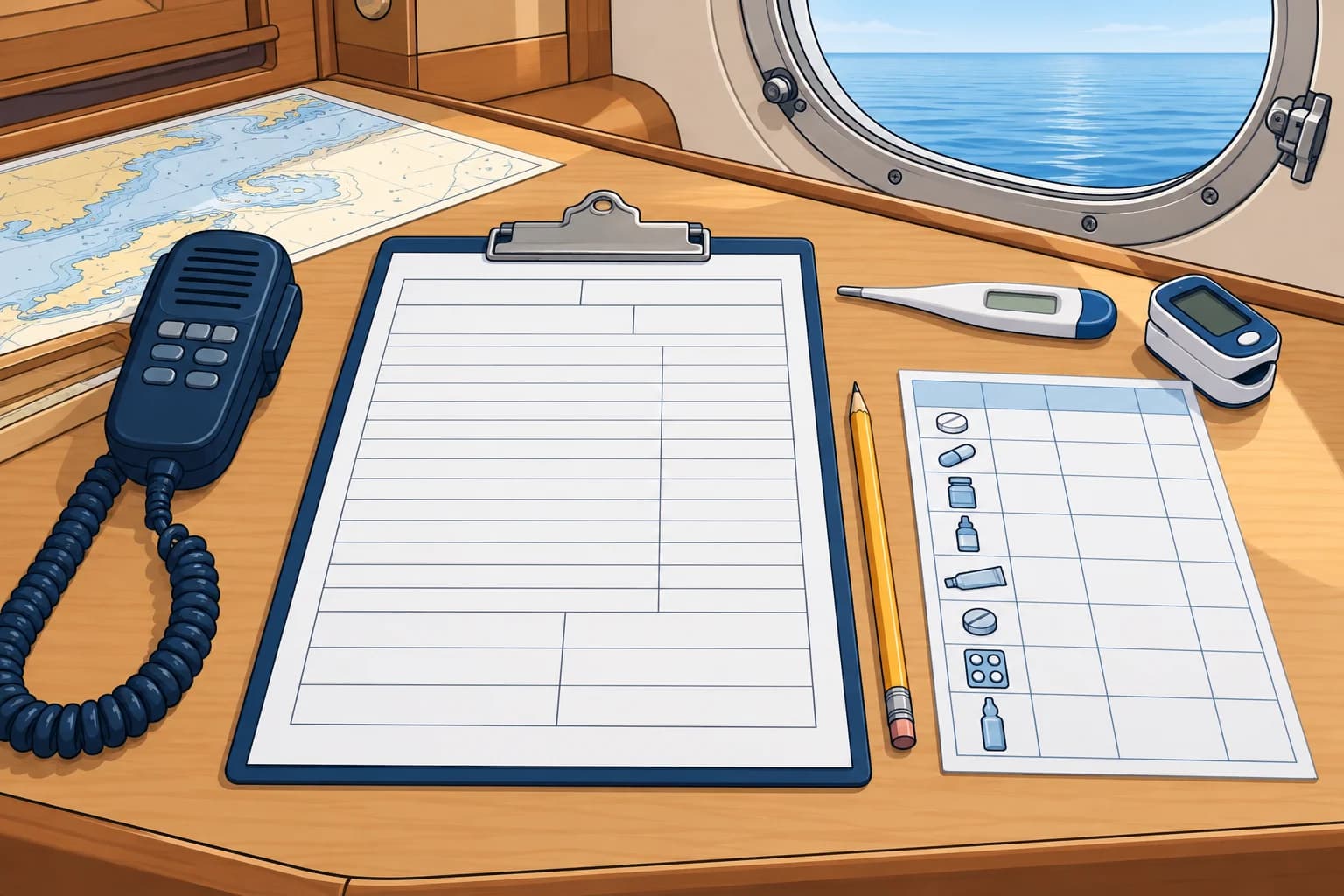
Ships’ medical guides contain a medical report form for radio calls: the World Health Organization (WHO) International Medical Guide for Ships (3rd edition), the UK Ship Captain’s Medical Guide and the Spanish Guía sanitaria a bordo. Keep a blank form with the medicine chest. For a stable patient, prepare it before the consultation. Never delay an urgent call to complete it; gather and send missing details while help is arranged.
About the boat
Have ready the boat's name, call sign and MMSI; your position, course and speed; the nearest port and how long to reach it; the weather and sea; and the number and medical training of the crew. The coastguard needs these to plan a possible evacuation.
About the patient
Age, sex and approximate weight. The main complaint: what is wrong, when it started and how it changed. What happened, if there was an injury. Known illnesses, allergies and regular medicines. What you have done and given, with times and doses. Then the vital signs with the time you took them; the next lesson shows how.
What you can offer
Tell the doctor which medicines and equipment you carry. Keep a list of the medicine chest, with names and strengths, next to the form. The doctor can only prescribe what you have aboard. If you can send photos, for example of a wound or rash, ask; it can help.
Write it all down
Write down the doctor's advice as you hear it, then read it back to check. Agree when you will call again, and what change should make you call sooner. Record every treatment, medicine, dose and time in the treatment record described in The medicine chest, with new vital signs at each step.
Key figures
- Forms
- WHO IMGS 3rd ed.; Ship Captain's Medical Guide; Guía sanitaria a bordo
- Boat
- Name, call sign, MMSI, position, nearest port, weather, crew
- Patient
- Age, sex, weight, complaint, history, allergies, medicines
- Also
- Treatment given with times, vital signs, medicine chest list
- After the call
- Read back advice; agree next call time; log every step
Remember
- Prepare a medical report form, but never delay an urgent call to finish it.
- Give boat details and position: the coastguard plans any evacuation from them.
- Patient: complaint, history, allergies, medicines, treatment given, vital signs.
- Have your medicine chest list ready: the doctor prescribes from what you carry.
- Read back the advice, agree the next call, and log every step.
Common mistakes
Wrong: Delay an urgent call until every box is complete.
Right: Call promptly with your position and main concern. Gather and pass on the remaining details while help is arranged.
Wrong: Remember the doctor's advice; there is no need to write it down.
Right: Write it down and read it back. Treatment over hours or days depends on an accurate record.
Worked case
The doctor asks when pain relief was given. Your crewmate remembers 14:00; the treatment record says 14:30. The next dose depends on that time. What do you say and record?
Show the answer
Tell the doctor there is a timing discrepancy; do not guess. Check the written record with the person who gave the medicine. Read back the confirmed medicine, strength, dose and time, or state what remains uncertain. Record the advice and agree the next call and any reason to call sooner.
Practice question
Why have your medicine chest list ready during the call?
- The coastguard must approve it
- The doctor prescribes from it
- It shows the boat's insurance
- It replaces the patient's history
Show the answer
Answer: B. The doctor needs to know which medicines and strengths you have aboard before advising treatment.
4 · Vital signs
Measuring vital signs for the doctor
Vital signs are the doctor's eyes. Measure them the same way each time, write down the time, and repeat them to show the trend.
Pulse
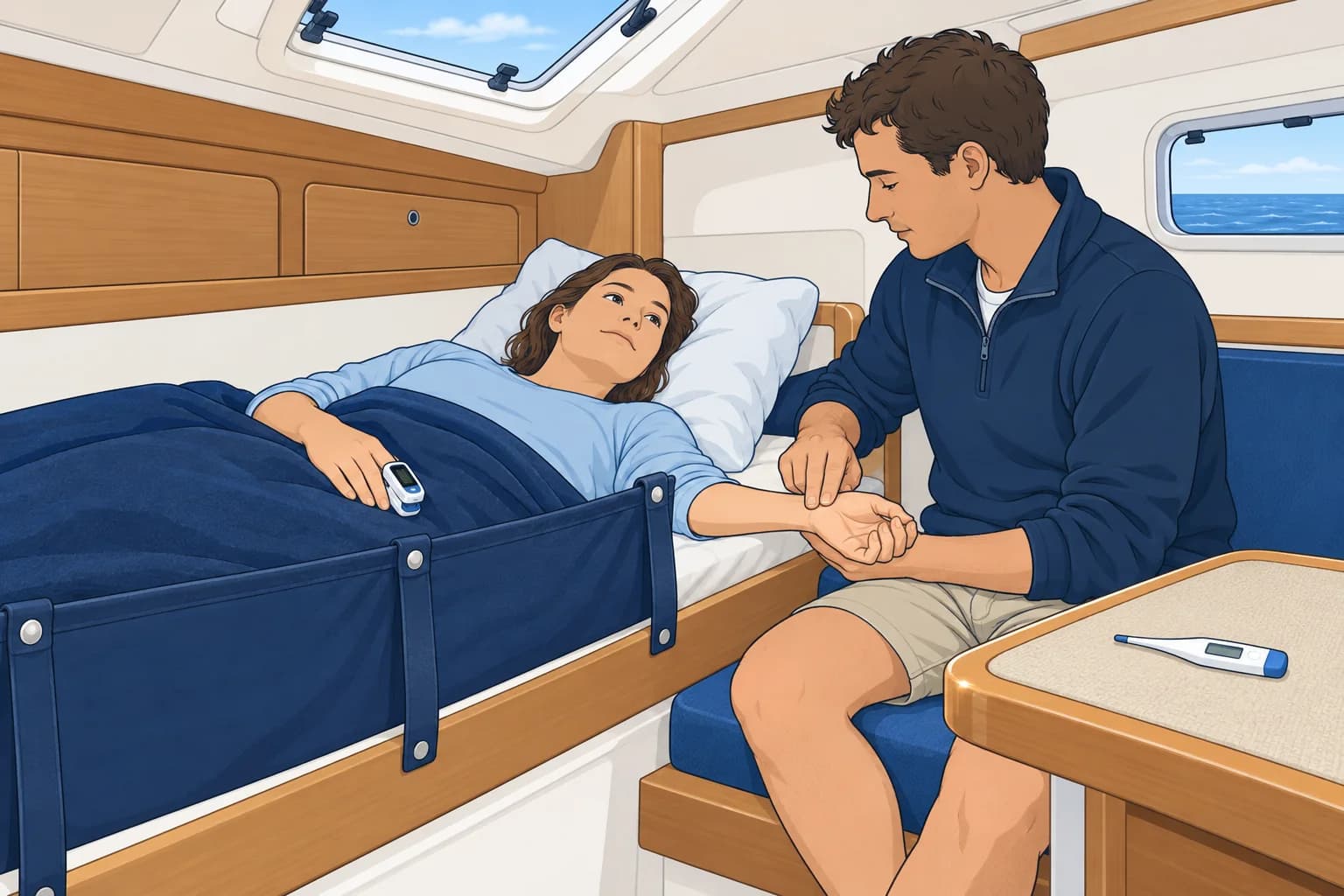
Feel the pulse at the wrist, on the thumb side, or at the side of the neck. Count for 30 seconds and double if regular; if irregular, count for a full minute and report the irregularity. Note whether it is strong or weak. Example: 46 regular beats in 30 seconds is 92 a minute. A resting adult is usually between 60 and 100.
Breathing
Count for 30 seconds and double if regular; if irregular, count for a full minute and report the irregularity. Count quietly: people change their breathing when watched. Example: 11 regular breaths in 30 seconds is 22 a minute, faster than the usual adult 12 to 20. Also note whether breathing is noisy, laboured or shallow.
Temperature and more
Use a thermometer as instructed; note whether you measured in the mouth, ear or armpit. Normal is about 37 °C. If available, measure blood pressure with an automatic cuff and oxygen saturation, an estimate of how much oxygen your blood is carrying, with a pulse oximeter, a finger clip. Saturation is usually 95–100%. Cold or movement can distort readings; report a low reading promptly and repeat without delaying help.
Consciousness
Use AVPU: Alert, responds to Voice, responds to Pain, Unresponsive. V means not alert, but responds when you speak to them. P means responds only to pain. Note whether they know who and where they are. Check whether both pupils are the same size and react to light. Report any drop in consciousness promptly.
Other signs
Note skin colour and temperature: pale, grey, flushed, cold or sweaty. Ask where the pain is and score it from 0 (no pain) to 10 (worst imaginable pain). Note how much urine they pass and its colour, and any vomiting. Measure blood sugar if you carry a meter. Repeat the vital signs as the doctor asks, and write each set down with its time.
Key figures
- Count
- Regular pulse/breaths: 30 s × 2; irregular: count 60 s
- Adult at rest (typical)
- Pulse 60–100/min; breathing 12–20/min
- Temperature
- About 37 °C; note where you measured it
- Oxygen saturation
- Usually 95–100%; report low readings, recheck without delaying help
- AVPU
- Alert, Voice, Pain, Unresponsive
- Worked example
- 46 beats in 30 s = 92/min; 11 breaths in 30 s = 22/min
Remember
- Count regular pulse and breathing for 30 seconds and double; if irregular, count a full minute and report it.
- Typical resting adult: pulse 60–100, breathing 12–20 a minute.
- Use AVPU to describe consciousness; any drop is important.
- A pulse oximeter can misread with cold or movement; report low readings promptly and recheck without delaying help.
- Write every set of vital signs down with its time; the trend matters.
Common mistakes
Wrong: Tell the patient you are counting their breaths.
Right: People change their breathing when watched. Count quietly, for example while still holding the wrist after the pulse.
Wrong: One set of vital signs is enough for the doctor.
Right: The trend shows whether the patient is improving or getting worse. Repeat them and record the times.
Worked case
While a crewmate calls about vomiting and abdominal pain, you count 52 regular pulse beats and 12 regular breaths, each in 30 seconds. An ear thermometer shows 38.6 °C. The patient responds only when spoken to. What will you report?
Show the answer
Pulse 104/min and breathing 24/min, both fast; ear temperature 38.6 °C, a fever. AVPU: V, responds only when spoken to. Report pain site and score, skin colour, vomiting and urine, with measurement times. Repeat observations without delaying help.
Practice question
You count 40 regular pulse beats in 30 seconds. What is the pulse rate?
- 40 a minute
- 60 a minute
- 80 a minute
- 120 a minute
Show the answer
Answer: C. 40 × 2 = 80 beats a minute, within the usual resting range of 60–100.
5 · Evacuation
Medical evacuation: deciding, preparing and following up
The doctor and the rescue centre decide whether to evacuate, and how. Your job is to prepare the patient, the paperwork and the boat, and keep a clear record.
Who decides
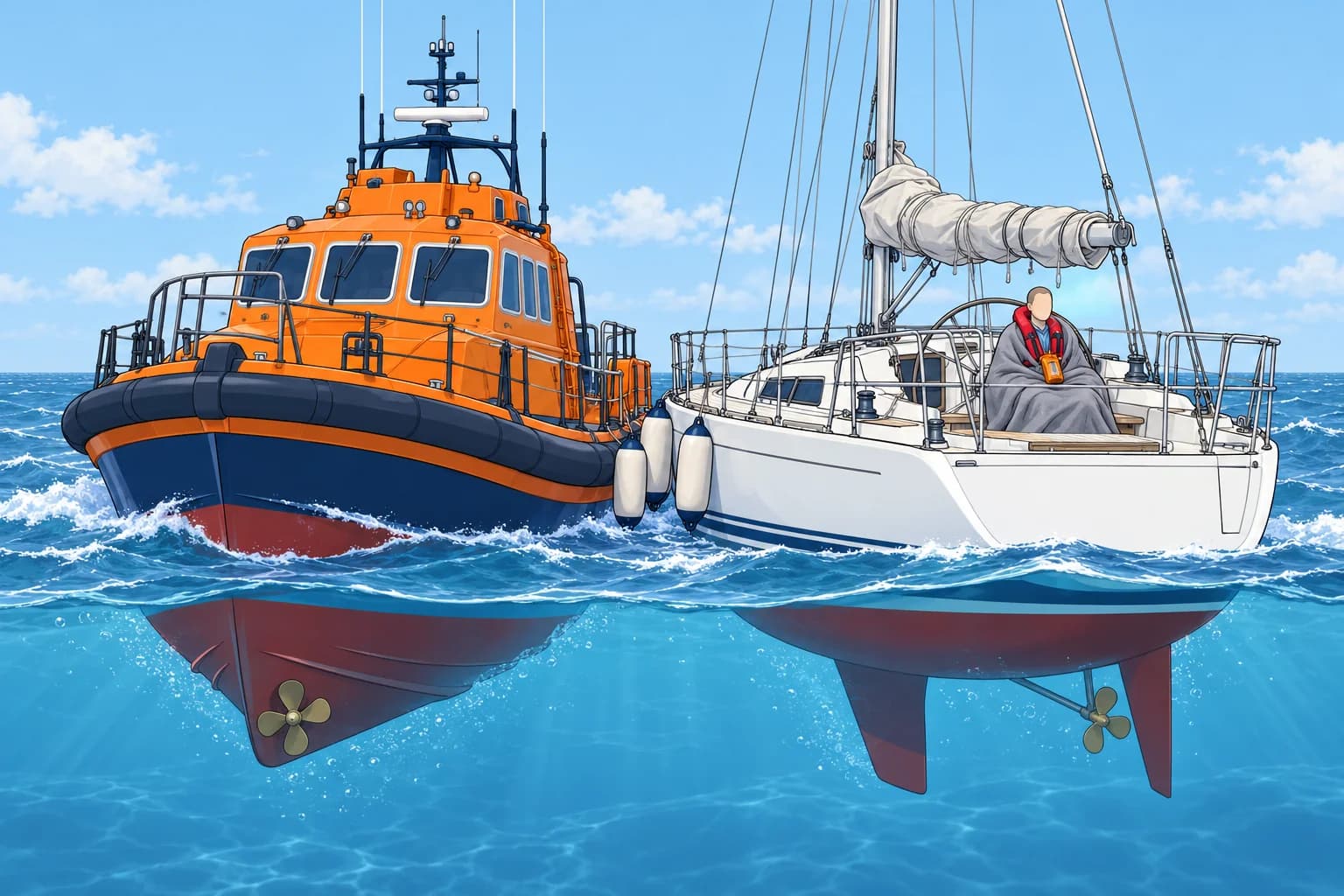
A MEDEVAC (medical evacuation) is decided by the TMAS doctor together with the MRCC. They weigh the patient's condition against the risks and delays of the rescue itself. Options include continuing with advice, diverting to a port, meeting a lifeboat or another vessel, or a helicopter lift. Give them honest facts, including your crew's limits and the weather.
Range and timing
Helicopters have limited range and may need daylight or better weather for some operations. Far offshore the MRCC may ask you to steer towards the coast, or to meet a ship that carries medical help. Tell them your speed and the time to the nearest port. Keep treating the patient as the doctor advises while help comes.
Prepare the patient
Dress the patient warmly and protect them from spray. Put on a lifejacket unless the rescuers say otherwise. Put a written summary in a waterproof bag fixed to the patient: the problem, vital signs with times, medicines given with doses and times, allergies, and their own medicines. Add their passport or identity card.
Prepare the boat
Follow the rescuers’ instructions; see Emergencies: helicopter rescue and pyrotechnics for helicopter preparation. Ask whether a crew member may accompany the patient and how you will receive updates.
Follow-up
Keep the treatment record going until the hand-over: what was given, when, and the latest vital signs. Note the time and method of the evacuation and who took the patient. Afterwards, write up the event in the log, restock the medicine chest and review what you would do differently.
Key figures
- MEDEVAC decision
- TMAS doctor with the MRCC, weighing benefit and risk
- Options
- Advice only, divert, lifeboat, other vessel, helicopter
- Patient bag
- Summary, vital signs, medicines given, allergies, own medicines, ID
- Helicopter prep
- See Emergencies: helicopter rescue and pyrotechnics
- Afterwards
- Complete the log, restock, review
Remember
- The TMAS doctor and MRCC decide on evacuation and the method.
- Tell them your speed, time to port, weather and crew limits honestly.
- Fix a waterproof bag to the patient: summary, vital signs, medicines, ID.
- Prepare the boat for the lifeboat or helicopter as the rescuers ask.
- Keep the treatment record until hand-over; restock and review afterwards.
Common mistakes
Wrong: Insist on a helicopter for every serious illness.
Right: An evacuation has its own risks. The doctor and the MRCC choose the safest option; give them the facts.
Wrong: Send the patient off and tell the rescuers what was given from memory.
Right: Fix a written summary to the patient: medicines, doses, times and vital signs. Memory fails under stress.
Wrong: A crew member always goes with the patient.
Right: The rescuers decide who goes, depending on space and safety. Agree how you will get news.
Worked case
Forty miles offshore, a patient awaiting evacuation is getting worse. Fog delays the helicopter; a port is two hours away. You have given pain relief twice. What do you tell the doctor and MRCC, and what do you prepare?
Show the answer
Report the deterioration, latest timed vital signs, fog and time to port. Ask the doctor and MRCC to reassess the plan. Continue the agreed care. Prepare a waterproof summary with symptoms, vital signs, allergies, regular medicines and both pain-relief doses and times, plus ID. Keep the record until hand-over. Prepare the boat as rescuers direct; see Emergencies: helicopter rescue and pyrotechnics.
Practice question
Who decides whether a crew member is evacuated?
- The skipper alone
- The patient themself
- The doctor and the MRCC
- The nearest marina office
Show the answer
Answer: C. The doctor and the rescue centre weigh the patient's condition against the risks of the evacuation.