
Medical care on board · Level P1 · 6 parts · about 21 min
Body structure, shock, electric shock and moving a casualty (STCW A-VI/1-3)
6 short parts: The body · At the scene · Shock · Electric & burns · Moving casualty · Toxic exposure. Each part explains the idea, then gives the points to remember, the common mistakes, a worked case and a practice question; the Academy unit adds all 36 check questions.
1 · The body
How the body works: a first-aider's map
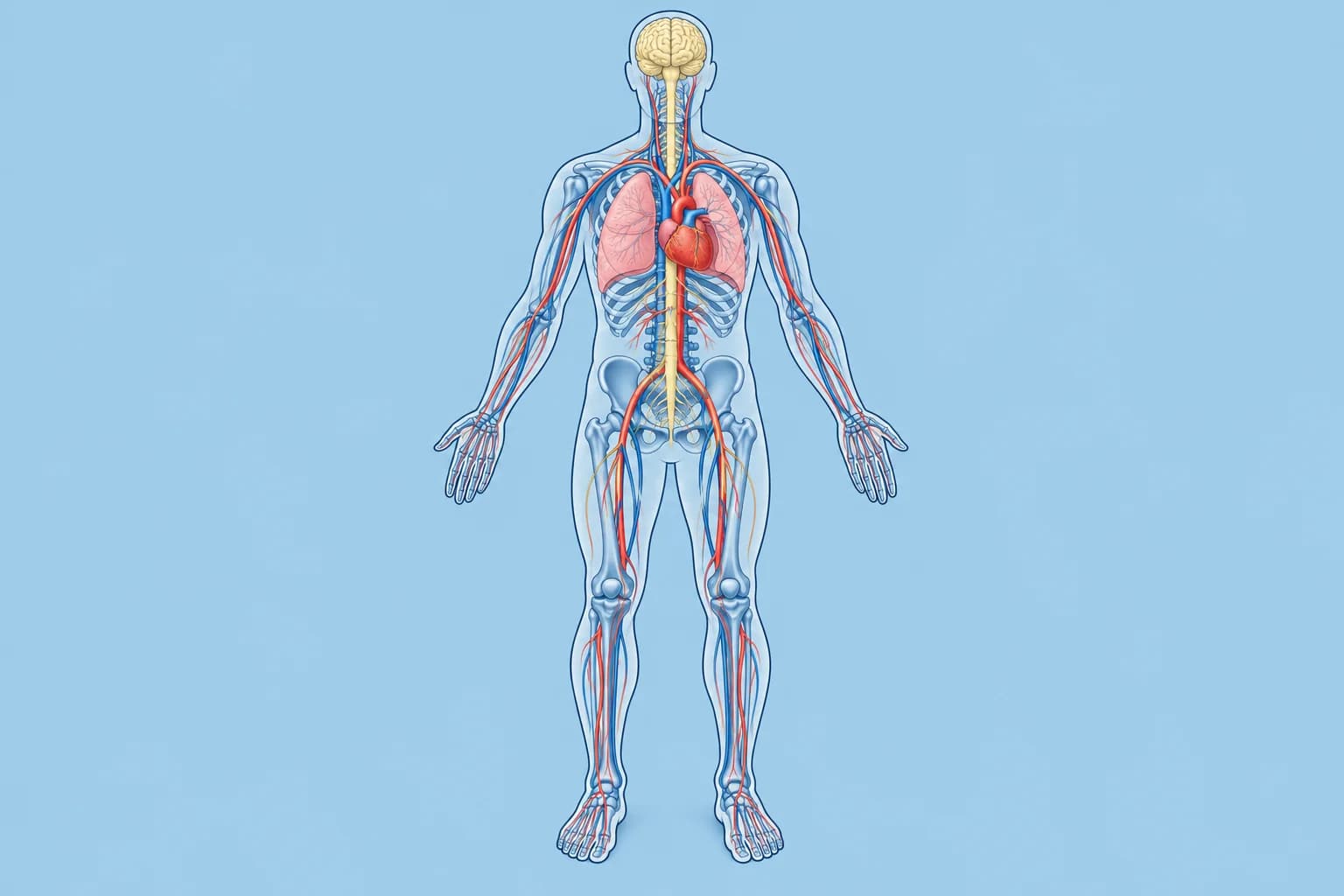
First aid makes sense once you know what the bones, heart, lungs, nerves and skin do, and how fast the body fails without oxygen.
Why it matters
Elementary first aid is about keeping someone alive and stopping things getting worse until better help arrives. To do that you need a simple map of the body: what protects what, how oxygen gets to the brain, and what an injury stops working. This unit adds the ship's side to the first-aid, injuries and cold-weather lessons. The practical skills, such as CPR on a manikin and stretcher lifts, are done in your approved course.
Skeleton and muscles
The skeleton holds the body up and protects the organs. The skull protects the brain; the spine, a column of bones called vertebrae, protects the spinal cord; the ribcage protects the heart and lungs; the pelvis supports the lower body. Bones meet at joints, held by ligaments, strong bands of tissue. Muscles pull on bones through tendons, tough cords of tissue. A broken thigh bone or pelvis can bleed heavily inside, without anything showing.
Heart and circulation
The heart is a muscular pump behind the breastbone. At rest, an adult heart beats about 60–100 times a minute. Arteries carry blood away from the heart; veins return it. A limb artery may bleed in bright-red spurts; venous bleeding is usually darker and steadier. Either can be life-threatening. An adult has about 5 litres of blood; rapid loss can cause shock.
Lungs and breathing
Air passes through the nose and mouth, down the windpipe into the lungs. There, oxygen passes into the blood and carbon dioxide passes out. The diaphragm, a sheet of muscle under the lungs, does most of the work. An adult at rest breathes about 12–20 times a minute. If the brain gets no oxygen, damage starts within a few minutes.
Nervous system and skin
The nervous system carries messages and controls the body. The brain controls consciousness, breathing and the heartbeat; the spinal cord carries messages between brain and body through the nerves. Damage to the spinal cord can cause loss of feeling or movement below the injury. The skin is the body’s largest organ: it keeps germs out, limits fluid loss and helps control temperature. Burns damage that barrier, so the casualty loses fluid and heat and can get infected.
Key figures
- Adult heart rate at rest
- About 60–100 beats a minute
- Adult breathing at rest
- About 12–20 breaths a minute
- Adult blood volume
- About 5 litres
- No oxygen to the brain
- Damage begins within a few minutes
- STCW basis
- Regulation VI/1; Code table A-VI/1-3, elementary first aid
Remember
- Skull: brain. Spine: spinal cord. Ribs: heart and lungs. Pelvis: support for the lower body.
- Arteries carry blood away from the heart; veins return it. Either can bleed dangerously.
- An adult has about 5 litres of blood; fast loss leads to shock.
- Without oxygen, the brain can be damaged within minutes.
- Skin keeps germs out, limits fluid loss and helps control temperature; burns damage that protection.
Common mistakes
Wrong: If there is no blood outside, the bleeding cannot be serious.
Right: A broken thigh bone or pelvis, or an injury to the abdomen, can bleed heavily inside.
Wrong: The heart is on the left side of the chest, so compress there.
Right: It lies in the centre, behind the breastbone. CPR compressions go in the centre of the chest.
Wrong: A burn only damages the skin's surface.
Right: The skin controls fluid, heat and infection. A large burn affects the whole body.
Worked case
A crew member falls about 3 m from a ladder onto the steel deck. He is pale and says his hip hurts badly. There is no blood to be seen. A shipmate says it is just a bruise and he can walk it off.
Show the answer
Do not let him walk. A fall from that height can break the pelvis or thigh bone, which can bleed heavily inside with nothing showing, and a back injury is possible. Raise the alarm and call the bridge. Keep him still and warm, with insulation between him and the cold steel, and watch for signs of shock. Wait for the stretcher team and the person in charge of medical care.
Practice question
What protects the spinal cord?
- The ribs around the chest
- The vertebrae of the spine
- The bones of the pelvis
- The bones of the skull
Show the answer
Answer: B. The spinal cord runs inside the column of vertebrae. The skull protects the brain and the ribcage the heart and lungs.
2 · At the scene
At the scene: safety, alarm and the ship's medical organisation
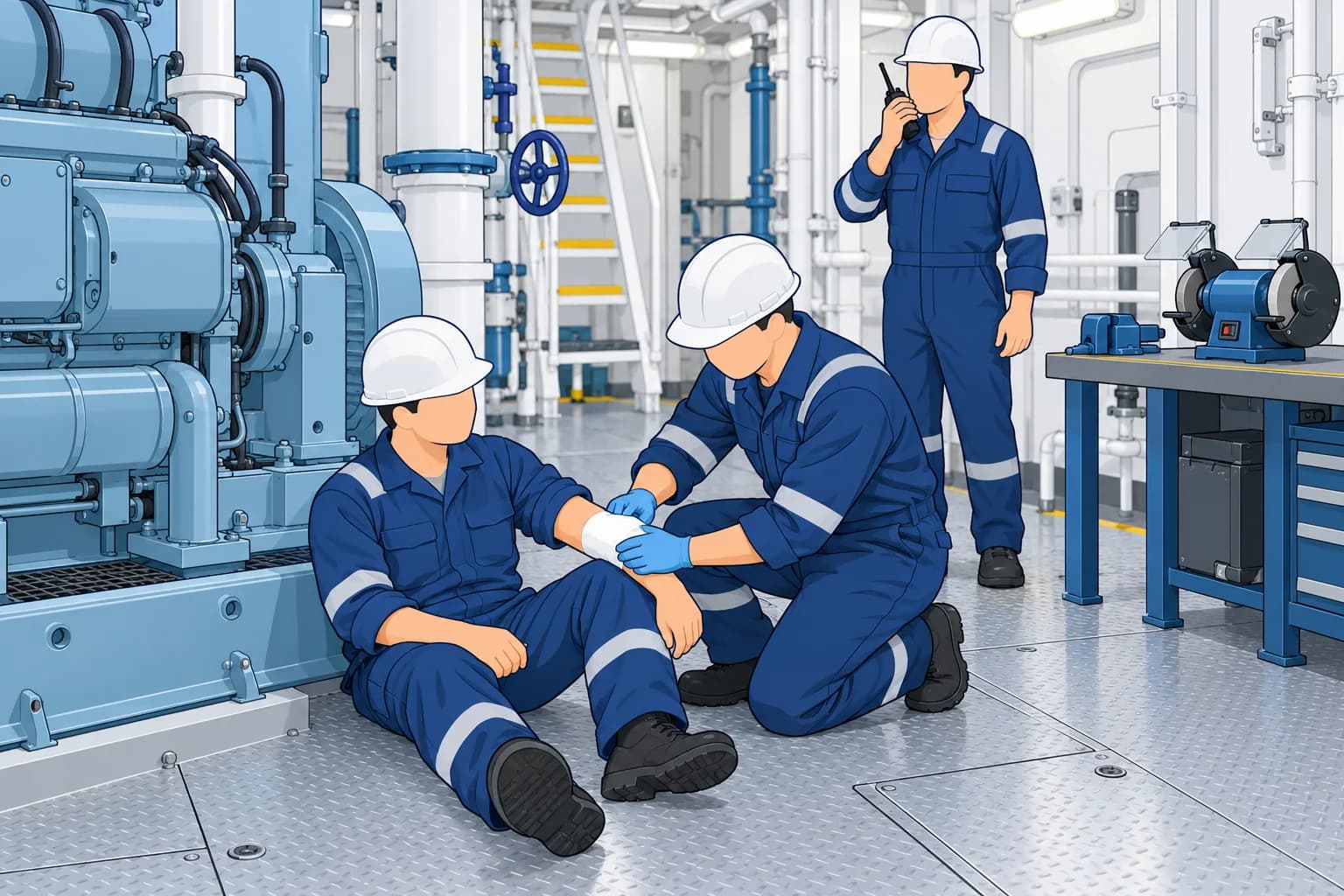
On a ship you are the first responder, and hospital may be days away. Make it safe, raise the alarm, assess, and use the ship's medical organisation.
Make it safe
Do not become the second casualty. On a ship the dangers include running machinery, live electrics, fire and smoke, gas in an enclosed space, moving cargo, work at height and the ship's motion. Stop machinery and isolate power through the person in charge if you can do it safely. Never go into an enclosed space or a smoke-filled room to reach a collapsed person: raise the alarm and wait for a team with breathing apparatus.
Raise the alarm
Call the bridge by phone or radio, or use the nearest alarm. Say where you are, what happened, how many are hurt, their condition and any danger at the scene. The bridge can sound the alarm, send the first-aid or stretcher team named in the muster list, which assigns emergency duties, and call the person in charge of medical care. Stay with the casualty if you can, and send someone to guide the team.
Assess needs
From a safe position, report how many casualties there are, whether they respond, their visible condition and any change. Tell the bridge about remaining hazards, access difficulties, equipment needs and trained help needed. Record times, observations and care for handover. Use First aid and resuscitation for the primary survey.
The ship’s medical organisation
Basic-trained crew learn elementary first aid (STCW A-VI/1-3). A designated medical first-aider holds A-VI/4-1 competence; where required, the person in charge of medical care holds A-VI/4-2 competence. Roles depend on ship and flag requirements, not rank alone. Know who is assigned and how to summon them. Follow your ship’s medical guide and keep records confidential. A ship carrying 100 or more people on international voyages of more than three days must carry a doctor (MLC 2006).
Radio medical advice
The designated seafarer can contact a doctor ashore through the ship’s telemedical service; see Radio medical advice.
Key figures
- Report to the bridge
- Where, what happened, how many, condition, dangers
- Basic-trained crew
- Elementary first aid, STCW A-VI/1-3
- Designated first-aider
- Medical first aid, STCW A-VI/4-1; as assigned on your ship
- Person in charge of medical care
- STCW A-VI/4-2 competence where required; check assigned roles
- Doctor on board (MLC 2006)
- 100 or more people, international voyages over 3 days
Remember
- Make it safe first; never enter an enclosed space or smoke to reach a casualty.
- Report where, what happened, how many, their condition and dangers.
- Tell the bridge about difficult access and any equipment or trained help needed.
- The person in charge of medical care treats, records and calls for advice.
- Use the ship’s medical guide. Record times, observations and care; keep records confidential.
Common mistakes
Wrong: Run straight to a collapsed person in a tank.
Right: Raise the alarm and wait for the breathing-apparatus rescue team. The gas that felled them may fell you.
Wrong: Tell the bridge there is an injury and go back to help.
Right: Give the details: where, what, how many, condition and dangers, so the right team comes.
Wrong: Medical care at sea is the officers' job alone.
Right: You are often first on scene. Your first aid and notes shape everything that follows.
Worked case
In the engine room you find a motorman sitting on the deck beside a grinder, holding his forearm. Blood is running between his fingers and the grinder is still running. Nobody else is near.
Show the answer
Stop the grinder at its switch if you can reach it safely. Press firmly on the wound with a dressing or cloth to control the bleeding. Call the engine control room or bridge: engine room, grinder injury, one casualty, heavy bleeding from the forearm, conscious. Keep pressing, keep him sitting or lying down and warm, and watch for shock. Hand over to the first-aid team and tell them what happened and when.
Practice question
A crew member has collapsed inside a cargo hold. What do you do first?
- Go down quickly to check his breathing
- Raise the alarm and do not enter the hold
- Lower a bottle of water to him on a line
- Shout to him and wait for him to wake
Show the answer
Answer: B. The hold may lack oxygen or contain toxic gas. Raise the alarm; rescue is for a team with breathing apparatus.
3 · Shock
Shock: types, signs and first aid
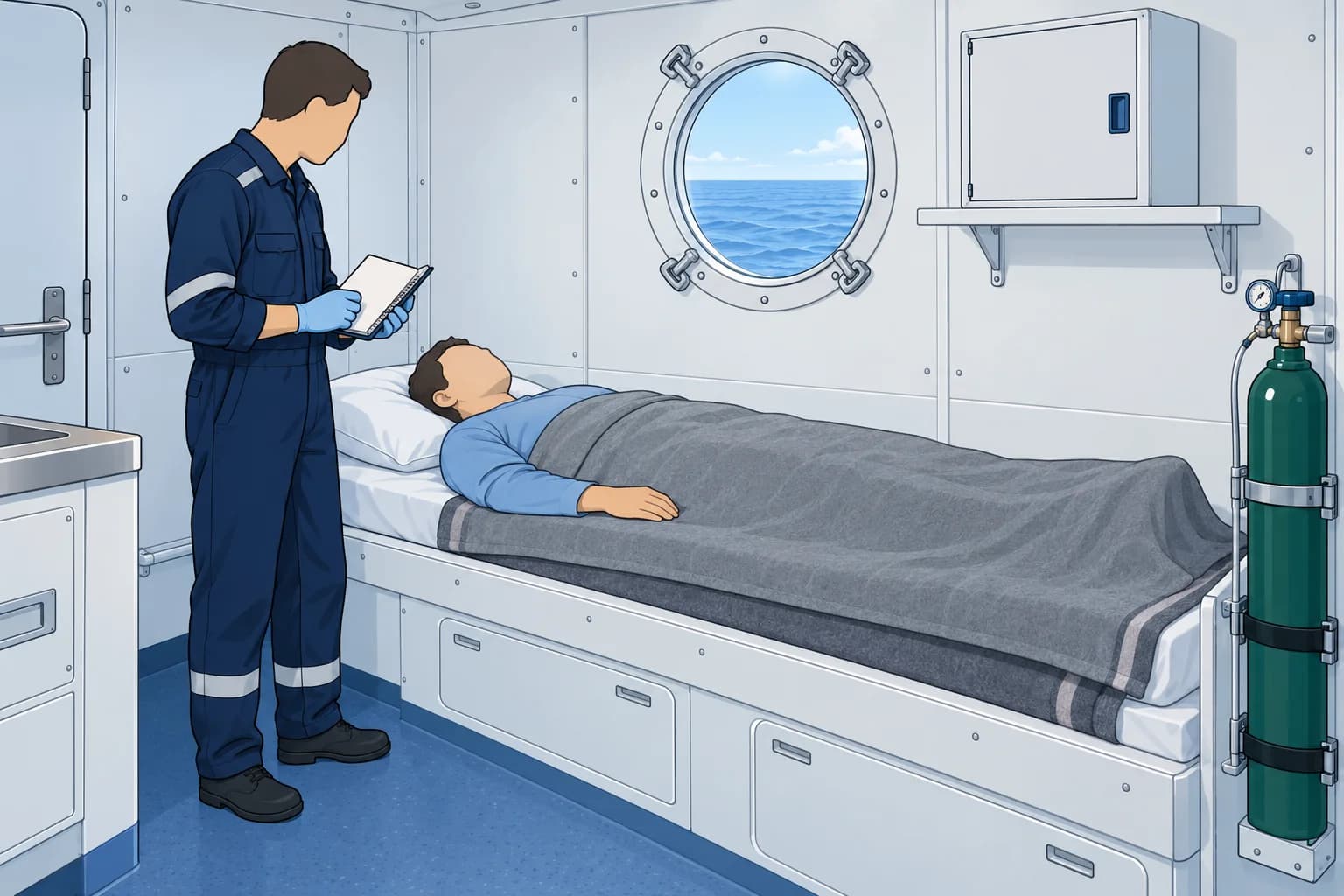
Shock means the organs lack blood flow. If responsive, lay the casualty flat unless breathless; keep them warm, monitor and get urgent help.
What shock is
In first aid, shock is not fright. It means the circulation cannot deliver enough oxygen-rich blood to the organs. Without help the brain, heart and kidneys fail, and the casualty can die. Shock can develop within seconds or worsen over hours. Watch for it after any serious injury or illness.
Types of shock
Shock has several causes. Loss of blood or fluid: heavy bleeding outside or inside, large burns, severe vomiting or diarrhoea. The heart failing as a pump, for example in a heart attack. Blood vessels widening so the blood pressure falls: a severe allergic reaction (anaphylaxis), severe infection (sepsis) or a spinal cord injury. A blockage of circulation, such as pressure building inside the chest after an injury and preventing the heart filling properly. Recognise shock and get urgent help.
Signs
Signs vary with the cause. Look for a fast pulse, rapid breathing, anxiety, thirst or nausea. Skin is often pale, cold and clammy. Severe infection, anaphylaxis or spinal injury may instead cause warm skin; spinal injury may slow the pulse. Worsening shock may cause a weak pulse, confusion, drowsiness and unconsciousness. Becoming quieter is not necessarily improvement. Anaphylaxis may also cause an itchy rash, face or throat swelling, wheezing and breathing difficulty.
First aid
Control bleeding first. If responsive, lay the casualty flat on their back; raising the legs is not routine. If breathing is difficult, let them sit with legs extended. Never let someone with suspected anaphylaxis stand or walk. Keep them warm, including insulation underneath, and give no food or drink. Monitor breathing and response, record changes and get urgent medical advice through the officer. If unresponsive, follow First aid and resuscitation.
Anaphylaxis
Help the casualty use their adrenaline auto-injector in the outer thigh, following its label, and call urgent help; see Medicine chest.
Key figures
- Shock
- Circulation fails to supply the organs with oxygen
- Main causes
- Blood/fluid loss, heart failure, wide vessels, blockage
- Common signs
- Fast pulse and breathing; skin often pale, cold and clammy
- Position (ERC 2025)
- If responsive: flat on the back; leg raising not routine
- Food and drink
- None; moisten the lips only
- Anaphylaxis
- Adrenaline auto-injector into the outer thigh
Remember
- Shock means the organs are short of oxygen-rich blood; it can kill.
- Causes: blood or fluid loss, heart failure, wide vessels, blocked circulation.
- Signs: fast pulse and breathing, confusion; skin often pale, cold and clammy.
- Control bleeding; if responsive, lay flat unless breathless; keep warm, nothing by mouth, monitor and get help.
- Anaphylaxis: help with their auto-injector and call urgent help.
Common mistakes
Wrong: Shock is the fright people feel after an accident.
Right: In first aid, shock means the circulation is failing. It is life-threatening.
Wrong: Give a cup of sweet tea to settle the casualty.
Right: Nothing to eat or drink: they may need surgery, and may vomit. Moisten the lips.
Wrong: A casualty who has gone quiet is recovering.
Right: Drowsiness and confusion can mean worsening shock. Keep checking and report it.
Worked case
After a crush injury to his leg, a deckhand is lying on the steel deck. Ten minutes later he is pale, sweating, breathing fast and asking for water. His pulse is fast and weak.
Show the answer
These are signs of shock, probably from bleeding inside the leg. Report to the bridge so the person in charge of medical care comes and radio medical advice is sought. Keep him lying flat on his back and put a blanket under and over him. Give no water; moisten his lips. Support the injured leg as found. Talk to him, check his breathing and response every few minutes and note the times.
Practice question
What does shock mean in first aid?
- The fright a person feels after a serious accident
- A failure of the circulation to supply the organs
- A sudden electric current passing through the body
- A brief faint that always passes without any help
Show the answer
Answer: B. Shock is a life-threatening failure of the circulation. Fright and fainting are different things.
4 · Electric & burns
Electric shock and burns at ship scale
Ships may have 440 V supplies, high voltage, steam and chemicals. Isolate first, cool heat burns for 20 minutes and flush chemicals for a long time.
Electric shock
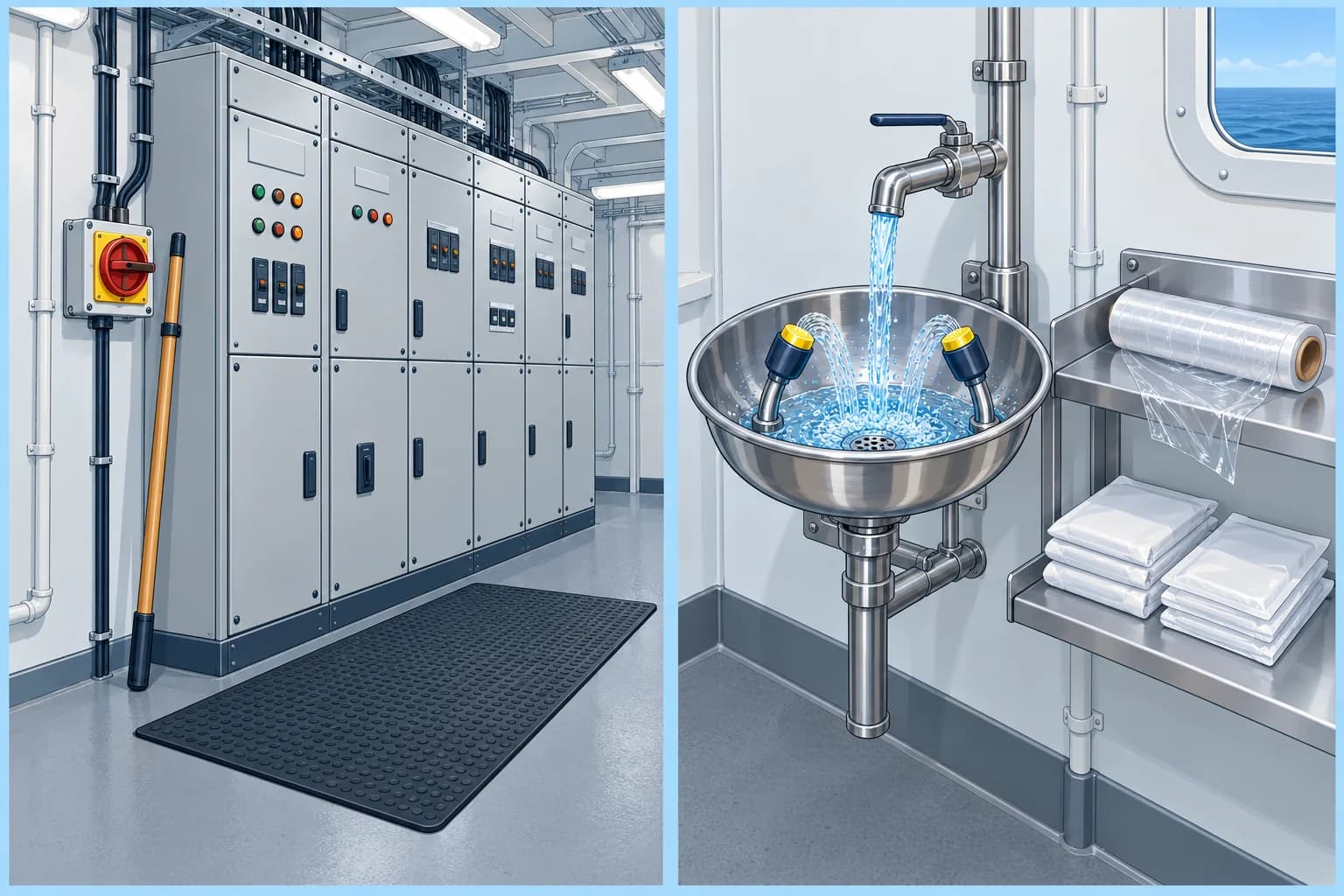
Current through the body can stop the heart or breathing, cause deep burns and throw someone off a ladder. A 440 V shipboard supply is classed as low voltage but can kill; wet steel decks conduct well. Do not touch the casualty or live equipment. Raise the alarm and keep others clear. For low voltage, operate a readily accessible switch only if safe, or call the engineer. If you cannot isolate safely, keep clear and call the engineer.
High voltage
High voltage can arc across a gap and kill a rescuer who only comes close. Do not approach. Stay outside the high-voltage switchboard room or enclosure until an authorised engineer confirms it is safe.
After an electric shock
Once the current is off, check response and breathing. If the casualty is unresponsive and not breathing normally, start CPR and use the AED (see First aid and resuscitation). Even if they seem well, report it and get radio medical advice: the heart rhythm can be disturbed later and the burns are often deeper than they look. Cover entry and exit burns with clean dressings. Stay with them and keep checking response and breathing until help takes over.
Heat burns and steam
On ships, burns come from steam leaks, hot oil, exhausts, galley equipment and fires. High-pressure steam may be invisible near the leak and can cut and scald deeply: never put your hand out to find it. Cool the burn with cool running water for 20 minutes as soon as possible. Remove rings and loose clothing but leave anything stuck. Lay cling film over the burn, never around a limb or over the face. Keep the casualty warm.
Chemical burns
Battery acid, caustic soda and other shipboard chemicals burn skin and eyes. Use suitable gloves and goggles. A safety data sheet (SDS) gives product-specific precautions. For skin, gently brush dry powder off skin only and remove soaked clothing, following SDS precautions. Flush with running water for at least 20 minutes, longer if directed. Start eye flushing immediately; never brush or rub an eye. Hold the lids open and rinse from the inner corner outward. Never neutralise a chemical with another.
Key figures
- Low voltage
- Use an accessible switch only if safe, or call the engineer
- High voltage
- Keep away until an authorised engineer confirms safety
- Heat burns
- Cool running water for 20 min, as soon as possible
- Chemical burns
- Flush at least 20 min; longer if the SDS says
- Stuck clothing
- Leave it; cut around it
Electric shock: the first steps
- Do not touch the casualty while they may be in contact with the current. — The current can pass into you.
- Operate an accessible low-voltage switch only if safe; otherwise keep clear and call the engineer. — Removing the current is the only safe way to free them.
- For high voltage, keep away until an authorised engineer says it is safe. — High voltage can arc across a gap.
- Once safe, follow First aid and resuscitation if unresponsive or not breathing normally. — Electric shock can stop the heart.
- Cover burns, keep them warm, monitor response and breathing, and get radio medical advice. — Internal damage and heart problems can appear later.
Remember
- Never touch someone in contact with electricity: isolate first.
- High voltage: stay away until an authorised engineer says it is safe.
- After any electric shock: follow resuscitation guidance if needed, monitor and get medical advice.
- Heat burns: cool 20 min, leave stuck clothing, keep warm; film laid over, never wrapped; not on the face.
- Chemical burns: protect yourself, then flush for at least 20 minutes.
Common mistakes
Wrong: Pull the casualty off the cable with your hands.
Right: Do not touch the casualty or cable. Isolate the supply from a safe position; if the voltage or conditions are uncertain, keep clear and call the engineer.
Wrong: A casualty who walks away from an electric shock is fine.
Right: Heart rhythm problems and deep burns can appear later. Report it and get medical advice.
Wrong: Peel off a melted boiler suit to see the burn.
Right: Leave anything stuck to the skin. Cool the burn and cut clothing around it.
Worked case
An engine-room crew member tops up a battery bank and acid splashes into his eye and onto his forearm. He is shouting in pain and rubbing his eye. The eyewash station is 5 m away.
Show the answer
Put on gloves, then lead him straight to the eyewash station. Hold his eyelid open and flush the eye from the inner corner outward, keeping the good eye above the injured one. Remove soaked clothing from his arm and flush it under running water too. Keep flushing for at least 20 minutes, and longer if the SDS says so. Call the bridge so the person in charge of medical care can get radio medical advice.
Practice question
A crew member is still holding a live cable. What do you do first?
- Pull him away by gripping his dry boiler suit
- Throw a bucket of water over him and the cable
- Safely isolate the supply or call the engineer
- Start CPR immediately while he holds the cable
Show the answer
Answer: C. Touching or wetting someone in contact with electricity can pass current to you. Isolate only from a safe position; otherwise keep clear and call the engineer.
5 · Moving casualty
Moving a casualty: stretchers and lifts on a ship
Steep ladders, hatches and engine rooms make moving a casualty hard. Move only when you must, with the right stretcher and enough people.
When to move
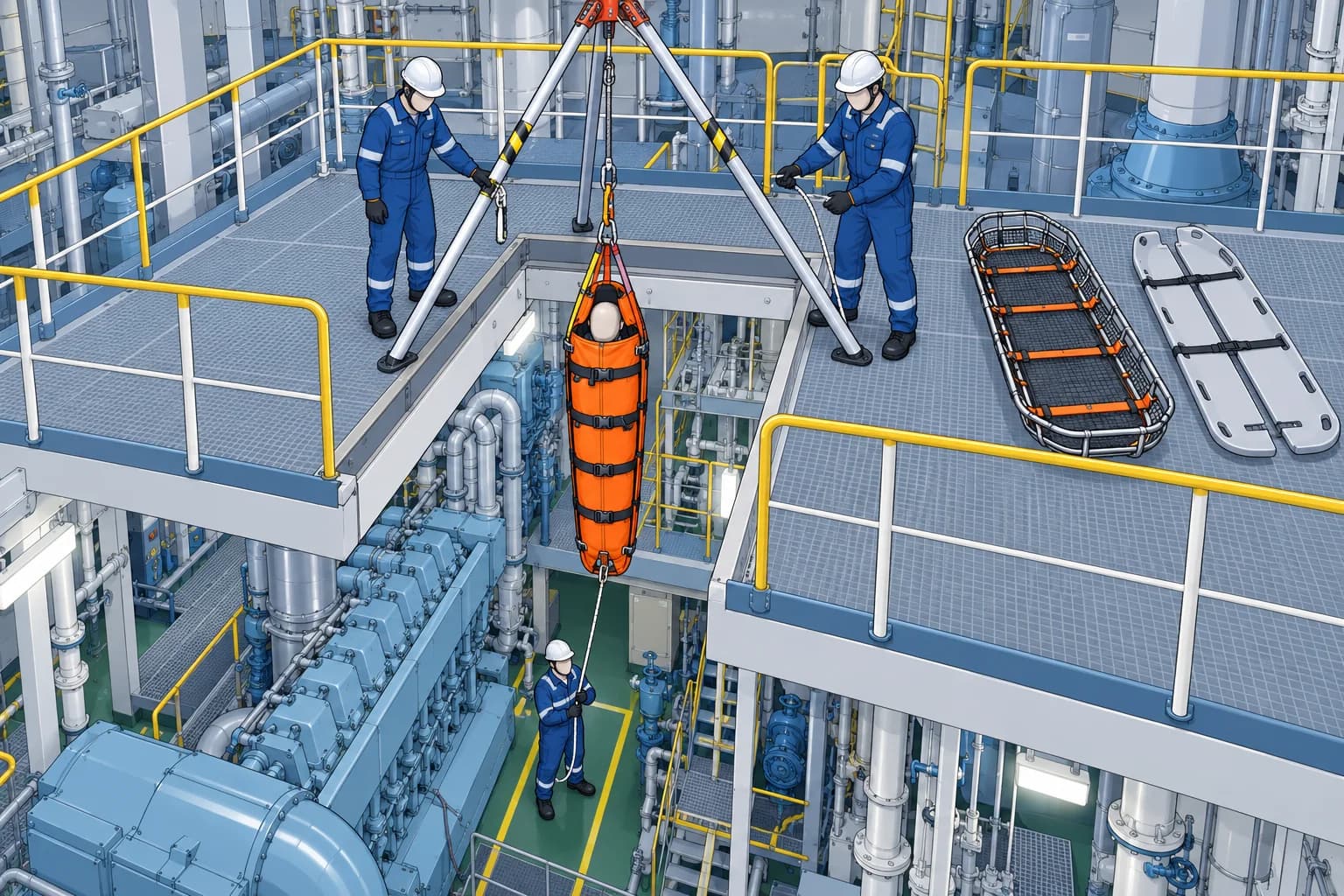
Treat a casualty where they are unless the place is dangerous, such as fire, smoke, gas, flooding or machinery, or unless you cannot treat them there. Moving can make injuries worse, especially to the spine. Move only as far as necessary to escape danger or make essential care possible. Otherwise wait for the stretcher team named in the muster list.
Emergency moves
For a quick move out of danger, drag the casualty along the deck by the clothing at the shoulders, supporting the head between your forearms, or on a blanket. Never lift a heavy casualty alone. Two trained people can use a hand-seat carry, making a seat with their hands, for a cooperative casualty without suspected serious injury. Lift with your legs and a straight back, and agree the command before you lift.
Ship’s stretchers
The Neil Robertson stretcher is canvas stiffened with wooden or bamboo slats. It wraps around the casualty for vertical lifts through narrow openings, when approved for their condition and the planned lift. The Stokes basket is a rigid wire or plastic basket for carrying and approved lifts. A scoop stretcher separates so a trained team can position its halves under the casualty with little movement. Never assume it is approved for hoisting. Know where your ship keeps its stretchers.
Carrying on board
Plan and clear the route, and strap the casualty in as the stretcher instructions require. Use enough trained bearers for the equipment and route, with one leader giving commands. On suitable stairs, carry head first going up; on the level, feet first. Keep the casualty supported and monitor them. For steep ladders or vertical openings, use the ship’s approved rescue-lifting arrangement rather than trying to carry a loaded stretcher up the ladder.
Vertical lifts
A trained rescue team chooses a stretcher suitable for the casualty’s condition and the planned lift. Use the ship’s approved casualty-lifting equipment, rigged by trained personnel, following its instructions and specified lifting points. A guide line at the foot steadies the stretcher; its operator stays outside the fall path. If the space may be unsafe, only the trained team with breathing apparatus enters. Entry rules are in Law: personal safety and Ropes: deck work safely.
Key figures
- Move only if
- Danger at the scene, or treatment impossible there
- Neil Robertson
- Wraps casualty; vertical lifts when suitable and approved
- Stokes basket
- Rigid basket; carrying and approved lifts
- Scoop stretcher
- Splits into two halves to reduce movement during transfer
- Direction
- Feet first on level; head first up suitable stairs
- Vertical lift
- Approved equipment; secured casualty; guide operator outside fall path
Remember
- Treat in place unless there is danger or essential care cannot be given there.
- Emergency drag by the shoulders, head supported between your forearms.
- Neil Robertson: vertical rescue; Stokes: basket; scoop: transfer. Check suitability and approval for each lift.
- Plan the route, enough bearers, one person in command, casualty strapped in.
- Vertical lifts: trained team, approved equipment, secured casualty; guide-line operator outside the fall path.
Common mistakes
Wrong: Always move a casualty to the ship's hospital at once.
Right: Treat in place unless there is danger or essential care cannot be given there.
Wrong: One strong person can carry a casualty up an engine-room ladder.
Right: Steep ladders need the trained rescue team and an approved lifting arrangement, not a manual carry up the ladder.
Wrong: A Stokes basket is best for lifting through a small tank opening.
Right: The team must choose a stretcher suitable for the casualty, the opening and the planned lift, following its instructions.
Worked case
A fitter has fallen in the lower engine room and hurt his back. He is conscious, the space is safe, and the only way out is two steep ladders and a narrow passage to the upper deck.
Show the answer
Keep him still and warm, report to the bridge and wait for the trained team and medical lead. They assess the injury and choose a safe route and an approved rescue stretcher and lifting system. A scoop may help transfer him; it is not automatically suitable for hoisting. Clear the route. Use trained operators, one leader and a guide line controlled from outside the fall path.
Practice question
When should you move a casualty before the stretcher team arrives?
- Always, to give them a quiet rest in their own cabin
- If staying is dangerous or essential care is impossible
- Whenever they ask to be somewhere more comfortable
- As soon as you have written down all their injuries
Show the answer
Answer: B. Treat in place where possible. Move only as far as necessary to escape danger or make essential care possible.
6 · Toxic exposure
Toxic gases and chemicals: the first steps
Shipboard gases can kill crew and rescuers. Keep clear of exposure, raise the alarm and use chemical safety information and the officer’s medical guide.
Do not become a casualty
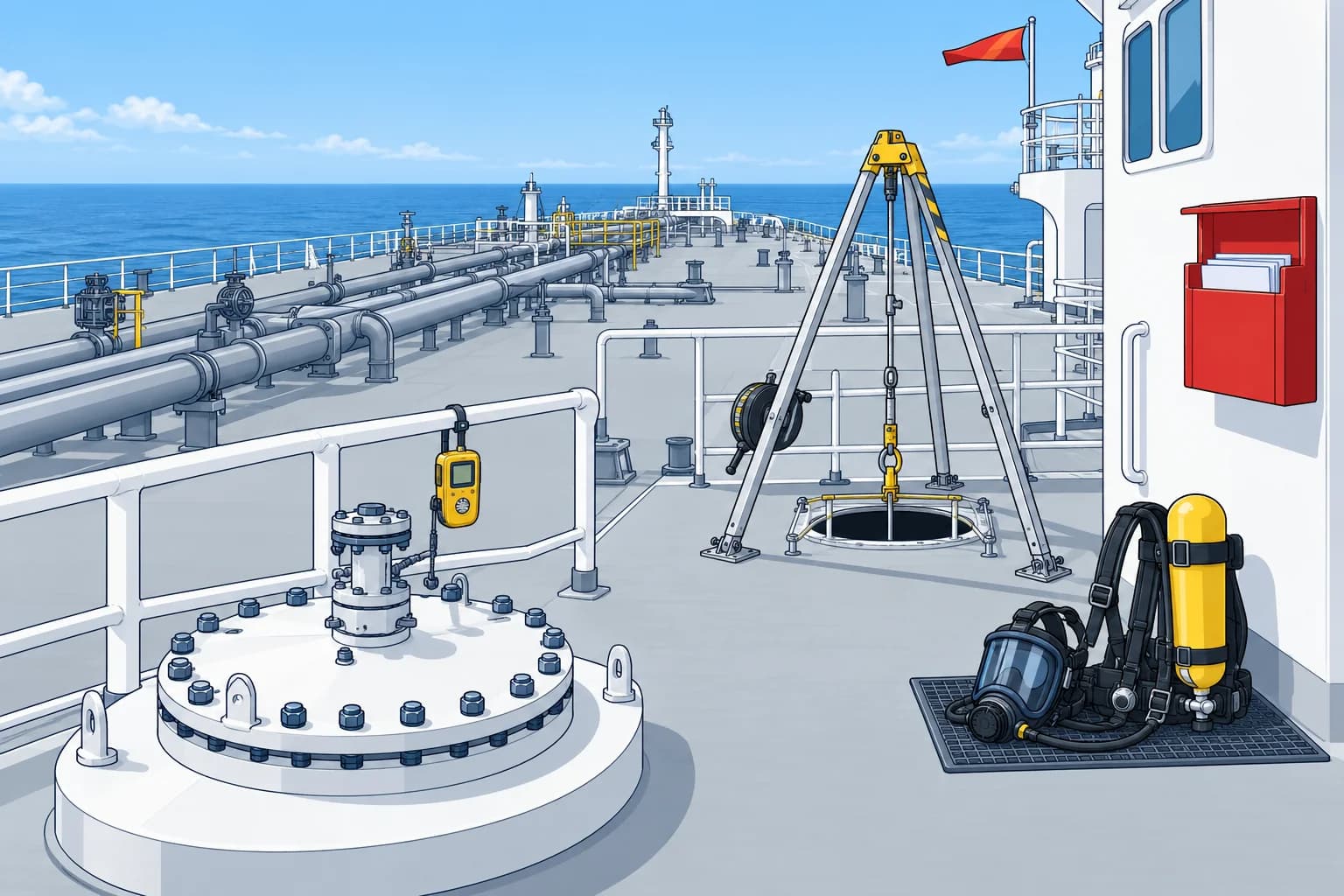
Toxic gases and missing oxygen give little or no warning, and many deaths on ships are of people who went in to help. If someone collapses in a tank, hold, pump room or store, raise the alarm and do not enter. A rescue team in breathing apparatus brings them out. For a chemical spill, keep upwind and use the protective equipment the safety data sheet lists.
Hydrogen sulphide
Hydrogen sulphide (H₂S) comes from oil containing sulphur compounds, sewage tanks, bilges and rotting cargo such as fish. It may smell of rotten eggs at low levels, but high levels deaden your sense of smell. High concentrations can cause sudden collapse and death. Effects depend on concentration and exposure time. Never trust your nose to decide whether an area is safe.
Carbon monoxide and missing oxygen
Carbon monoxide (CO) comes from fire smoke, engine and boiler exhausts, and some cargoes such as coal and wood pellets. It has no smell; it causes headache, dizziness, nausea and confusion, then collapse. Oxygen deficiency happens in closed spaces where steel rusts, cargoes such as logs, grain or fruit use oxygen, or inert gas or nitrogen has been used. Collapse can come without warning. First aid: fresh air, oxygen if trained, CPR if needed.
Skin and eyes
Protect yourself with gloves and eye protection specified by the safety data sheet. For skin, gently brush dry powder off skin only and remove contaminated clothing, following chemical-specific SDS precautions. Start eye flushing immediately; never brush or rub an eye. Hold the lids open and rinse from the inner corner outward. Flush skin or eyes with running water for at least 20 minutes, longer if directed. Get urgent medical advice; provide the chemical’s label or safety data sheet for handover.
The SDS and the MFAG
A safety data sheet (SDS) comes with every hazardous chemical on board: its dangers, first aid and the protection to wear. Oil cargoes and fuel oils have one too (SOLAS VI/5-1). The MFAG, IMO's Medical First Aid Guide for Use in Accidents Involving Dangerous Goods, is the officer's tool: it gives treatment tables for chemical exposures and is used with radio medical advice. Know where the SDS file is kept.
Key figures
- H₂S danger
- High levels can cause sudden collapse; smell is unreliable
- Carbon monoxide
- No smell; headache, dizziness, confusion, collapse
- Chemical on skin or eyes
- Flush at least 20 min, longer if the SDS directs
- SDS
- Hazards, first aid and protection for each chemical
- MFAG
- IMO guide for dangerous-goods exposures; officer's tool
Remember
- Raise the alarm and keep clear of exposure; rescue is for the trained team with breathing apparatus.
- H₂S: smell is unreliable; high concentrations can cause sudden collapse.
- CO has no smell; headache, dizziness or confusion may occur. Oxygen deficiency can cause collapse without warning.
- Follow SDS precautions; remove soaked clothing, brush powder off skin only. Flush eyes at once; irrigate for at least 20 min.
- Bring the label or SDS to the person in charge of medical care; MFAG supports their decisions.
Common mistakes
Wrong: If the rotten-egg smell has gone, the H₂S has cleared.
Right: High levels deaden your sense of smell. A fading smell does not mean the area is safe; keep clear and raise the alarm.
Wrong: Hold your breath and dash in to pull the casualty out.
Right: You may collapse before you can help. Raise the alarm and wait for the trained rescue team with breathing apparatus.
Wrong: Remove chemical-soaked clothing with your bare hands.
Right: Protect yourself with the gloves and eye protection specified by the SDS before handling contaminated clothing.
Worked case
Your ship carries oil that can release H₂S. A shipmate staggers beside an open cargo sampling point. You noticed a rotten-egg smell earlier, but now you smell nothing.
Show the answer
Suspect H₂S. Raise the alarm and move upwind away from the opening. From a safe position, tell him to move upwind if he can. Do not approach the gas plume; a trained rescue team with breathing apparatus must recover him if he cannot escape. Once he is safely in fresh air, check response and breathing. Give oxygen only if trained; start CPR if unresponsive and not breathing normally. Get urgent medical advice.
Practice question
Why is the smell of H₂S an unsafe warning?
- Because H₂S has no smell at any concentration
- Because it only smells when it mixes with oil
- Because high levels deaden your sense of smell
- Because its smell remains after all gas has gone
Show the answer
Answer: C. High levels of H₂S can deaden your sense of smell. Losing the smell does not show that the danger has gone.