
Medical care on board · Level P4 · 6 parts · about 21 min
Medical care on board: treatment, nursing and death at sea (STCW A-VI/4-2)
6 short parts: Nursing · Giving medicines · Infection control · Port health · Death at sea · Master’s duties. Each part explains the idea, then gives the points to remember, the common mistakes, a worked case and a practice question; the Academy unit adds all 39 check questions.
1 · Nursing
Nursing the sick and injured on board
A patient may stay in your care for days. Good nursing, careful charts and simple comfort prevent complications and give the radio doctor reliable facts.
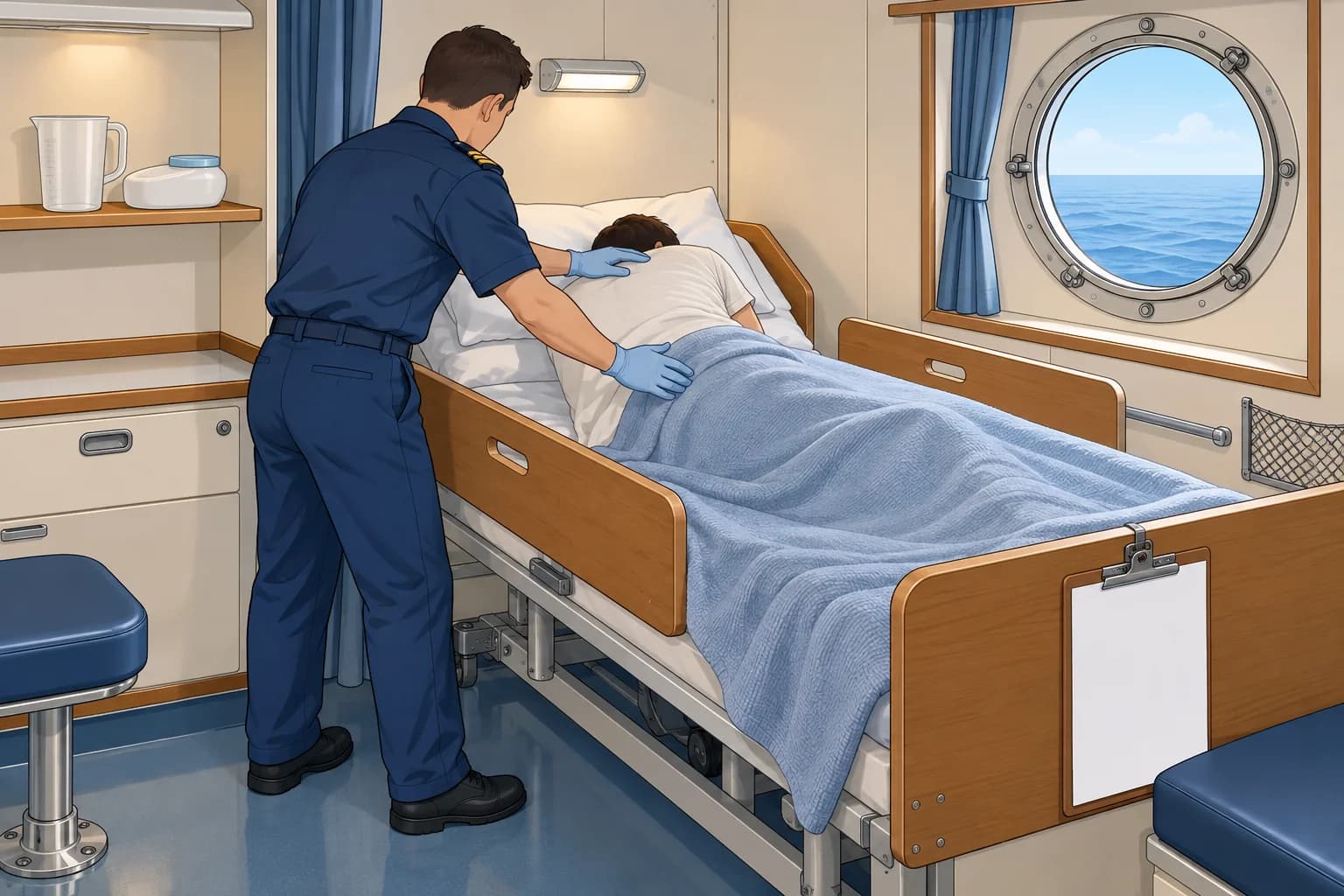
The ship’s hospital
Ships carrying 15 or more seafarers on voyages over three days must have separate hospital accommodation under the Maritime Labour Convention (MLC), Standard A3.1. The competent authority may relax this requirement for coastal trade. Keep it clean, ready and never used as a store. Nurse a patient there, or in a cabin, with a call bell or regular checks, good light and fresh air, a bowl and urine bottle, and a way to keep them safely in the bunk in bad weather.
Observation charts
An observation chart records pulse, breathing, blood pressure, oxygen saturation, temperature, consciousness and pain, each with the time. The radio doctor sets how often: every 15 minutes for a seriously ill patient, perhaps every 4 hours for a stable one. Note new symptoms, vomiting, bowel movements and medicines on the same sheet. Trends, such as a pulse rising over several readings, warn you early.
Fluid balance
A fluid balance chart records measured intake and urine, vomit and diarrhoea in millilitres, with 24-hour totals. Record unmeasured losses separately. Adult urine output below about 0.5 ml/kg/h is a warning. Dehydration is one possible cause; poor circulation, kidney injury or retention can also reduce output. Retention means urine cannot leave the bladder. Report low output, colour changes and trends promptly. Give fluids only as advised: low urine output alone does not tell you how much fluid is safe.
Pressure care and moving
A patient who lies still can develop pressure sores: skin that breaks down under constant pressure over bony points such as the base of the spine, hips, heels, shoulders and elbows. Help them change position at least every 2 hours, keep the sheets dry and smooth, and check the skin daily. Encourage leg movements and deep breathing to prevent blood clots and chest infection. Raise the head end for breathlessness.
Hygiene and dignity
Wash your hands before and after every contact. Give a daily bed bath, mouth care and help with the toilet, in privacy. Offer light food and drinks as the doctor allows. Explain what you are doing and keep the patient informed. Keep medical information confidential: tell other crew only what they need to know for safety and work.
Key figures
- Hospital accommodation
- 15+ seafarers, >3 days; coastal relaxation may apply (MLC A3.1)
- Observations
- As the doctor asks: e.g. 15-minutely if serious, 4-hourly if stable
- Fluid balance
- Measured intake and output in ml; note unmeasured losses separately
- Urine output
- Below about 0.5 ml/kg/h in an adult: report promptly
- Pressure care
- Change position at least every 2 hours; check skin daily
Remember
- Keep the ship’s hospital clean, equipped and ready; it is not a store.
- Chart observations with the time, as often as the doctor asks.
- Chart measured intake and output in millilitres over 24 hours; note unmeasured losses separately.
- Turn a bedbound patient at least every 2 hours and check the skin daily.
- Hand hygiene before and after every contact; protect privacy and confidentiality.
Common mistakes
Wrong: Estimate how much the patient drank.
Right: Measure drinks in millilitres with a jug. Clearly mark any estimates and note losses you could not measure.
Wrong: Let a weak patient lie without moving for days.
Right: Turn them at least every 2 hours and encourage leg movement to prevent sores, clots and chest infection.
Wrong: Jot observations on scraps and copy them later.
Right: Write each set straight onto the chart with the time, so the trend is clear.
Worked case
A cadet with vomiting and diarrhoea has been in the hospital for 24 hours. The chart shows 1,800 ml in by mouth and 2,900 ml out, including only 300 ml of dark urine in the last 12 hours. He weighs 65 kg. What does this tell you and what do you do?
Show the answer
The recorded balance is minus 1,100 ml; it is not an exact measure of total dehydration. Urine output averages 25 ml/hour over the last 12 hours, below 32.5 ml/hour for 65 kg. Report both figures and the trend promptly to the radio doctor. Keep measuring intake and output, chart timed observations and follow the agreed monitoring and fluid plan. Record any losses you could not measure.
Practice question
Unless a permitted coastal-trade relaxation applies, which ships must have separate hospital accommodation under MLC 2006?
- Any ship that carries a doctor on board
- 15 or more seafarers, voyages over 3 days
- Passenger ships only, whatever their crew
- Ships over 500 GT, whatever the voyage length
Show the answer
Answer: B. MLC Standard A3.1 requires separate hospital accommodation for 15 or more seafarers on voyages over three days. The competent authority may relax this requirement for coastal trade.
2 · Giving medicines
Giving medicines safely: routes, injections and the controlled drugs register
Give prescription medicines only on radio medical advice. Check the five rights, use the agreed route and record each dose. Lock and account for controlled drugs.
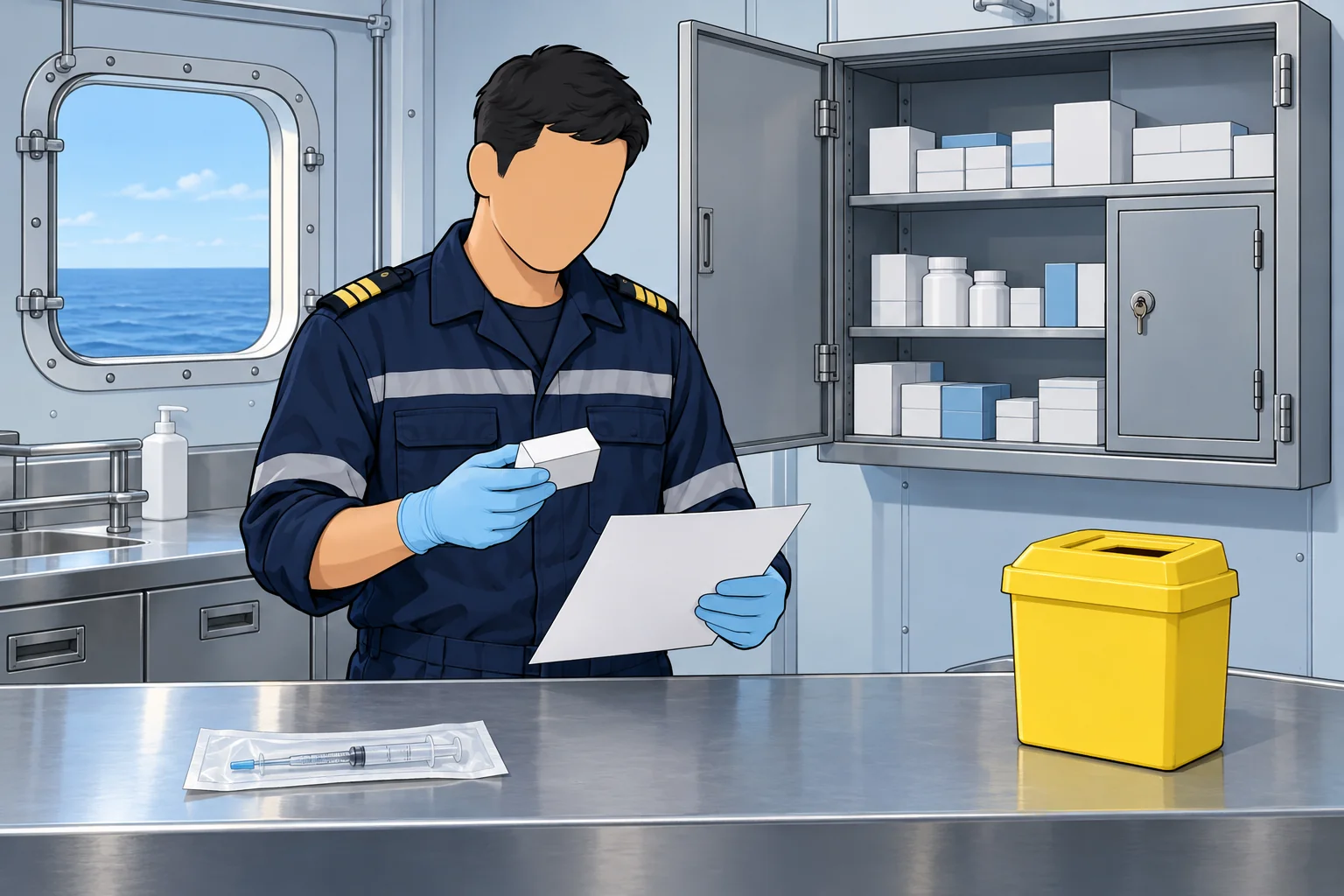
On radio medical advice
Prescription medicines from the ship’s chest are given only on radio medical advice: the doctor chooses the medicine, dose, route and timing from your medicine list. The ship’s guide explains how each medicine works, its side effects and how to give it; it is not a licence to prescribe. Before every dose, ask about allergies and other medicines, and about pregnancy where relevant.
The five rights
Check the five rights before every dose: the right patient, the right medicine (generic name and strength), the right dose, the right route and the right time. Read the label three times: when you take it out, when you prepare it and before you give it. Check the expiry date and that it looks normal. If anything does not match, stop and ask. Then record it.
Routes
Oral medicines are swallowed; sublingual ones dissolve under the tongue; inhaled ones are breathed in; topical ones go on the skin or eye; rectal medicines go into the rectum. An intramuscular injection goes into muscle; a subcutaneous one into fat under the skin; intravenous medicines go into a vein. For every injection, use the medicine-specific site, anatomical landmarks and technique taught in practical training and confirmed by the radio doctor. Landmarks are body features used to locate the site.
Giving an injection
Give injections only if trained and authorised, on radio medical advice. Check the five rights and allergies. Wash your hands, wear gloves and use a new sterile needle and syringe. Use aseptic technique: keep sterile parts untouched. Follow product instructions, including any air bubble in a prefilled syringe. Clean the skin and let it dry. Use your trained site, landmarks and technique. Bring a rigid sharps box to the patient; discard equipment immediately without recapping. Observe and record reactions; have emergency equipment ready.
Controlled drugs
Controlled drugs, such as morphine, are legally restricted. Keep them in a separate locked cupboard inside the medicine chest; the master controls the key. Enter every receipt, dose, broken ampoule and disposal in the controlled drugs register: date, time, quantity, patient, who ordered it, who gave it and the balance. Check the stock regularly with a witness. Follow your flag’s rules, for example keeping the register for two years after the last entry.
Key figures
- Prescription medicines
- Only on radio medical advice
- Five rights
- Patient, medicine, dose, route, time; then record
- Label check
- Three times: taking out, preparing, before giving
- Intramuscular sites
- Use trained landmarks and medicine-specific medical instructions
- Used needles
- Never recap; straight into the sharps box
- Controlled drugs register
- Every receipt, dose, loss and disposal; e.g. kept 2 years
Remember
- Prescription medicines are given only on radio medical advice.
- Check the five rights and read the label three times before every dose.
- Ask about allergies and other medicines before you give anything.
- Never recap a needle: take the sharps box to the patient.
- Record every controlled drug movement, including broken ampoules, with a witness.
Common mistakes
Wrong: Use the guide’s usual dose when radio contact is poor.
Right: Keep trying the maritime rescue coordination centre (MRCC) and other channels: prescription medicines need radio medical advice.
Wrong: Recap the needle carefully before carrying it to the bin.
Right: Recapping causes needle-stick injuries. Take the sharps box to the patient.
Wrong: A broken morphine ampoule does not need recording.
Right: Record it in the register with a witness: every ampoule must be accounted for.
Worked case
The radio doctor advises an intramuscular painkiller for a crew member with a broken ankle. Preparing it, the officer finds two strengths of the medicine in the chest, and one box expired last month. What should happen?
Show the answer
Stop before preparing it. Confirm the strength with the doctor using the generic name and strength from the list. Use the in-date box; set the expired one aside for return ashore. Check the five rights and allergies. Read the label three times. Inject only within your training, using the instructed site and landmarks; discard equipment into the sharps box. Record medicine, dose, route, time, who gave it and the response; enter controlled drugs in the register too.
Practice question
Which list gives the five rights of giving a medicine?
- Patient, doctor, price, route, time
- Patient, medicine, dose, route, time
- Medicine, supplier, dose, label, date
- Patient, medicine, ward, route, shift
Show the answer
Answer: B. Right patient, medicine, dose, route and time, checked before every dose and then recorded.
3 · Infection control
Infection control, isolation and communicable diseases
In a closed steel community one infection can stop a ship. Break the chain early: clean hands, the right protection, isolation and early advice.
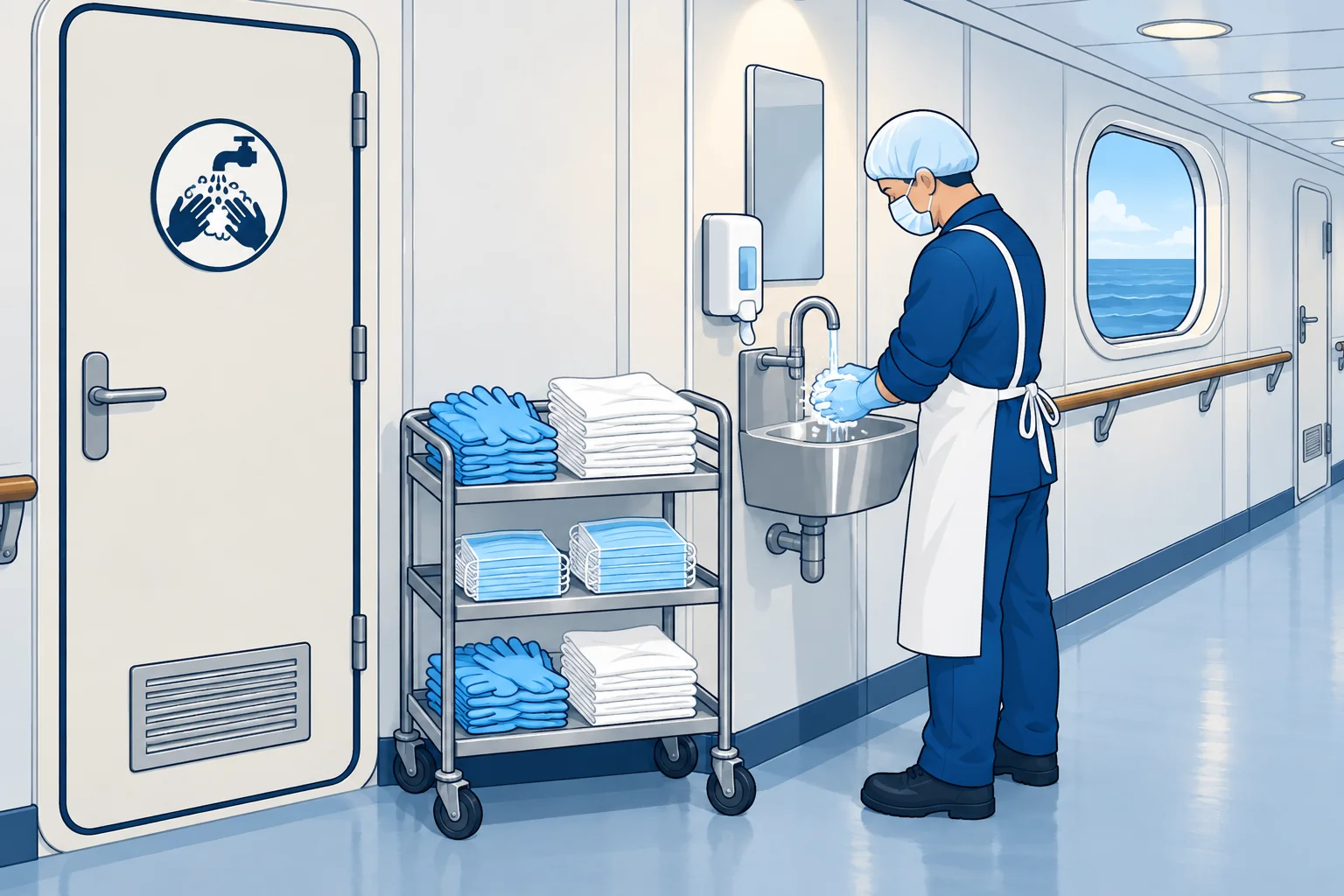
How germs spread
A communicable disease can spread directly or indirectly between people, including through food, water or insects. Germs pass by contact (hands and surfaces), droplets (coughs and sneezes at close range), the air (fine particles, as with tuberculosis or measles), food and water, blood and body fluids, and insect bites (malaria, dengue). Standard precautions apply to every patient: hand hygiene, gloves for body fluids, safe sharps, cleaning and safe waste.
Isolation
Suspect infection with new vomiting or diarrhoea, fever with a rash or cough, jaundice, unusual bleeding or linked cases. Use the hospital or a single cabin with its own toilet. Keep the door closed and limit carers. Get radio medical advice on precautions and ventilation. Wear gloves and an apron or gown for body fluids, with eye protection for splashes. For suspected airborne infections such as tuberculosis or measles, carers need a fit-tested respirator (a tight-fitting filtering mask); a surgical mask is insufficient.
Common problems at sea
Gastroenteritis causes vomiting or diarrhoea. For suspected norovirus, isolate until 48 hours symptom-free; wash hands with soap and water and use a labelled norovirus-effective disinfectant after cleaning. Respiratory infections, including influenza and COVID-19, spread through the air: masks and ventilation help. Sexually transmitted infections spread mainly through sexual contact; condoms reduce risk. Hepatitis means liver inflammation. Hepatitis A/E often spread through contaminated food or water; B/C through blood, and B also through sex. Vaccines protect against A/B, not C.
Malaria
Malaria is spread by mosquitoes in tropical areas. Suspect it in any fever after a visit to a malaria area, even weeks or months later, and get radio medical advice at once: it can kill within days. Prevent it with nets, screens, long sleeves at dusk, repellent and the antimalarial tablets the company doctor prescribes.
Food, water and pests
Many outbreaks start in the galley or the water tanks. Galley staff with vomiting, diarrhoea or infected skin stop handling food until cleared. Keep cold food cold and hot food hot, and raw meat below cooked food. Keep drinking water disinfected as the World Health Organization (WHO) Guide to Ship Sanitation describes, and control rats, cockroaches and mosquitoes.
Records and cleaning
Record each case, its start date, symptoms and contacts to identify linked cases. Remove visible dirt before disinfecting. Use a product effective against the suspected germ, at its labelled dilution and wet contact time (how long the surface must stay wet); never mix cleaning chemicals. Wash linen hot and bag contaminated waste. Keep crew vaccination records up to date.
Key figures
- Standard precautions
- Hand hygiene, gloves, safe sharps, cleaning, safe waste
- Isolate
- Vomiting/diarrhoea, fever with rash or cough, jaundice; clusters
- Norovirus
- Isolate until 48 h symptom-free; clean, then disinfect as labelled
- Hand cleaning in outbreaks
- Soap and water; alcohol gel works poorly on norovirus
- Malaria
- Fever after a malaria area, even months later: advice at once
- Galley staff
- Off food handling with vomiting, diarrhoea or skin infection
Remember
- Standard precautions apply to every patient, whatever the diagnosis.
- Isolate suspected infectious cases early; vomiting or diarrhoea may occur without fever.
- In a vomiting and diarrhoea outbreak, wash hands with soap and water; clean surfaces, then disinfect as labelled.
- Any fever after a malaria area needs radio medical advice at once.
- Sick galley staff stop handling food until cleared.
Common mistakes
Wrong: Alcohol gel is enough during a vomiting outbreak.
Right: Alcohol gel works poorly against norovirus. Wash hands with soap and water. Clean surfaces, then use a norovirus-effective disinfectant as labelled.
Wrong: A fever weeks after leaving a tropical port cannot be malaria.
Right: Malaria can start weeks or months later. Get radio medical advice at once.
Wrong: A cook with mild diarrhoea can keep working if careful.
Right: Take sick galley staff off food handling until cleared; one cook can infect the whole crew.
Worked case
Two days after leaving a West African port, three crew have vomiting and watery diarrhoea. The second cook was sick yesterday but kept working. What do you do?
Show the answer
Treat it as an outbreak. Isolate the sick in cabins or the hospital with their own toilets; take the second cook off food handling. Wash hands with soap and water; clean first, then disinfect toilets and touch points as labelled. Check shared food and water sources and seek advice on any suspected source. Record cases and contacts, and get radio medical advice; any fever after West Africa could also be malaria.
Practice question
What are standard precautions?
- Measures used only for patients with a known infection
- Measures used for every patient, whatever the illness
- Measures port health orders when a ship arrives
- Measures used only after a confirmed death on board
Show the answer
Answer: B. Hand hygiene, gloves for body fluids, safe sharps, cleaning and waste handling apply to every patient.
4 · Port health
Port health: IHR 2005, the Maritime Declaration of Health and sanitation certificates
Diseases cross borders on ships. The International Health Regulations tell the master what to declare before arrival, and port health decides what happens next.

The International Health Regulations
The International Health Regulations (2005) (IHR) are a World Health Organization (WHO) treaty that 196 States use to stop disease spreading between countries without needless interference with traffic and trade. For ships they set the Maritime Declaration of Health, the Ship Sanitation Certificates and the role of port health authorities. Amendments adopted in 2024 entered into force on 19 September 2025 for most States, adding a pandemic emergency level of alert.
The Maritime Declaration of Health
The Maritime Declaration of Health (MDH), modelled in IHR Annex 8, is completed and signed by the master, countersigned by the ship’s doctor if one is carried, and sent to the port health authority where the port State requires it. It lists the recent ports and asks about deaths on board other than by accident, suspected infectious disease, more ill people than usual, people ill now, medical advice taken, sanitary measures and sick animals.
Signs to report
Port health wants to hear about illness that may be infectious: fever, especially with weakness, confusion, swollen glands, jaundice, cough or breathlessness, unusual bleeding or paralysis; a new rash; severe vomiting or diarrhoea; or repeated fits. Report early, by radio or through the agent, so the port can assess the risk and prepare assistance. Restrictions may still be necessary.
Free pratique and sanitation
Free pratique is health clearance to enter port, embark or disembark people, and load or discharge cargo or stores; it may be granted by radio. Customs and immigration clearance are separate. A Ship Sanitation Certificate records inspection for health risks: food, water, waste and pests. An exemption certificate records no risks found; a control certificate records measures taken. It is valid for at most six months, extendable by one month.
Your part
Keep medical records, case lists and crew vaccination records ready: they are the evidence behind the MDH. Answer every question honestly. Follow port health instructions on isolation, testing, disinfection and landing patients.
Key figures
- IHR (2005)
- 2024 amendments: 19 Sep 2025 for most States; check applicability
- MDH
- IHR Annex 8; master signs, ship’s doctor countersigns
- MDH covers
- Non-accidental deaths, suspected infections, more ill than usual
- Free pratique
- Health clearance for people, cargo and stores; may be by radio
- Ship Sanitation Certificate
- Exemption or control; max 6 months, +1 month extension
Remember
- The IHR (2005) set the Maritime Declaration of Health and the Ship Sanitation Certificates.
- The master signs the MDH; a death not caused by an accident must be declared.
- Report suspected infectious illness early so the port can prepare.
- Free pratique is health clearance for people, cargo and stores; it may be granted by radio.
- Ship Sanitation Certificates last at most six months, with a possible one-month extension.
Common mistakes
Wrong: Only declare deaths from infectious disease.
Right: The MDH asks about any death on board other than by accident, such as a heart attack.
Wrong: Wait until arrival to mention a sick crew member.
Right: Report early through the agent or by radio so port health can prepare; restrictions may still be necessary.
Wrong: A Ship Sanitation Certificate lasts a year.
Right: It is valid for at most six months, extendable by one month if the inspection cannot be done.
Worked case
Your ship is due at a European port in 18 hours. A crew member has had fever and a cough for three days and now a new rash. Another crew member died last week of a heart attack. How do you handle port health?
Show the answer
Complete the Maritime Declaration of Health honestly: declare the ill crew member as a suspected infectious case. A heart attack is not an accident, so declare that death too, with the date, the cause given by the doctor and the records. Send the MDH and early notice through the agent as the port requires and follow port health’s instructions: they may board, test and land the patient before granting free pratique.
Practice question
Who signs the Maritime Declaration of Health?
- The ship’s agent ashore
- The master of the ship
- The port health officer
- The chief engineer
Show the answer
Answer: B. The master signs the MDH; a ship’s doctor, if carried, countersigns it.
5 · Death at sea
Death at sea: confirming, recording and caring for the body
A death on board is a medical, legal and human event. Confirm it with the doctor, preserve the evidence, care for the body properly and inform everyone who must know.

Confirming death
Ask the radio doctor to guide your assessment of a possible death. Absent breathing, pulse or pupil reactions alone do not establish irreversible death. If life is uncertain, follow your first-aid training while seeking immediate advice; do not wait several minutes for signs. Cold immersion, overdose and electric shock can make someone appear dead. Hypostasis is purple staining in the lowest parts; rigor mortis is post-death stiffening. Report findings and times accurately. Formal certification follows flag-State requirements.
Records and evidence
Record the date, time and position of death, what happened, the treatment given and all radio medical advice. In an accident, a suspected suicide or any unexplained death, leave the scene as it is if possible, photograph the body as found, keep notes, letters, medicines and equipment, and take signed statements promptly. Enter the death in the official log book. A post-mortem ashore may follow.
Care of the body
Wear gloves and an apron. Unless the death is suspicious, close the eyes and mouth, straighten the limbs, wash and dry the body, and attach an identity label. Wrap it in a sheet, then a leak-proof body bag labelled on the outside. In a suspicious death, change as little as possible and follow the advice of the company and the authorities.
Storage
Keep the body refrigerated at about 4 °C in a dedicated cold space, never below 2 °C and never frozen: freezing damages tissue and can ruin a later examination. Refrigeration is suitable for up to about two months; for longer, the company and protection and indemnity (P&I) insurer advise. Where possible keep the body for examination and burial ashore. Burial at sea is a last resort, only as the flag State and company allow.
Reporting and belongings
Inform the company, which normally contacts the next of kin, the flag State as required, the P&I insurer and, through the agent, the next port authorities and consul. Declare non-accidental deaths on the Maritime Declaration of Health; report all deaths through the required channels. Inventory belongings with a witness, seal and store them, and obtain a receipt at handover. A death affects everyone: offer the crew support and the company’s welfare help.
Key figures
- Confirmation
- Radio doctor guides assessment; certification follows flag rules
- Caution
- Cold, overdose or electric shock: may look dead
- Evidence
- Photos as found, notes, statements, records of advice
- Storage
- About 4 °C, never below 2 °C, never frozen
- Refrigerated storage
- Up to about two months; longer: company and P&I advice
- Belongings
- Inventory with a witness, seal, hand over against receipt
Remember
- Ask the radio doctor to guide assessment; certification follows flag rules. Cold, overdose and electric shock can mislead.
- In an unexplained death, preserve the scene, take photographs and keep the evidence.
- Store the body at about 4 °C, refrigerated, never frozen.
- Inform the required authorities and company; declare non-accidental deaths on the MDH.
- List belongings with a witness and hand them over against a receipt.
Common mistakes
Wrong: Freeze the body to keep it best.
Right: Freezing damages tissue and hampers the post-mortem. Refrigerate at about 4 °C.
Wrong: Tidy the cabin before the authorities arrive.
Right: In an unexplained death, leave it as found, photograph it and lock it.
Wrong: Bury the body at sea to spare the crew distress.
Right: Keep it for examination and burial ashore where possible; burial at sea only as the flag State and company allow.
Worked case
Mid-ocean, 9 days from port, a crew member is found unresponsive in his cabin in the morning. There is no sign of violence; an empty medicine packet lies on the floor. What do you do?
Show the answer
Follow your first-aid training and contact the radio doctor immediately. Do not assume an overdose is fatal. If death is established, preserve the scene, photographs, statements and records. Log findings, times, position, treatment and advice. Notify the company and required authorities. Follow their instructions on evidence and handling the body; refrigerate at about 4 °C, never frozen, for examination ashore. Formal certification follows flag-State requirements.
Practice question
With no doctor aboard, who should guide your assessment of suspected death?
- The master, using personal judgement alone
- The radio doctor, using your findings
- The watch officer, using the bridge log
- The finder, using the medicine packets
Show the answer
Answer: B. The radio doctor guides your clinical assessment. Formal certification follows flag-State requirements; radio advice alone is not a death certificate.
6 · Master’s duties
The master’s medical responsibilities: MLC 2006, the medicine chest and radio advice
The master is responsible for medical care on board. MLC 2006 and STCW set the minimum: chest, guide, trained people, free radio advice and records.

MLC 2006 Regulation 4.1
The Maritime Labour Convention (MLC) 2006, Regulation 4.1 and Standard A4.1, requires prompt medical care on board, as close as possible to care ashore. Every ship carries a medicine chest, medical equipment and a medical guide, as the flag State specifies and inspects. Ships carrying 100 or more persons and ordinarily engaged on international voyages lasting over three days must carry a qualified doctor. Otherwise carry a designated medical-care seafarer or, where the flag State permits, a seafarer competent in medical first aid.
Who does what
Under STCW Regulation VI/4, a seafarer designated to provide medical care holds the Medical Care certificate (Code A-VI/4-2); designated first-aiders hold Medical First Aid (A-VI/4-1). The master designates them, often the master or the chief mate, and stays responsible. Many flags require a refresher about every five years. The person in charge of medical care keeps the chest, records and hospital ready and leads the care, with radio medical advice.
The chest and the guide
The flag State sets chest contents. Check the WHO International Medical Guide for Ships (IMGS) medicine list and 2010 Quantification Addendum against flag requirements. For dangerous-goods carriage, check the Medical First Aid Guide for Use in Accidents Involving Dangerous Goods (MFAG) for additional supplies. MLC guidance asks for inspection at intervals no longer than 12 months: labels, expiry dates, storage and instructions. Restock after use and return expired medicines ashore. The IMGS 3rd edition (2007) remains current; check flag notices for updates.
Records
Keep the medical log: every illness and injury and its treatment. Use the standard medical report form (MLC Standard A4.1), kept confidential, for exchanges with doctors ashore. Keep the controlled drugs register and the record of chest inspections. These records serve the patient, port health, claims and investigations; keep them as long as your flag requires.
Radio medical advice at master level
MLC requires free medical advice by radio or satellite, 24 hours a day, including specialist advice. Ensure a competent officer can make the call. Weigh advice against the voyage and weather. Decide on diversion, rendezvous or evacuation with the telemedical assistance service (TMAS) doctor and maritime rescue coordination centre (MRCC). Seek advice early. If diversion is needed, act promptly: night or bad weather can make evacuation riskier.
Key figures
- Doctor required
- 100+ persons; ordinarily on international voyages over 3 days
- Without a doctor
- Medical Care or Medical First Aid, as the flag requires
- Chest inspection
- At least every 12 months (MLC Guideline B4.1.1)
- IMGS
- 3rd edition 2007 + 2010 addendum; 4th edition in progress
- Radio medical advice
- Free, 24 hours a day, including specialists (MLC A4.1)
- Records
- Medical log, report form, drug register, chest inspection records
Remember
- Every ship carries a medicine chest, equipment and a medical guide set by the flag State.
- Ships carrying 100+ persons and ordinarily on international voyages over three days must carry a qualified doctor.
- Without a doctor, carry a designated medical-care or first-aid seafarer, as the flag requires.
- Arrange chest inspections at intervals no longer than 12 months under flag rules; check and restock after use.
- The master decides on diversion or evacuation with the TMAS doctor and the MRCC.
Common mistakes
Wrong: Medical care is the designated officer’s business, not the master’s.
Right: The master designates the people and remains responsible for medical care on board.
Wrong: Check the medicine chest only when something is missing.
Right: Inspect it at least every 12 months and restock after every use.
Wrong: Delay a diversion until the patient is clearly worse.
Right: Seek advice early and act promptly on the agreed plan; delay can leave only a risky night or bad-weather evacuation.
Worked case
You are 450 nautical miles from the nearest port. The radio doctor suspects a heart attack and advises evacuation. The MRCC says no helicopter can reach you. The port has a hospital, 30 hours away at an estimated safe average speed of 15 knots. As master, what do you do?
Show the answer
Agree a plan with the TMAS doctor and the MRCC: divert at best safe speed towards the port, and ask about a rendezvous with a ship carrying a doctor, or a helicopter once in range. Make sure the person in charge of medical care gives oxygen and medicines only as advised, charts observations and reports at agreed times. Log the diversion and inform the company; the master’s discretion for safety (SOLAS V/34-1) protects the decision.
Practice question
Which ships must carry a qualified doctor under MLC 2006?
- Any ship with more than 25 seafarers, ordinarily on coastal voyages
- 100+ persons, ordinarily on international voyages over 3 days
- All passenger ships, ordinarily on voyages of any length or type
- Any ship ordinarily trading over 200 nautical miles offshore
Show the answer
Answer: B. MLC Standard A4.1 requires a doctor on ships with 100 or more persons ordinarily on international voyages of more than three days.