
Medical care on board · Level R3 · 5 parts · about 16 min
The medicine chest and seasickness
5 short parts: The kit · Stowage, records · Seasickness · Seasick medicines · Crew medicines. Each part explains the idea, then gives the points to remember, the common mistakes, a worked case and a practice question; the Academy unit adds all 29 check questions.
1 · The kit
A medical kit for the passage you plan
Size the kit to how far you will be from help, follow your flag’s carriage rules, and carry a medical guide that tells you how to use it.
Distance decides
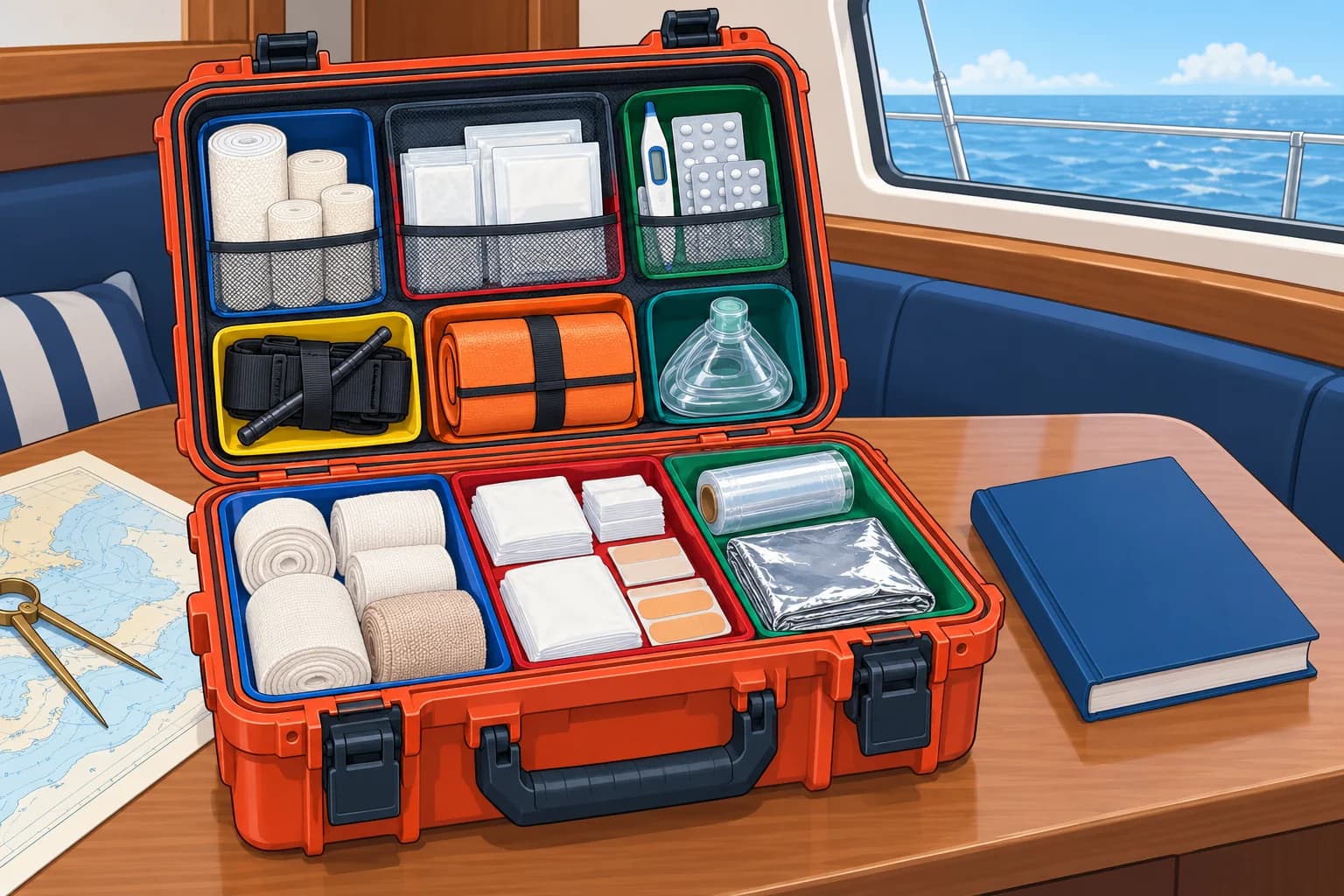
Match your kit to how long medical help may take to reach you. On a day sail near a harbour, carry first-aid supplies for immediate care, but allow for delays in reaching help. Coastal passages may leave you hours from port. Offshore, help may take days, so plan supplies and training with a doctor.
What every kit holds
Every boat, however small, should carry gloves, a pocket mask for rescue breaths, dressings, a haemostatic dressing (to help blood clot), a manufactured tourniquet (a strap to stop severe limb bleeding), wound-closure strips, bandages, a mouldable splint (to support an injured limb), tape, scissors, tweezers, cling film for burns, a survival bag, a thermometer, eye wash, painkillers and seasickness tablets. Keep a list inside the lid.
Carriage rules
Rules depend on flag and use. In Spain, RD 339/2021 requires recreational boats without professional crew in zones 1–4 to carry the RD 258/1999 annex II liferaft-type kit and Guía sanitaria a bordo. EU Directive 92/29/EEC categories for working vessels: A, unrestricted voyages; B, under 150 nautical miles from the nearest medically equipped port (under 175 if continuously within helicopter-rescue range); C, harbour craft, craft staying very close to shore, or craft with no accommodation beyond a wheelhouse.
A guide on board
A kit is only useful if someone knows how to use it. Carry a medical guide: the Spanish Guía sanitaria a bordo, the UK Ship Captain’s Medical Guide, or the WHO International Medical Guide for Ships on commercial vessels. The radio doctor will often refer to the medicines by their number or name in your official list, so keep that list up to date.
Optional extras
Offshore crews may add an automated external defibrillator (AED), a device that can give an electric shock in certain cardiac arrests, medical oxygen if someone is trained to use it, and prescription medicines such as antibiotics and stronger painkillers after a talk with a doctor. A first-aid course for at least two crew members is worth more than any extra item.
Key figures
- Spain, recreational
- RD 339/2021: zones 1–4 carry the liferaft kit of RD 258/1999
- Spain, guide
- Guía sanitaria a bordo with any kit
- EU working vessels
- Directive 92/29/EEC: categories A, B, C
- Category B
- Under 150 nautical miles; under 175 with helicopter-rescue cover.
- Professional guide
- WHO International Medical Guide for Ships
Remember
- Size the kit to the distance from help: day sail, coastal, offshore.
- Every kit: gloves, mask, dressings, tourniquet, splint, cling film, thermometer, survival bag.
- Spain: RD 339/2021, zones 1–4 carry the liferaft-type kit and the Guía sanitaria.
- EU working vessels: Directive 92/29/EEC, categories A, B and C.
- Carry a medical guide and train at least two crew in first aid.
Common mistakes
Wrong: A car first-aid kit is enough for any passage.
Right: Offshore you may be days from help. Size the kit and training to the passage.
Wrong: Buy a large kit and the job is done.
Right: A kit without a guide and trained crew helps little. Learn what is in it and how to use it.
Worked case
You are preparing a Spanish-flagged 11 m yacht, with no professional crew, for a coastal passage that stays within navigation zone 3. What medical kit do you need?
Show the answer
For zone 3, Real Decreto 339/2021 requires a kit identical to the liferaft kit in annex II of Real Decreto 258/1999, plus the Guía sanitaria a bordo. Check the required contents, then assess extra supplies for the passage and crew. Check expiry dates and make sure two crew know first aid.
Practice question
What should decide the size of a yacht’s medical kit?
- The number of berths in the cabin
- The length of the boat’s waterline
- The power of the boat’s engine
- The time it takes to reach help
Show the answer
Answer: D. The further from help, the longer you must treat a casualty yourself.
2 · Stowage, records
Stowing, checking and recording
Keep the kit dry, secured and where everyone can find it. Check it before every season and after every use, and write down every treatment.
Where to keep it
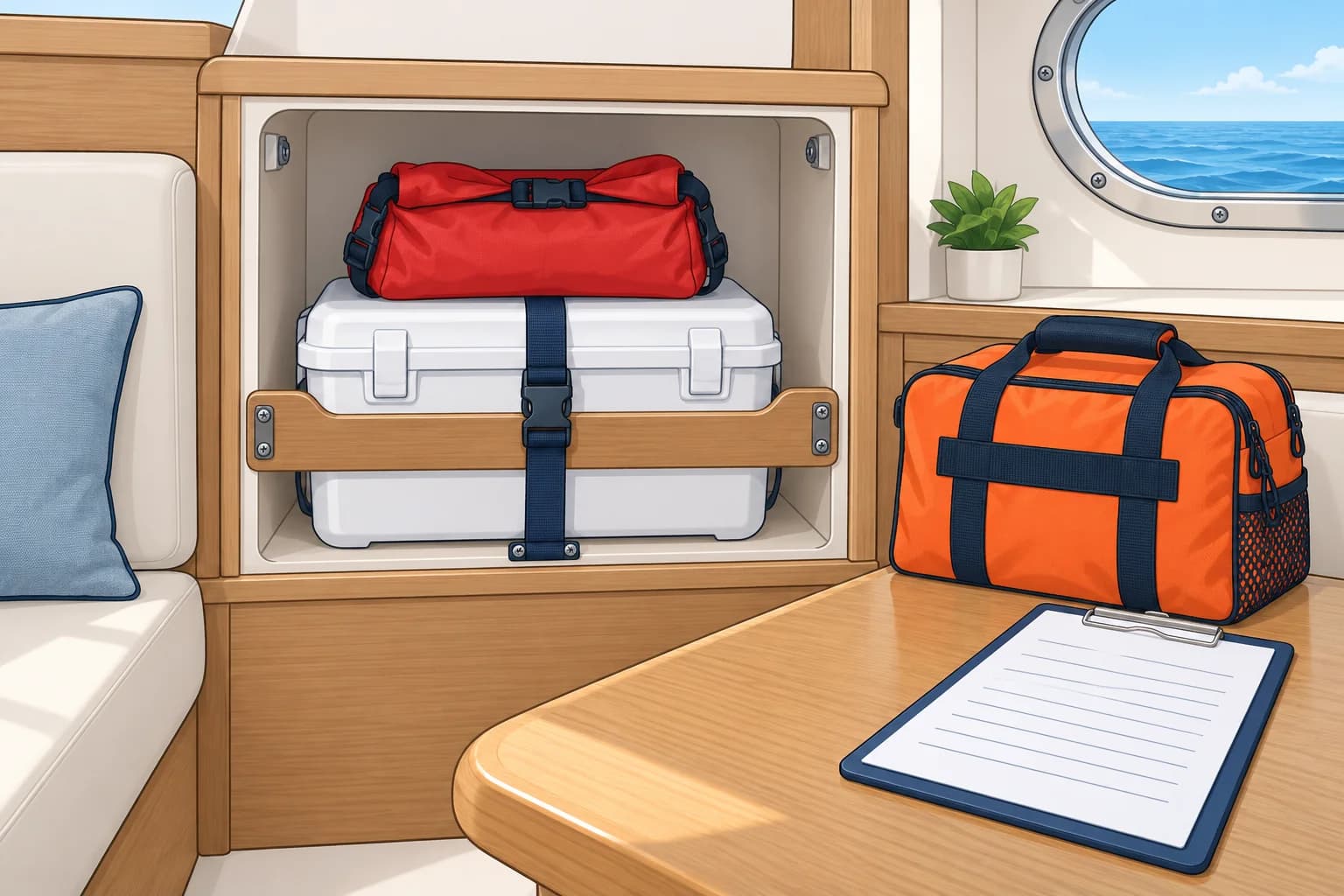
Stow the kit in a dry, cool place away from the engine, the galley and direct sun, secured so it cannot fly across the cabin in a knockdown. Everyone on board must know where it is. Pack the items you need fastest, gloves, mask, tourniquet, dressings, in a waterproof bag on top. Keep a small kit in the grab bag for the liferaft.
Heat, damp and light
Follow each medicine’s storage label; many specify below 25 °C. Protect medicines from heat, damp and light. A hot locker in summer can ruin them. Keep them in their original packs with the leaflet, inside sealed plastic boxes. Some medicines need a fridge: ask the pharmacist and keep a note of which ones.
Expiry and restocking
Check every item against the list before the season and after each use. Replace used supplies, expired products and items whose sterile packaging is damp or damaged. For opened multidose products, follow the label’s storage and after-opening limit. Write the earliest expiry date on the outside of the box. Out-of-date medicines can be weaker; return them to a pharmacy rather than throwing them overboard.
Record everything
Keep a treatment record: who was treated, what happened, what you saw, which medicines you gave, when and how much, and what the radio doctor advised. Note the times. Keep the detailed treatment record confidential and hand it to medical staff. In the vessel log, note the incident and operational actions without unnecessary medical details.
Controlled and personal medicines
Follow your flag’s supply, secure-storage and recording rules for controlled medicines (legally restricted drugs); crew manage their own prescriptions and tell the skipper what they take.
Key figures
- Storage
- Dry, secured; follow each medicine’s temperature label.
- Check
- Before the season and after every use
- Record
- Who, what, medicine, dose, time, doctor’s advice
- Old medicines
- Return to a pharmacy, never overboard
Remember
- Dry, cool, secured, and everyone knows where it is.
- Urgent items on top in a waterproof bag; a small kit in the grab bag.
- Check against the list before the season and after every use.
- Record every treatment, medicine and time, and the doctor’s advice.
- Controlled medicines: follow your flag’s supply, secure-storage and recording rules.
Common mistakes
Wrong: Keep the medicine box in the engine compartment where it is out of the way.
Right: Heat ruins medicines. Store them dry and cool, where everyone can reach them.
Wrong: Remember what you gave and tell the doctor later.
Right: Write it down at the time: medicine, amount, time and effect.
Worked case
Before a summer cruise you open the medical box. Two dressings are damp, the painkillers expired last year and a tube of burn gel is half used. The box lives in a locker beside the engine.
Show the answer
Replace the damp dressings and expired painkillers; return old medicines to a pharmacy. Check the opened tube’s label and opening date; replace it if its usable period or storage conditions cannot be confirmed. Move the kit to a dry, cool place, secure it and tell everyone where it is. Keep urgent items in a waterproof bag on top, note the next expiry date and start a confidential treatment record.
Practice question
Where is the best place to keep the medical kit?
- In a hot locker by the engine
- In a dry, cool, secure locker
- Loose on the chart table
- In the anchor locker forward
Show the answer
Answer: B. Medicines need dry, cool storage, and the kit must stay put in rough weather.
3 · Seasickness
Seasickness: why it happens and how to prevent it
Seasickness comes from a mismatch between what your eyes see and what your balance organs feel. It is not a weakness, but it is a safety problem.
Why it happens
Your inner ear senses movement. Below deck your eyes see a cabin that seems still, while your inner ear feels the boat rolling and pitching. The brain gets two different messages, and the result is seasickness: yawning, cold sweat, pale skin, headache, nausea and vomiting. Almost anyone gets it in the right conditions, including experienced sailors.
Why it matters
Seasickness is more than unpleasant. A seasick crew member gets cold, tired and dehydrated, thinks slowly and may stop caring about safety. Leaning over the rail to vomit puts you at risk of falling overboard. A seasick skipper makes poor decisions. Most people adapt after two or three days at sea, but some never fully do.
Prevention on deck
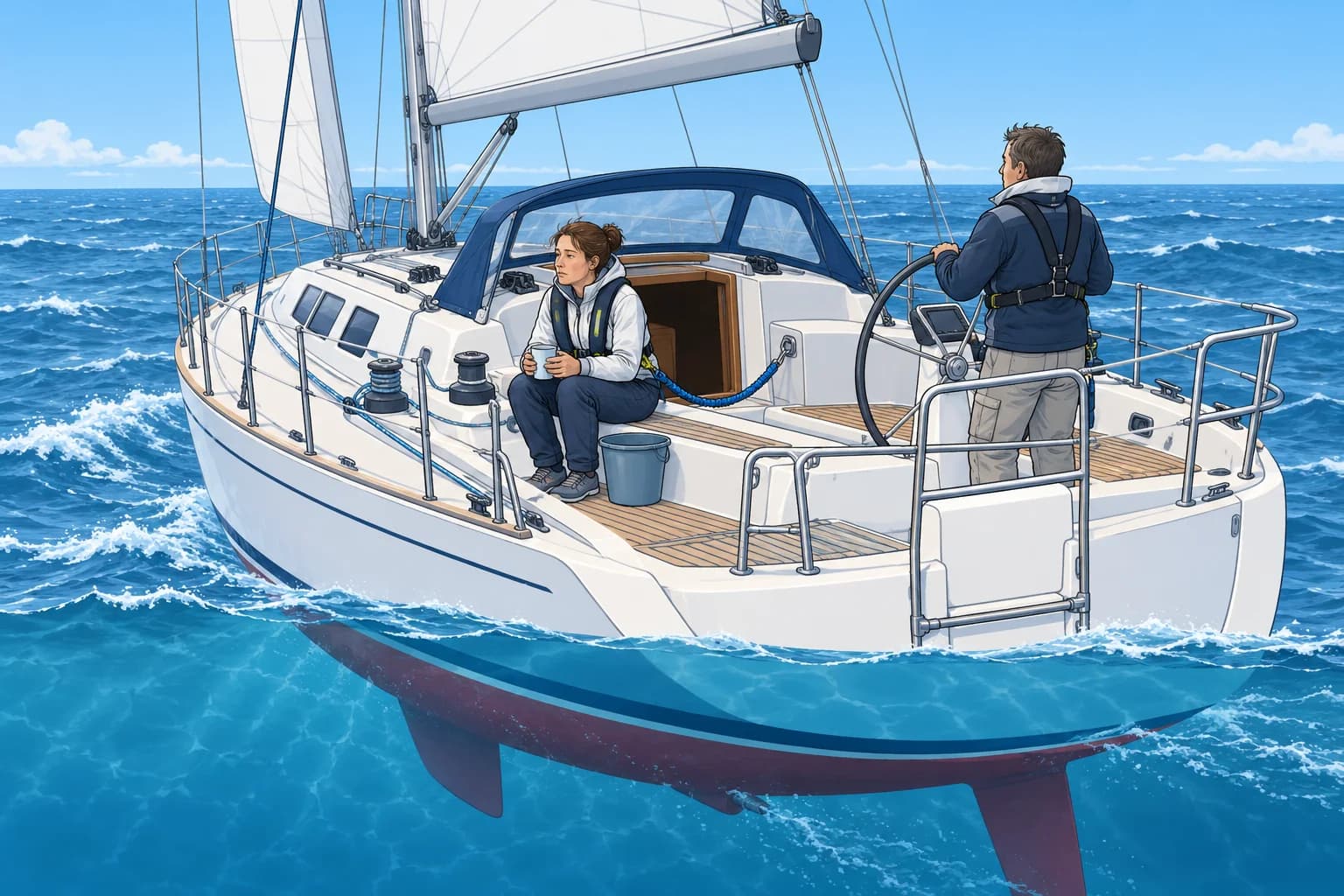
Stay on deck in fresh air and watch the horizon. Taking the helm can help you anticipate the motion, but do so only if alert and fit. Sit low and near the middle of the boat (amidships), where the motion is least. Keep warm and dry, and avoid diesel fumes and strong smells.
Before and during the passage
Sleep well the night before, avoid alcohol and heavy or greasy food, and eat small, plain meals and snacks often. Drink small amounts regularly. Below deck, lie down with your eyes closed. Avoid reading, screens and chart work below when you feel queasy. Ginger and wrist bands help some people; the evidence for them is weak.
Looking after a seasick crew member
Keep them on deck if they can be, wearing a safety harness tethered to a suitable strong point. Keep watch and give them a bucket in the cockpit rather than letting them lean over the lee rail. Give small sips of water often. If they are very ill, let them lie down below, warm and wedged in, with a bucket. Do not leave them alone on deck.
Key figures
- Cause
- Eyes and inner ear send different messages
- Early signs
- Yawning, cold sweat, pallor, headache
- Adaptation
- Most people after 2–3 days at sea
- Best place
- On deck, low and amidships, eyes on the horizon
Remember
- Seasickness is a mismatch between the eyes and the inner ear.
- It is a safety problem: cold, tired, dehydrated, and at risk of going overboard.
- Watch the horizon, low near the middle of the boat; helm only if alert and fit.
- Rest, no alcohol, small plain meals, small regular drinks.
- Seasick crew stay clipped on, watched, and vomit into a bucket.
Common mistakes
Wrong: Go below to rest and read until you feel better.
Right: Reading below makes it worse. Go on deck and watch the horizon, or lie down with eyes closed.
Wrong: Let a seasick crew member lean over the lee rail unclipped.
Right: Clip them on, keep watch, and give them a bucket in the cockpit.
Wrong: Experienced sailors never get seasick.
Right: Anyone can be seasick in the right conditions. Plan for it on every passage.
Worked case
Two hours into a lumpy crossing, a guest who has been navigating at the chart table below comes up pale, sweating and yawning. She says she feels awful and wants to lie on the foredeck.
Show the answer
She is becoming seasick. Keep her in the cockpit, not on the foredeck, clipped on and low near the middle of the boat. Ask her to watch the horizon or offer her the helm if she is up to it. Give small sips of water and a plain biscuit, keep her warm, and give her a bucket. Take over the navigation yourself.
Practice question
What causes seasickness?
- Salt carried in the sea air
- Eyes and inner ear disagree
- Eating fish before sailing
- Low oxygen in the cabin
Show the answer
Answer: B. The brain receives conflicting signals from the eyes and the balance organs.
4 · Seasick medicines
Seasickness medicines and their cautions
Seasickness medicines work best taken before you sail. Most cause drowsiness, so the skipper and helm need to know who has taken what.
Take them early
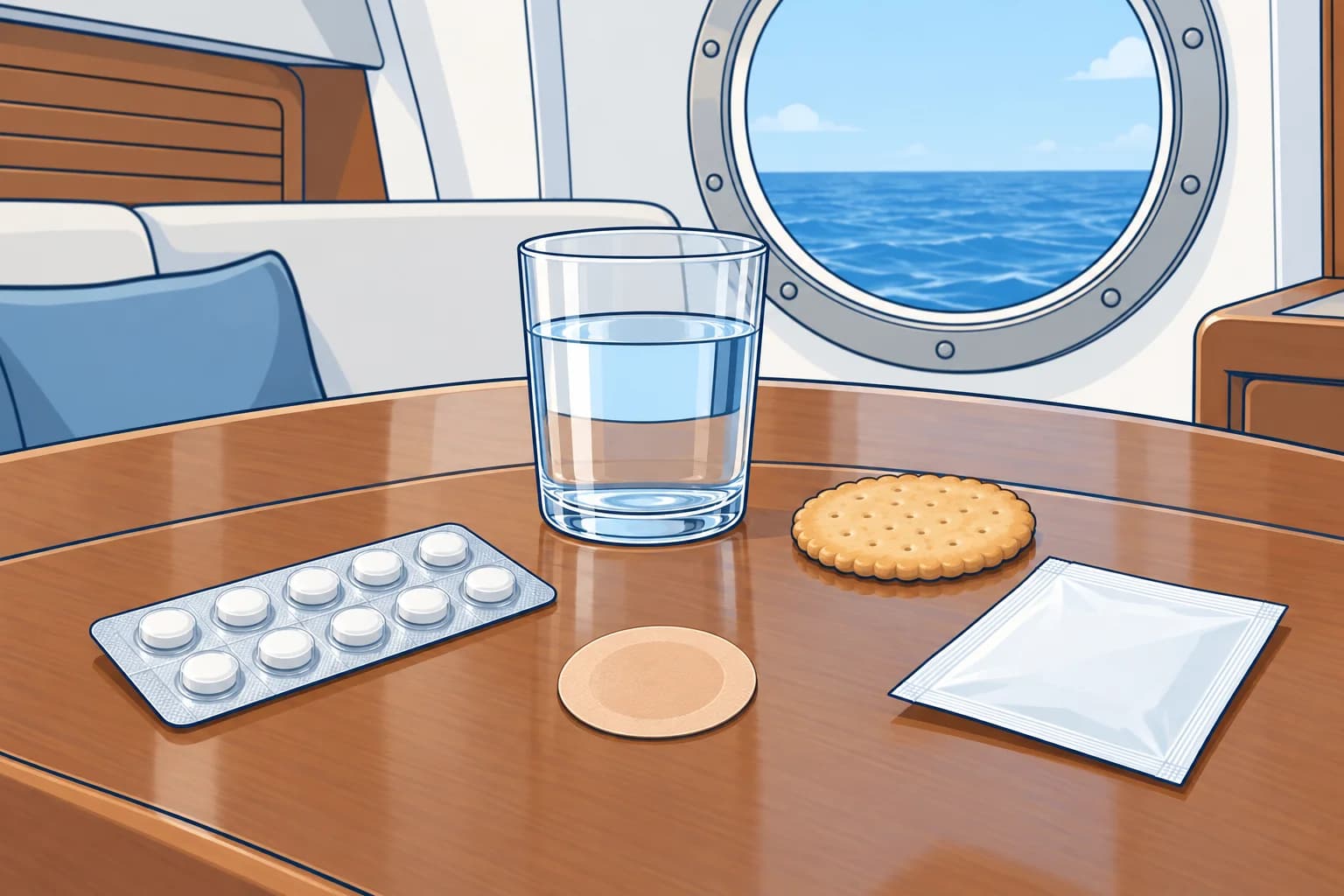
Seasickness medicines prevent sickness much better than they cure it, and tablets are often vomited before they work. Take them before you sail, at the time the label gives: some work in 30 minutes, others need a couple of hours or the night before. Always follow the label or the advice of a pharmacist or the radio doctor.
The main medicines
Hyoscine (also called scopolamine) comes as tablets or as a skin patch worn behind the ear, which lasts several days. Cyclizine, cinnarizine and promethazine are antihistamines, medicines also used for allergies. Promethazine is the most sedating and is sometimes taken the night before. Try the medicine ashore first, when off duty and not driving.
Drowsiness and the helm
Most of these medicines can make you drowsy, and some blur vision or slow reactions. That matters on a boat: a drowsy helm or skipper is dangerous. Tell the skipper what you have taken, do not take the helm or work alone on deck if you feel sleepy, and never mix them with alcohol. The skipper should choose carefully for themselves.
Cautions
Check with a pharmacist or doctor first if you have glaucoma, difficulty passing urine or an enlarged prostate, heart, liver, kidney or epilepsy problems, or if you are pregnant, breastfeeding, or taking other medicines, especially other sedating ones. Children need their own doses. After handling a hyoscine patch, wash your hands: on the eye it blurs vision. Remove the patch and get urgent medical advice if confusion, fever or difficulty passing urine develops.
Dehydration after vomiting
A crew member who keeps vomiting loses water and salts fast. Offer frequent small sips of water or oral rehydration solution, made by mixing the oral rehydration salts with water exactly as the packet directs. If they cannot keep any fluid down for several hours, become drowsy or confused, or pass very little urine, get radio medical advice: the doctor may advise other medicines or a change of plan.
Key figures
- Timing
- Before sailing, as the label says
- Hyoscine (scopolamine)
- Tablets or a patch behind the ear
- Antihistamines
- Cyclizine, cinnarizine, promethazine
- Main side effect
- Drowsiness; no alcohol, care at the helm
- Doses
- Follow the label or the radio doctor
Remember
- Take seasickness medicine before you sail, as the label says.
- Main options: hyoscine (scopolamine), cyclizine, cinnarizine, promethazine.
- Most cause drowsiness: tell the skipper, no alcohol, care at the helm.
- Check cautions such as glaucoma, prostate, pregnancy and other medicines.
- Persistent vomiting: sip water or correctly mixed rehydration solution; get advice if fluids stay down poorly.
Common mistakes
Wrong: Wait until you are sick, then take a tablet.
Right: Take it before you sail; tablets taken late are often vomited.
Wrong: A seasickness tablet and a glass of wine are fine together.
Right: Alcohol adds to the drowsiness. Avoid it with these medicines.
Wrong: Everyone can take the same seasickness medicine.
Right: Some people should not take certain medicines. Ask a pharmacist and read the leaflet.
Worked case
You are skipper of a two-handed overnight passage. Your crew offers you one of his promethazine tablets before you leave, saying it works brilliantly for him.
Show the answer
Decline it. Promethazine is strongly sedating, and as skipper on a two-handed overnight passage you must stay alert. Ask a pharmacist before the trip for a medicine that suits you. Try the medicine ashore first, when off duty and not driving. Take it before sailing as the label says. Check what your crew has taken and whether he is fit for his watch.
Practice question
When are seasickness medicines most effective?
- Taken once you have vomited
- Taken before you set sail
- Taken after you reach port
- Taken with a glass of wine
Show the answer
Answer: B. They prevent sickness better than they cure it. Follow the label’s timing.
5 · Crew medicines
Crew health, allergies and the adrenaline auto-injector
Know each crew member’s conditions, medicines and allergies before you sail. Anyone with a severe allergy carries two adrenaline auto-injectors.
Ask before you sail
Before a passage, ask every crew member, in private, about medical conditions, regular medicines and allergies, and write it on a confidential crew health form kept with the medical kit. Conditions such as diabetes, epilepsy, asthma, heart disease or a severe allergy change your plans and your kit. The radio doctor will ask for this information.
Bring your own medicines
Crew members bring enough of their own prescription medicines for the whole trip plus extra for delays, in their original packs and in hand luggage, with a copy of the prescription. Seasickness can stop tablets being absorbed, and some medicines interact with seasickness tablets: they should ask their pharmacist.
Anaphylaxis
Anaphylaxis is a severe, life-threatening allergic reaction, for example to a wasp sting, nuts, shellfish or a medicine. Suspect it after sudden tongue or throat swelling, a hoarse voice, breathing difficulty or persistent faintness/collapse after a likely allergen (allergy trigger). Lip swelling alone does not establish anaphylaxis. A rash may be absent. Treat suspected anaphylaxis at once with adrenaline and call for help.
The auto-injector
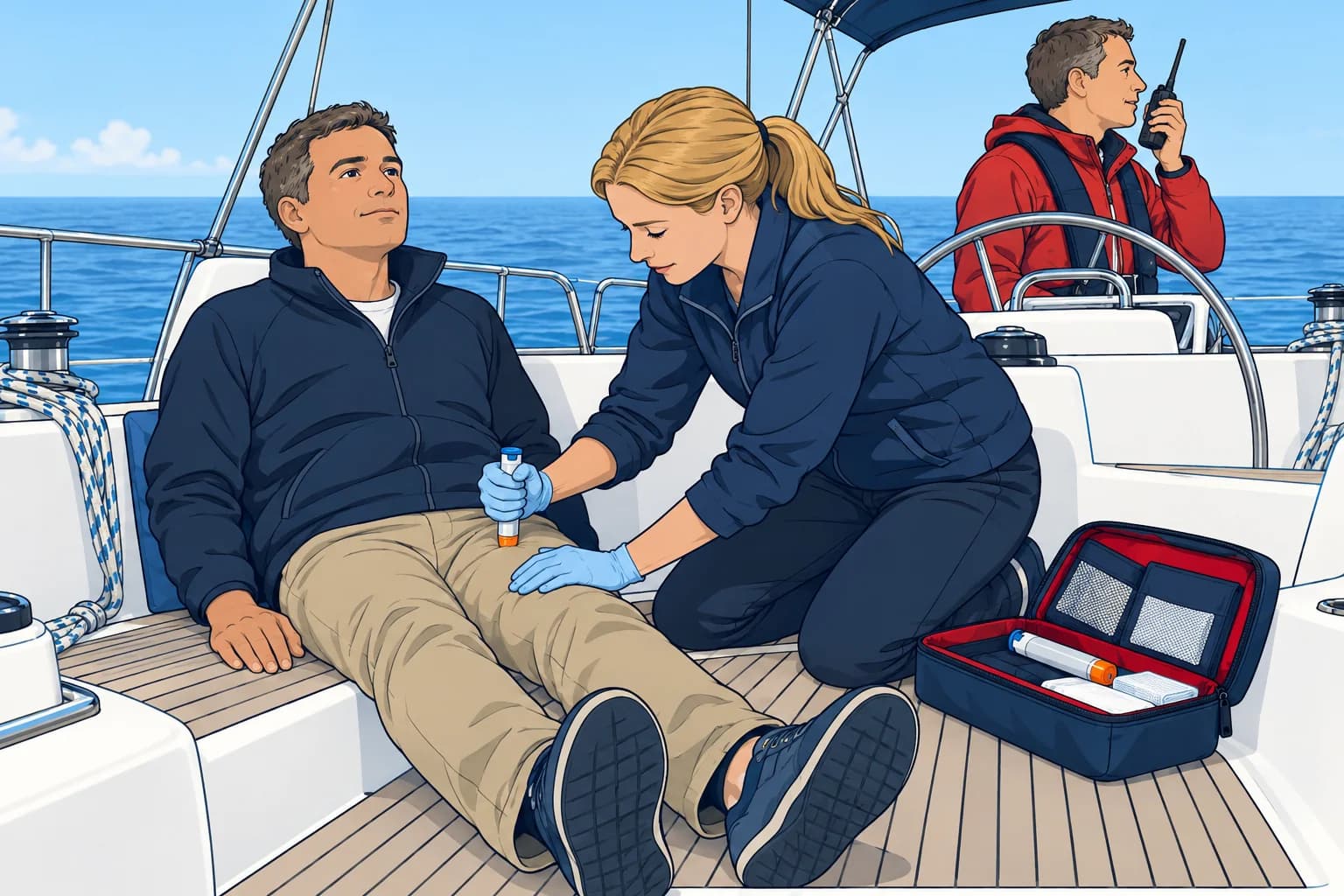
An adrenaline auto-injector is a pen that injects a fixed dose into the outer thigh, through clothing if needed. Follow the instructions on the pen; you hold it in place for a few seconds. Give a second one if airway, breathing or circulation problems persist after 5 minutes, ideally in the other leg. People at risk should carry two; check the expiry dates before you sail.
Position and after
Lay the casualty flat with the legs raised. If breathing is hard, let them sit up with legs out in front. Do not let them stand or walk, even if they feel better: this can cause collapse. If they become unresponsive but breathe normally, use the recovery position; if they are not breathing normally, start cardiopulmonary resuscitation (CPR). Every casualty given adrenaline needs hospital care, because the reaction can return.
Key figures
- Before sailing
- Confidential crew health form
- Own medicines
- Whole trip plus extra, original packs
- Auto-injector
- Outer thigh, through clothing if needed
- Second dose
- After 5 minutes if serious symptoms persist; carry two
- Position
- Flat, legs raised; sit up if breathing is hard
Anaphylaxis: using the auto-injector
- Suspect anaphylaxis after sudden tongue or throat swelling, a hoarse voice, breathing difficulty or persistent faintness/collapse after a likely allergen. Lay them flat with legs raised; if breathing is difficult, allow sitting with legs outstretched. Never let them stand or walk. — Anaphylaxis can kill within minutes. Standing can cause sudden collapse.
- Give the adrenaline auto-injector immediately into the outer thigh, following the pen’s instructions. — Adrenaline reverses the swelling and the drop in blood pressure.
- Call for emergency help and get radio medical advice. — The reaction can return and needs hospital care.
- Give the second auto-injector if airway, breathing or circulation problems persist after 5 minutes. — One dose is not always enough, even if there has been some improvement.
- If they become unresponsive and are not breathing normally, start CPR. — Severe anaphylaxis can cause cardiac arrest.
Remember
- Collect a confidential crew health form: conditions, medicines, allergies.
- Crew bring their own medicines for the trip plus extra.
- Suspect anaphylaxis with throat swelling, breathing difficulty or collapse after an allergy trigger. Give adrenaline.
- Outer thigh; repeat after 5 minutes if airway, breathing or circulation problems persist.
- Lie flat with legs raised; never let them stand; hospital afterwards.
Common mistakes
Wrong: Wait for throat swelling or breathing difficulty to get worse before using the auto-injector.
Right: Use it at once. Anaphylaxis can kill within minutes.
Wrong: After the injection she feels better, so let her walk below to rest.
Right: Keep her lying flat with legs raised. Let her sit up only if breathing is difficult. Do not let her stand or walk.
Wrong: One auto-injector is enough for a long passage.
Right: People at risk should carry two, in date, and the crew should know where they are.
Worked case
At anchor, a guest who told you she is allergic to wasps is stung on the arm. Within minutes her lips swell, her voice becomes hoarse and she says she feels faint. Her auto-injector is in her bag.
Show the answer
Lay her flat with legs raised; if breathing is difficult, let her sit with legs outstretched. Give her auto-injector immediately into the outer thigh, following its instructions. Do not let her stand or walk. Call for emergency help and radio medical advice. Give the second pen if airway, breathing or circulation problems persist after 5 minutes. She needs hospital care.
Practice question
Where do you inject an adrenaline auto-injector?
- Into the upper arm
- Into the outer thigh
- Into the stomach wall
- Into the buttock
Show the answer
Answer: B. Into the outer thigh, through clothing if needed.