
- 3 nautical milesmaximum distance from the coastDecreto-Lei n.º 93/2018 (decree-law)
- 10 nautical milesmaximum distance from a port of refugeDecreto-Lei n.º 93/2018
- From age 16with parental consent until age 18Decreto-Lei n.º 93/2018
- 6 mand 22.5 kW between ages 16 and 18Decreto-Lei n.º 93/2018
- 12 mafter age 18, with power matching the vessel’s certificationDecreto-Lei n.º 93/2018
The first stepWhat is the Carta de Marinheiro?
The Carta de Marinheiro is Portugal’s entry-level recreational boating category. It sits after Marinheiro Júnior (junior sailor) and before Patrão Local (local skipper), Patrão de Costa (coastal skipper) and Patrão de Alto Mar (ocean skipper). It helps you build confidence at the helm while respecting the limits for your vessel, age and navigation area.
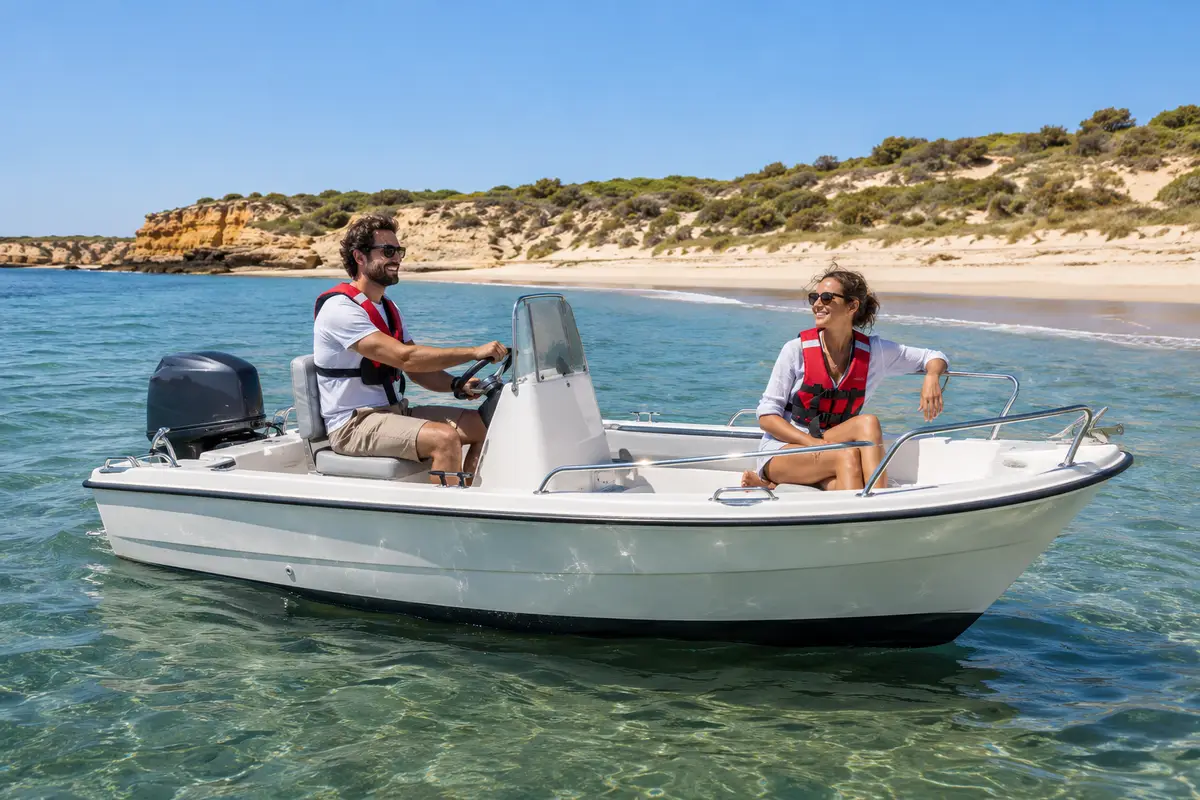
Your cruising rangeHow far you can go and which craft you can operate
The licence allows daytime navigation only, and both distance limits apply together: up to 3 nautical miles from the coast and up to 10 nautical miles from a port of refuge. Between ages 16 and 18, the general rule is up to 6 metres and 22.5 kW. After age 18, you can operate craft up to 12 metres, with power appropriate to their certification.
With the Carta de Marinheiro, you can
- Navigate by day up to 3 nautical miles from the coast and up to 10 nautical miles from a port of refuge
- Between ages 16 and 18, operate craft up to 6 metres and 22.5 kW
- Between ages 16 and 18, use personal watercraft and powered boards regardless of power
- After age 18, operate craft up to 12 metres with power appropriate to their certification
With the Carta de Marinheiro, you cannot
- Navigate at night
- Go beyond 3 nautical miles from the coast, even if you are within 10 nautical miles of a port of refuge
- Between ages 16 and 18, operate craft longer than 6 metres or more powerful than 22.5 kW, outside the stated exceptions
Before you beginWhat you need for this category
- Be at least 16 years old
- Have parental consent if you are between 16 and 18
- Prepare for both a theory and a practical component
Towards your licenceHow to prepare and take the assessment
- Start with the rules you will use at sea
Study RIEAM (Portugal’s collision regulations), including rules 5 to 19 and 23 to 37, steering and sailing rules, IALA Region A buoyage, lights, shapes and sound signals.
- Complete your navigation foundation
Also study the rest of the Portaria n.º 288/2000 (ministerial order setting out the syllabus): regulations and the vessel, tides and tide tables, anchoring, weather, safety and first aid, communications and flags “A” and “B”, engines and the environment. The free preparation course covers these in five blocks.
- Prepare for both components
The assessment has a theory component and a practical component, and you must pass both. Practical preparation is an essential part of the route to the Marinheiro category.
- Check the current syllabus
Confirm the official format, exam fee, requirements and applicable syllabus with DGRM / Polícia Marítima (Portugal’s maritime administration / Maritime Police).
What counts in the assessmentTheory and practice: the minimum requirements
- Theory and practiceyou must pass both components
- More than 60 per centoverall score required
- At least 75 per centin RIEAM and in navigation
- At least 60 per centin radiocommunications and in safety and emergency
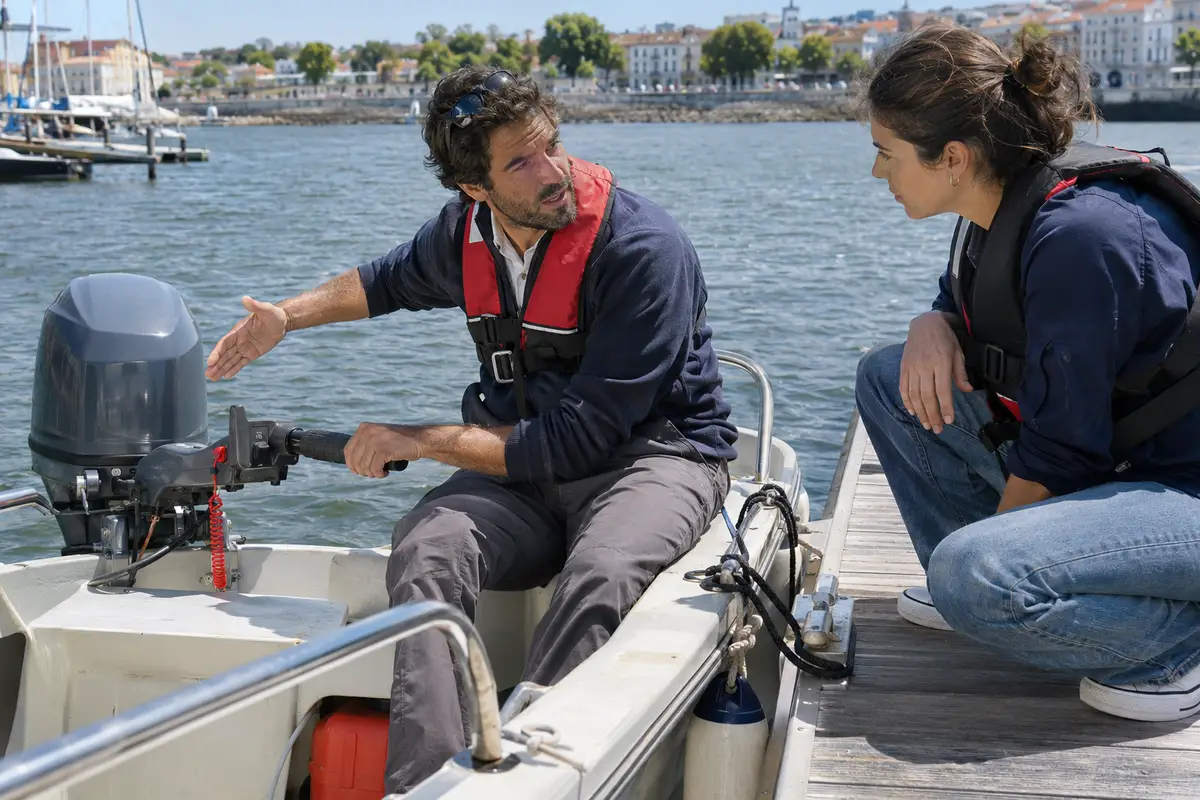
If you want to go fartherPortugal’s recreational licence ladder
The Carta de Marinheiro is the second step, after Marinheiro Júnior. Progression widens your navigation area, but each category retains the rules for the vessel itself. Patrão Local is the next licence with a guide available.
- Marinheiro Júniorby day; up to 1 nautical mile from the low-water line and 3 nautical miles from a port of refuge
- Marinheiroby day; also within 3 nautical miles of the coast; between ages 16 and 18, up to 6 metres and 22.5 kW
- Patrão Localnormally within sight of land and up to 6 nautical miles from the coast; authorised inter-island exceptions exist in the Azores and Madeira
- Patrão de Costanormally up to 40 nautical miles from the coast; authorised inter-island exceptions exist in the Azores and Madeira
- Patrão de Alto-Marno geographical limit imposed by the licence; the vessel’s certified limits apply
Our verdict
What works well
- An entry-level category available from age 16
- Combines theory learning with a practical component
- After age 18, allows craft up to 12 metres with power appropriate to their certification
Keep in mind
- Daytime navigation only
- You must respect both the 3-nautical-mile coastal limit and the 10-nautical-mile port-of-refuge limit
- Vessel limits are tighter before age 18
The Carta de Marinheiro is a sound choice for starting recreational boating within clear limits that expand as you progress. If your plans take you farther offshore, the natural next step is to explore the Patrão Local category.
Topics tested
Practice tests
IALACOLREG Exam Pass
Carta de Marinheiro: get ready for your exam with the Exam Pass
Unlimited timed mock exams, every mistake back until it's right, and a readiness score that shows when you're ready for the exam.
512 exam-style questions with explanations · 7 timed subject exams · every simulator scenario
One payment for 12 months, so it covers a resit too. No subscription.
Practice questions (with answers)
Safe water marks have:
Show answer
Correct answer: A. Red and white vertical stripes
Safe water marks are red and white vertical stripes, indicating navigable water all around.
Special marks are coloured:
Show answer
Correct answer: C. Yellow
Special marks are yellow, indicating special areas like military zones, cables, or pipelines.
How does IALA Region B differ from Region A?
Show answer
Correct answer: B. The colours are reversed — red to starboard
Region A: port-hand red, starboard-hand green. Region B: port-hand green, starboard-hand red. Interpret both in the charted conventional direction of buoyage.
An East Cardinal mark shows how many quick flashes?
Show answer
Correct answer: B. 3 flashes
White lights, when fitted: North Q or VQ; East VQ(3) 5 s or Q(3) 10 s; South VQ(6)+LFl 10 s or Q(6)+LFl 15 s; West VQ(9) 10 s or Q(9) 15 s. The long flash lasts at least 2 s.
A 12-metre sailing yacht wants to cross a traffic lane and decides to linger inside the lane while sorting sails because she is exempt from using the main lane. What is correct?
Show answer
Correct answer: C. Incorrect because she must not impede a power-driven vessel following the traffic lane
Under Rule 10, small vessels and sailing vessels may have limited allowances, but they still shall not impede the safe passage of a power-driven vessel following a traffic lane.
A power-driven vessel meets a constrained-by-draught ship displaying the proper signals in a dredged approach. What is the best understanding of Rule 18?
Show answer
Correct answer: B. The power-driven vessel should avoid impeding her safe passage if circumstances admit
Rule 18 gives constrained-by-draught vessels special consideration through the 'avoid impeding' requirement. It is important, but it does not erase the need to assess the full situation under the rest of COLREG.
In dense fog the vessels are not in sight and collision risk has not been ruled out. You hear a fog signal apparently forward of the beam and radar shows developing close quarters there. What principle applies?
Show answer
Correct answer: B. Reduce to the minimum speed for course-keeping and be prepared to take all way off
Rule 19(e), unless collision risk has been ruled out, requires minimum course-keeping speed when a fog signal is heard apparently forward of the beam or close quarters there cannot be avoided. Take all way off if necessary and navigate with extreme caution until danger is over.
At night a vessel engaged in fishing other than trawling has outlying gear extending more than 150 metres horizontally to starboard. Which extra light is required?
Show answer
Correct answer: A. An all-round white light in the direction of the outlying gear
Rule 26(c)(ii) requires an additional all-round white light toward outlying gear extending more than 150 metres for fishing other than trawling. The corresponding day shape is a cone with apex upward.
The full guide
The Carta de Marinheiro is the entry-level Portuguese recreational boating licence — required for the Portuguese Marinheiro category, whose current limits depend on vessel type, age and the applicable coastal/sheltered-water rules.
Programme (Portaria 288/2000): regulations and the boat, RIEAM and buoyage, tides and anchoring, weather, safety and first aid, radio and the ICS flags A and B, engines and the marine environment.
Who should take the Carta de Marinheiro
Portuguese recreational skippers checking the current DGRM limits for the Marinheiro category and their vessel.
How to prepare
Study the five blocks of the programme. To pass you need over 60% overall, with at least 75% on RIEAM and on navigation and 60% on radio and on safety. New candidates train at a DGRM-accredited school; this site is a study companion, not a replacement.
Other exams
Reviewed by Ramon Curto, Nautical teacher at IECNPC · Last reviewed: