
- 6 milesnautical miles from the coast
- 25 milesnautical miles from a port of refuge
- 18 yearsminimum age
- 2 teststheory and practical, both compulsory
- More than 60 per centoverall mark required
The essentialsWhat is the Carta de Patrão Local?
The Carta de Patrão Local is the Portuguese category for operating recreational craft within sight of the coast. It allows you to navigate up to 6 nautical miles from the coast and up to 25 nautical miles from a port of refuge. In the licence sequence, it comes after Marinheiro (recreational boat operator) and before Patrão de Costa (coastal skipper) and Patrão de Alto-Mar (offshore skipper).
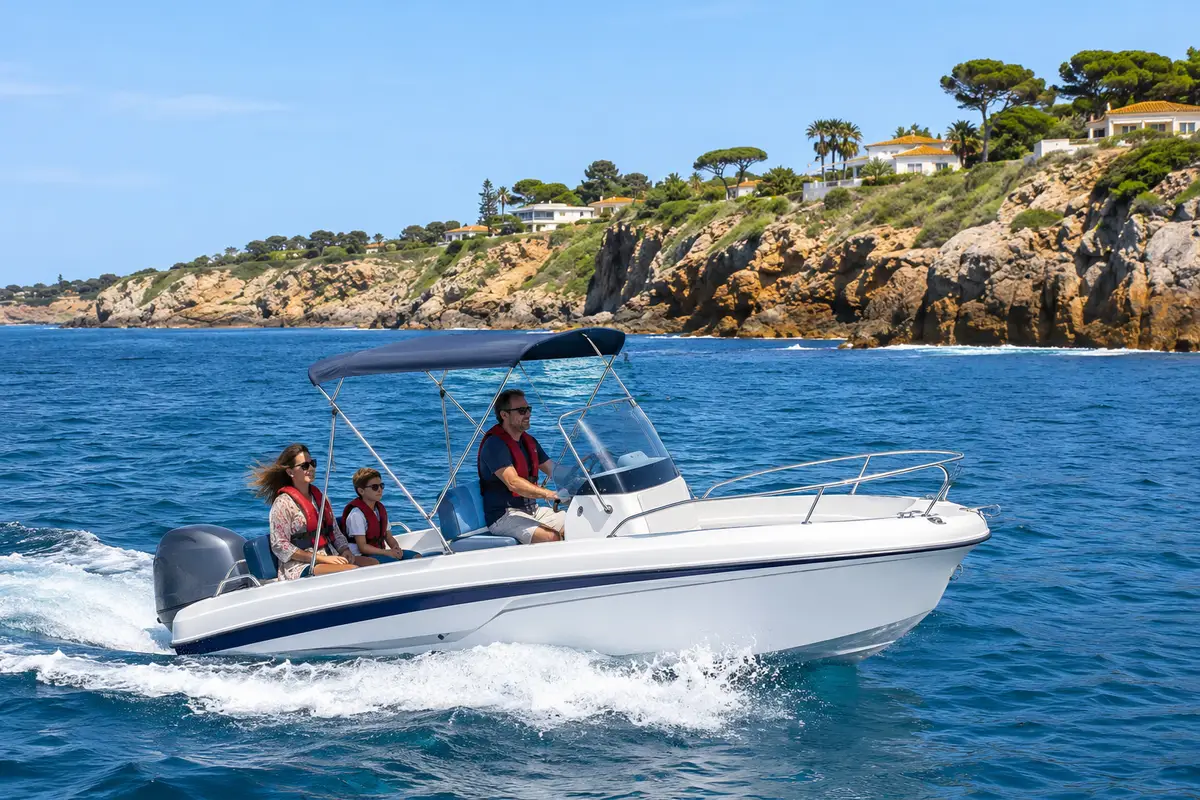
Cruising areaTwo limits to meet at the same time
This licence has two distance limits to plan around. You must stay within sight of the coast, up to 6 nautical miles from the coast and up to 25 nautical miles from a port of refuge. Both limits apply together, so check them before casting off.
With the Carta de Patrão Local you can
- Operate recreational craft within sight of the coast
- Navigate up to 6 nautical miles from the coast
- Navigate up to 25 nautical miles from a port of refuge
Stay within these limits
- Keep within 6 nautical miles of the coast
- Keep within 25 nautical miles of a port of refuge
- Plan every trip to meet both limits
Before you beginAge requirement
- Be at least 18 years old
PreparationHow to prepare and earn the licence
- Start with RIEAM
Master RIEAM (Portugal’s collision-prevention rules) 5–37, including lights, shapes and sound signals.
- Work on buoyage and coastal navigation
Study the rest of the syllabus in Portaria n.º 288/2000 (Ministerial Order No. 288/2000). It covers Mercator charts and position lines, compass variation and deviation, dead reckoning and coastal navigation, tides and calculating depth at a given time, radar, GPS and depth sounders, radio at CRO (restricted operator certificate) level, meteorology, manoeuvring, safety and engines. The free preparation course covers these in five blocks.
- Complete the practical preparation
The category includes a practical component alongside the theory. Include safety equipment in your study too.
- Pass both components
You take theory and practical tests and must pass both. Check the current requirements and exam syllabus with DGRM (Direção-Geral de Recursos Naturais, Segurança e Serviços Marítimos, Portugal’s maritime resources and safety authority) / Polícia Marítima (maritime police).
AssessmentWhat counts in the exam
| Element | Requirement |
|---|---|
| Components | Theory and practical, with a pass in both |
| Overall mark | Above 60 per cent |
| RIEAM and navigation or chartwork | At least 75 per cent, when assessed |
| Radio and safety or emergencies | At least 60 per cent, when assessed |
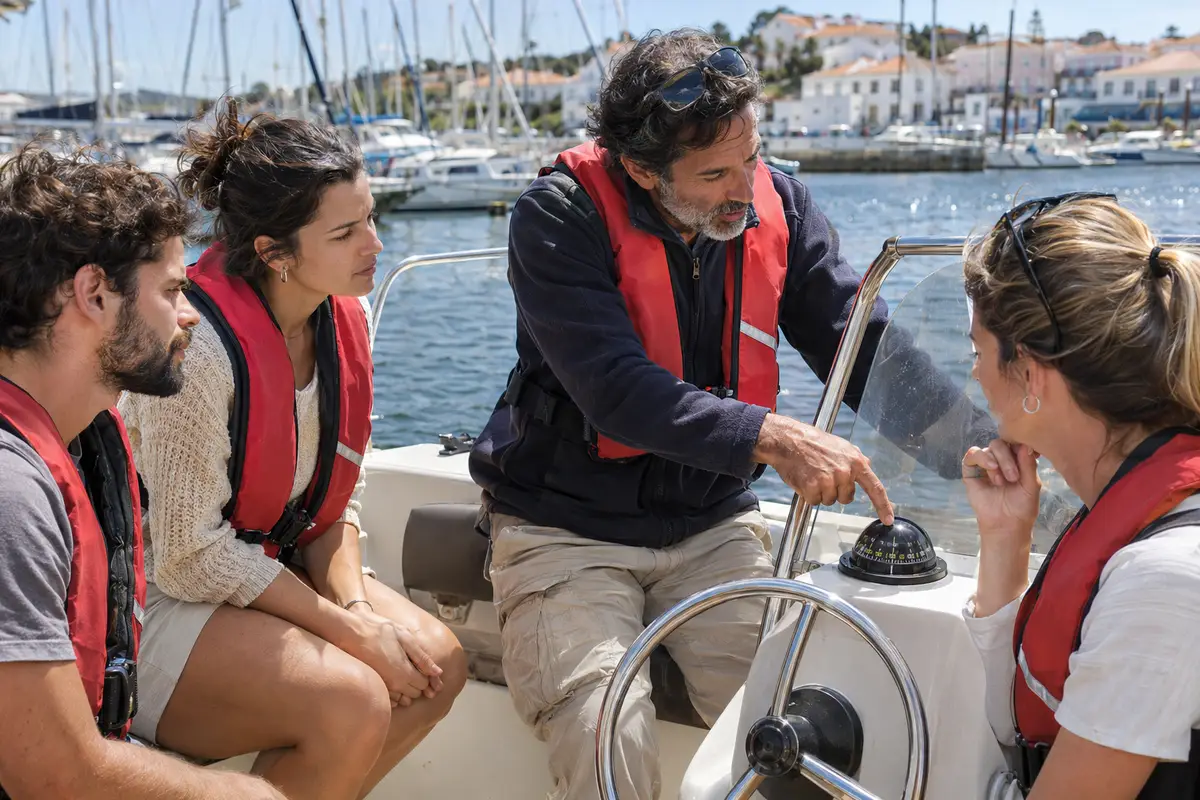
ProgressionWhere does it sit in the Portuguese ladder?
- Marinheiro Júnior (junior recreational boat operator)by day, up to 3 nautical miles from a port of refuge
- Marinheiroby day, up to 10 nautical miles from shelter
- Patrão Localwithin sight of the coast, up to 25 nautical miles from a port of refuge
- Patrão de Costathe boat’s own limits still apply
- Patrão de Alto-Marthe boat’s own certified limits still apply
Our verdict
Strengths
- Gives you a clear framework for boating within sight of the coast
- Covers essential subjects including RIEAM, IALA, coastal chartwork and meteorology
- The intermediate step between Marinheiro and Patrão de Costa
Keep in mind
- The coast and port-of-refuge limits apply together
- Passing requires both theory and practical tests
- Some subjects have their own minimum marks when assessed
The Carta de Patrão Local is a sound choice if you plan to use a recreational boat within sight of the coast and within its two distance limits. Put time into chartwork, RIEAM and weather planning to turn the category into responsible independence afloat.
Topics tested
Practice tests
IALACOLREG Exam Pass
Carta de Patrão Local: get ready for your exam with the Exam Pass
Unlimited timed mock exams, every mistake back until it's right, and a readiness score that shows when you're ready for the exam.
512 exam-style questions with explanations · 7 timed subject exams · every simulator scenario
One payment for 12 months, so it covers a resit too. No subscription.
Practice questions (with answers)
In IALA Region A, the port-hand mark colour is:
Show answer
Correct answer: B. Red, usually can-shaped
Region A: port-hand red, starboard-hand green. Region B: port-hand green, starboard-hand red. Interpret both in the charted conventional direction of buoyage.
A North Cardinal mark indicates safe water lies to the:
Show answer
Correct answer: C. North of the mark
Cardinal marks indicate safe water lies on the named side: North cardinal = pass to the north.
An isolated danger mark indicates:
Show answer
Correct answer: B. A danger with navigable water all around
An isolated danger mark is on or near a danger with navigable water around it. Consult charts and nautical publications for the extent of the danger and safe passing distance.
Safe water marks have:
Show answer
Correct answer: A. Red and white vertical stripes
Safe water marks are red and white vertical stripes, indicating navigable water all around.
The day shape for a power-driven vessel towing astern when the tow exceeds 200 metres is:
Show answer
Correct answer: C. A diamond shape
Rule 24(a)(v): a diamond shape is shown where it can best be seen if the tow exceeds 200 metres, measured from the stern of the towing vessel to the after end of the tow.
A vessel under oars at night, if she does not exhibit the lights for sailing vessels, shall:
Show answer
Correct answer: C. Have ready an electric torch or lantern showing a white light, to exhibit in time to prevent collision
Rule 25(d): a vessel under oars may exhibit the lights prescribed for sailing vessels; if she does not, she shall have ready at hand an electric torch or lighted lantern showing a white light to be exhibited in sufficient time to prevent collision.
A vessel engaged in fishing with gear restricting manoeuvrability shows sidelights and a sternlight when:
Show answer
Correct answer: C. Making way through the water
Rule 26: sidelights and sternlight are shown by fishing vessels only when making way through the water.
A dredger of at least 12 metres restricted in ability to manoeuvre shows on the obstructed side:
Show answer
Correct answer: B. Two red all-round lights or balls
Rule 27(d): two red all-round lights or two balls on the obstructed side, two green or two diamonds on the clear side.
The full guide
The Carta de Patrão Local is the Portuguese coastal-skipper licence — the Portuguese local-skipper category for craft in sight of the coast, up to 6 nautical miles from the coast and 25 nautical miles from a port of shelter.
Programme (Portaria 288/2000): chart and compass, dead reckoning and coastal navigation, tides and height of tide at a given time, full RIEAM and radar, GPS and echo sounder, SRC radio and GMDSS, weather, boat handling, safety and engines.
Who should take the Carta de Patrão Local
Portuguese skippers operating recreational craft in sight of the coast, within 6 NM of the coast and 25 NM of a port of shelter.
How to prepare
Study the five blocks of the programme. To pass you need over 60% overall, with at least 75% on RIEAM and on navigation and chartwork and 60% on radio and on safety. New candidates train at a DGRM-accredited school; this site is a study companion, not a replacement.
Other exams
Reviewed by Ramon Curto, Nautical teacher at IECNPC · Last reviewed: