Decide
Four situations at sea. Decide first, then read why.
0330, the bridge fire panel shows a smoke detector in the crew corridor. Nothing visible. First?
Key points
- Musters and drillsGeneral alarm: 7+ short and 1 long. Drills monthly.
- Muster list: signals, duties, substitutes.
- Drills within 24 h of sailing if over 25 % missed last month's.
- Lifeboat launched every 3 months; enclosed-space drills every 2.
- FireRemove heat, fuel or oxygen; choose the agent for the class.
- No water jet on oil or live electrics.
- CO2 only after evacuation, head count and sealing.
- Close fire doors, stop ventilation, cool boundaries.
- LifesavingLifejacket and suit on, SART and VHF in, clear of the ship.
- Abandon only on the master's order.
- Rafts float free on the HRU.
- 12 rocket parachute flares on the bridge.
- MOB and enclosed spacesShout, throw, point; never enter to rescue without breathing apparatus.
- Wheel to the side the person fell.
- Williamson turn returns along the track.
- Permit, ventilate, test (O2 about 20.9 %), attendant outside.
Check what you have read
What is the general emergency alarm signal on a ship?
Worked case: Fire alarm at 0330: smoke detector in the accommodation
You are OOW at sea, 0330, with an AB lookout. The fire detection panel on the bridge alarms: smoke detector, deck C, crew corridor port side. Nothing is visible from the bridge.
Before you read the solution: what would you do?
True or false?
Decide each statement before you see the answer.
General alarm: 7+ short and 1 long. Drills monthly.
When a person falls overboard, turn the wheel away from that side.
Open the doors to let smoke out of a burning cabin.
Remove heat, fuel or oxygen; choose the agent for the class.
Drills are only needed before a new voyage.
Water is fine on any fire.
Lifejacket and suit on, SART and VHF in, clear of the ship.
Shout, throw, point; never enter to rescue without breathing apparatus.
A smoke detector alarm at night is usually false: reset it.
The attendant should go in at once to save time.
Exercise: Emergency order of actions
Get the order right: in an emergency the first minute matters most.
Step by step
Person overboard, seen from the bridge wing by the OOW. Put the first actions in order.
- 1Press the MOB button and put the wheel over to that side
- 2Sound the alarm and call the master
- 3Start the recovery turn and keep a lookout on the person
- 4Release the bridge-wing lifebuoy with light and smoke
Fire in a galley fat fryer. What do you use?
How many short blasts, at least, before the long blast in the general emergency alarm?
Your colleague collapses in a ballast tank. You are the attendant. What do you do?
Now on your own
Now on your own.
Before releasing fixed CO2 into the engine room, put the steps in order.
- 1Account for everyone by head count
- 2Order everyone out of the space
- 3Close openings and stop ventilation and fuel pumps
- 4Release the CO2 on the master's order
How often, in months, must each crew member join an abandon-ship drill?
Which recovery turn brings the ship back along her own track at night?
What frees a liferaft automatically if the ship sinks?
Check: 10 questions
Questions from this subject, explained after each answer.
Free: lesson + 10 questions · Exam Pass: all 26 questions, unlimited practice tests, your mistakes retrained
The full explanation and the lessons for each programme item
Topic 1 of 5
Muster list, alarms and drills
The muster list shows the general emergency alarm and other signals, what each person does in an emergency, and who replaces key persons who are injured.
It is posted in conspicuous places, including the bridge, engine room and accommodation.
The general emergency alarm is seven or more short blasts followed by one long blast, on the whistle or siren and the alarm bells. On it, go to your muster station with your lifejacket and warm clothing.
SOLAS chapter III requires every crew member to take part in at least one abandon-ship drill and one fire drill every month. If more than 25 % of the crew have not taken part in drills on board that ship in the previous month, drills are held within 24 hours of leaving port. Enclosed-space entry and rescue drills are held at least every two months.
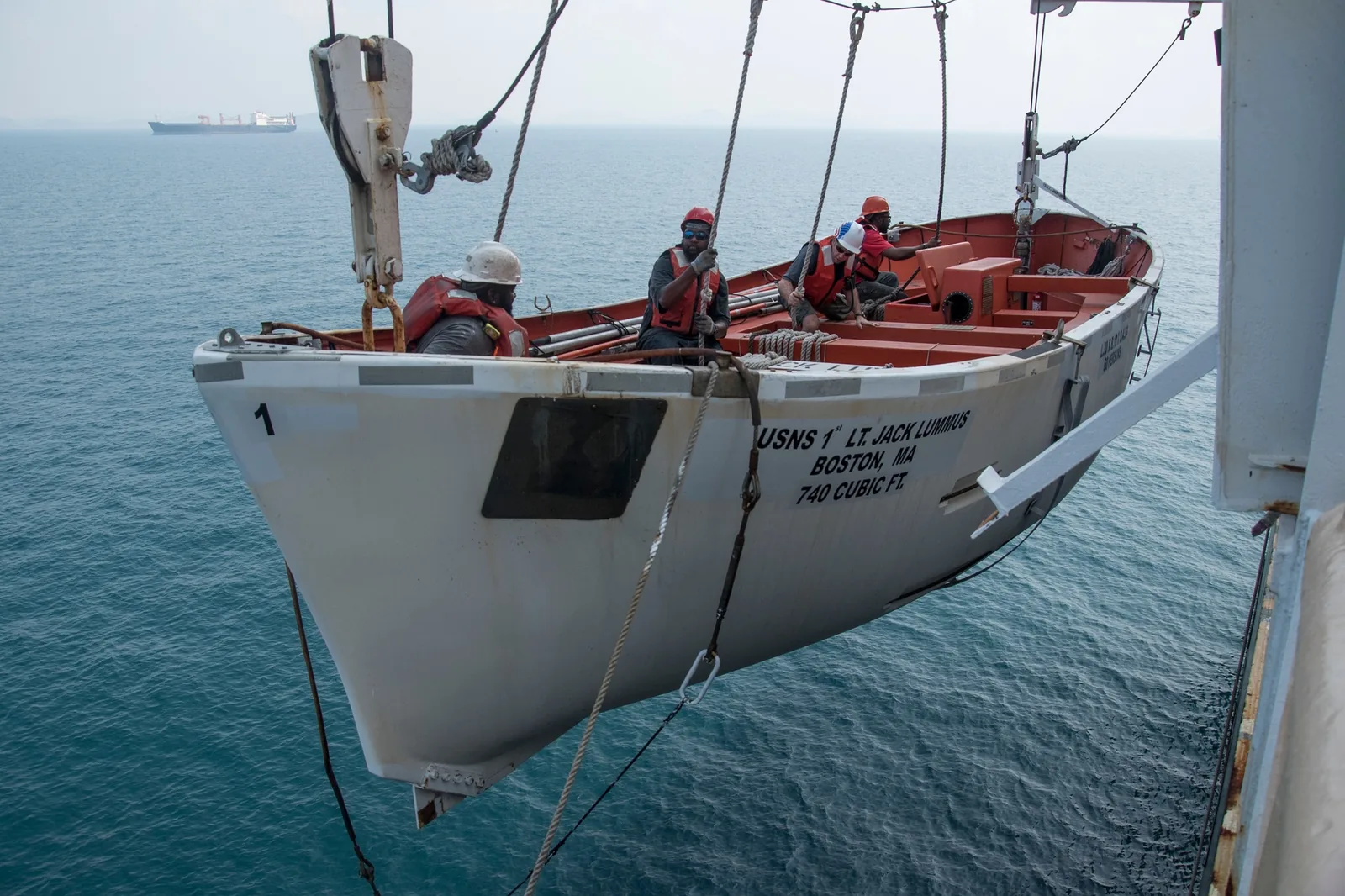
- Each lifeboat is launched with its assigned crew aboard and manoeuvred in the water at least once every three months.
- New crew get safety familiarisation before the voyage, or as soon as they join.
Topic 2 of 5
Fire: prevent, detect, fight
Fire needs heat, fuel and oxygen.
Fighting fire removes one of them: cooling with water takes away heat; foam, CO2 or closing openings takes away oxygen; shutting fuel valves takes away fuel.
Classes help choose the agent. Solids such as wood and paper: water. Flammable liquids: foam, dry powder or CO2, never a water jet. Electrical equipment: isolate it, then CO2 or dry powder. Burning gas: stop the flow first.
Prevention is daily work: no smoking outside permitted places, hot-work permits, oily rags in closed metal bins, fire doors kept closed, and fire patrols and detection systems working.
- Fixed CO2 in a machinery space: evacuate and count everyone, close all openings and stop ventilation, and only then release. CO2 kills anyone left inside.
- Boundary cooling stops the fire spreading through steel decks and bulkheads.
Topic 3 of 5
Lifesaving appliances and abandoning ship
Every person has a lifejacket, and most ships carry immersion suits for everyone.
Lifebuoys are spread around the ship; at least one on each side has a buoyant line, and some have self-igniting lights and self-activating smoke signals for use from the bridge wings.
Liferafts on a hydrostatic release float free and inflate if the ship sinks. The painter's weak link breaks to release the raft from the sinking ship.
Abandon ship only on the master's order. Wear your lifejacket and immersion suit, take the SART, the two-way VHF and the EPIRB if it has not floated free, and board the survival craft dry if you can. Once in, get clear of the ship, stay together and keep warm.
- The bridge carries at least 12 rocket parachute flares.
- Jumping into the water: from as low as possible, with the lifejacket held down and the legs together.
Topic 4 of 5
Person overboard and enclosed spaces
Whoever sees a person fall: shout "man overboard" and which side, throw a lifebuoy, and keep pointing at the person.
The OOW presses the MOB button on the GNSS or ECDIS, releases the bridge-wing lifebuoy, puts the wheel over to the side the person fell (to swing the stern away), sounds the person-overboard alarm the muster list sets, calls the master and starts a recovery turn.
The Williamson turn brings the ship back along her own track on the reciprocal course, good at night or when the person is lost from sight. The single turn (Anderson) is quickest when the person is in sight and the ship handles well. The Scharnow turn suits a delayed report.
Enclosed spaces, such as tanks, cofferdams and holds, can lack oxygen or hold toxic or flammable gas. Entry needs a permit, ventilation, atmosphere testing (oxygen about 20.9 %, no flammable or toxic gas), communications and an attendant at the entrance. If someone collapses inside, the attendant raises the alarm and does not go in: the rescue team enters with breathing apparatus.
- Most deaths in enclosed spaces include would-be rescuers who went in without breathing apparatus.
- Inform the master and other ships (urgency call) during a person-overboard search.
Topic 5 of 5
Practise and go further
The best places to practise this subject. When you finish, one tap brings you back to the course.
- Man overboard trainerSimulator
- Musters and alarmsLesson
- Emergency drillsLesson
- Fire theoryLesson
- FirefightingLesson
- Fire on boardLesson
All lessons by programme item
- 8.1 Muster list, alarms and drills (SOLAS chapter III)
- 8.2 Fire prevention, detection and fighting (SOLAS chapter II-2)
- 8.3 Life-saving appliances and abandoning ship
- 8.4 Person overboard and enclosed-space entry
Sources
Checked against the public standards on .