
Pick a mooring or anchorage carefully
Mooring areas contain people, dinghies and trailing ropes.
Take extra care at night: moored boats may not be lit. In a powered vessel travelling at 6 knots or more, keep at least 30 metres from moored vessels. If that is not possible, keep a safe distance and travel at a safe speed. Approach a mooring slowly with minimal wash, usually towards the wind or current. Stop with the buoy ahead of the bow, put the engine in neutral, then pick up the mooring. Boating Handbook, pp. 144–145.
Pink buoys are free public moorings for a 24-hour period. Yellow identifies private moorings, orange commercial, red club and blue emergency moorings. Do not assume an empty buoy is yours to use: private, commercial and emergency moorings require a licence or authorisation. At a wharf, secure bow and stern lines and allow for the tide. Before leaving, start the engine at idle, check traffic and bring loose lines aboard so they cannot foul the propeller. Boating Handbook, pp. 145–146.
Choose shelter for the expected wind and swell, adequate depth through the tide and enough room to swing if the wind changes. Never anchor in a navigation channel, where you would obstruct access to wharves, ramps or moorings, or within 200 metres of underwater cables. Avoid reefs, bomboras, historic wrecks and sensitive habitat such as seagrass, even without a sign. If your anchor snags a cable, do not try to pull it free; cut the line as close as possible to the anchor. Boating Handbook, p. 146.
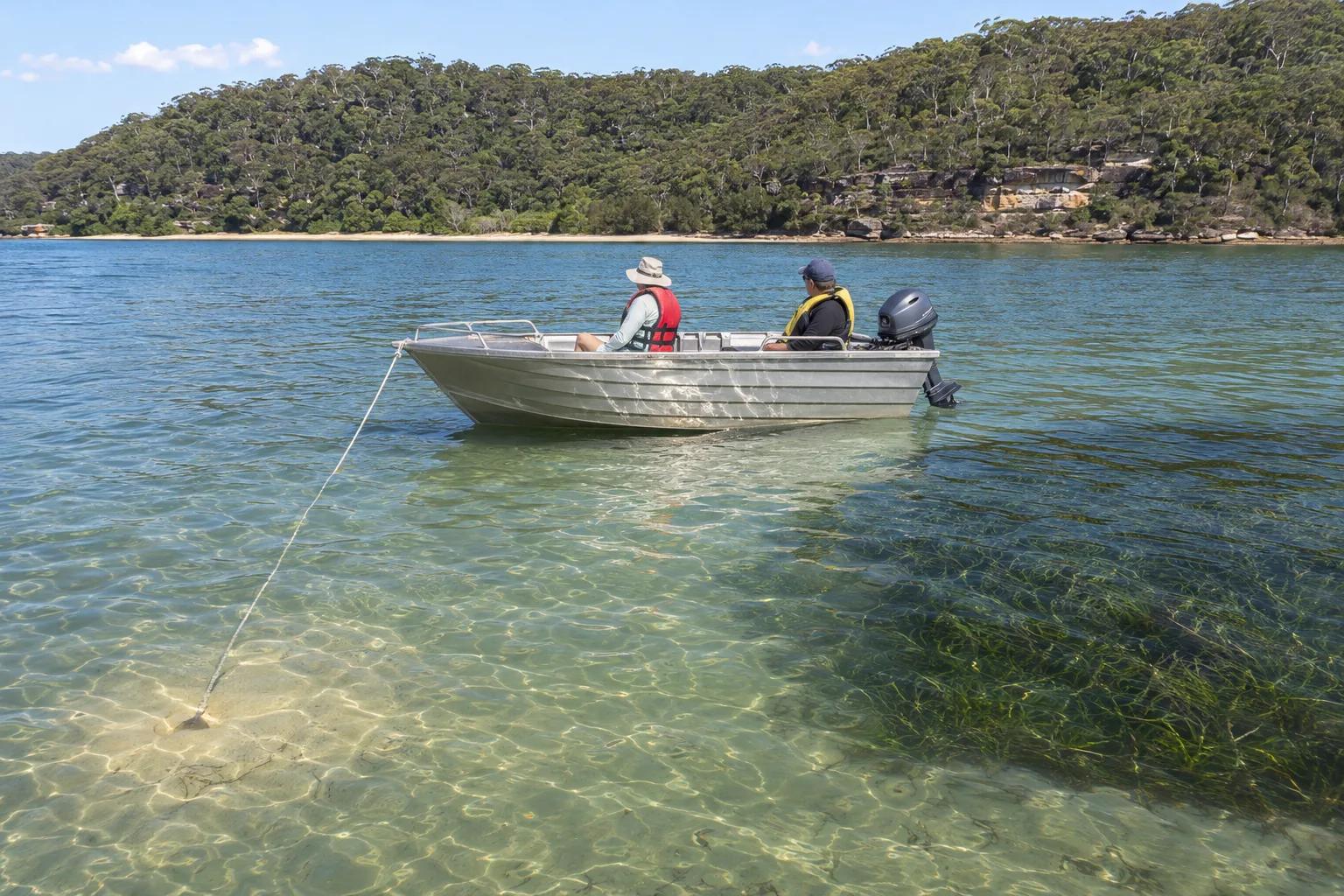
Prepare an anchor suited to the boat and seabed, with the line's other end secured. Lower it from the bow and let the boat move backwards as you pay out line. The handbook gives 3 times the water depth, increased to 5 times or more in deteriorating weather or strong currents. Keep feet clear of the line, allow swing room, check the anchor has held against nearby landmarks and recheck regularly in strong wind or current. Anchoring by the stern can swamp and flood the boat. Boating Handbook, pp. 146–147.
- Shelter that works in one wind direction may be unsafe after a wind change.
- A buoy's colour identifies its mooring category, not a promise that it suits your boat.
- Anchor from the bow and confirm you are holding before settling in.
Check this lesson
An empty yellow mooring buoy looks convenient for lunch. What does its colour tell you?