

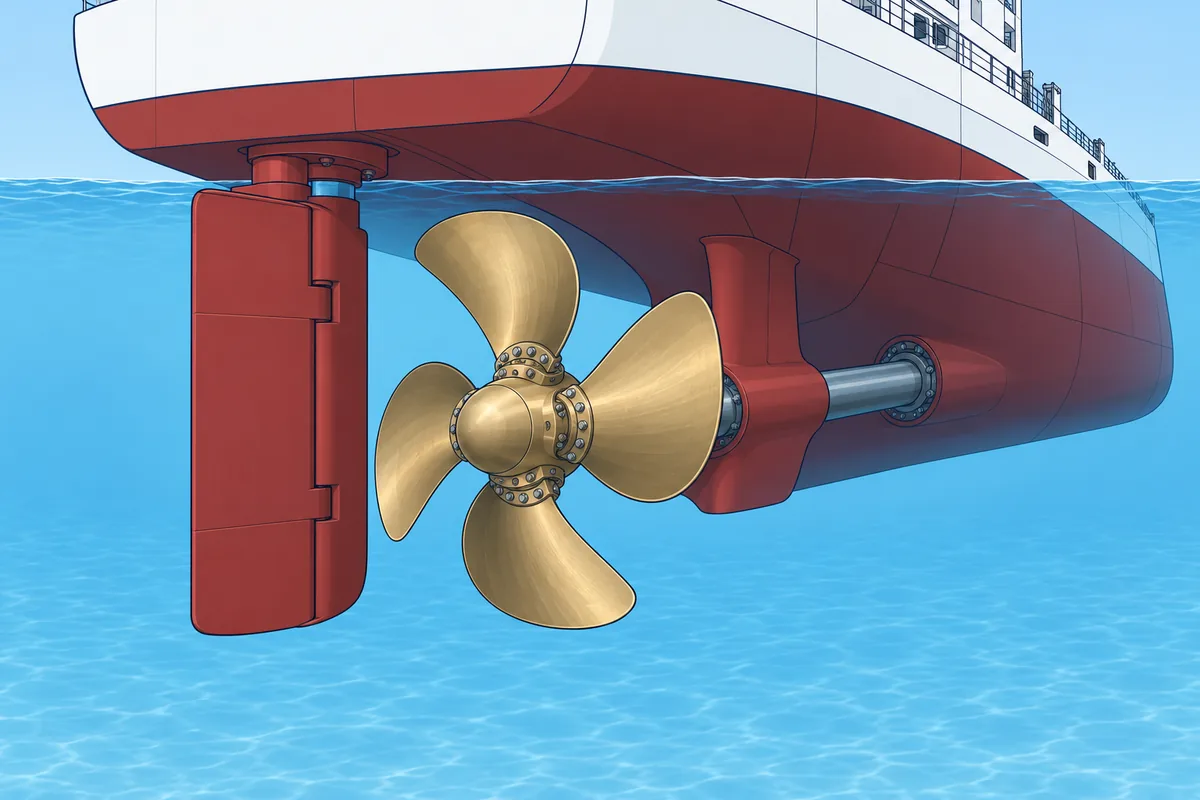
Controllable-pitch and ducted propellers
See it in 3D
Drag to rotate, scroll or pinch to zoom. Try the controls to see how thrust changes. Double-click to reset the view.
1The lesson in plain words
A controllable-pitch propeller changes blade angle for ahead or astern. A Kort nozzle adds low-speed pull around a propeller.
Fixed and controllable pitch
Pitch describes a blade’s theoretical advance in one revolution; it is linked to blade angle. A fixed-pitch propeller (FPP) cannot change that angle. Change shaft speed for thrust and reverse shaft rotation for astern. A controllable-pitch propeller (CPP) twists its blades in the hub, usually using hydraulic oil pressure. Ahead, zero and astern pitch are available without reversing shaft rotation, often at constant shaft speed.
Zero is not stopped
Zero pitch gives little net thrust but leaves the propeller turning. Do not select zero pitch to slow down while you need the rudder: it breaks the rudder flow. Keep people and lines clear. Before work near the propeller, stop the shaft and secure controls against restart; zero pitch is not isolation.
Handling and limits
CPP is less effective astern. CPPs are usually left-turning, so astern their lateral force takes the stern to port, like a conventional right-handed FPP. A right-turning CPP astern would take the stern to starboard. With a fixed shaft, a separate rudder steers. Hydraulic failure may leave the last pitch or a preset pitch; know the installation.
Kort nozzle
A duct, often called a Kort nozzle, is a shaped ring around a propeller. It adds thrust when working hard at low speed. Tugs use it for bollard pull, the pulling force measured while secured to a fixed bollard. At high speed the ring adds drag. A fixed nozzle does not steer; a steering nozzle turns the ring to direct thrust and can replace a rudder.
2Key points
- 1
FPP reverses shaft rotation; CPP changes blade angle for astern.
- 2
Zero pitch does not stop rotation and may still allow slow movement.
- 3
CPP is weaker astern; usual left-turning CPP walks stern to port, right-turning to starboard.
- 4
A Kort nozzle improves heavily loaded low-speed thrust but adds high-speed drag.
- 5
A steering nozzle turns to direct thrust; a fixed nozzle does not.
3Frequent mistakes
Wrong: Zero pitch makes the stern safe for a diver.
Right: The propeller still turns. Stop the shaft and lock out propulsion under the vessel’s procedure.
Wrong: A Kort nozzle improves efficiency at every speed.
Right: It helps at high load and low speed. Its drag becomes a disadvantage at high speed.
4Practice case & exam keys
Your CPP vessel is alongside at zero pitch. Someone wants to inspect a line near the propeller.
Show the answer
Keep them clear. Zero pitch can leave the propeller rotating and may allow slow movement. Stop the shaft and secure the controls against restart before anyone goes near it, following the vessel’s isolation procedure.
Exam keys
- FPP: fixed blade angle; CPP: adjustable blade angle with unchanged shaft direction.
- Zero pitch: little net thrust, continuing rotation; avoid it while slowing if you need rudder flow.
- Kort nozzle: extra low-speed pull; steering nozzle: ring turns to direct thrust.
Finish this unit
When you've read it, answer three questions. Get all three right to finish the unit; opening the page alone doesn't count.
My notes for this unit
No notes