

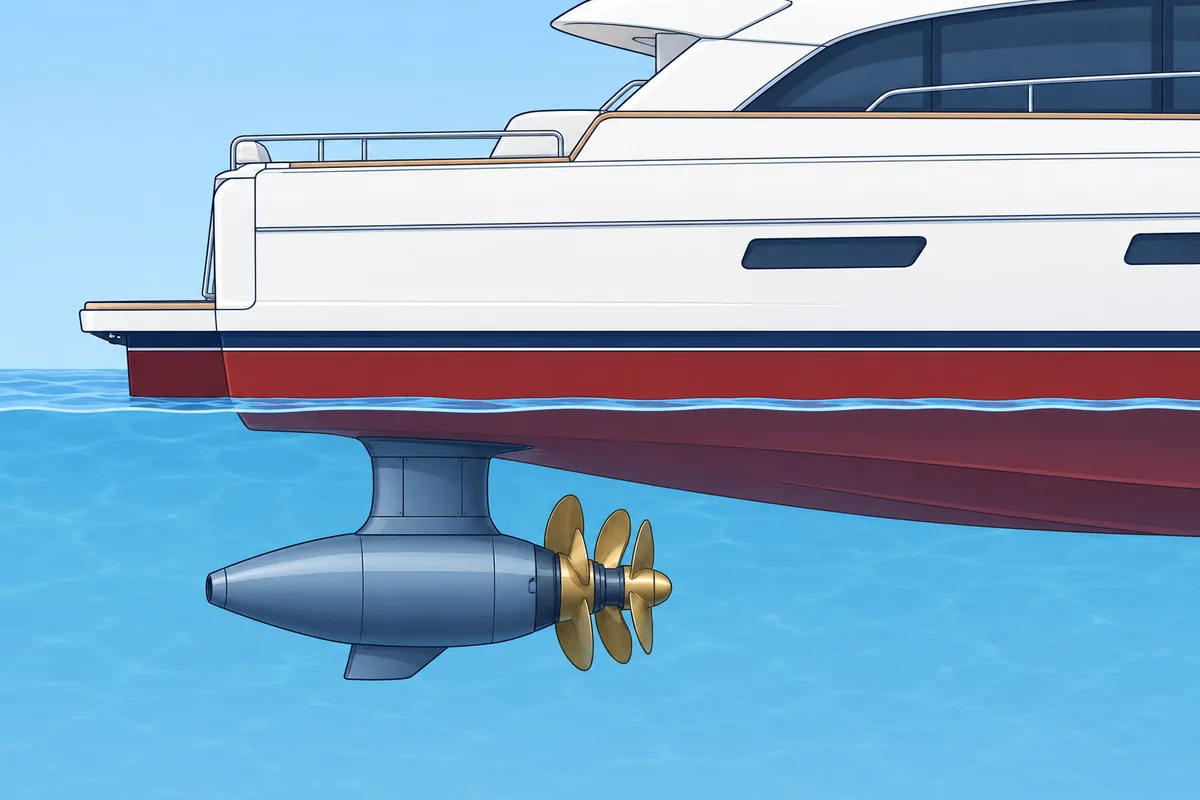
Pod drives and azimuth thrusters
See it in 3D
Drag to rotate, scroll or pinch to zoom. Try the controls to see how thrust changes. Double-click to reset the view.
1The lesson in plain words
Pods and azimuth thrusters point their thrust to steer. Know their turning limits and how to control the boat after a fault.
Yacht pods
Many motor yachts have twin pods below the hull, driven by engines inside. Some use forward-facing, counter-rotating propellers that pull the boat. Each pod swivels through a limited angle. A joystick combines their angles and thrust to move sideways or turn nearly on the spot. This makes close handling easier, but the underwater units are exposed to grounding damage.
Electric ship pods
Large ship pods contain an electric motor directly on the propeller shaft. Generators in the hull supply electricity. Many can turn through 360°, giving thrust in any direction without a separate rudder. Cruise ships, icebreakers and ferries use them. Do not assume a yacht pod has the same turning range.
Azimuth thrusters
An azimuth thruster turns its underwater propeller unit to point the thrust. A mechanical Z-drive transmits power from a motor inside the hull through shafts and gears; electric variants also exist. An azimuth stern drive (ASD) tug has units aft. A tractor tug has its propulsion units forward. Tractor tugs may use azimuth or cycloidal drives.
Turning limits
Pods take time to rotate. Large units may need several seconds to reach an ordered angle. Follow the maker’s limits on angle, speed and power: a large sideways thrust at speed can make the ship heel, or lean. Anticipate the delay instead of making repeated large corrections.
Faults and backup
A failed pod may stay at its last angle; do not assume it centres or stops thrusting. Learn the backup wheel-and-lever controls or alternative control station before departure. A control backup cannot cure every mechanical fault. Follow the maker’s fault procedure; stop an uncontrollable unit as instructed. One working unit gives reduced capability, not normal handling.
2Key points
- 1
Pods steer by pointing thrust; twin yacht pods can combine forces for sideways moves.
- 2
Yacht pods usually have limited angles; many ship pods turn 360°.
- 3
ASD tug units are aft; tractor-tug units are forward.
- 4
Pods rotate at a limited rate; respect angle and power limits.
- 5
A faulty unit may hold its last angle: know the backup controls.
3Frequent mistakes
Wrong: Every pod turns instantly through 360°.
Right: Yacht pods often have limited angles. Large ship pods rotate at a limited rate.
Wrong: A failed pod automatically centres itself.
Right: It may hold its last angle. Know the fault procedure and how to stop an uncontrollable unit.
4Practice case & exam keys
A yacht’s joystick reports a fault near a marina entrance. One pod is still angled.
Show the answer
Stay in clear water and reduce the demand for thrust. Follow the maker’s fault procedure and use the backup controls if available. Do not assume the angled pod has centred. Delay a tight approach until you have confirmed what control remains.
Exam keys
- Yacht pods: joystick combines limited-angle units for close handling.
- Electric ship pod: motor inside the pod, electricity supplied from the hull.
- ASD units aft; tractor units forward; thrust direction is steerable.
- Limited rotation rate and possible last-angle failure require anticipation and backup control.
Finish this unit
When you've read it, answer three questions. Get all three right to finish the unit; opening the page alone doesn't count.
My notes for this unit
No notes