

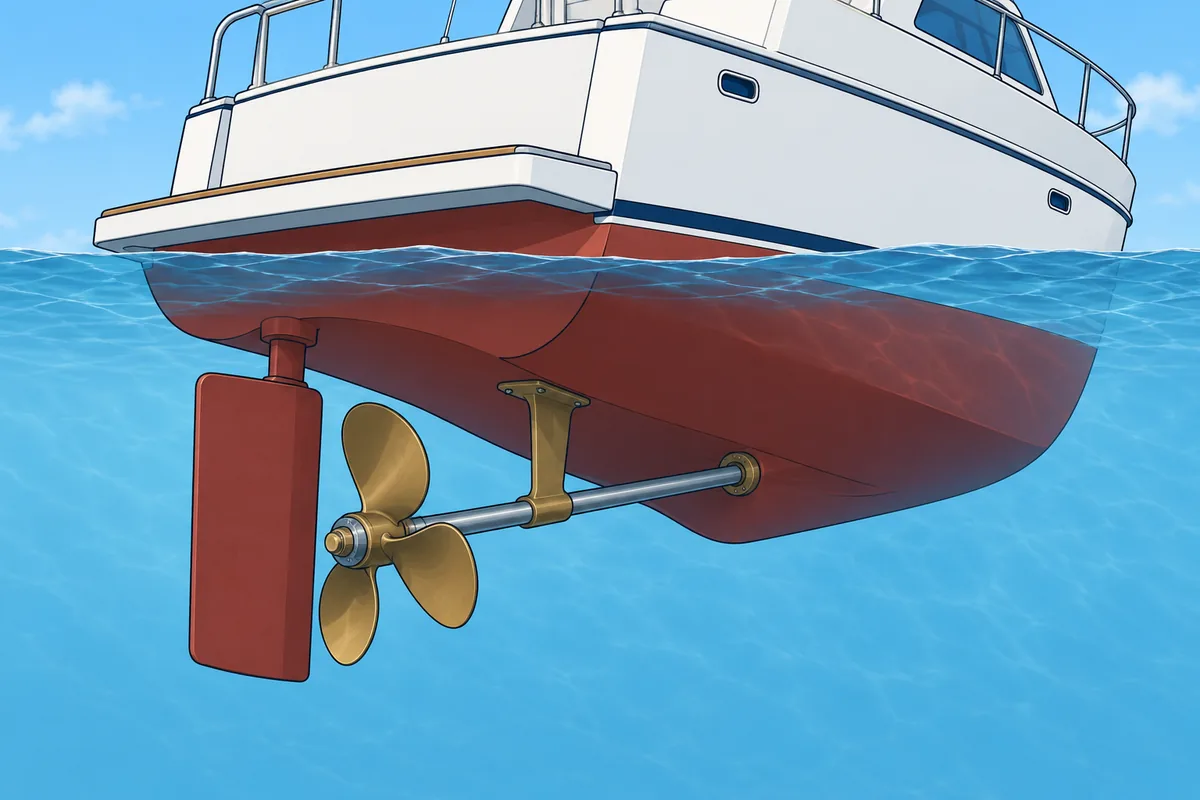
Inboard engine with shaft drive (and V-drive)
See it in 3D
Drag to rotate, scroll or pinch to zoom. Try the controls to see how thrust changes. Double-click to reset the view.
1The lesson in plain words
An engine inside the hull turns a shaft and propeller. A separate rudder steers; expect a sideways stern kick when you reverse.
Layout
An inboard engine sits inside the hull. On a typical yacht, a gearbox drives a long shaft through a sealed tube to the propeller below the hull. A separate rudder, the underwater steering blade, sits behind the propeller. The layout is rugged and suits cruising yachts, workboats and ships. Its underwater propeller is exposed to grounding damage.
Steering and walk
Going ahead, propeller wash, the water accelerated by the propeller, flows over the rudder. This helps steering even at low boat speed. Going astern, that wash flows away from the rudder, so steering is weak until you move backwards. Propeller walk is the sideways kick of the stern. A conventional right-handed propeller, clockwise viewed from astern when driving ahead, usually kicks the stern to port (left) astern. See Manoeuvring: forces for handling it.
V-drive
A V-drive puts the engine aft, near the back of the boat, with its output facing forward. A special gearbox turns the drive back towards the propeller. This frees cabin space in the middle. You still steer with a separate rudder, and propeller walk remains.
Direct-drive ships
Many large ships couple a slow-speed diesel directly to a fixed-pitch propeller, whose blade angle cannot change. With no reversing gearbox, the engine must stop and restart in the opposite direction for astern. Compressed air starts it; the available starts are limited. Allow for the delay.
Main check
Know the shaft seal where the shaft passes through the hull: a failed seal can let the sea in. Check for abnormal leakage before departure. Shift a yacht gearbox through neutral at idle; the full drive-line check belongs in Propulsion basics.
2Key points
- 1
A shaft drive has an inboard engine, shaft, propeller and separate rudder.
- 2
Propeller wash helps the rudder ahead; initial steering astern is weaker.
- 3
Expect propeller walk astern; confirm its direction on your boat.
- 4
A V-drive puts the engine aft and turns its output back towards the propeller.
- 5
A direct-drive fixed-pitch ship goes astern by stopping and reversing the engine.
3Frequent mistakes
Wrong: The rudder responds equally well ahead and astern.
Right: Astern wash does not flow over it. You need movement through the water for a useful rudder response.
Wrong: A direct-drive ship reverses instantly.
Right: The engine must stop and restart in reverse. Starting air is limited, so repeated changes need care.
4Practice case & exam keys
Your unfamiliar V-drive yacht is stopped in clear water. Before trying a tight berth, what should you establish about its first movement astern?
Show the answer
Test at low power with ample clearance. A V-drive still uses a shaft and separate rudder. Expect sideways walk before useful rudder response develops with backward movement. Confirm the actual kick and response on this boat.
Exam keys
- Shaft drive: separate rudder in the ahead propeller wash.
- Right-handed single shaft: stern usually kicks to port astern; test your boat.
- V-drive: engine aft, output forward, drive turned back through a gearbox.
- Direct-drive fixed-pitch ship: engine stopped and restarted in reverse.
Finish this unit
When you've read it, answer three questions. Get all three right to finish the unit; opening the page alone doesn't count.
My notes for this unit
No notes