

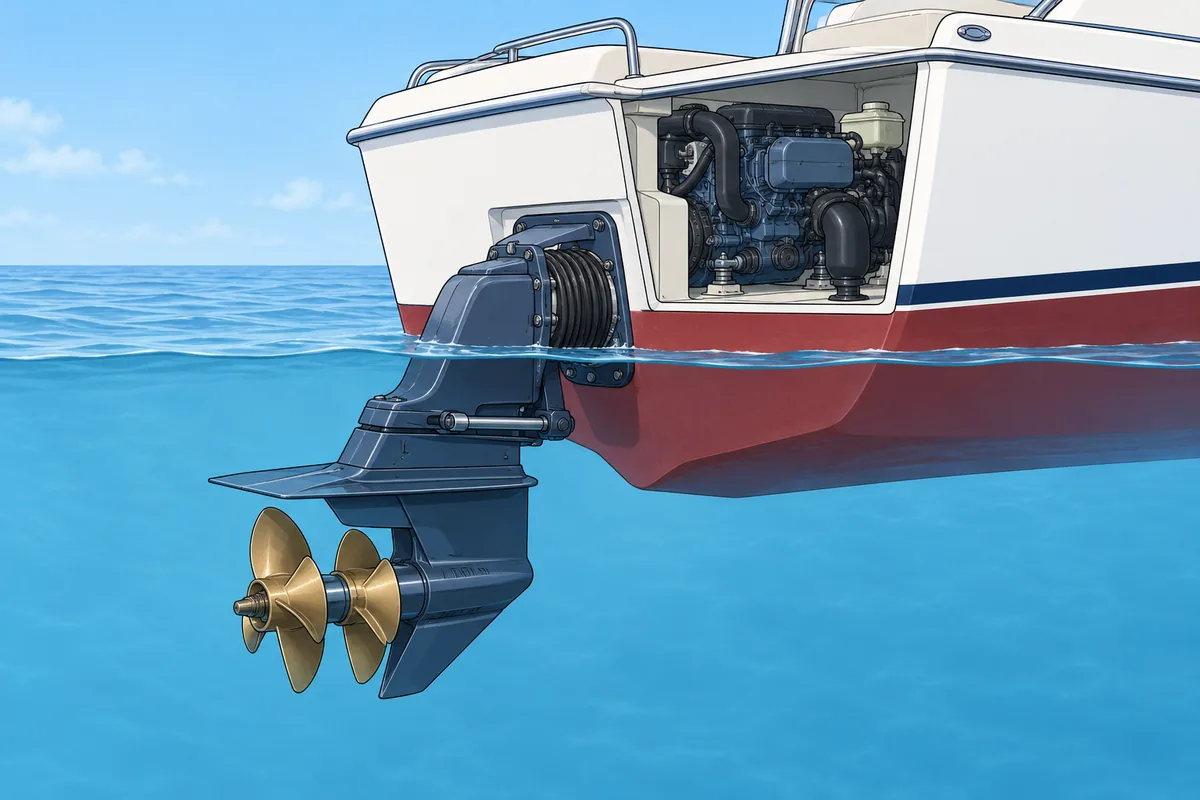
Sterndrive (inboard-outboard)
See it in 3D
Drag to rotate, scroll or pinch to zoom. Try the controls to see how thrust changes. Double-click to reset the view.
1The lesson in plain words
A sterndrive combines an engine inside the hull with a steerable leg outside. Check its bellows and ventilate petrol engine spaces.
Layout
A sterndrive, also called an inboard-outboard, has an engine inside the boat near the transom, the flat stern end. It drives a leg outside the transom. The leg turns to steer and can adjust its running angle (trim) or lift (tilt). This compact layout is common on motor boats about 5 to 12 metres long.
Steering and duoprop
The leg points the propeller thrust, so at low speed steering is strong under power and much weaker in neutral. With appreciable way, the immersed leg and skeg can still steer without thrust. A duoprop has two propellers on one leg turning in opposite directions: counter-rotating. Their sideways forces largely cancel, giving very little propeller walk and good grip. A single-propeller leg may still give a sideways kick.
Bellows
Flexible rubber bellows protect and seal connections through the transom, including the drive joint and shift cable on many designs. Failure of a watertight bellows can admit water into the boat or damage the drive. Inspect for cracking at each lift-out and renew at the maker’s interval. Bellows arrangements vary; an exhaust bellows is not the same flooding barrier on every model.
Petrol safety
Petrol vapour is heavier than air and can collect in the bilge, the lowest space inside the hull. Before starting a petrol inboard, run the bilge blower, a ventilation fan, for the maker’s specified time, often several minutes. Check for petrol vapour. Do not start if you smell petrol. Find and fix the cause first.
Benefits and limits
You get an inboard engine with outboard-like steering and trim. The exposed leg and its seals need care. Lift it fully only with the engine stopped, and keep the cooling intake submerged during permitted running. Follow the maker’s limits rather than treating tilt as permission to run anywhere.
2Key points
- 1
Engine inside; steerable leg outside the transom.
- 2
A duoprop uses counter-rotation to largely cancel propeller walk.
- 3
Watertight bellows can be flooding points: inspect and renew on schedule.
- 4
Petrol inboard: blower before start; never start with a petrol smell.
3Frequent mistakes
Wrong: Duoprop means one propeller drives ahead and the other astern.
Right: Both produce thrust together. They rotate oppositely so their sideways forces largely cancel.
Wrong: All bellows are just protective covers.
Right: Some seal openings below the waterline. Their failure can flood the boat; check your drive’s arrangement.
4Practice case & exam keys
You have run the blower before starting a petrol sterndrive, but you still smell petrol near the engine space.
Show the answer
Do not start. Running the blower does not make a continuing fuel leak safe. Keep ignition sources away and have the cause found and corrected before using the engine.
Exam keys
- Sterndrive: inboard engine, steerable external leg, little steering in neutral.
- Duoprop: two counter-rotating propellers on one leg, very little walk.
- Inspect watertight bellows; use the blower before starting a petrol inboard.
Finish this unit
When you've read it, answer three questions. Get all three right to finish the unit; opening the page alone doesn't count.
My notes for this unit
No notes