

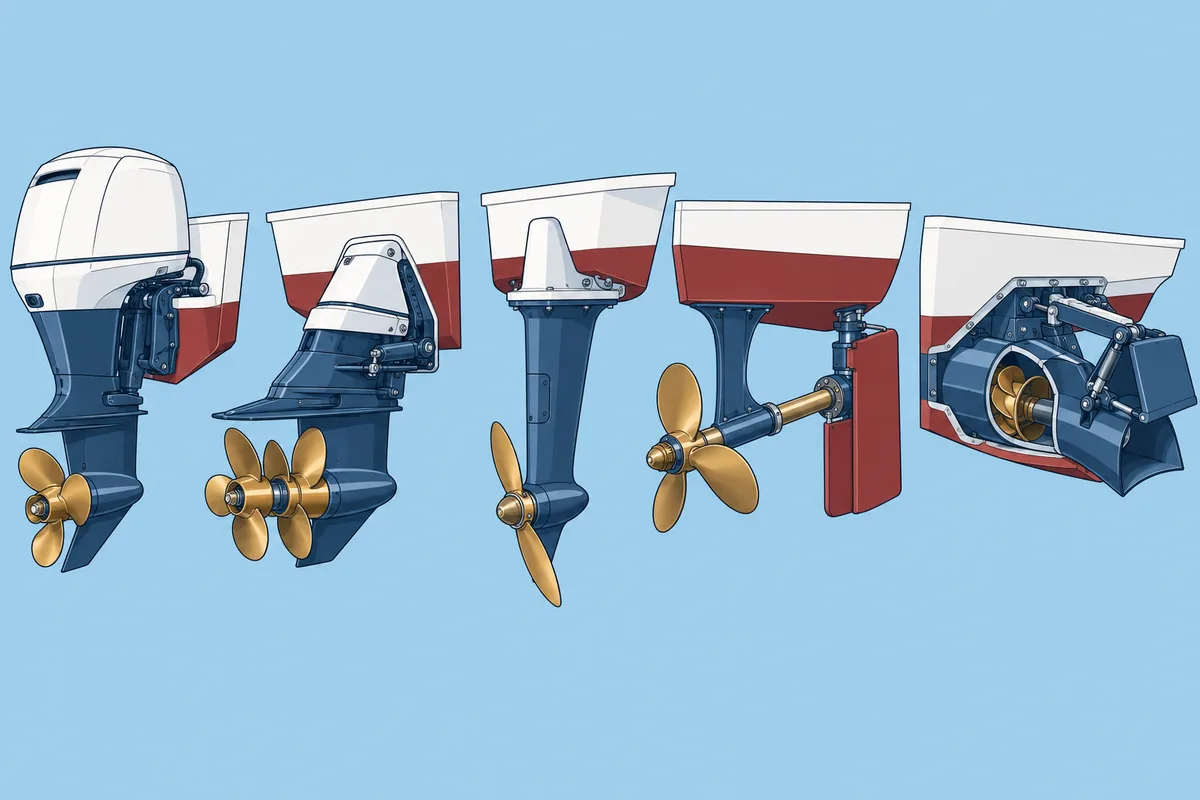
Comparing the systems
1The lesson in plain words
Start with how the boat steers, then its sideways kick and operating limits. Learn your own installation before you leave the berth.
Steering families
Conventional shaft drives and saildrives use a separate rudder, which needs flow from boat movement or propeller wash. Outboards, sterndrives and steerable pods point propeller thrust. Cycloidal drives direct thrust by blade angle. Waterjets steer by directing pump flow. A moving rudder boat may steer in neutral. A waterjet can also steer at a balanced neutral bucket setting if pump flow continues; this differs from stopping the pump.
Propeller walk
Propeller walk is the sideways kick from the propeller. It is usually strongest astern on a single inclined shaft. A saildrive generally has less. Outboards can also have side force, but pointing thrust dominates their handling. Counter-rotating pairs, turning in opposite directions, largely cancel walk. Waterjets have no propeller walk, but bucket and nozzle settings can create sideways forces. Do not treat every pod as a counter-rotating pair.
Match the boat
Shaft drives suit robust cruising and long-range work. Saildrives suit many cruising sailing yachts. Outboards suit tenders, rigid inflatable boats and small fast craft. Sterndrives and yacht pods suit motor cruisers. Waterjets suit fast ferries and rescue craft; shallow draught, the depth needed below the waterline, is an advantage, but intakes need clearance from debris.
Specialist choices
Azimuth and cycloidal drives suit tugs and ferries needing precise low-speed control. CPP and ducted propellers suit varied loads or strong low-speed pull. Battery-electric drive suits short trips with suitable charging and reserves; diesel-electric suits ships needing flexible power distribution. The best choice depends on the work, not one claim of maximum efficiency.
Day one
Find out the drive layout, steering method and actual astern walk. Ask about thruster duty limits, pod backup controls and any delay in reversing. Locate underwater seals, intakes and anodes. Learn the engine stop, fuel shut-off or battery isolator. Check the maker’s limits and practise at low power in clear water before attempting a tight berth.
2Key points
- 1
Rudders need water flow; waterjets need pump flow, which can continue at a neutral bucket setting.
- 2
Walk varies by installation: single inclined shafts usually have the strongest astern kick.
- 3
Choose a drive for the boat’s work, depth, range and maintenance needs.
- 4
On day one, learn the controls, limits, backup and stop, then practise in clear water.
3Frequent mistakes
Wrong: All boats respond to the wheel the same way in neutral.
Right: A moving rudder boat may steer in neutral. A jet can retain steering at bucket neutral while its pump supplies sufficient flow.
Wrong: A familiar joystick means there is nothing new to learn.
Right: Check the drive’s limits and backup controls. A different installation can behave very differently.
4Practice case & exam keys
You charter a pod-drive motor cruiser after years on a single-shaft yacht. What should you establish before leaving?
Show the answer
Learn the joystick and backup controls, pod-angle limits and fault response. Check the stop controls and underwater drive risks. Practise low-power moves in clear water; do not assume the shaft yacht’s astern walk or rudder response applies.
Exam keys
- Separate rudder: conventional shaft and saildrive. Directed thrust: outboard, sterndrive, pod and jet.
- Counter-rotating propellers largely cancel walk; a single shaft usually walks more.
- Drive choice follows the job: range, speed, depth, handling and maintenance.
- First day: identify steering, walk, limits, underwater openings, backup and stop controls.
Finish this unit
When you've read it, answer three questions. Get all three right to finish the unit; opening the page alone doesn't count.
My notes for this unit
No notes