

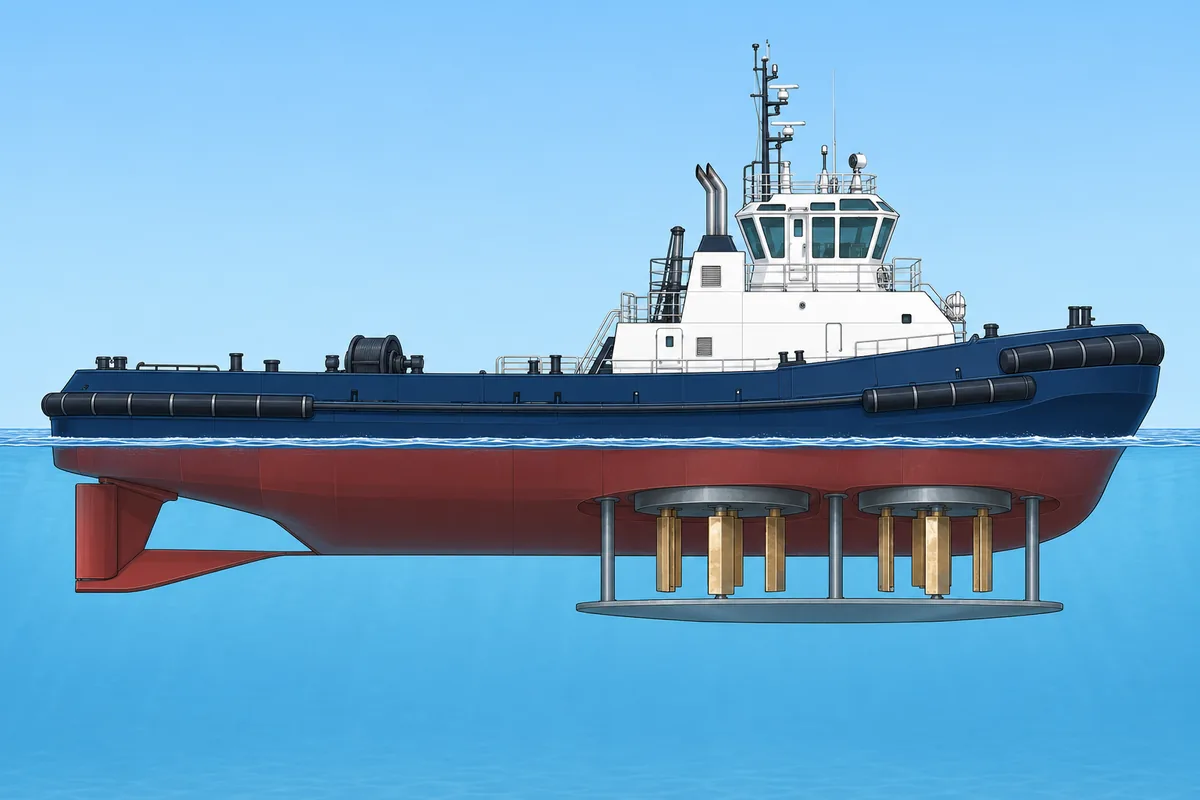
Cycloidal (Voith Schneider) propellers
See it in 3D
Drag to rotate, scroll or pinch to zoom. Try the controls to see how thrust changes. Double-click to reset the view.
1The lesson in plain words
A cycloidal propeller uses vertical blades on a rotating disc. Changing blade angles gives precise thrust in any direction.
Layout
A rotor, a flat rotating disc under the hull, carries vertical blades around its edge. As it turns, a mechanism continually changes each blade’s angle. The pattern of angles sets the direction and strength of the combined thrust. This is the principle of a cycloidal, or Voith Schneider, propeller.
Steering
The rotor can keep turning the same way while blade-angle control changes thrust from ahead to astern or sideways. There is no separate rudder and no need to swivel the whole unit. The quick, precise response helps a tug hold position or change its pull without first turning the hull.
Where it fits
Cycloidal drives suit some tractor tugs, whose propulsion units are forward, and double-ended ferries, which can work in either direction without turning round. They also serve vessels needing precise low-speed control. They are generally less attractive for long, fast passages than conventional propellers.
Trade-offs and care
The blade-control mechanism is complex and costly. The units need room and depth below the hull, and their exposed blades risk impact damage. Some have a guard plate beneath the blades, but that does not make grounding harmless. Follow the maker’s inspection schedule for blades and pitch-control linkages.
2Key points
- 1
Vertical blades hang from a rotor under the hull.
- 2
Blade angles set thrust direction and strength while the rotor keeps turning.
- 3
No separate rudder or whole-unit rotation is needed to change thrust direction.
- 4
Useful for tractor tugs and double-ended ferries.
- 5
Precise control comes with complexity, cost and underwater clearance needs.
3Frequent mistakes
Wrong: The rotor must reverse to produce astern thrust.
Right: The rotor can keep turning the same way. Changing the blade-angle pattern reverses the thrust.
Wrong: A guard plate means the blades are safe from any grounding.
Right: It offers some protection, not immunity. Maintain clearance and inspect after an impact.
4Practice case & exam keys
At a shallow ferry landing, a colleague says the guard plate makes checking clearance beneath the cycloidal blades unnecessary. Do you proceed?
Show the answer
Do not rely on the guard plate. Confirm adequate clearance for the blades and plate under the vessel’s operating limits before committing. Precise thrust control does not remove grounding risk. If you cannot establish safe clearance, change the plan.
Exam keys
- Cycloidal: vertical blades on a horizontal rotor beneath the hull.
- Thrust direction changes through blade angle, without reversing the rotor.
- Typical uses: tractor tugs and double-ended ferries; trade-offs: cost, complexity and depth.
Finish this unit
When you've read it, answer three questions. Get all three right to finish the unit; opening the page alone doesn't count.
My notes for this unit
No notes