

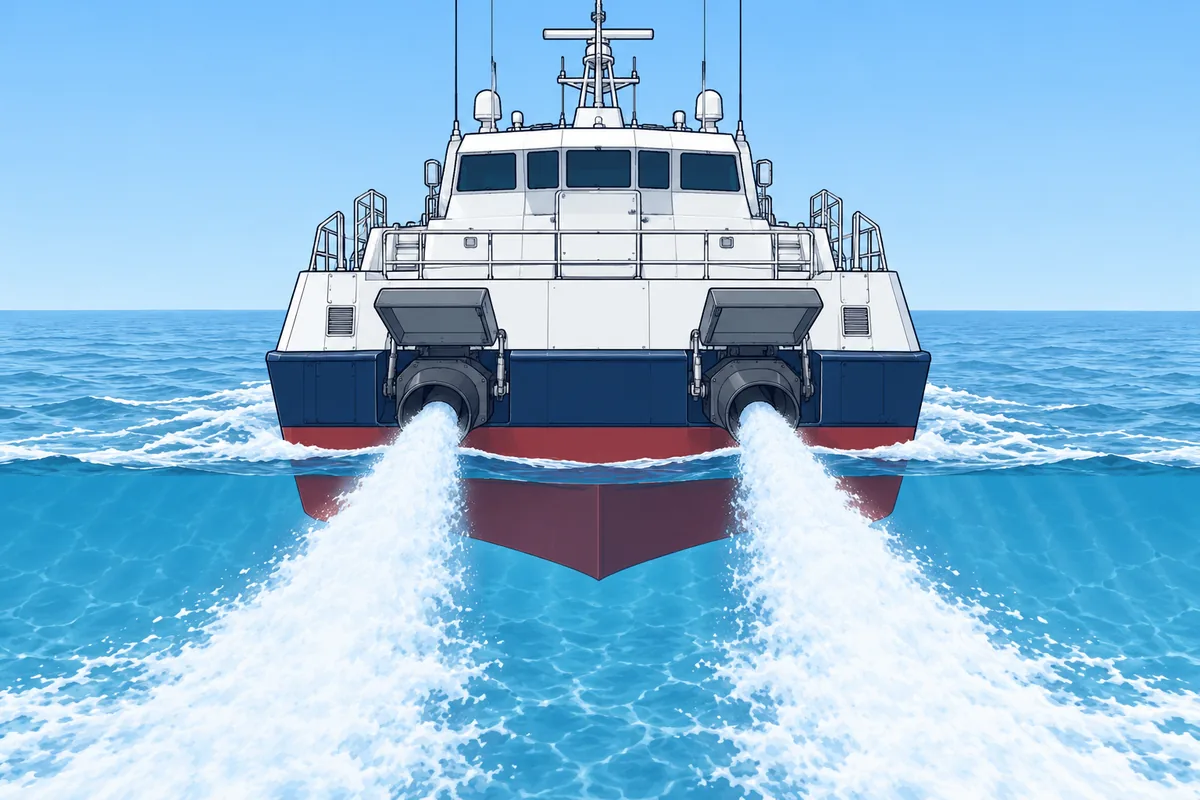
Waterjets and surface drives
See it in 3D
Drag to rotate, scroll or pinch to zoom. Try the controls to see how thrust changes. Double-click to reset the view.
1The lesson in plain words
A waterjet pumps water through a steerable nozzle. A bucket redirects it for astern; little jet flow means little steering.
Flow path
Water enters an intake beneath the hull. An impeller, a rotating pump, accelerates it through a nozzle at the stern. The nozzle points the jet to steer. A reversing bucket lowers into the jet and deflects water forward to produce astern thrust. The impeller need not reverse. An intermediate bucket position can balance ahead and astern forces, but water is still moving.
Where it fits
Waterjets suit fast ferries, patrol boats, rescue craft and personal watercraft. They can be efficient at high speed, often from about 25 knots. There is no exposed propeller, and draught can be shallow. At low speed a conventional propeller is often more efficient. The intake and jet still endanger people: stop propulsion near them.
Steering
Little jet flow means little steering. Reducing pump speed weakens steering; closing the throttle on some personal watercraft can remove it. A neutral bucket setting can balance ahead and astern forces while jet flow and steering remain available. Learn your craft’s controls and any steering assistance. Bucket position changes the thrust pattern; practise low-speed and astern responses in open water.
Blocked intake
Weed, plastic, rope or bottom debris can restrict the intake and reduce both thrust and steering. Engine speed may rise while boat speed falls. Follow the maker’s clearing procedure. A reversing bucket redirects the outlet jet; it does not itself reverse flow through the intake. Stop the engine and prevent restart before opening an inspection hatch or reaching near the impeller.
Surface drives
A surface drive is different: it uses a surface-piercing propeller, commonly on a shaft leaving the transom. At speed, roughly half the propeller is above water, reducing underwater drag. Some very fast boats use it. Low-speed and astern handling are generally weaker. Steerable versions swivel the shaft; fixed-shaft versions use rudders.
2Key points
- 1
Waterjet: intake, impeller, nozzle and reversing bucket.
- 2
The bucket redirects the outlet jet for astern; it does not reverse the pump.
- 3
Little jet flow means little steering; bucket neutral can retain steering.
- 4
An intake blockage reduces thrust; isolate propulsion before reaching inside.
- 5
Surface drives use partly immersed propellers for very high speed.
3Frequent mistakes
Wrong: A waterjet has no exposed propeller, so it cannot injure a swimmer.
Right: The intake and high-speed jet remain dangerous. Stop propulsion near people.
Wrong: Lowering the reversing bucket always flushes debris backwards through the intake.
Right: The bucket redirects the outlet jet. Use only the maker’s documented clearing method.
4Practice case & exam keys
In floating weed, your jet boat slows while engine speed rises. Steering also becomes weak.
Show the answer
Suspect an intake blockage. Move clear of danger if you can and follow the maker’s clearing procedure. Do not assume lowering the bucket reverse-flushes the intake. Stop and secure the engine before opening access or reaching near the impeller.
Exam keys
- Impeller pumps water; nozzle steers; bucket redirects thrust for astern.
- Without sufficient jet flow, steering is very weak.
- Blocked intake: follow the maker’s clearing method; isolate before access.
- Surface-piercing propellers suit very high speed, with low-speed handling limits.
Finish this unit
When you've read it, answer three questions. Get all three right to finish the unit; opening the page alone doesn't count.
My notes for this unit
No notes