

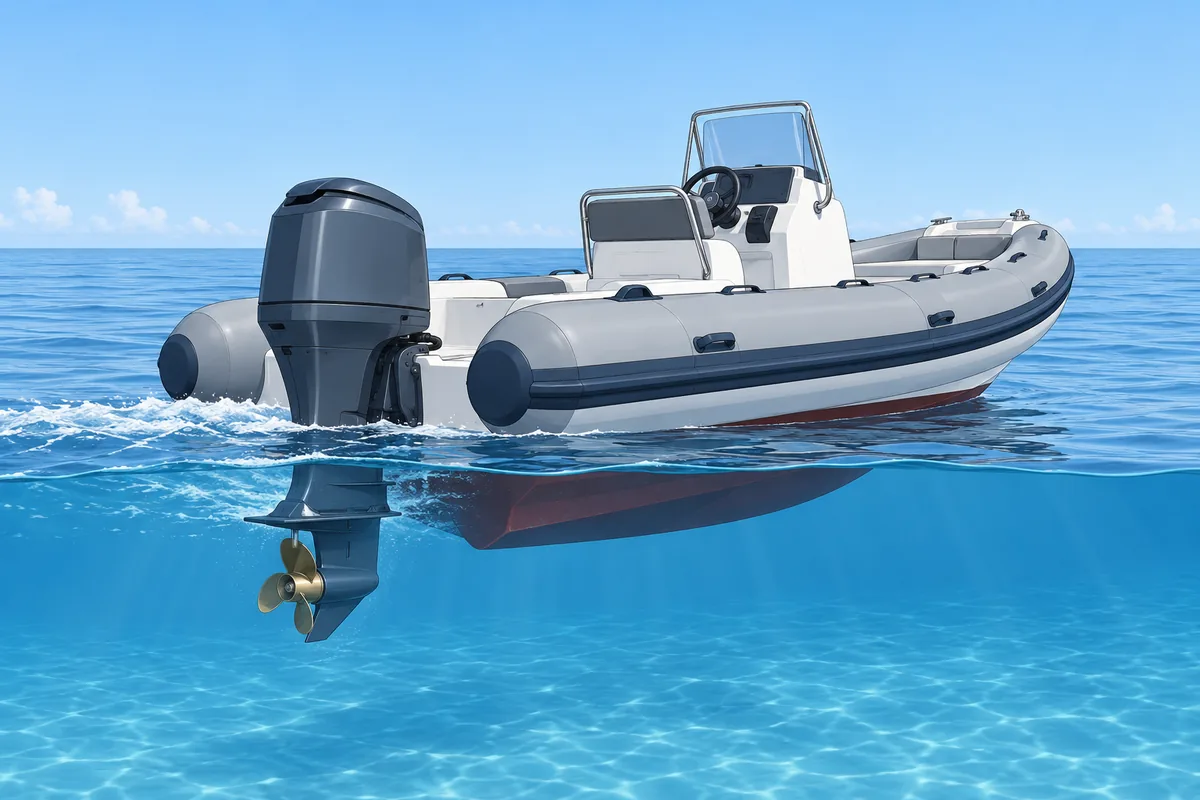
Outboard engine
See it in 3D
Drag to rotate, scroll or pinch to zoom. Try the controls to see how thrust changes. Double-click to reset the view.
1The lesson in plain words
An outboard combines engine, gears and propeller in one unit. You steer by pointing its thrust; protect people from the propeller.
Layout and steering
An outboard mounts outside the stern, the back of the boat. The engine sits above a vertical driveshaft and lower gears that turn the propeller. Turning the unit points its thrust, the push it produces. There is no separate rudder. It suits tenders, rigid inflatable boats (RIBs) and fast motor boats. It is accessible for servicing, but its exposed leg can strike the bottom.
Trim
Trim adjusts the leg’s running angle. Trim in, towards the transom (the stern’s flat end), brings the bow down and helps the hull rise onto the plane, skimming over the water. Trim out raises the bow and may improve speed in flat water. Too much can draw air to the propeller: ventilation, which reduces its grip. Adjust gradually for the boat and conditions.
Tilt
Tilt raises the leg for shallow water or storage. Fully tilt it only with the engine stopped. Any permitted shallow-water running must follow the maker’s limits and keep the cooling-water intake submerged. Otherwise the engine can overheat. In neutral, with no thrust, steering is very weak; anticipate that when slowing down.
Kill cord and cooling
Clip the kill cord, the engine-stop lanyard, to yourself while driving. Leaving the helm pulls it out and stops the engine; the boat still coasts. After starting, check the tell-tale, the small cooling-water jet. If it stops, stop the engine and check by the maker’s method: the outlet may be blocked or cooling flow may have failed.
People in the water
A turning propeller can cause severe injury. Stop the engine and prevent restart before anyone is close enough to reach it. Neutral alone is not a safe isolation method. Keep swimmers away from the propeller; recovery manoeuvres belong in Emergencies.
2Key points
- 1
An outboard steers by pointing thrust; neutral gives little steering.
- 2
Trim adjusts the running angle; tilt lifts the leg.
- 3
Keep the cooling intake submerged whenever the engine runs.
- 4
Wear the kill cord and check the tell-tale after starting.
- 5
Stop and secure the engine before a person can reach the propeller.
3Frequent mistakes
Wrong: The kill cord can stay clipped to the console.
Right: It must be attached to you so leaving the helm stops the engine.
Wrong: Neutral makes the propeller safe for swimmers.
Right: Stop the engine and prevent restart. Neutral does not provide secure isolation.
Wrong: No tell-tale is harmless if the engine still sounds normal.
Right: Stop and check it. You may have lost cooling water; do not wait for overheating.
4Practice case & exam keys
You tilt the outboard for shallow water. Its cooling intake is now above the surface. Can you idle forward?
Show the answer
No. Stop the engine. Lower the leg enough to submerge the intake before any permitted running, following the maker’s limits. Check the tell-tale after restarting. A tilted engine still needs cooling water.
Exam keys
- Outboard: self-contained unit, steerable thrust, little steering without power.
- Trim in lowers the bow; too much trim out can cause ventilation.
- Kill cord on the driver; cooling intake submerged and tell-tale checked.
- Stop and secure the engine before anyone approaches the propeller.
Finish this unit
When you've read it, answer three questions. Get all three right to finish the unit; opening the page alone doesn't count.
My notes for this unit
No notes