

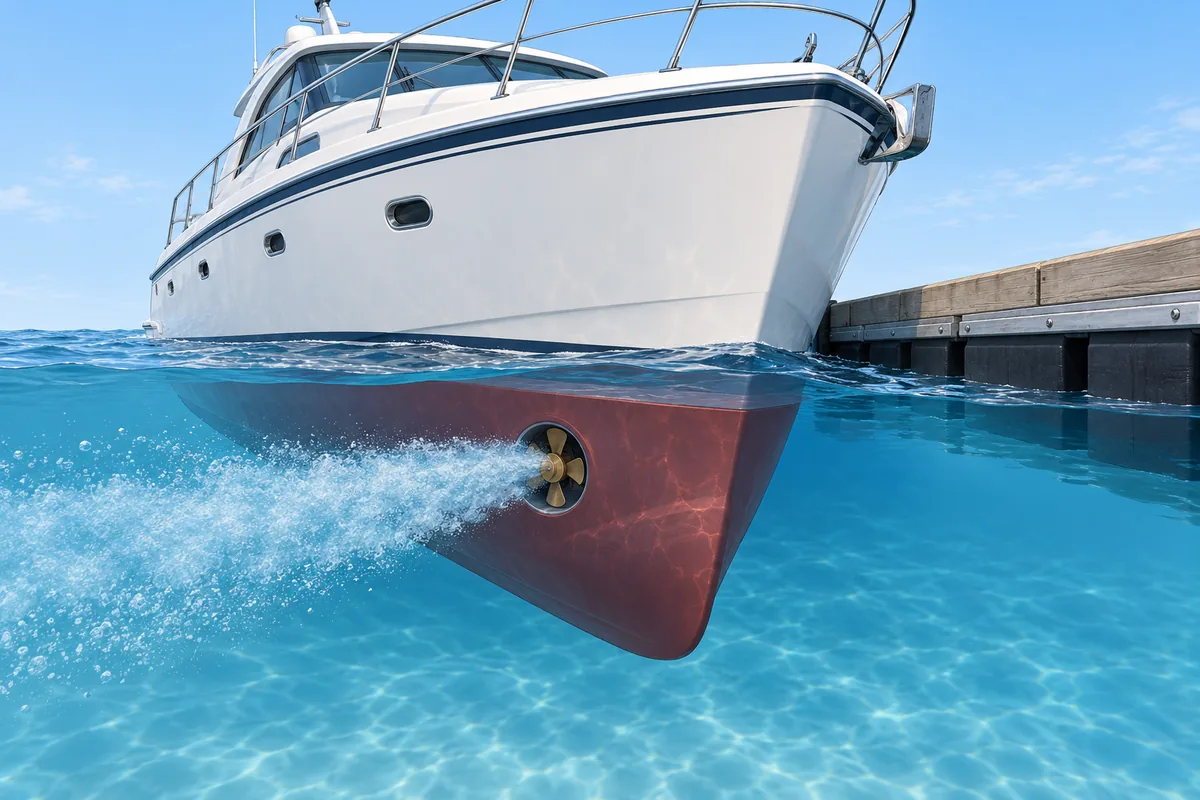
Bow and stern thrusters
See it in 3D
Drag to rotate, scroll or pinch to zoom. Try the controls to see how thrust changes. Double-click to reset the view.
1The lesson in plain words
Tunnel thrusters push the bow or stern sideways at low speed. Respect their running limits and keep a plan that does not rely on them.
Layout
A bow thruster has a propeller in a tunnel across the hull near the bow, the front of the boat. Pushing water out one side moves the bow the other way. A stern thruster does the same at the back. These are auxiliary controls for close handling, not the boat’s main propulsion. Small units are often battery-electric; larger ones may be electric or hydraulic.
Low-speed tool
A bow tunnel thruster can lose about 50 % of its lateral thrust at only 2 knots ahead (Marí Sagarra). Flow past the tunnel weakens it; actual performance varies by installation. It works best nearly stopped. Use the main drive and steering at passage speed. Shallow immersion or strong wind can also reduce its useful effect.
Duty cycle
Duty cycle is the permitted running time and cooling time. Small electric thrusters draw high current and may be rated for only a few minutes of running. A thermal cut-out switches off an overheated motor. Use short bursts within the maker’s limits and allow cooling; repeated bursts can still exceed the total limit.
Berthing plan
A thruster makes small corrections easier, but it can overheat, lose battery power or be overpowered by wind. Plan your berth with the main drive, available lines and room to stop or abort. If you cannot complete the approach safely without the thruster, change the plan or arrange help before committing.
2Key points
- 1
Tunnel thrusters move the bow or stern sideways.
- 2
They work best nearly stopped, not at cruising speed.
- 3
Duty cycle includes running and cooling time; short bursts still count.
- 4
A thermal cut-out can remove thrust until the unit cools.
- 5
Plan to berth safely without relying on the thruster.
3Frequent mistakes
Wrong: A bow thruster is a steering aid at cruising speed.
Right: Flow past the tunnel reduces its effect. Use the main steering system at speed.
Wrong: Short bursts mean the thruster can run indefinitely.
Right: The total running time still heats the motor. Follow the stated running and cooling limits.
4Practice case & exam keys
You need continuous bow-thruster power to hold an approach against the wind. The small electric unit is already hot.
Show the answer
Do not commit to a berth that depends on one more push. Abort while there is room. Let the unit cool and choose a plan using the main drive, lines or assistance, within your boat’s capability.
Exam keys
- Bow or stern tunnel: sideways force for close handling.
- Effect falls with speed through the water; best nearly stopped.
- Electric units: obey duty cycle and thermal limits; plan for loss of the thruster.
Finish this unit
When you've read it, answer three questions. Get all three right to finish the unit; opening the page alone doesn't count.
My notes for this unit
No notes